Direct answer
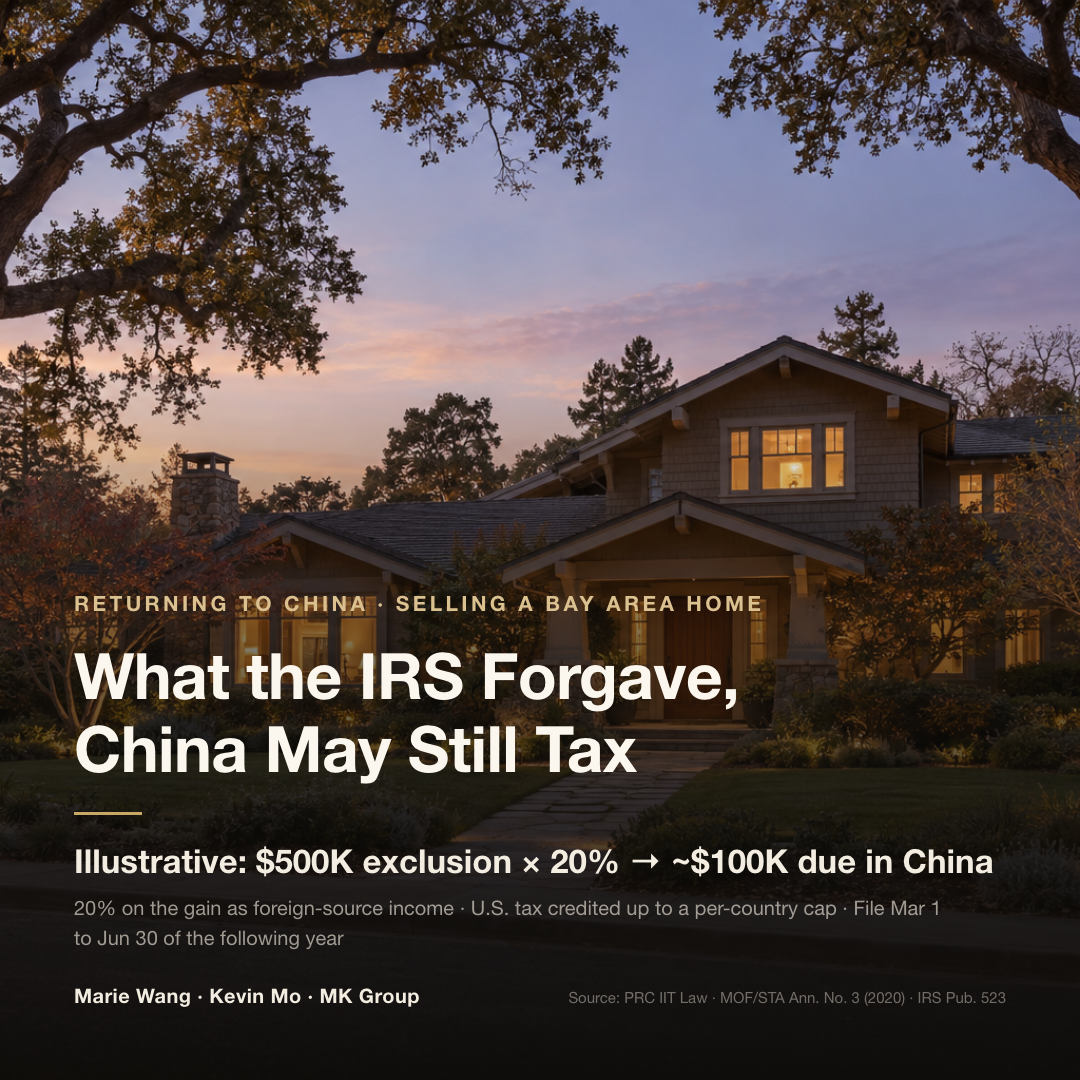
Yes, if you were a Chinese tax resident in the year the house closed. The gain is reported in China at 20%. U.S. income tax is credited up to a cap, any shortfall is paid in China, and the filing window runs from March 1 to June 30 of the following year.
How residency is decided: if your household registration (hukou) is in China and the family has moved back, you are generally treated as domiciled in China, and the number of days you spent there that year does not matter (Individual Income Tax Law, Article 1). The 20% rate on property-transfer income is in Article 3. The credit, capped at the Chinese tax computed on the same income, is in Article 7, and the filing window is in Article 13. U.S. tax above the cap can be carried forward for up to five tax years (Ministry of Finance and State Taxation Administration Announcement No. 3 of 2020, Part 6).
The piece most sellers miss is the home-sale exclusion. Section 121 lets a qualifying owner exclude $250,000 of gain on a primary residence, or $500,000 for a married couple (IRS Publication 523), so the U.S. tax on that slice is zero. Chinese law has no matching deduction, and nothing in writing says China's own exemption for a family's only home held five years reaches property abroad. The gain the U.S. left untaxed may be exactly the gain China asks you to pay on.
Who this article is for
- Owners who hold a Chinese passport, whose hukou is still in China, who have already moved back, and who are preparing to sell a primary residence of $5 million or more in Palo Alto, Los Altos, or Los Altos Hills
- Families still in the Bay Area who plan to return to China within a year or two and are working out whether to sell first or move first
- Sellers who closed after moving back, have already filed in the U.S., and are about to report foreign-source income in China for the first time
- Family members organizing the Bay Area sale file for parents or a spouse who have resettled in China, and working alongside a tax adviser there
This article covers homes held directly in an individual's name. Homes held through an LLC, a trust, or an offshore structure are taxed differently on both sides. Sellers who still hold a green card or have become U.S. citizens file in the U.S. as residents or citizens, which is also outside the scope here.
Three things that decide it
The question breaks into three parts, answered in order. Were you a Chinese tax resident in the year of the sale? How does China compute the 20%? How much of the U.S. tax can be credited against it? The first decides whether you file in China at all. The other two decide whether you owe anything once you do, and how much.
One: in the year of the sale, were you a Chinese tax resident?
Article 1 of the Individual Income Tax Law sets two routes to resident status: being domiciled in China, or, without a domicile, spending a cumulative 183 days or more in China in a tax year. A resident individual is taxed on income from inside and outside China. Article 2 of the implementing regulations defines domicile as habitually residing in China by reason of household registration, family, or economic interests. If your hukou is still in China and the family has moved back, you are generally domiciled there. Residency then does not depend on how many days you spent in China that year. The 183-day test is for people without a domicile.
The character and source of the income are spelled out as well. Part 1, item 7 of Announcement No. 3 of 2020 lists income from transferring real property located outside China as foreign-source income. Article 2, item 8 of the IIT Law lists property-transfer income as taxable, and Article 10, item 4 requires anyone who receives foreign-source income to file a return.
That ties the timing of the sale to your status. If the house closes after you have moved back, the income falls in a tax year in which you are a resident individual, and a Chinese filing is unavoidable. The tax year runs from January 1 to December 31 (Article 1), and nothing in the statute splits the year at the date you returned. A sale earlier in the year you moved back may still fall inside the filing requirement.
If the house closes before you move back, the question is whether you counted as domiciled in China that year. The regulations look at habitual residence, not where you happened to be in a given year. For someone whose hukou stayed in China through many years of working in the U.S., the text draws no year-by-year line for when that domicile lapses. If you were also a U.S. tax resident that year, through a green card or the substantial presence test, you were resident in both countries.
The U.S.–China tax treaty does not settle that for you. Article 4(2) lists no tie-breaker order of its own. It reads: "Where by reason of the provisions of paragraph 1 an individual is a resident of both Contracting States, then the competent authorities of the Contracting States shall determine through consultations the Contracting State of which that individual shall be deemed to be a resident for the purposes of this Agreement." The 1984 protocol adds that the two authorities are to be guided by the tie-breaker rules in the UN Model Convention, which look in turn at permanent home, center of vital interests, habitual abode, and nationality. Either way, the answer comes from the two governments, not from the seller. Selling before you move back does not let you decide on your own that no Chinese filing is due. Confirm your status for the year of sale with advisers on both sides.
Marie Wang, discussing new rules on offshore trusts on her YouTube channel @MarieWang (44K+ subscribers), gave families weighing a change of status a short rule: "assets first; be careful with status." Settle the tax plan with professionals before you land. She was speaking about taking on U.S. status. Moving back to China is the same decision in reverse. When your tax residence changes, so does the set of returns that applies when the same Bay Area house is sold.
Two: how China computes the 20%, on a different basis from the U.S.
The formula is in Article 6, paragraph 1, item 5 of the IIT Law: taxable income from a property transfer is the proceeds less the property's original value and reasonable expenses. Article 3, item 3 sets a flat 20% rate for interest, dividends, rental income, property-transfer income, and incidental income. Part 2, item 3 of Announcement No. 3 provides that foreign property-transfer income is not combined with income from inside China; its tax is computed separately. For a home owned jointly by a married couple, Article 18 of the implementing regulations computes each person's share of the income separately.
On paper this looks like the U.S. formula: price minus cost. In practice the two bases differ in at least four places, and the gains they produce are usually not equal.
- No home-sale exclusion. Chinese law has nothing like the $250,000 / $500,000 deduction under Section 121. For homes in China there is the "five years, only home" exemption: Guoshuifa [2006] No. 108, Article 5, restates Caishuizi [1999] No. 278, which exempts income from transferring a home the individual has lived in for five years or more that is also the family's only residence. Whether it applies to property abroad has no official written answer. Even if it did, a seller who also owns a home in China would have trouble meeting the "only residence" condition.
- Original value has to be documented. Under Article 16 of the implementing regulations, the original value of a building is its construction cost or purchase price plus related expenses. If the taxpayer cannot provide complete and accurate records, the competent tax authority assesses the original value instead. The closing statement from a purchase a decade or more ago and the payment records for renovations decide how much you can deduct today.
- Reasonable expenses are defined differently. Article 16 limits reasonable expenses to the taxes and fees paid as required when the property is sold. For homes in China, Guoshuifa [2006] No. 108 separately lists renovation costs (deductible up to 10% of original value for commodity housing, supported by official tax invoices), mortgage interest, handling fees, and notary fees. No specific rule says how China treats the brokerage commission, closing costs, and capital improvements that a U.S. return subtracts from the sale price of a property abroad.
- The math is in renminbi. Article 32 of the implementing regulations converts foreign-currency income at the central parity rate on the last day of the month before the return is filed, and Part 12 of Announcement No. 3 applies the same rule to foreign income and foreign tax paid. The text says nothing specific about which date's rate converts a purchase price paid in dollars many years ago. Different conversion choices can produce a renminbi gain that does not match the dollar gain.
Three: how much U.S. tax counts, under a per-country cap, on tax actually paid, with five years of carryforward
Article 7 of the IIT Law lets a resident individual credit individual income tax already paid abroad against the Chinese tax on that foreign income, up to the Chinese tax computed on it. Article 21 of the implementing regulations spells out both outcomes. If U.S. tax actually paid is below the cap, you pay the difference in China. If it is above the cap, the excess cannot be used that year but can be applied against the unused cap on income from the same country in later years, for no more than five years.
The cap is pooled by country, not by transaction. Under Part 3 of Announcement No. 3, the caps for comprehensive income, business income, and other categorized income from one country are added together to form that country's cap. If you also had U.S. wages or rental income in the year you moved back, that income sits in the same "U.S." pool as the house sale. Any excess carried forward can only be used against later income sourced in the U.S.
Only tax actually paid counts. Part 4 of Announcement No. 3 defines creditable tax as income tax owed under the source country's law and actually paid, and excludes foreign tax the foreign taxing authority has refunded or compensated. Three consequences follow:
- The gain excluded under Section 121 was never taxed in the U.S., so there is no tax to credit. What the U.S. forgave may be what China collects.
- FIRPTA tax withheld at closing is a prepayment. The final figure is the tax settled on your U.S. return, and any amount refunded after overwithholding cannot be credited.
- Whether California income tax can be credited has no clear answer. Article 2 of the U.S.–China treaty limits the U.S. taxes it covers to "Federal income taxes," and Article 22, paragraph 1(a) credits "the amount of the United States income tax payable in respect of that income in accordance with the provisions of this Agreement." Chinese domestic law speaks of income tax paid under the laws of the source country. Whether California's state income tax falls inside that wording is a question for the competent tax authority.
The treaty also confirms that both countries may tax this gain. Article 12, paragraph 1 provides: "Gains derived by a resident of a Contracting State from the alienation of real property referred to in Article 6 and situated in the other Contracting State may be taxed in that other Contracting State." The U.S. right to tax does not cancel China's right as the country of residence. Where the two overlap, Article 22 removes the double tax through a credit.
Illustrative example: a Bay Area home sold for $6 million, and what China may still collect
For scale: according to MK Bay Area Pulse (MLSListings data), Palo Alto recorded 139 single-family closings in Q2 2026 at a median sale price of $4.1 million, and Los Altos Hills recorded 32 at a median of $5.725 million. The example below uses a primary residence sold for $6 million. Every figure in the table is hypothetical, used only to show how the calculation is built, and does not correspond to any real transaction.
The key numbers first. Assume a $3 million purchase price and $300,000 in selling costs, so both countries start from a $2.7 million gain. After the $500,000 exclusion ($250,000 for each spouse), U.S. federal tax, simplified at 20%, is about $440,000. Chinese tax at 20% is $540,000. Crediting federal tax alone leaves about $100,000 due in China, exactly the $500,000 exclusion times 20%. FIRPTA withholds $900,000 at closing, and that number cannot be used for the credit.
| Item (illustrative, USD) | U.S.: federal income tax | China: individual income tax |
|---|---|---|
| Sale price | $6,000,000 | $6,000,000 |
| Less: purchase price | $3,000,000 | $3,000,000 (assumes China accepts the same original value) |
| Less: selling costs | $300,000 | $300,000 (assumes a full deduction; actual treatment to be confirmed) |
| Gain | $2,700,000 | $2,700,000 |
| Less: home-sale exclusion | $500,000 (Section 121, $250,000 per spouse on separate returns) | No equivalent deduction ("five years, only home" has no written answer for property abroad; treated here as not applying) |
| Taxable gain | $2,200,000 | $2,700,000 |
| Rate | 20% (top long-term capital gains rate, simplified) | 20% (IIT Law, Article 3) |
| Tax | About $440,000 | $540,000 (also the credit cap) |
| Creditable U.S. tax | — | About $440,000 (federal income tax only) |
| Due in China | — | About $100,000 |
| FIRPTA withholding at closing | $900,000 (15% of the amount realized; a prepayment, trued up on the return) | Not a basis for the credit |
Table assumptions: the sellers are a married couple, both nonresident aliens for U.S. tax purposes at closing, who own the home jointly in their own names and meet the Section 121 tests. Each files a separate Form 1040-NR and claims a $250,000 exclusion, for $500,000 combined. China accepts the same original value and selling costs as the U.S. Both countries' tax is shown in dollars, without renminbi conversion. U.S. federal tax is simplified at the top 20% long-term capital gains rate; any portion taxed in the 0% or 15% brackets would lower the U.S. figure. California tax is not included in the credit; see below. Sources: PRC Individual Income Tax Law; MOF/STA Announcement No. 3 of 2020; IRS Publication 523; IRS FIRPTA rules; MK Bay Area Pulse, Q2 2026 (MLSListings). Updated: 2026-10. Scope: sellers who are Chinese tax residents in the year of sale and hold a Bay Area primary residence in their own names.
What to remember: the roughly $100,000 due in China comes straight from the $500,000 of gain the U.S. excluded. The U.S. collected nothing on it, so there is nothing to credit. The figure can move in two directions. First, actual U.S. federal tax will come in below $440,000 once the lower brackets apply, and the amount due in China rises with it. Second is California. Under the FTB rate schedule, the top marginal rate on personal income is 12.3%, plus a 1% Mental Health Services Tax on taxable income above $1 million, so state tax on $2.2 million of taxable gain runs far above $100,000. If the competent tax authority accepts California tax as creditable, nothing may be due in China, and the amount above the cap can be carried forward five years. If it does not, the $100,000 is due.
For the Section 121 tests, and how long after moving out you can still sell and claim the exclusion, see Relocating abroad: sell the Bay Area house or keep it as a rental? For the U.S. tax owed on gain above the exclusion, see When the $500,000 exclusion barely dents the gain, how the rest is taxed.
Before and after closing: which documents become your credit evidence in China
The core rule first. Part 10 of Announcement No. 3 requires a taxpayer claiming a foreign tax credit to provide a tax payment certificate, tax payment form, tax record, or similar evidence issued by the foreign taxing authority; without qualifying evidence, no credit is allowed. Where such evidence genuinely cannot be obtained, the foreign tax return (or a tax notice confirmed by the foreign taxing authority) together with the matching bank payment record may be used instead. For a Bay Area sale, that evidence is spread across the escrow company, the IRS, the California Franchise Tax Board, and your own bank accounts. Start collecting it at closing.
| Document | Who issues it, and when | What it proves in China |
|---|---|---|
| Closing (settlement) statement from the purchase; contracts and payment records for capital improvements | The original escrow company and contractors; you keep these yourself | Original value; without complete records, the competent tax authority assesses it (implementing regulations, Article 16) |
| Final settlement statement from the sale | Escrow company, at closing | Sale proceeds and selling costs |
| Form 8288-A (Copy B) | Stamped by the IRS and mailed to the seller after the buyer files | FIRPTA amount withheld: a prepayment, not the final tax |
| Form 593 | Issued by escrow at closing | California amount withheld: also a prepayment |
| Form 1040-NR (federal) and Form 540NR (California) | The seller or the seller's CPA, filed the year after the sale | Final tax owed under U.S. law |
| IRS Account Transcript; bank records of any balance paid or refund received | IRS (request with Form 4506-T); your bank | Tax actually paid; what counts as proof is set by the competent tax authority |
What to remember: the two countries' calendars do not line up. Under the IRS instructions for Form 1040-NR, a nonresident with U.S. wages subject to withholding files by April 15 of the following year, and one without such wages files by June 15. The IRS then needs time to process the return and issue any refund, while China's deadline is June 30. Part 10, paragraph 2 of Announcement No. 3 leaves room for this. If you reported the foreign income but could not claim the credit because the evidence had not arrived, you can claim it later against the year the income belongs to, going back no more than five years. If the U.S. tax actually paid changes within those five years, the credit is recomputed on the actual figure and tax is paid or refunded, with no late-payment surcharge and no interest on refunds. So the order is: file the income on time, then claim the credit when the evidence arrives. Do not hold the return until every document is in hand.
What MK Group sees in practice: selling once you have left the Bay Area
In an episode on holding title through an LLC or a trust, on Kevin Mo's YouTube channel @KevinMoRE (24K+ subscribers), Kevin Mo and Marie Wang described a high-end purchase as a process in which funding, immigration status, legal structure, privacy, financing, tax, and family planning all move at once. A sale is no different. A seller who has moved back to China adds one more layer: they are no longer in the Bay Area.
The sale itself can be run from a distance. MK Group handled an $8 million off-market sale in Atherton for a couple who had long lived outside the Bay Area. The value sat in the land more than the house, and the deal was agreed with a local developer before any listing preparation began. The couple flew back only to sign; the team coordinated everything else on the ground (case details). Where these sellers live was not disclosed, and this article draws no conclusion about their tax status. What the case does show is that the close of escrow ends only the U.S. side of the transaction. For a seller who was a Chinese tax resident in the year of sale, the U.S. return, the California withholding true-up, and the Chinese filing begin there, across two countries and two sets of deadlines. Before listing, sit down with your CPA and map which document sits with whom, and when each one arrives.
Common mistakes
Mistake one: "I already paid U.S. tax, so China doesn't need to hear about it"
Wrong. A credit is not an exemption from filing. Article 10, item 4 of the IIT Law requires anyone with foreign-source income to file, and Article 13 sets the window for resident individuals at March 1 to June 30 of the year after the income is received. Even if U.S. tax already covers the Chinese tax in full and nothing more is owed, the return still has to be filed. If U.S. tax falls short, Article 21 of the implementing regulations requires the difference to be paid in China. Under Part 13 of Announcement No. 3, failure to file and pay as required is handled under the Tax Collection and Administration Law and related rules, and is recorded in the individual's tax credit rating.
Mistake two: "Two years of living there makes the gain tax-free in the U.S., so China must exempt it too"
Not necessarily. Section 121 is a deduction in U.S. law, and China's IIT Law has no counterpart. There is no official written answer on whether China's "five years, only home" exemption covers property abroad, so confirm with the competent tax authority before filing rather than treating the gain as exempt on your own. The excluded gain was never taxed in the U.S., so under the "actually paid" standard in Part 4 of Announcement No. 3 there is no tax to credit against it. In the example above, the $500,000 exclusion maps directly to the roughly $100,000 that may be due in China.
Mistake three: "The 15% FIRPTA took is my U.S. tax"
It isn't. FIRPTA withholding is figured on the amount realized (15% on a sale above $1 million, under IRS rules) and is a prepayment. The final tax is settled on Form 1040-NR, with any overpayment refunded and any shortfall paid. In the example, $900,000 was withheld and federal tax came to about $440,000; the difference comes back. Part 4, item 4 of Announcement No. 3 excludes foreign tax that has been refunded or compensated, so claiming the Form 8288-A withholding as a credit would overstate it. What counts is the tax you actually bear after settlement. The same goes for California's Form 593 withholding, which defaults to 3⅓% of the sale price, can be figured on the gain instead, and does not apply to a qualifying principal residence. For how to reduce or recover the withholding, see How a foreign seller gets FIRPTA's 15% back.
Mistake four: "I spend fewer than 183 days a year in China, so I'm not a Chinese tax resident"
Not if you are domiciled there. The 183-day test in Article 1 applies to individuals without a domicile in China. If your hukou is in China and you habitually live there by reason of household registration, family, or economic ties, you are domiciled in China and a resident individual regardless of how many days you spent there that year. Dividing the year between two countries after moving back, with less than half of it physically in China, does not by itself make you a nonresident.
Mistake five: "I hold a U.S. passport, so after moving back the same rules apply to me"
The rules are different. A foreign national usually has no hukou in China and is generally treated as an individual without a domicile, who becomes a resident only after 183 days in China in a tax year. Even then, Article 4 of the implementing regulations provides that while the years with 183 or more days in China number fewer than six in a row, income sourced outside China and paid by an entity or individual outside China is exempt, upon filing a record with the competent tax authority. A single departure of more than 30 days in any of those years restarts the count. Whether proceeds paid by a U.S. buyer meet that condition, and which year starts the six, have to be confirmed case by case. U.S. citizens report worldwide income to the IRS wherever they live. When the two statuses overlap, plan with a cross-border CPA before you move.
Next steps
- Settle your status for the year of sale first. Write down the date you moved back, your hukou, where your family and main economic interests are, and your U.S. visa or green card status that year. Have a tax adviser in China and a U.S. CPA decide together whether you were a Chinese resident individual, a U.S. tax resident, or both.
- Run both sets of numbers before listing. On the U.S. side: federal tax, California tax, whether Section 121 applies, and how much FIRPTA and Form 593 will withhold. On the Chinese side: original value, reasonable expenses, the exchange-rate basis, and the 20% tax. Ask the competent tax authority for an answer on the two open questions: whether "five years, only home" can apply to property abroad, and whether California tax can be credited.
- Start collecting evidence now: the closing statement and renovation payment records from the purchase (they set original value), the final settlement statement from the sale, Form 8288-A and Form 593, the following year's Form 1040-NR and Form 540NR, and the IRS account transcript with bank records of any tax paid or refunded.
- File on time, and credit when the evidence arrives. Between March 1 and June 30 of the year after the sale, file with the competent tax authority where your employer is located or, without an employer in China, where your hukou is registered or where you habitually live (Announcement No. 3, Part 8). If the U.S. evidence has not arrived, report the income first and claim the credit retroactively within five years once it does.
This article is for decision education and is not legal or tax advice. Confirm specifics with your attorney, a U.S. CPA, and a tax adviser in China, and rely on the competent tax authority's answer. How Chinese tax residency is determined, how original value and expenses are measured on a sale abroad, whether "five years, only home" applies to property abroad, and whether California tax can be credited in China either have no uniform official answer or depend heavily on individual facts. The Chinese statutes, MOF/STA announcements, and U.S.–China tax treaty cited here reflect the current texts as reviewed in October 2026, and English renderings of Chinese provisions are descriptive, not official translations. U.S. rules follow the IRS and California FTB requirements for the year in question. All example figures are illustrative.