Direct Answer
Be out of the house on showing day, and take the pets with you. Put away every family photograph and every letter and bill on the counter. Move valuables off-site rather than locking a room. Open the windows in advance instead of spraying scent. None of it costs much, and together it decides both the first ten seconds and how much leverage a buyer leaves with.
Who this article is for
- Bay Area owners who have set a list date and want to know what to do on showing day — and where to be instead
- Sellers who have already spent the renovation budget and want to know what is still leaking value
- Owner-occupants living with pets, children, and a full house, unsure how far the clear-out actually has to go
- Owners protective of jewelry and privacy who don't want a locked door to raise questions
Three ways to think about showing day
One: you get one weekend, and a first impression has no second pass
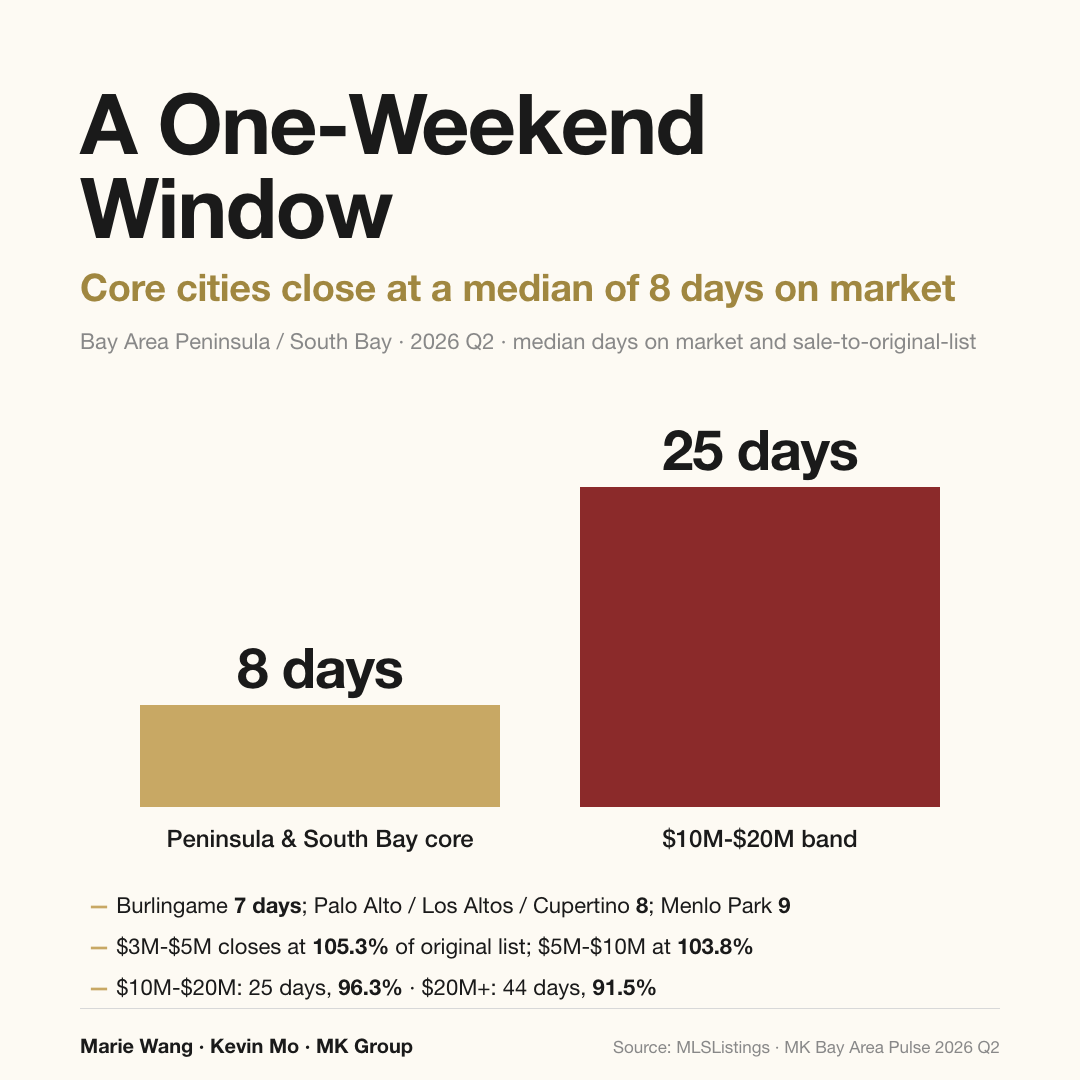
Closing tempo on the Peninsula and in the South Bay leaves no room to fix things later. A median of eight days to contract means the useful exposure is concentrated in the first weekend after a listing goes live. By the time you notice the living room reads dark or the backyard reads unfinished, the first wave of buyers is already touring someone else's house.
So the question is never whether an item is worth doing. It is whether it can be finished before that first weekend. Marie Wang walks the list in order on YouTube @MarieWang (44K+ subscribers), from the front door to the back fence — twelve details, nearly all of them free or close to it, all of them due before the listing goes live.
Two: whatever a buyer can read about you turns into leverage
This is the least intuitive item on the list. Wedding photos, family portraits, baby pictures, the letters and bills stacked on the counter — all of it comes down, and not because it looks cluttered. Arranged neatly, it still comes down. The reason is information. Once a buyer sees the traces of a life, they start inferring: how many people live here, why the house is selling, whether the move is urgent, whether a job changed.
Those inferences travel through the buyer's agent straight into negotiation. A buyer who has decided the seller is in a hurry bids lower, holds harder terms, and answers slower. A moving-company estimate left on the entry console can cost more than any defect in the house.
Three: the target is naturally clean, not scented
On odor, what not to do matters more than what to do. Pet smell, smoke, and cooking oil fade for the people who live with them and register instantly for everyone else. That part isn't controversial. The method is. Don't mask it with a heavy diffuser, and don't scrub the house down with bleach and vinegar. Open the windows well in advance and leave the faintest possible scent in the room. The standard is a buyer who walks out calling the house fresh — not a buyer who calls it fragrant.
Why the window is so narrow: closing tempo in the core cities
The headline numbers first. In the second quarter of 2026, Palo Alto ran a median of 8 days on market, a median sale price of $4.10M, and a closing price equal to 105.6% of the original list. Burlingame moved faster still — a median of 7 days and 107.1%. Menlo Park came in at 9 days and 102.1%. Across the core Peninsula and South Bay cities, a sensibly priced house goes from live to accepted offer in well under two weeks, which means the concentrated attention a buyer gives you is essentially one weekend.
| City | 2026 Q2 closings | Median sale price | Median days on market | Sale price as % of original list |
|---|---|---|---|---|
| Palo Alto | 139 | $4,100,000 | 8 days | 105.6% |
| Los Altos | 97 | $4,920,000 | 8 days | 105.1% |
| Menlo Park | 94 | $3,793,500 | 9 days | 102.1% |
| Burlingame | 68 | $3,205,250 | 7 days | 107.1% |
| Cupertino | 60 | $3,362,500 | 8 days | 104.8% |
| Hillsborough | 48 | $6,500,000 | 8 days | 101.6% |
| Atherton | 31 | $10,000,000 | 13 days | 97.1% |
| Woodside | 31 | $4,500,000 | 21 days | 97.3% |
The rows to hold on to are the last two, and the price-band pattern behind them. Atherton ran a median of 13 days and closed at 97.1% of its original list; Woodside ran 21 days at 97.3%. Both finished below where they started. By price band the split is sharper still: $3M–$5M closed in a median of 8 days at 105.3% of original list, $5M–$10M also 8 days at 103.8%, while $10M–$20M stretched to 25 days and dropped to 96.3%, and $20M+ ran 44 days at 91.5%. Read that as the higher the band, the longer the median listing runs and the deeper the discount to original list (39 sales in the $10M–$20M band, 8 above $20M — thin samples, and negotiation dynamics differ by band). It is not evidence that any one house loses value by sitting. It does show how little margin for error the top bands carry: a presentation debt does not repay itself over extra weeks, and "list now and fix it later" was never a safe plan. For how pricing and tempo interact, see pricing strategy for a Bay Area sale.
From the curb to the backyard: a checklist that costs almost nothing
The entry and the driveway
Judgment starts the moment a buyer gets out of the car. Dead plants in the front beds, old shoes in the corner by the door, empty delivery boxes — all of it goes. The driveway is the piece most often skipped. It rarely rains in Silicon Valley, but a driveway left alone for years collects dark staining, moss, sometimes an oil patch. One pass with a pressure washer and the concrete comes back several shades lighter.
Inside: clear the counters, remove the information, take the valuables with you
The standard for kitchen counters is nothing on them — spice jars, pots and pans, the rice cooker, all of it into the cabinets. Same for the living room: remotes, charging cables, the stack of mail and bills on the table. Personal photographs come down for the reason above. Bedroom and bathroom counters get the same treatment plus one more layer, this one about security: jewelry and watches on the nightstand, a necklace on the vanity, anything of value sitting on a bathroom counter — take it with you. A lot of people move through a house during a listing, and even with someone staffing the open house, no one can watch every room at once.
Owners often ask whether they can simply lock the small study. Better not to. Trading a question mark for peace of mind is a poor trade — the fix is to move valuables off-site, not to close a door.
The backyard
Backyards carry real weight in the Bay Area. Dead plants, a yellowed lawn, old pots stacked in the corner — clear all of it, lay fresh sod, or convert to the hardscape that has become both more common and easier to maintain across Silicon Valley. The goal is a yard that reads as an extension of the living space rather than a plot of ground the next owner has to deal with.
Two small line items are worth finishing in the same pass: swap dim, dated fixtures for LED, and repaint in a current neutral. Both belong to presentation baseline, not renovation investment — for which renovations actually earn their cost back, Kevin Mo ran the returns line by line in what to fix before selling a Bay Area home.
What MK Group sees in the field
Before an open house, MK Group listings get a dedicated vendor pass on the backyard — dead plants, yellowed lawn, and old pots removed, then fresh sod or a conversion to hardscape. That step happens before the house opens; the same logic applies to listing photography, where a cluttered patch of ground is nearly unsalvageable, while clean hardscape gets read directly as usable square footage.
Two other items Marie Wang confirms with sellers again and again are the two sellers most often resist. The first is that the owner and the pets both leave for showing day. The objection is reasonable enough — I know this house better than anyone, wouldn't it help if I were here to point out what's good about it? Pets are a separate matter: a buyer who doesn't like animals, or an animal that greets someone a little too enthusiastically, is avoidable risk. The second is moving valuables out rather than locking a door. Both read as concessions from the owner's side. What they buy is a buyer who can relax in the house long enough to picture living in it. Choosing not to open the house at all is a different playbook — see whether you need an open house to sell a Bay Area home.
Common Misconceptions
"I can be there to point out what's good about the house — that has to help"
Usually it costs. With the owner standing nearby, a buyer who wants to open a closet to check storage, or ask whether there's a problem under that flooring, won't say it out loud. What should have been a walk through a possible future home turns into a visit to somebody else's house. Buyers need room to move and room to imagine.
"Locking the small study is the safe move — buyers don't need to see it anyway"
The suspicion a locked door creates is worse than the risk it removes. A buyer who finds a door that won't open reads it as something being hidden on purpose, and the question follows them into the offer. The correct move is to take the jewelry, the watches, the necklaces, and anything of value on the bathroom counter out of the house before showings begin.
"A diffuser plus a hard bleach scrub through the kitchen and baths will make it smell clean"
An overdone smell is itself a signal. A buyer who walks into heavy perfume or heavy cleaning product doesn't think how clean — they think what's being covered up. Odor does need handling, but the method is open windows well in advance plus the faintest scent in the room. The target is naturally clean, not fragrant.
"Family photos and personal objects give the house warmth — leaving them up makes it feel lived in"
Warmth is an asset while you live there and a leak while you sell. A buyer who sees wedding photos, family portraits, and baby pictures instinctively works out how many people live here, why the house is selling, and whether the move is urgent — and each of those inferences ends up as negotiating leverage. Letters and bills on the table are more direct still: private information laid out for the other side.
"The backyard is secondary — buyers are really looking at the interior"
Not in the Bay Area. Peninsula and South Bay buyers count the backyard as usable living space, and a patch of dead grass with old pots in the corner reads as one more expense after closing. Clearing it and laying sod costs far less than any interior project.
Next steps
- Work the schedule backward and land every task before the first weekend. Median days on market in the core cities runs 7 to 9.
- Run one sweep for personal information. The standard is that a stranger can't tell who lives here — photographs, letters and bills, the calendar on the refrigerator, all of it away.
- Take valuables out for the day and leave every door unlocked. Jewelry, watches, necklaces, and anything of value on the bathroom counter go with you.
- Book one vendor for the front and one for the back. Driveway pressure-washing and the backyard clean-up — sod or hardscape — both belong ahead of listing photography.
- On showing day, neither the owner nor the pets are home. For the full schedule of the week before a listing goes live, see the Bay Area one-week high-intensity sale plan.