Direct answer
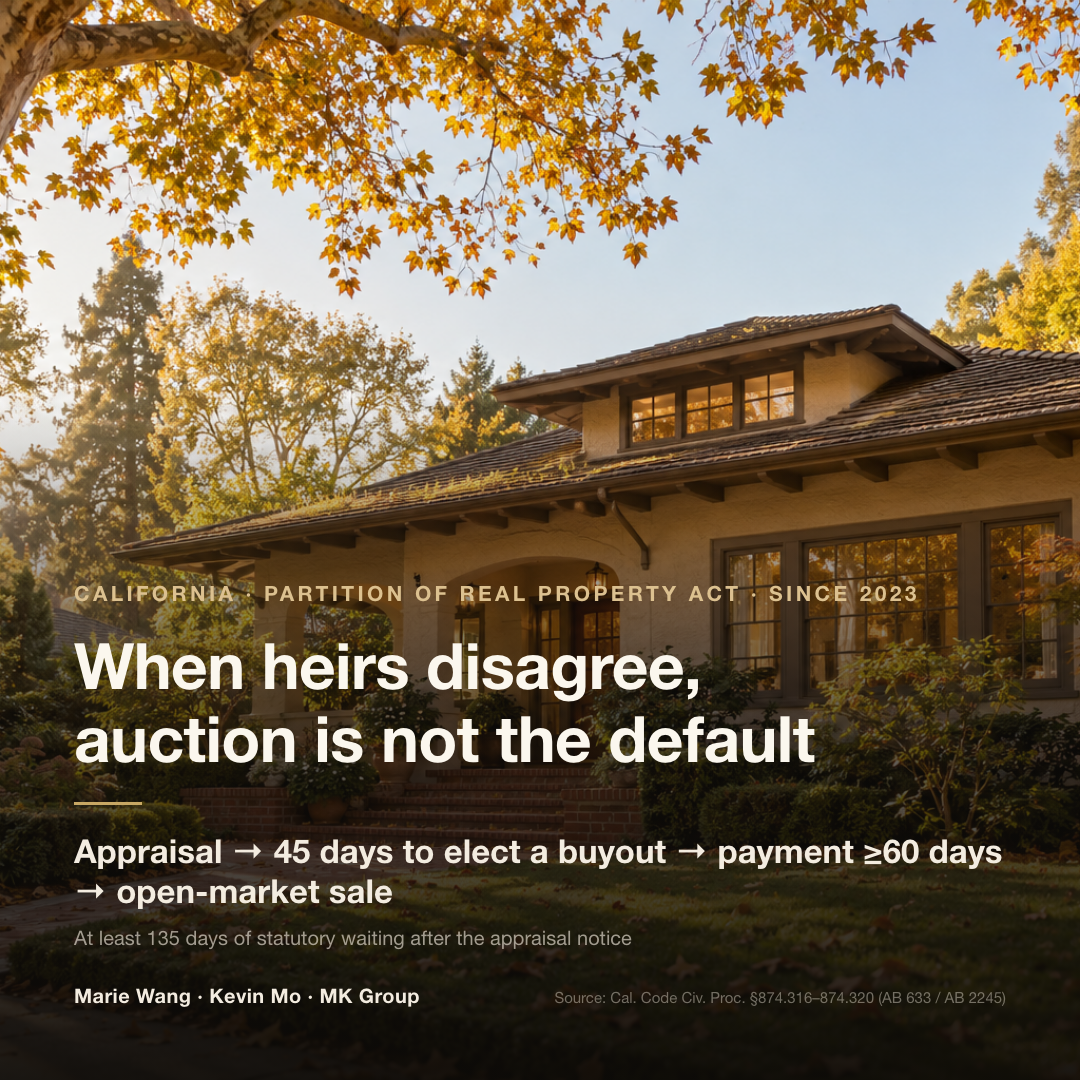
Any one co-owner can file to partition the property without the others' consent (CCP §872.210). The court orders an appraisal first. Co-owners who don't want to sell then have 45 days to elect to buy out those who do. Only if no one buys does a broker sell the home on the open market, at no less than the appraised value.
Counting from the day the appraisal notice goes out, the waiting periods written into the statute add up to at least 135 days — before the filing, service, or the court's calendar.
One boundary first. "Dividing" the house, in this article, mainly means the stage after title has passed from your parents to the siblings jointly. If the house is still in a trust or in probate, different rules apply — see the first of the three questions below.
Who this article is for
- Families in which several adult children have jointly inherited a long-held single-family home in Palo Alto, Los Altos, or Los Altos Hills, and can't agree whether to live in it, sell it, or hold it
- The sibling who wants to move into the family home and first needs to know what buying out the others will cost, and where that money will come from
- The sibling who wants to turn their share into cash while the others keep putting off signing a listing agreement
- Co-heirs living overseas or in another state who can't easily fly back, and want to know what happens if they don't appear
- Families whose parents are still living and who want to settle now who will one day live in the house and who will take cash
Three questions that decide how the house gets divided
One: Who holds the house right now — that decides who you are negotiating with, and in which court
When siblings disagree, the first step is to pull a current title report and see where the house actually sits. Each of the three states runs on entirely different rules:
- Still in a trust (your parents put the house into a living trust, and after the settlor's death a successor trustee took over): whether to sell, when, and to whom are decided by the successor trustee under the trust's terms. A beneficiary who objects to the trustee's decisions can petition the court under California Probate Code §17200. The matters the statute lists include instructing the trustee, reviewing the trustee's acts (discretionary decisions included), compelling the trustee to account, and removing the trustee.
- Still in probate (the house is titled in a parent's own name): a court-authorized personal representative handles it, and heirs' objections run through the probate case itself. Who has authority to sign, and how the court confirms a sale, are covered in whether the house has to go through probate before you can sell.
- Already deeded to the siblings (the trust or estate has been distributed, usually into tenancy in common): no trustee or personal representative decides for you anymore. Each of you stands as a co-owner on equal footing. This third state is what most of this article covers.
The first two states offer a window the third does not, and it is worth using before distribution. In August 2026, the California State Board of Equalization (BOE) sent county assessors a Prop 19 FAQ, Letter to Assessors No. 2026/026. It says that unless the will or trust expressly prohibits a non-pro rata distribution, the executor or trustee can distribute the parents' principal residence entirely to one child while the others receive other assets of equal value. As long as the home's market value does not exceed that child's share of the whole estate, the parent-child exclusion can still apply. The same document says that once distribution is complete, transfers of interests between siblings are reassessable changes in ownership — California has no sibling-to-sibling exclusion. Put simply, settling "who takes the house, who takes the cash" while the house is in a trustee's hands can produce a very different property tax result than settling it once the siblings hold title.
For families whose parents are still living, that window can open even earlier. Q41 of the same FAQ also says that if the will specifies that Child A takes the principal residence and Child B takes the rental property, the executor has no discretion to adjust. Whether a future trustee can settle "who takes the house, who takes the cash" for the siblings at the distribution stage therefore depends on a few lines in today's documents. While your parents are alive, an estate attorney can write express permission for non-pro rata distribution into the trust — or simply provide that the child who plans to live there takes the house and the others are equalized with assets of equal value. That moves the future sibling buyout into the distribution itself. Which wording fits, and whether Prop 19's occupancy requirement and exclusion cap go far enough, is something your estate attorney and CPA need to model against the makeup of the whole estate.
Two: For the sibling who wants to live there, a buyout clears three hurdles
Ranked by cost and time, the first of three ways forward is for the sibling who wants to live there to buy the others' shares at appraised value. That path has three hurdles.
The first is price. The most common fight between siblings is over what the house is actually worth. If it reaches court, the question has a set answer. When the parties have not agreed on the value or on how to determine it, CCP §874.316 generally has the court appoint a disinterested California-licensed appraiser to determine the fair market value of the whole property, assuming sole ownership of the fee simple estate. (If the court finds that an appraisal would cost more than its evidentiary value, it can set the value at an evidentiary hearing instead, §874.316(c).) Under §874.317(c), the buyout price is that whole-property value multiplied by the share being bought. Two things follow. The sibling who wants to live there cannot push the price down by arguing that a one-third share would fetch little on its own. And the sibling who wants to sell cannot claim a premium above the whole-property value. In a private negotiation, borrowing the court's yardstick as a shared starting point is worth doing.
The second is property tax. Prop 19's parent-child exclusion requires at least one child to make the home their principal residence and file for the homeowners' exemption within one year of the date of death. The exclusion is capped at the prior taxable value plus $1,044,586, for transfers between February 16, 2025 and February 15, 2027 (BOE Letter to Assessors No. 2025/009). The BOE's 2026 FAQ says that when several children inherit together, the exclusion holds as long as one qualifying transferee keeps living there. But as noted above, any share bought from a sibling after distribution is reassessed at its market value at that time. How the exclusion is calculated, and what annual property tax looks like city by city, is in how high the property tax goes on an inherited Palo Alto home you don't move into. One conclusion to carry forward: when and how you buy out a sibling is itself a property tax decision.
The third is where the money comes from. Take Q3 2026's Palo Alto single-family median sale price of $4.2 million as an illustration. With three siblings at one-third each, the one who wants to live there pays $2.8 million for the other two shares. At Los Altos Hills' median of $6.625 million, the same two shares come to about $4.417 million. Note, though, that in a court proceeding §874.317 only reaches the shares of co-owners who requested a sale. If only the sibling who wants to sell asks for a sale, the court buyout covers just that one-third — about $1.4 million on the same median. The overseas sibling's share can be bought as well only if that sibling also requests a sale, or was served and did not appear (§874.317(g)(h), which requires the court's approval after a hearing). If the overseas sibling also elects to buy, the share being sold is allocated in proportion to existing interests (§874.317(d)(2)); at one-third each, the two buyers take half apiece. The $2.8 million figure fits a privately negotiated deal in which both other siblings agree to be bought out, or a lawsuit in which both of them request a sale.
The money usually comes from one of three places: cash on hand, a jumbo loan secured by the house itself, or financing secured by other assets. In a court proceeding, the buyout is paid into court. After the 45-day election period ends, the court sends a further notice setting the payment date, which falls no sooner than 60 days after that notice (§874.317(d)(e)). Lenders differ in what they require to approve financing on co-owned title plus a buyout, so get a lender's terms in writing before you elect to buy.
Three: A listing needs every signature; a lawsuit needs no one's consent
The second way forward is an ordinary sale once everyone agrees. With title in three names, the listing agreement, purchase contract, and deed generally need signatures from all three owners (or an authorized agent signing for one) before the title company will insure the sale. This route is the fastest and the cheapest. The market moves in days: Palo Alto's median days on market in Q3 2026 was 9. A sibling overseas can sign and notarize remotely; the process is laid out in selling a Bay Area home without flying back.
The third way forward is a partition action. CCP §872.210 lets a co-owner of real property bring a partition action — with no need for the other co-owners' consent, and no need for a majority interest. The procedure changed twice in consecutive years. AB 633 (Stats. 2021, Ch. 119) brought the Uniform Partition of Heirs Property Act into California, effective January 1, 2022, for property held by heirs. AB 2245 (Stats. 2022, Ch. 82) renamed it the Partition of Real Property Act and, from January 1, 2023, extended it to all tenancy-in-common real property with no written agreement binding all co-owners on how to partition it (§874.311). For siblings filing today, the procedure is the table in the next section.
This article is written for decision-making education and is not legal or tax advice. Partition actions, trust and estate distribution, and the Prop 19 exclusion all turn on individual facts — how title is held, the terms of the will or trust, each co-owner's occupancy and contributions, and how a given county Assessor applies the rules. Confirm each point with your estate attorney, litigation attorney, and CPA.
How a partition action runs: every waiting period the statute sets
The headline numbers: counting from the day the court mails the appraisal notice, the statute sets three minimum waiting periods that run back to back. The valuation hearing comes no sooner than 30 days after that notice. Once the court determines the value and sends the buyout notice, co-owners have 45 days to elect a buyout. After that 45-day window closes, the court sends another notice setting the payment date, no sooner than 60 days after that notice. Together that is at least 135 days — before the filing, service, the 30-day response period, the appraiser's report, and the court's calendar. If no one buys out and the court orders a sale, the parties then have 10 days to agree on a broker.
| Step | Authority | Statutory deadline |
|---|---|---|
| Defendant files a response after being served | CCP §412.20(a)(3) | Within 30 days of service |
| Court appoints a licensed appraiser; parties notified once the appraisal is filed | §874.316(d)(e) | Notice sent within 10 days of filing |
| Objection to the appraisal | §874.316(e)(3) | Within 30 days after the notice is sent |
| Valuation hearing; fair market value determined | §874.316(f)(g) | No sooner than 30 days after the notice is sent |
| Co-owners who did not request a sale elect a buyout (limited to the shares of those who did) | §874.317(a)(b) | Within 45 days after the court sets the value and sends the buyout notice |
| Buyout funds paid into court | §874.317(d)(e) | After the election period, the court sends another notice; payment no sooner than 60 days after it |
| If some buyers fail to pay, those who paid may buy the remaining shares | §874.317(f) | Within 20 days of the court's notice |
| Parties jointly choose a broker after a sale order | §874.320(b) | Within 10 days of the order; otherwise the court appoints one |
| Broker reports an offer at or above the appraised value to the court | §874.321(a) | Within 7 days of receiving the offer |
What to remember: nothing in this table is an auction. If no one buys out, the court first considers partition in kind under §874.318, weighing the factors in §874.319 — whether the property can practicably be divided, whether the divided parts together would be worth substantially less than the whole sold as one, how long the family has held it and what it means to them, who is using it, and who has been paying the property tax, insurance, and upkeep. For a single-family home, the first two factors usually settle the direction; if the home is not divided, the court orders a sale. Under §874.320(a), the default is an open-market sale: the broker must market the home in a commercially reasonable manner, at a list price no lower than the court's appraised value. Two more details matter to the sibling who wants to live there. First, the buyout window belongs only to co-owners who did not request a sale, and it reaches only the shares of those who did; the sibling who filed asking for a sale cannot turn the procedure around to buy the others out. Second, even if you miss the buyout window, once the house is on the open market you can bid like any outside buyer, and under §874.320(f) you can credit your own share of the sale proceeds against the price.
Every month of this carries a cost. Prop 19 reassessment takes effect as of the date of death, not the closing date. The companion article converts Palo Alto's Q2 2026 median of $4.10 million at a blended rate of roughly 1.2%: with no one living there, annual property tax comes to about $49,200; with one child qualifying as an occupant, about $36,700. Counting only the 135-day statutory minimum above, the first case works out to about $18,000 in property tax — before insurance, upkeep, and vacancy. The cost of the case itself counts too. Under §874.010, partition costs include reasonable attorney's fees incurred for the common benefit, referee's fees, title report costs, and similar expenses, and §874.040 generally apportions them by share. Where a sale is ordered, §873.820 pays the proceeds out in order: the expenses of the sale first, then the other costs of partition, then liens on the property. Only what remains is divided among the co-owners by share.
Source: California Code of Civil Procedure §412.20, §873.820, §874.010, §874.040, §874.316–§874.321 (chaptered texts of AB 633, Stats. 2021, Ch. 119, and AB 2245, Stats. 2022, Ch. 82); annual property tax figures from the companion article on inherited Palo Alto homes and Prop 19 reassessment (Q2 2026 basis)
Updated: 2026-10
Scope: California partition actions over tenancy-in-common real property, filed on or after January 1, 2023, with no written partition agreement binding all co-owners. Table values are statutory deadlines and exclude the actual time for service, the appraiser's work, and the court's calendar. "About $18,000" is illustrative arithmetic: $49,200 × 135 ÷ 365.
What an open-market sale means on today's Peninsula
The headline numbers: according to MLSListings Q3 2026 closed sales, Palo Alto recorded 103 single-family sales at a median sale price of $4.2 million and 9 median days on market, with a median sale-to-original-list ratio of 107.6%. Los Altos Hills recorded 28 sales at a median of $6.625 million and 20 median days on market, with a ratio of 98.0%.
| City | Sales | Median sale price | Median days on market | Sale ÷ original list (median) | All-cash share |
|---|---|---|---|---|---|
| Atherton | 21 | $12.25M | 9 | 105.4% | 61.9% |
| Los Altos Hills | 28 | $6.625M | 20 | 98.0% | 42.9% |
| Los Altos | 72 | $4.91M | 8 | 104.8% | 38.9% |
| Palo Alto | 103 | $4.20M | 9 | 107.6% | 36.9% |
| Menlo Park | 74 | $3.718M | 9 | 104.3% | 43.2% |
What to remember: §874.320 sends a court-ordered sale into exactly the market this table describes — the same MLS, the same buyers, the same pace measured in days, with the list price no lower than the court's appraisal. The idea that "a court sale is a fire sale" comes from the old courthouse auction; the current default is an open listing. The table also holds a number that should steady everyone at the negotiating table. Palo Alto's median sale price was 107.6% of original list, but Los Altos Hills' was 98.0%, with 20 median days on market. In a market where that ratio sits below 100%, a home listed with the appraisal as its floor may not draw a buyer in the first round. §874.320(d) provides a way out: if no offer at or above the appraised value arrives within a reasonable time, the court, after a hearing, may approve the highest outstanding offer, re-value the home and keep it listed, or switch to sealed bids or an auction. Reach that stage and the clock runs longer still.
Source: MLSListings Q3 2026 closed sales, compiled in MK Bay Area Pulse
Updated: 2026-10
Scope: Single-family homes closed between July 1 and September 30, 2026. Median days on market runs from listing to contract. Atherton (21 sales) and Los Altos Hills (28 sales) are small single-town, single-quarter samples and show direction only. All-cash share covers all price points.
What MK Group sees in practice
One thing to say plainly first: neither deal below was an inheritance, and neither involved a dispute between siblings. They are here because each carries a piece of logic that co-owners can bring straight to the negotiating table.
The first speaks to owners who live in different places and want to sell the house as it stands, quickly. In July 2026, a Spanish-style Atherton home from the 1940s–1950s was coming to market; its sellers had long been based outside the Bay Area. The insulation, the pool, the grounds, and many of the trees all needed to be redone. Taking the house to market in that condition meant at least six weeks of preparation, and with the owners away, overseeing the work would have been hard. MK Group held the exclusive listing. Rather than start on the preparation, Marie Wang (DRE# 02110980) and Kevin Mo (DRE# 02127623) first looked at where the value came from. The lot had three points of access and wide latitude for replanning, so the value lay mostly in the land, not the house. That shifted the target buyer from owner-occupant families to a local developer, and the home sold off-market for $8 million before any listing preparation began; the sellers only had to fly back to sign. For co-owners, the lesson is this: "fix it up, then sell" needs someone on site to manage the work, someone to front the money, and someone to make the calls — exactly the steps siblings in different places tend to fight over. If the value lies mostly in the lot, that whole stretch can be skipped. It does require every co-owner's agreement, so it belongs to the second way forward. How a developer works an offer backward from land value is covered in whether a developer's teardown offer is high or low.
The second speaks to a different question: when one sibling buys out the others on an old house, are they paying for a house or for land? Also in July 2026, Marie Wang and Kevin Mo ran the full rebuild numbers for a buyer interested in a century-old house in Old Palo Alto. Built in 1926 and listed above $8 million, it sat on a narrow lot of about 10,000 square feet, and the house had value only as a teardown. By the on-the-spot estimates they gave in a video: building about 5,000 square feet with no basement would cost about $4 million to construct, for a total outlay of about $12 million. Adding a basement and full landscaping would bring construction to about $6 million and the total to about $14 million, before holding costs. The ideal sale price three years out would be about $21 million to $22 million. The conclusion: to build and sell, the price would need to come down to about $7 million to leave room; to build and live there, $8 million is roughly break-even. The same location on a regularly shaped lot could list at $10 million. For co-owners, the math says two things. The court's appraisal is the fair market value of the whole fee simple, and for an old house worth only rebuilding, that number is essentially land value. And the same lot breaks even at different prices for "build to live in" and "build to sell" — the price gap between the sibling who wants to live there and the one who wants to sell is often just the gap between those two uses. Putting the rebuild math on the table narrows a dispute faster than each side naming a number.
Common mistakes
Mistake one: "As long as I don't sign, the house can't be sold"
Refusing to sign blocks only the second way forward — a voluntary sale everyone agrees to — not the third. CCP §872.210 lets any single co-owner file a partition action, with no one else's consent and no majority interest. What refusing actually buys you is handing the decision to the court. The price is set by a court-appointed appraiser and a valuation hearing; if the parties don't jointly pick a broker within 10 days of a sale order, the court appoints one (§874.320(b)); and the costs of the case are split by share (§874.040). If what you really want is to live there, use the §874.317 buyout window rather than withholding your signature. It is a right the current procedure reserves for co-owners who did not request a sale, it reaches the shares of those who did, and it holds only if your money is in place by the payment date the court sets.
Mistake two: "Going to court means an auction, and an auction means a fire sale"
That is an old impression. For partition of co-owned property filed on or after January 1, 2023 with no written partition agreement, the default under §874.320(a) is an open-market sale: a licensed broker markets the home in a commercially reasonable manner, lists it no lower than the court's appraised value, and reports any offer at or above that value to the court within 7 days (§874.321). Sealed bids or an auction are the exception. The court must find that one of them is more economically advantageous and in the best interest of the co-owners as a group — or, when no offer at or above the appraised value has come in within a reasonable time, hold a hearing before it can change course (§874.320(d)). What usually pushes the price down is time. The longer it drags, the higher the carrying costs, and in a market like Los Altos Hills — 20 median days on market in Q3 2026, with the median sale price slightly below original list — the risk that a listing floored at the appraisal won't sell is real.
Mistake three: "If the sibling who wants to live there moves in first, we keep our parents' tax base forever, so a buyout changes nothing"
Half right. The BOE's August 2026 Prop 19 FAQ says that when several children inherit, the exclusion holds as long as one qualifying transferee keeps living there — so "one sibling lives there, and all the siblings keep owning it" works for property tax. Two points get overlooked. First, the exclusion is capped; even at the full exclusion, property tax on a long-held Peninsula home still jumps sharply. Second, once distribution is complete, any share the resident sibling buys from the others is a sibling-to-sibling transfer with no exclusion available, reassessed at its market value at that time. And keeping the house in joint ownership does not end the disagreement. Without a written partition agreement, any co-owner can still file a partition action at any time.
Mistake four: "A buyout can be discounted to what a one-third share would fetch on the market"
Not in a court proceeding. §874.316(d) requires the appraiser to value the whole home assuming sole ownership of the fee simple estate, and §874.317(c) then sets the buyout price at that value times the share. In practice, a one-third interest in a single-family home, sold on its own to an outsider, would be hard to place and would go at a steep discount — but the court does not count it that way. The sibling who wants to live there does not get that discount, and the sibling who wants to sell need not worry about being squeezed by it. In a private negotiation, opening at "fair market value of the whole home × share" usually narrows the gap faster than each side naming a number. If you disagree on value, follow the court's approach and have all parties jointly engage one licensed appraiser.
Mistake five: "I live overseas — if I don't come back and don't respond, the case can't move"
It moves; you just aren't heard. The Act does not limit how the complaint may be served (§874.314(a)), and if the plaintiff seeks service by publication, a conspicuous notice of the action must also be posted and kept on the property (§874.314(b)). At the buyout stage, §874.317(g)–(h) lets co-owners entitled to buy ask the court, within 45 days of the notice, to authorize the sale of the interests of co-owners who were served but did not appear, on terms the court sets after a hearing as fair and reasonable. What a co-owner abroad should really do is state a position early — take cash, keep the share, or be bought out — and arrange remote signing and notarization in advance.
Next steps
- Pull the title records first and confirm which state the house is in: in a trust, in probate, or already distributed to co-owners. If it has not been distributed, start with the trustee or personal representative on a non-pro rata distribution — who takes the house, who takes assets of equal value — and have counsel confirm that the will or trust allows it and that the home's value does not exceed the resident sibling's share. If your parents are living, have an estate attorney review the distribution provisions in the trust or will now, and confirm whether non-pro rata distribution is expressly permitted.
- Run the buyout price yourselves on the court's terms. Have a licensed appraiser value the whole home at fair market value, multiply by each share, and use "whole-home appraisal × share" as the siblings' shared starting point. If the house is worth only rebuilding, put the rebuild math on the table too.
- If you are the one who wants to live there, get a lender's written terms for co-owned title plus a buyout before you elect to buy, and have a CPA model Prop 19's one-year occupancy and filing window together with how the timing of the buyout affects property tax.
- If no one is selling for now, sign a written agreement among all co-owners: who lives there, who pays property tax, insurance, and upkeep, and when and on what appraisal basis a buyout happens. Under §874.311(b), when a written agreement binding all co-owners governs how the property is partitioned, the Act's default procedure no longer applies — so have counsel draft the terms.
- If you have decided to sell, or the case is already in court, aim to agree jointly, within 10 days of the sale order, on a broker who knows that neighborhood and price point (§874.320(b)), so that the siblings themselves decide how the house is brought to market.
The California statutes cited here, and the exclusion amounts and FAQ positions published by the BOE, are subject to revision, and county Assessors and courts differ in how they apply them. This article is written for decision-making education and is not legal or tax advice; confirm each point with your estate attorney, litigation attorney, and CPA.