Direct Answer
A few categories are worth leaving alone rather than replacing: kitchens, flooring, HVAC, window treatments and windows, pools and landscaping and driveways, and interior and entry doors. The money rarely comes back. What does pay is small and fast — recessed lighting, paint, a deep clean, scraping the popcorn ceiling, and cleaning up the curb appeal.
Who this article is for
- Owners with a Peninsula or South Bay single-family home going to market, trying to decide how far to take the prep work
- Sellers holding a contractor bid and wondering which line items to cut
- Owners of 1950s–1980s houses that read dark and still have popcorn ceilings, unsure where to start
- Anyone working with a fixed budget who needs a priority order instead of an even spread across every room
Three ways to judge a pre-listing dollar
One: is this money about what you like, or about what a buyer will pay more for?
This is Kevin Mo's governing rule, and it is the axis the whole article turns on. Money spent before listing is not about what you like. It is about what a buyer will pay more for — and those are not the same thing.
Renovating to live in a house is about pleasing yourself. Renovating to sell it is about pleasing someone you have not met. Any project that asks you to make an aesthetic decision on the buyer's behalf carries high risk. Any project that returns the house to a baseline of clean, bright, and nothing-obviously-wrong carries low risk. Feed the second list first.
Two: the more personal the taste, the worse the return
Kitchens are the clearest case. Countertops, cabinetry, and color are the three most taste-driven elements in the house. The more finished you make them, the more the next buyer thinks about what it will cost to undo. Industry cost-versus-value reporting puts a major kitchen remodel at 38%–50% of cost recouped. Spend $70K–$80K and you may sell for $30K–$40K more. The rest is gone.
Custom window treatments and large landscape projects behave the same way. The expensive drapery you install is the first thing many buyers plan to remove — and the strongest move is usually to take the old treatments down entirely. It costs nothing, and the rooms immediately read larger and brighter. The same logic applies to appliances that still work. Buyers want to choose their own, and they will not pay a premium for yours.
Three: the small money that shapes the first 15 seconds returns the most
A buyer's first impression is usually set in the first 15 seconds at the front door — and most buyers now see the house on a phone before they ever stand at that door. So what moves an offer is rarely how finished one room is. It is whether the whole house reads bright, clean, and well-kept from the curb.
The common flaw in older Bay Area homes is not dated finishes. It is not enough light. Where the wiring and ceiling structure allow, adding recessed lighting in the main spaces — living room, kitchen — changes the room the moment the switch goes on: brighter, larger, more current. It helps in person and it helps in the listing photography. More fixtures is not the goal. Placement, color temperature, and consistent overall brightness are, and the work belongs with a licensed professional.
How to split the pre-listing budget: what to leave alone, what to pay for
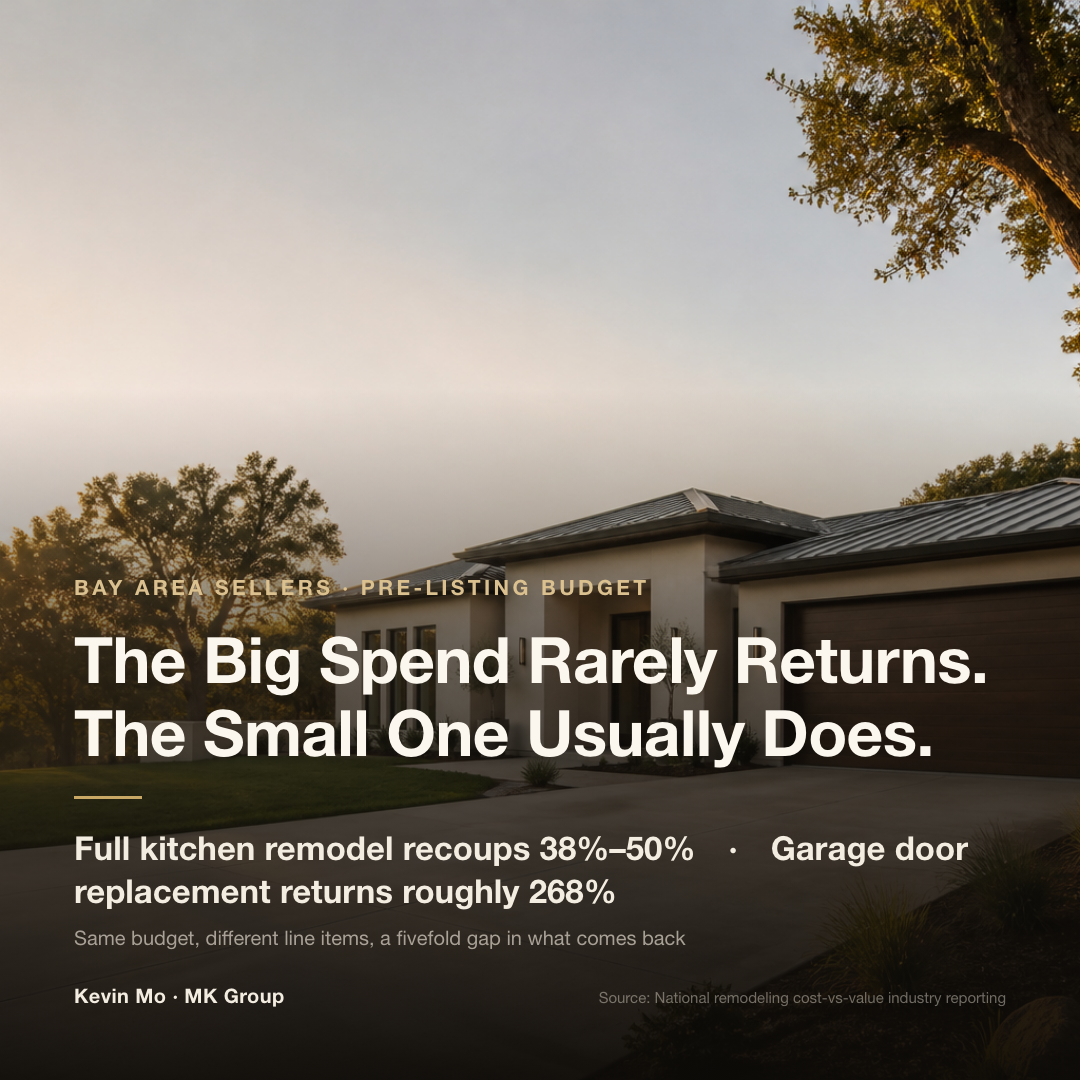
The headline numbers first. A full kitchen remodel typically recoups only 38%–50% of its cost, making it the worst return on this list. The same kitchen refreshed rather than rebuilt — cabinet doors painted, hardware swapped, a new faucet, a deep clean — averages about $28,000 spent and about $32,000 returned, which is net positive. And the highest-return item in the country costs far less than either: replacing a genuinely dated garage door averages under $5,000 and adds $12,000 or more in value, roughly 268% ROI, ranked first nationally two years running.
| Verdict | Item | Typical spend | Expected return / effect | What to do instead |
|---|---|---|---|---|
| Leave alone | Full kitchen remodel | $70K–$80K | Typically recoups 38%–50% of cost | Refresh instead; keep the replaceable surfaces replaceable |
| Leave alone | Large-area flooring replacement | Tens of thousands | One "I don't like this color" and it is worth zero | Professional deep clean or refinishing; a few hundred dollars, visible immediately |
| Leave alone | Full HVAC system replacement | Five figures | Unnecessary when the problem is minor | A few hundred dollars for a licensed HVAC service call |
| Leave alone | Custom window treatments | Several thousand and up | Buyers plan to remove them on sight | Take them down; $0, and the rooms read larger and brighter |
| Leave alone | Whole-house window replacement | Major expense | Buyers rarely notice | Clean the glass; replace individual panes only when broken |
| Leave alone | Pool / major landscaping / driveway repaving | Repaving runs into the high tens of thousands | Almost never recovered | Trim the lawn, pull the weeds, lay fresh mulch, add a few planters; pressure wash the driveway for $100–$200 |
| Leave alone | Replacing all interior and entry doors | Several thousand to five figures | Money spent for nothing | Paint them; fix the loose hinges and handles |
| Worth paying for | Light kitchen refresh | About $28,000 on average | Returns about $32,000 on average | Paint the cabinet doors, swap the hardware, change the faucet, deep clean |
| Worth paying for | Adding recessed lighting | Depends on wiring and ceiling structure | Improves the showing and the listing photos at the same time | Consistent placement and color temperature, licensed installer |
| Worth paying for | Whole-house repaint | A few thousand to $10K–$20K | Usually far better value than a $70K–$80K kitchen | One bright neutral throughout — off-white, pale gray |
| Worth paying for | Deep clean plus window washing | Modest | The most direct improvement to the first impression | Schedule it before the listing photography |
| Worth paying for | Scraping the popcorn ceiling | Depends on square footage | Scraped and repainted, the whole space reads years younger | Test for asbestos first; use a licensed abatement contractor |
| Worth paying for | Replacing an old garage door | Under $5,000 | Adds $12,000-plus in value, roughly 268% ROI | Only when that door is genuinely past its life |
What to remember is the slope of that table. The three most expensive projects on it — the full kitchen, whole-house windows, driveway repaving — deliver the worst returns, while the three cheapest actions — taking down the window treatments, washing the glass, pressure washing the driveway — cost close to nothing and show immediately. The extremes are the kitchen and the garage door: $70K–$80K into the kitchen comes back as $30K–$40K, while under $5,000 into the garage door buys $12,000 or more.
One item needs its own paragraph. Scraping a popcorn ceiling is worth doing, but the ceiling layer in some older Bay Area homes can contain asbestos. Test before anyone touches it, and have a licensed contractor handle the abatement to code. This is not a cost question. It is a safety and compliance question.
Once the budget is set, what actually determines the sale price is pricing and launch sequencing — see Bay Area pricing strategy for sellers and the one-week pre-listing checklist.
What MK Group sees in the field
One of the questions Kevin Mo gets most often on YouTube @KevinMoRE (23K+ subscribers) came from a client preparing to list: should I spend $70K–$80K redoing the kitchen first — that should sell for more, right?
His answer was two words: don't remodel. Not to save money, but because the structure of that spend is wrong. Seventy or eighty thousand dollars in returns thirty or forty. And once the countertop and cabinet colors are locked, the seller has made an aesthetic decision on behalf of a buyer nobody has met yet. Break the same budget apart instead: a few thousand to $10K–$20K to repaint the house in a bright neutral, a run of recessed lighting in the main rooms, a deep clean and a window wash. Leave the rest unspent. The house shows better than the remodel would have.
There is one more thing MK Group does before every listing goes live: professional staging, plus professional photography and video. A buyer's first emotional reaction decides whether they come see the house at all, and over time that line item outperforms any hard construction spend. Marie Wang (DRE# 02110980) and Kevin Mo (DRE# 02127623) keep arriving at the same conclusion in competitive markets like Palo Alto and Menlo Park: winning in the photographs matters more than being expensive on paper. The mechanics are broken down in how Palo Alto homes sell above asking.
Common misconceptions
"The kitchen is the showpiece — the nicer it is, the more the house sells for"
The opposite, usually. The kitchen is the most taste-driven room in the house, and the more finished it is, the more a buyer thinks about undoing it. Industry reporting puts a major kitchen remodel at 38%–50% of cost recouped, while painting the cabinet doors and swapping the hardware averages about $28,000 spent and about $32,000 returned. Same kitchen, two approaches, one loses money and one makes it.
"The old drapes look terrible — I should replace them before listing"
Replacement is the worst option here. Custom window treatments are expensive and intensely personal, and buyers often want them gone on sight. The better move is to take them down: zero dollars, and the rooms immediately read larger and brighter. Windows follow the same rule — buyers rarely notice a full window replacement, clean glass is enough, and individual panes get replaced only when they are actually broken.
"The driveway is cracked and the doors look worn — that drags the price down, so redo them"
Buyers care about the house. Nobody pays a premium for a perfect driveway, and repaving one runs into the high tens of thousands. One hundred to two hundred dollars of pressure washing gets it dramatically cleaner. Doors are the same: a coat of paint plus fixing the loose hinges and handles reads as new. The only door worth fully replacing is a garage door that is genuinely past its life — and that is the highest-return item in the country.
"Popcorn ceilings just need scraping — any cheap crew can do it in a day"
The popcorn layer in some older Bay Area homes can contain asbestos, and dry-scraping it puts fibers through the entire house. The right sequence is testing first, then a licensed contractor working to code if it comes back positive. The savings on this one are nowhere near worth the exposure.
"The house is dark because of how it was built — renovation can't fix that"
Usually it can. Older Bay Area homes read dark far more often because of how the lighting is laid out than because of the windows. Adding recessed lighting, paired with repainting the house in a bright neutral like off-white or pale gray, moves the whole property up a level — at a fraction of what a kitchen remodel costs.
Next steps
- Split the budget into two columns before you read the bid. The left column returns the house to a clean, bright, nothing-obviously-wrong baseline. The right column makes aesthetic decisions on the buyer's behalf. As a rule, cut the entire right column.
- Sequence it: clean and wash the windows, repaint, add recessed lighting, fix the curb appeal. Those four cover nearly everything most houses need before listing, and none of them conflict with each other.
- Anything that still works gets a service call, not a replacement. If the air conditioning is cooling poorly, making noise, or overdue for maintenance, a few hundred dollars for a licensed HVAC technician saves five figures against a full system swap.
- Test for asbestos before touching a ceiling. The popcorn ceiling is worth scraping, but testing and licensed handling are preconditions, not optional steps.
- Model homes above $5M separately. This national logic breaks down at the top of the market — some sellers spend heavily on pre-listing renovation and end up with a longer selling window instead of a higher price. For how the calendar and rate environment factor in, see seasonality and the rate window for Bay Area sellers.