The Direct Answer
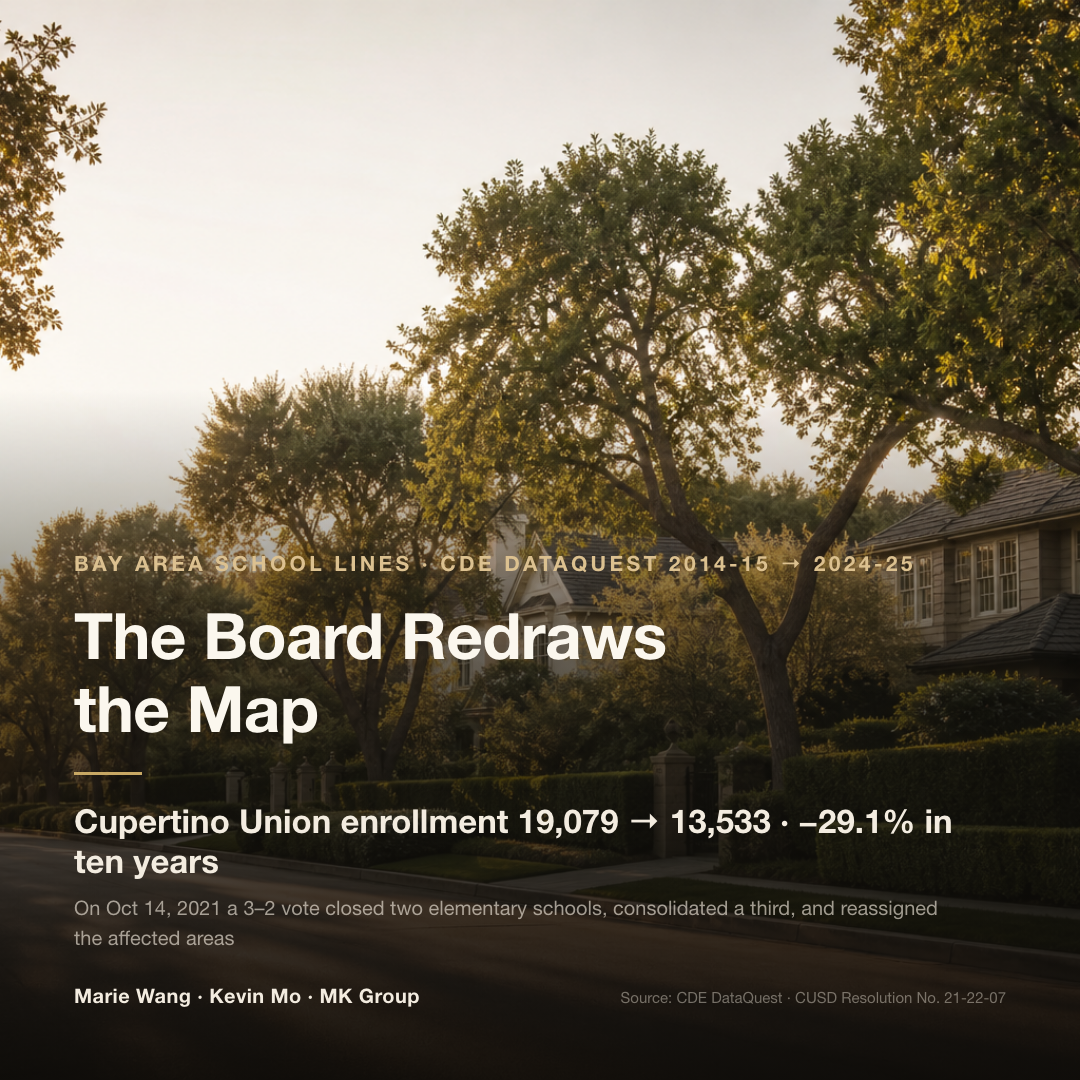
Yes, it can change. The power to redraw a district's internal attendance areas sits with the school board and nowhere else — the city council has no vote. Cupertino Union voted 3–2 on October 14, 2021 to adopt Resolution 21-22-07, closing Regnart and Meyerholz elementary schools, consolidating Muir, and reassigning every student inside those three attendance areas.
Who this article is for
This article is written for three kinds of readers.
The first is the buyer who has already written the school district into the budget and is about to write an offer. You have checked which school the house feeds today — that step is covered in full in Bay Area school-district homes: how do you verify which district a house actually belongs to? — and the next question is how long that assignment holds.
The second is the long-hold family. The younger the child, the more boundary cycles you have to cross. A family that carries one child from kindergarten through high school graduation will most likely sit through more than one enrollment review and more than one conversation about surplus school property.
The third is the cross-border or remote buyer. You cannot sit in a board meeting every month, but agendas, minutes and attachments are required by law to be published online. What you need is not a contact — it is knowing which site to open, which terms to search, and which decisions belong to the district versus the county.
You will leave with three things: who holds the authority to move the line, what public signals appear before it moves, and which three documents to pull before you write an offer, beyond a school-finder lookup.
Three things that tell you whether a boundary will move
One: who holds the pen — attendance areas belong to the board, district reorganization goes through the county
California's compulsory-attendance starting point is Education Code §48200: a school-age student attends the district where the parent or legal guardian resides. §48204 then lists several compliant paths that do not rest on residence alone — foster placement, an approved interdistrict transfer, a parent employed at least 10 hours a week within the district's boundaries, and others.
Note that both sections stop at the district level. How a district assigns which street to which school — the attendance area — is not spelled out section by section in state law. It is local policy the school board sets and amends under the general authority of Education Code §35160. This is the single point buyers get wrong most often: a city government cannot change which school your address is assigned to. Only a board of a few elected trustees can.
There is a second distinction worth writing down separately, because it is where the question "does the county have a say?" usually goes sideways. Everything above concerns attendance areas inside a district. The line between two districts — moving an area from one district to another, or merging or splitting districts — runs an entirely different route. Under Education Code §35700 et seq., the county committee on school district organization takes up the petition and holds hearings, the State Board of Education then approves, and in some circumstances the matter goes to an election. So the accurate framing is not that the county is irrelevant. It is this: attendance areas inside a district belong to the school board; reorganizing district lines belongs to the county committee and the State Board. Neither route passes through city hall. Which one you watch depends on whether you are worried that your street gets moved to a different elementary school, or that your neighborhood gets moved out of the district entirely. The first is far more common.
City limits and district lines were never aligned in the Bay Area to begin with. The town of Atherton spans three elementary districts, assigned street by street. Palo Alto's high school split is likewise the district's own map, not a city planning map (see Buying in Palo Alto: how do you know whether a house feeds Gunn or Paly?). What you are buying is an address's position on a district's internal map — and the author of that map is the board.
Two: where the public signals come from — three records anyone can pull
The good news is that in California a decision like this is nearly impossible to announce overnight. It has to pass through at least three layers of public process, and each layer leaves a searchable document.
Layer one is the Brown Act. California's Ralph M. Brown Act (Government Code §54954.2(a)) requires a local agency to post the agenda at least 72 hours before a regular meeting, in a location freely accessible to the public and on the agency's website home page. Subdivision (b) carves out statutory exceptions for items added late — an emergency, or a need found urgent by the required vote — but boundary adjustments, closures and property dispositions all require formal resolutions and do not fall inside those exceptions. They run the 72-hour agenda. Which means any formal discussion of boundaries, closures or school property appears in writing on the district site at least three days before the meeting. Most Peninsula districts host agendas on a system such as BoardDocs, and the attachments — slide decks and consultant reports included — are generally published with them.
Layer two is the statutory committee for surplus property. Under Education Code §17387 et seq., before a district sells or leases surplus school property (short leases under 30 days excepted), it must appoint a district advisory committee. §17389 sets the committee at 7 to 11 members and requires representation across community age groups, the business community, landowners and tenants (with priority to community associations), teachers, administrators and parents — known in the trade as the "7-11 committee." The legislative intent is stated plainly: bring the community in before the decision on closure or disposition of unused space is made. The moment a district posts a 7-11 committee, you have the clearest advance notice available.
Layer three is year-by-year enrollment. The California Department of Education publishes each district's enrollment by school year through DataQuest, and anyone can pull it year by year using the district's CDS code. This is the earliest signal of the three — the demographic curve usually turns several years before a board begins to discuss anything.
Stack those three layers and "advance notice" stops being a feeling and becomes three anchors you can check one at a time. The first anchor is the statutory 72 hours: for any formal vote, the agenda is online three days ahead at the latest. The second is the measured length of one full decision cycle — Cupertino Union paused its closure discussion in favor of a parcel-tax path at a special board meeting on November 10, 2020, and the board formally adopted Resolution 21-22-07 on October 14, 2021, roughly eleven months later. The third is the 7-11 committee: under Education Code §17389 and §17390, the board must establish that committee by public action and the committee must then deliver written recommendations on surplus property, and that stretch from formation to report is public the whole way. The shortest of the three anchors is 72 hours; the longest runs in years — and the DataQuest curve turns earlier than all three combined.
Three: closure and reassignment are two different things, and grandfathering only covers half
These get conflated constantly, and they are independent. A district can close a school with almost no boundary change (fold the whole area into a neighboring school). It can also close nothing at all and simply redraw a few lines to balance headcount across campuses. The Cupertino Union vote is a ready-made sample of both at once: inside the same Resolution 21-22-07, Regnart and Meyerholz were closures and Muir was a consolidation, effective with the 2022-23 school year. Closure, consolidation and reassignment are three outcomes of the same procedure, written on the same page, produced by the same vote. So the thing a buyer should watch is not the headline "will a school close" but the narrower question "will my address be assigned to a different school" — which is triggered by far more conditions, and requires no school to actually disappear.
Grandfathering — letting enrolled students stay put — is the most common cushion in a boundary adjustment, and its coverage is narrower than most people assume. Take the Cupertino Union case: students inside the former Regnart attendance area could elect Lincoln or Blue Hills; students in the former Meyerholz area folded into Dilworth, with Eaton or Blue Hills as options; and the resolution gave students in the former Muir, Regnart and Meyerholz areas priority in the 2022-23 intradistrict enrollment process. Note what is protected — the cohort of students inside the affected areas at that moment, not a permanent attribute of those houses.
For a buyer that reduces to two sentences. First, if your child is already enrolled, a boundary adjustment usually comes with a transition provision for your generation. Second, when you resell, the buyer prices the house on which school the next family can attend that year — not on your child's transition rights. The premium attaches to the map, not to your personal exemption. If you also want the timing side of this — when a closing has to record and when you have to be living there to make fall enrollment — read Moving to the Bay Area for schools: when does the house have to close, and when do you have to move in, to make fall enrollment? alongside it.
Ten years of enrollment across five districts
Start with the numbers. All five of these Peninsula and South Bay districts lost students between 2014-15 and 2024-25. The steepest decline is Cupertino Union, from 19,079 to 13,533 — 5,546 fewer students, down 29.1%. Los Altos Elementary follows, from 4,675 to 3,370, a loss of 1,305 students (−27.9%). Palo Alto Unified went from 12,527 to 10,209, down 2,318 students (−18.5%). Las Lomitas Elementary went from 1,386 to 1,138, down 248 (−17.9%). The shallowest is Menlo Park City, from 2,904 to 2,685, a loss of just 219 students (−7.5%). Same Peninsula and South Bay price tier — and the slope of the curve differs by nearly a factor of four across the five.
| District | 2014-15 enrollment | 2024-25 enrollment | Ten-year change |
|---|---|---|---|
| Cupertino Union (CUSD) | 19,079 | 13,533 | −5,546 (−29.1%) |
| Los Altos Elementary (LASD) | 4,675 | 3,370 | −1,305 (−27.9%) |
| Palo Alto Unified (PAUSD) | 12,527 | 10,209 | −2,318 (−18.5%) |
| Las Lomitas Elementary | 1,386 | 1,138 | −248 (−17.9%) |
| Menlo Park City (MPCSD) | 2,904 | 2,685 | −219 (−7.5%) |
What to take away: falling enrollment is not by itself a closure signal. It only puts "close" and "redraw" on the board's table. What decides the outcome is the district's funding structure. Palo Alto Unified is a basic aid (community-funded) district — revenue comes chiefly from local property tax rather than per-student state apportionment — so losing 2,318 students over ten years does not mean losing a proportional share of the budget. Per-student resources actually get roomier. Cupertino Union took a different path: in the special election of May 4, 2021, Measure A, which would have raised the parcel tax from $250 to $398, drew 59.3% yes and failed for want of a two-thirds majority. Five months later the board voted on closures and consolidation, citing exactly those two reasons in public — declining enrollment plus the failed parcel tax.
The same signal points in different directions depending on the funding structure, which is why one district's precedent cannot be used to forecast another's. One recent, checkable parallel: Palo Alto Unified's Measure B, an $800-per-parcel school tax, drew roughly 61% support in the June 2026 election and likewise fell short of two-thirds, after which the district published its operating-gap projection for FY 2026-27. Two parcel taxes stopping at 59.3% and roughly 61%, both under the two-thirds line — that is a public signal worth writing down, and it is not, on its own, a prediction about any specific school or boundary.
What MK Group sees on the ground
Marie Wang (DRE# 02110980) and Kevin Mo (DRE# 02127623) worked with a family doing street-level district due diligence in central Atherton who found that the house they wanted sat on the far side of an elementary boundary. After comparing comparable listings on both sides of that line, they moved a few streets over — comparable homes on the two sides of the line were trading roughly $1.5 million apart. How that due diligence is actually run is written out in Bay Area school-district homes: how do you verify which district a house actually belongs to?. Here we only borrow the number to push one step further.
If an administrative line can produce a $1.5 million spread across itself, then the line is a price variable — and it is maintained by a body that can put it on an agenda and vote. Static verification answers "is what I am buying today a school-district home." This layer answers "will it still be one when I sell." Put that spread back into its price tier and it gets sharper: in the second quarter of 2026, Atherton recorded 31 single-family closings at a $10.0 million median with 64.5% all-cash; Palo Alto recorded 139 closings at a $4.10 million median with 36.0% all-cash (MLSListings, compiled in MK Bay Area Pulse 2026 Q2). At Atherton's tier, $1.5 million is roughly 15% of the median sale price — determined by nothing about the house itself, and eligible to be voted on again every few years. And in a tier where 64.5% of closings are all-cash, the transaction itself loses the outside second look a lender and an appraiser would otherwise provide. No institution is underwriting the stability of the administrative conditions on the buyer's behalf.
Another family MK Group worked with — a couple doing AI research at large tech employers in Seattle, with an 8-year-old daughter — closed on a home inside Palo Alto Unified in May 2026. The deciding variable in their move was neither salary nor commute. It was education: they wanted their daughter to go all the way through in a city with a deep enough school ecosystem. A family like that holds naturally across an entire K-12 cycle — from age 8 to high school graduation is another ten years. Ten years, on the timescale of a Bay Area school district, is long enough to hold a full demographic downturn, one parcel-tax election, and at least one conversation about surplus school property. The younger the child, the more reason to read that timeline before you buy, not after.
Common mistakes
Mistake one: "school boundaries are drawn by the city, so checking city limits is enough"
No. A school district is a public entity independent of the city. Attendance areas are set by the board under the general authority of Education Code §35160, and the city council has no vote; reorganizing the line between two districts goes through the county committee on school district organization and the State Board of Education (Education Code §35700 et seq.). Neither route passes through city hall. Bay Area city limits and district lines are misaligned all over the map — the town of Atherton spans three elementary districts, and Palo Alto's high school split is the district's own map. Checking city limits, or checking a zip code, is not due diligence.
Mistake two: "a closure always means a boundary change, and a boundary change always means a closure"
They are independent actions that frequently appear in the same resolution. Cupertino Union's October 14, 2021 vote produced all three outcomes at once: Regnart and Meyerholz closed, Muir consolidated. In the other direction, a district can close nothing and simply redraw a few lines to balance headcount — common in areas where new housing is delivering in volume. What a buyer should watch is not the headline "will a school close" but the specific question "will my address be assigned to a different school," which is triggered by far more conditions.
Mistake three: "my child is already enrolled, so a boundary change can't reach me"
Grandfathering does frequently give enrolled students a transition path, but what it protects is the cohort inside the affected area at the time of the vote — not a permanent attribute of those houses. When you resell, the next buyer cares about which school a new family can attend that year. The school premium attaches to the map, not to your personal transition rights. This is the line item long-hold families most often skip.
Mistake four: "there is no warning — by the time it's announced it's too late"
The opposite is true. This is one of the few American processes with statutory advance notice built in. California's Brown Act (Government Code §54954.2(a)) requires the agenda of a regular meeting to be posted and put online at least 72 hours ahead, and formal resolutions on boundaries, closures and property disposition do not qualify for the urgency exceptions in subdivision (b). Before surplus school property can be disposed of, Education Code §17387–17391 requires a 7-to-11-member community advisory committee, which must separately deliver written recommendations to the board. And CDE DataQuest enrollment usually turns several years before a board begins discussing anything. Cupertino Union went from pausing the discussion on November 10, 2020 to a formal vote on October 14, 2021 — about eleven months. The information was public the whole time. Nobody was reading it on the buyer's behalf.
Mistake five: "enrollment is down, so this district is in trouble"
Demographics are one line; finance is the other. Palo Alto Unified lost 2,318 students over ten years, but it is a basic aid (community-funded) district drawing chiefly on local property tax rather than per-student state apportionment, so per-student resources actually got roomier. Cupertino Union's closure and consolidation resolution came after Measure A stopped at 59.3%. Identical enrollment declines point to completely different outcomes under two different funding structures. Reading DataQuest without reading the parcel-tax results and the budget documents will invert your read on the risk.
Next steps
First, pull year-by-year enrollment from CDE DataQuest. Using the target district's CDS code, pull the last ten school years one at a time. You are reading the slope, not any single year's absolute number. A district trending down for several consecutive years is worth carrying through every step below.
Second, read the last 24 months of board agendas and minutes. Most Peninsula districts host agendas on a public system such as BoardDocs. Keep the search terms fixed: attendance area, boundary, consolidation, school closure, surplus property, 7-11 committee, enrollment projection. Finding no hits is itself a valuable finding. If what worries you is reorganization of the district line rather than internal reassignment, run a separate check on the county committee on school district organization's agendas.
Third, find the district's own enrollment projection. Districts commonly commission a demographic consultant to produce a multi-year enrollment projection, published as an attachment to a budget or facilities plan. The school-by-school forecast in that document is closer to what the board is actually looking at than any third-party guess.
Fourth, check the parcel-tax election record. A school parcel tax needs a two-thirds majority, and results are archived publicly by the county registrar. One failed measure is frequently the precursor to a structural adjustment. At the same time, confirm whether the target district is basic aid — that determines how much fiscal pressure the same enrollment decline actually creates.
Fifth, get two things in writing from the district registrar during your contingency period. One, the school currently assigned to this specific address. Two, the district's current grandfathering and transfer policy. Keep the written reply on file — it is both the basis for this purchase and the document you hand the next buyer when you sell.