Direct answer
With a child in private school, the house is free of school-district boundaries. The real constraint is one-way minutes at morning peak: Menlo School's bus takes 40 minutes from its Los Altos stop. Map the drop-off first, then choose the neighborhood.
Three things set how wide the list of candidate neighborhoods can be: one-way minutes at morning peak, how many campuses your children are spread across, and whether you keep a public-school fallback.
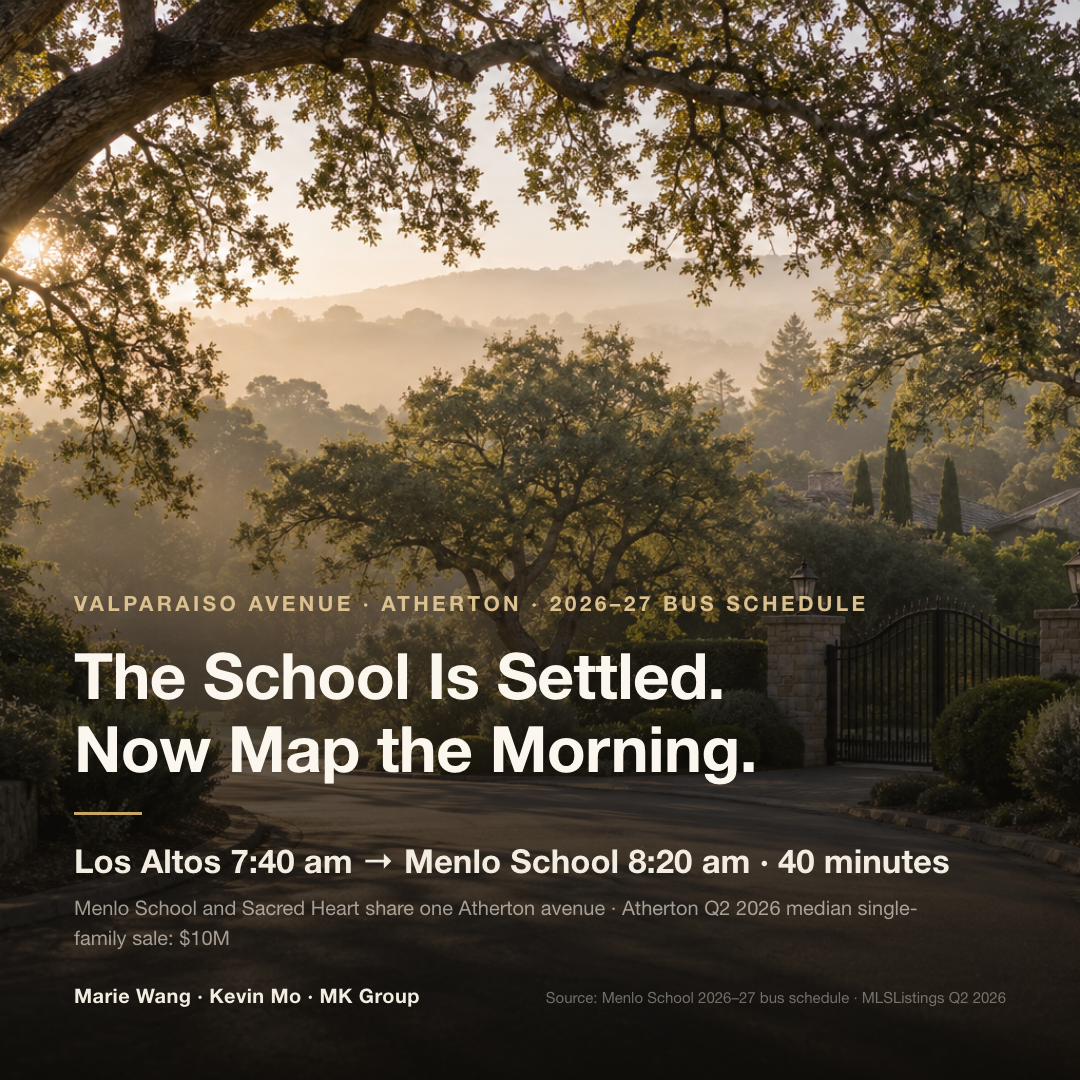
Take Valparaiso Avenue in Atherton. Menlo School (No. 50, grades 6–12) and Sacred Heart Schools (No. 150, preschool through grade 12) share the street, and Atherton's Q2 2026 median single-family sale price was $10,000,000 (MLSListings). Yet Menlo School's free buses run in from Woodside, Cupertino, Los Altos, San Mateo, Burlingame, and other directions, so the neighborhoods that work reach well beyond Atherton.
Who this article is for
- Families whose children attend, or are applying to, Peninsula and South Bay private schools such as Menlo School, Sacred Heart, Castilleja, Crystal Springs Uplands, Nueva, Pinewood, Woodside Priory, or Harker, and who are now deciding where to buy
- Buyers with a budget of $5 million and up, weighing Atherton, Palo Alto, Los Altos, Los Altos Hills, Hillsborough, Woodside, and Portola Valley against one another
- Families with two or more children whose age gaps will eventually put them in different schools, or on different campuses of the same school
- Families on the private-school path who still want the house inside a public school boundary, as a way back if they need one
- Families relocating from another state or from overseas who have to settle admission and a home purchase inside the same window
For choosing among the schools themselves and how their educational approaches differ, see Silicon Valley's Top Private Schools. This article takes up the question that comes after the school is settled: where to buy.
Three things that decide where to buy
A public-school home search asks one question: which district does this address belong to? A private-school family asks three instead. How long does the morning drive take from this address? How many places do we drop off each day? And if private school doesn't work out, is there a way back? The answers set how far the candidate neighborhoods can reach.
One: one-way minutes at morning peak, not distance on a map
Private school admission ignores home address, but the weekday hour from 7:30 to 8:30 a.m. gets no shorter for it. The unit for comparing neighborhoods is peak-hour minutes, and the schools' own bus schedules are a ready reference. On Menlo School's 2026–27 schedule, every bus arrives at 8:20 a.m. The Redwood City stop departs at 8:00 and the South Palo Alto stop at 7:55. Neither is far from campus, and the schedule still allots them 20 and 25 minutes.
Start times are not a single fixed number either. Menlo School lists an 8:45 a.m. start and a 3:00 p.m. dismissal for its Upper School; the Middle School starts at 8:35 a.m. and on most days dismisses at 3:20 p.m. Two children at the same school can be 10 to 20 minutes apart at each end of the day. The afternoon run is usually the harder one. Buses leave campus at 3:35 p.m., practices and rehearsals end later, and Menlo School's shuttle from campus to the Menlo Park Caltrain station runs until 5:45 p.m. On the days a parent does pickup, that parent is driving into the evening rush.
Two: how many children, how many campuses — one school can mean two drop-off points
A good number of Peninsula and South Bay private schools run separate campuses. Nueva's preschool through grade 8 is in Hillsborough (6565 Skyline Blvd.), and grades 9–12 are in San Mateo (131 E. 28th Ave.). Crystal Springs Uplands runs grades 6–8 in Belmont (10 Davis Dr.) and grades 9–12 in Hillsborough (400 Uplands Dr.). Pinewood's K–2 and grades 3–6 are on Fremont Avenue in Los Altos, and grades 7–12 are on Fremont Road in Los Altos Hills. Harker's K–5, 6–8, and 9–12 divisions sit on three San Jose campuses. The campus address you look up today may not be the one your child heads to every morning four years from now.
Some schools soften this with shuttles between campuses. Nueva runs a daily route between its two; Harker runs free morning and afternoon shuttles among all three, so parents can drop every child at one campus. Other schools set rules on how students arrive. Harker states that middle school students must carpool or ride school transportation to campus, because a city permit caps daily traffic at the campus. For families at a school like this, how close the house sits to a bus stop and to carpool partners matters more than how close it sits to the school gate.
Three: whether to keep a public-school fallback
Private school admission decisions are often still pending when the house has to be bought, and siblings may not follow the same path. If you want a way back — one child isn't admitted, a student wants to return to public school after two years, or a younger sibling plans to go public — the house has to sit inside a public school boundary you are comfortable with. The location freedom that private school just opened up narrows again. Whether that trade is worth it is each family's call. The long-run time and cost math is covered in Private vs Public School in Silicon Valley, so we won't redo it here.
Major Peninsula and South Bay private schools, grouped by drop-off corridor
The core numbers first. Menlo School and Sacred Heart Schools sit at 50 and 150 Valparaiso Avenue in Atherton, where the Q2 2026 median single-family sale price was $10,000,000. Castilleja is in downtown Palo Alto at 1310 Bryant Street, where the median over the same quarter was $4,100,000. The Crystal Springs Uplands upper school and Nueva's lower and middle grades are both in Hillsborough, at a $6,500,000 median. Pinewood's campuses are split between Los Altos ($4,920,000) and Los Altos Hills ($5,725,000).
| Drop-off corridor | School (grades) | Campus address | Buses and shuttles (as posted on the school's site) | Campus city, Q2 2026 median single-family sale |
|---|---|---|---|---|
| Valparaiso corridor (Atherton) | Menlo School (6–12) | 50 Valparaiso Ave., Atherton | Five free bus routes, serving Woodside/Portola Valley, Cupertino/Los Altos, San Mateo/Belmont/Redwood City, Palo Alto/Atherton/Menlo Park, and Burlingame; morning and afternoon shuttle to Menlo Park Caltrain | Atherton $10,000,000 |
| Valparaiso corridor (Atherton) | Sacred Heart Schools (preschool–12) | 150 Valparaiso Ave., Atherton | Morning and afternoon shuttle to Menlo Park Caltrain; the school encourages carpooling; public pages list no bus routes running toward family homes | Atherton $10,000,000 |
| Downtown Palo Alto | Castilleja (6–12, girls) | 1310 Bryant St., Palo Alto | Free bus routes serving San Carlos, Los Altos, West Menlo Park, Burlingame/Woodside, and Portola Valley/Stanford Hills; free shuttle from University Ave. Caltrain | Palo Alto $4,100,000 |
| Hillsborough / Belmont | Crystal Springs Uplands (6–12) | Grades 6–8: 10 Davis Dr., Belmont; grades 9–12: 400 Uplands Dr., Hillsborough | Separate bus and shuttle routes for middle and upper school, with stops clustered around where students live | Hillsborough $6,500,000 |
| Hillsborough / San Mateo | Nueva (preschool–12) | Preschool–8: 6565 Skyline Blvd., Hillsborough; 9–12: 131 E. 28th Ave., San Mateo | 6 routes to the Hillsborough campus and 4 to San Mateo; southbound routes reach Los Altos, Portola Valley, Woodside, Stanford, Menlo Park, Palo Alto, and nearby areas, with stops designed for a one-way ride under an hour; daily route between campuses; Caltrain pass for upper school students at no extra charge | Hillsborough $6,500,000 |
| Los Altos / Los Altos Hills | Pinewood (K–12) | K–2: 477 Fremont Ave.; 3–6: 327 Fremont Ave. (Los Altos); 7–12: 26800 Fremont Rd., Los Altos Hills | No fixed bus routes listed on public pages; confirm with the school | Los Altos $4,920,000; Los Altos Hills $5,725,000 |
| Portola Valley | Woodside Priory (6–12; boarding available in 9–12) | 302 Portola Rd., Portola Valley | No day-student bus routes listed on public pages; confirm with the school | Portola Valley $3,600,000 |
| Western South Bay | Harker (K–12) | K–5, 6–8, and 9–12 on three San Jose campuses (upper school at 500 Saratoga Ave.) | Bus fees included in tuition; morning routes serve the Peninsula, Cupertino, and other directions; free morning and afternoon shuttles among the three campuses; middle schoolers must carpool or ride school transportation | Campus in San Jose; neighboring Saratoga $4,394,000 |
What to take from this. First, the Valparaiso corridor holds the densest cluster of schools and the highest prices in this table, but using it doesn't require living in Atherton: Menlo School's five free bus routes come in from Woodside/Portola Valley, Cupertino/Los Altos, San Mateo, Palo Alto, and Burlingame. Second, half the schools here run split campuses (Crystal Springs Uplands, Nueva, Pinewood, Harker), so "where is the school" depends on which grade your child is in. Third, Pinewood and Woodside Priory don't list transportation on their public pages. That doesn't mean there is none — ask directly before you choose a house.
Morning peak, as the schools schedule it
The core numbers first. Every Menlo School bus on the 2026–27 schedule arrives at 8:20 a.m. The Los Altos stop departs at 7:40 a.m., 40 minutes to campus; the first Cupertino stop and the first Woodside stop both depart at 7:25 a.m., 55 minutes to campus; the shortest stop on the schedule gets 7 minutes. Castilleja's Burlingame stop departs at 7:35 a.m. and arrives at 8:20 a.m., 45 minutes.
| School | Route (school's name) | Boarding stop | Departs (a.m.) | Arrives (a.m.) | Scheduled time |
|---|---|---|---|---|---|
| Menlo School | Woodside/Portola Valley | SamTrans stop (Santa Cruz & Olive St.) | 8:13 | 8:20 | 7 min |
| Menlo School | Palo Alto/East Palo Alto/Atherton/Menlo Park | SamTrans stop (Coleman Ave. & Menlo Oaks Dr., Menlo Oaks) | 8:05 | 8:20 | 15 min |
| Menlo School | San Mateo/Belmont/RWC | Redwood City SamTrans stop | 8:00 | 8:20 | 20 min |
| Menlo School | Cupertino/Los Altos | South Palo Alto stop | 7:55 | 8:20 | 25 min |
| Menlo School | Palo Alto/East Palo Alto/Atherton/Menlo Park | Palo Alto Art Center | 7:50 | 8:20 | 30 min |
| Menlo School | Burlingame (morning run) | Black Mountain Park & Ride | 7:45 | 8:20 | 35 min |
| Menlo School | Cupertino/Los Altos | Los Altos stop | 7:40 | 8:20 | 40 min |
| Menlo School | Woodside/Portola Valley | Valley Presbyterian Church (Portola Valley) | 7:37 | 8:20 | 43 min |
| Menlo School | Cupertino/Los Altos | First Cupertino stop (10600 N. De Anza Blvd.) | 7:25 | 8:20 | 55 min |
| Menlo School | Woodside/Portola Valley | Pioneer Saloon (Woodside) | 7:25 | 8:20 | 55 min |
| Menlo School | San Mateo/Belmont/RWC | St. Matthew's Catholic School (San Mateo) | 7:24 | 8:20 | 56 min |
| Castilleja | Burlingame/Woodside | Woodside stop | 7:55 | 8:20 | 25 min |
| Castilleja | Burlingame/Woodside | Burlingame stop | 7:35 | 8:20 | 45 min |
What to take from this. Scheduled time includes intermediate stops, so it is not a door-to-door drive time, and a direct drive is usually somewhat shorter. But the schools built these schedules around real morning-peak traffic, which makes them far more reliable than a trial run on a weekend house-hunting trip. Two details deserve a closer look. First, time does not track distance. The shortest stop, Santa Cruz & Olive, gets 7 minutes and Menlo Oaks gets 15, yet the Redwood City and South Palo Alto stops, only a few miles from campus, are still allotted 20 and 25. Second, among buses coming from the north, the Burlingame morning run, which stops only at Black Mountain Park & Ride, reaches campus in 35 minutes, while the San Mateo/Belmont/RWC route, with five stops along the way, needs 56 minutes from its first stop. Riding a direct route or a multi-stop route can mean a 20-minute difference.
Location rules for three kinds of families
Applied to different family structures, the three dimensions produce three different rules.
One child, one school: draw the circle around the campus, for both rush hours
A family with one child at one school has the simplest problem. Put the campus at the center, set an acceptable one-way limit — say 15 or 20 minutes — and draw the circle at weekday morning peak. Then check it again against the evening peak around 5 p.m., because pickup after activities often lands in rush hour. Inside the circle, choose on lifestyle. The other approach is to live near a stop on a school bus route. Menlo School, Castilleja, Crystal Springs Uplands, Nueva, and Harker all publish bus or shuttle service running toward where families live, and a house close to a stop gives your child a way to school that doesn't depend on a parent at the wheel.
Several children, several campuses: anchor on the youngest child's campus
When two or more children attend different schools, or different campuses of the same school, the house should sit near the youngest child's campus. High schoolers can take the bus or Caltrain, and at 16 they may drive themselves; elementary and middle schoolers depend on parent drop-off for many more years. Several schools have built in a Caltrain link. Menlo School and Sacred Heart run shuttles from the Menlo Park station, Castilleja runs a free shuttle from University Avenue station in Palo Alto, and Nueva provides Caltrain passes to upper school students at no extra charge. Living a bit closer to a Caltrain station opens one more route for the older children.
Then stretch the timeline. A Crystal Springs Uplands student who finishes eighth grade moves from Belmont to Hillsborough. A Pinewood student entering seventh grade moves from Los Altos to Los Altos Hills. A Nueva student entering ninth grade moves from Hillsborough to San Mateo. The anchor moves, so the house should sit somewhere that still works after it does.
Public and private in parallel: draw the public boundary first, then find the spot closest to the private school
For families keeping a public fallback, the order can't be reversed. A school district boundary is a hard line drawn by street address; commute time is a soft constraint you can trade against other things. So draw the boundary first, then compare drive times to the private school inside it. All of Palo Alto belongs to Palo Alto Unified (PAUSD), and Castilleja sits downtown, so in a city like this the boundary and the private school are close together. Atherton calls for particular care: one town is split street by street across three K-8 districts, and a few blocks can mean a different district. The details are in Buying in Atherton or Menlo Park — Which School District Do Your Kids Actually Land In? In any city, verify the exact address in the district's official lookup tool rather than relying on the city name in the listing. The method is laid out in How Do You Verify Which District a House Actually Belongs To?
What MK Group sees in the field
The MK Group case library holds three real examples tied to the school run: one cautionary, one that worked, and one on the public-private track. The first two cases don't record whether the children attended public or private school, so they appear here only to show how daily routes shape the decision.
The cautionary example is a family office client that Marie Wang (DRE# 02110980) described on her YouTube channel, @MarieWang (44K+ subscribers), recorded as case-001. The family bought three homes in Silicon Valley at once, one to live in and two as investments, and chose mainly on the prestige of the address and the price. Six months after buying, they found the children's school run took about 30 minutes, longer in traffic, and the whole family felt the back-and-forth was taking over the day. The household rhythm fell out of sync. As the case review puts it, the core mistake was weighing only prestige and price, without drawing the children's school run, the parents' commutes, and everyday errands and social life onto one map and checking them against each other.
The example that worked comes from the same video (case-002): a family with a budget above $10 million. Their needs were clear, and Marie Wang distilled them into a checklist: a large living room for hosting investors and VCs at home; a private garden suited to gatherings of a dozen to twenty guests; proximity to Stanford and Sand Hill Road; and a drive to the children's school of 5 to 10 minutes, without exception. She then mapped the family's daily social, business, and family routes. Layered together, they pointed to Atherton: no commercial district, large parcels, a strong sense of privacy, and a location between Stanford and Sand Hill Road. On that checklist, the drive to school ranked as a hard constraint on the same level as location and entertaining space.
The public-private example is case-015: a dual-career couple doing AI research at a major Seattle tech company, who moved to the Bay Area for their 8-year-old daughter's education. They chose Palo Alto, in part because the PAUSD public school ecosystem gives them a floor even if the private-school path doesn't work out later. Marie Wang and Kevin Mo (DRE# 02127623) walked them through PAUSD's elementary attendance boundaries and middle school pathways, and the house they chose sits within a 5- to 10-minute drive of Stanford.
All three cases lead to the same conclusion: put the daily routes on a map first, then choose the neighborhood.
Common mistakes
Mistake one: "Living next door to the school is best"
For a family with one child who will finish every grade on one campus, living close to school does make life easier. But "next door" tends to move. A Crystal Springs Uplands student moves from Belmont to Hillsborough in ninth grade; a Nueva student moves from Hillsborough to San Mateo in ninth grade; a Pinewood student moves to Los Altos Hills in seventh grade; and a younger sibling may attend another school entirely. Once children reach high school, they can take the bus or Caltrain on their own. The sounder goal is the lowest total drop-off and pickup time for the whole family across a week. Being closest to any single school gate comes second.
Mistake two: "Our kids are in private school, so school districts don't matter at all"
If you are certain every child will stay in private school all the way through, the district boundary really does stop being a constraint. But admission results are often still out when you buy, siblings may not follow the same path, and students do sometimes switch back to public school after two years. If you want that option kept open, look up the exact address in the district's official tool before you write an offer. Don't assume the city name tells you the district.
Mistake three: "The school runs buses, so distance doesn't matter"
School buses run fixed stops on fixed times. Menlo School's buses arrive at 8:20 a.m. and leave at 3:35 p.m.; on days when practices or rehearsals end later, a parent still does pickup. From the first Woodside or Cupertino stop, the ride to campus is 55 minutes, which is not an easy morning for a younger child. Nueva states that its stops are designed around a one-way ride of under an hour. An hour is the bus's design ceiling, and it makes a poor target to buy around. Pinewood and Woodside Priory don't list fixed bus routes on their public pages, so ask those schools directly; Harker requires middle schoolers to carpool or ride school transportation. A bus route can strengthen a neighborhood's case, but it can't stretch the commute radius without limit.
Mistake four: "Map distance tells you how long the drive will take"
At morning peak, distance says very little. On Menlo School's schedule, the Santa Cruz & Olive stop gets just 7 minutes, while the Redwood City stop, only a few miles from campus, gets 20. Coming from the north, the Burlingame morning run with one stop arrives in 35 minutes, while the San Mateo route with five stops needs 56 minutes from its first stop. Estimate the commute from navigation predictions for a weekday departure around 7:30 a.m., and ideally drive it yourself at real school-run hours. A time clocked on a weekend house-hunting trip doesn't count.
Next steps
- List which school and which campus each child will attend over the next five years, flag the year any child changes campus on moving up a grade, and put every campus on a single map.
- Download this year's bus, shuttle, and Caltrain-connection schedules from each target school's website, and check whether each candidate neighborhood sits on a route and what time the bus departs. For schools that don't list routes, contact the school's transportation office directly.
- For each candidate neighborhood, time the drive to school once around 7:30 a.m. and once around 5:00 p.m. on a weekday, using navigation estimates or a test drive, and record the results in the same table as the home prices.
- If you are keeping a public fallback, verify the exact street address in the district's official tool first and save a screenshot, then compare drive times to the private school inside that boundary.
- Write a maximum one-way drive to school, in minutes, into your purchase criteria alongside budget, lot size, and bedroom count, before you start touring.