Quick Answer
Not if nothing is forcing a sale. A $6M–$8M single-family home in Palo Alto will sell today: two typical September sales, both around $7.5M, closed within 10 days to two weeks of listing at roughly 3%–4% over asking. But the next wave of buyers, funded by AI equity turning into cash, is only starting to arrive. Selling fast is not the same as selling at the best price.
That is the central judgment of an October 2026 video by Kevin Mo (DRE# 02127623), co-founder of MK Group, on his YouTube channel (@KevinMoRE, 24K+ subscribers). Sales volume at this price has held steady, but the same money now buys a smaller house. San Francisco, where cash from AI companies is landing first, has already risen about 25% in a year. And that cash arrives in stages; this is only the first. A house can be sold only once. The question isn't whether you can sell. It's whether waiting another year is worth it.
Who this article is for
- Palo Alto owners of a $6M–$8M single-family home who are weighing a listing while the market is hot
- Owners of a home of around 4,000 square feet on a lot of 9,000 square feet or more, who want to know how scarce that has become
- Owners who bought land to rebuild and are now bogged down in permits and construction
- Families planning to sell at about $7M and move up to a $10M–$12M home
- Owners with a fixed timeline: a job relocation, a move overseas, or an asset plan that has to be completed
Three core dimensions
Dimension one: the fast sales are real, but buyers at this price are getting less house
Two sales at this price in September 2026 show the pattern. One listed at $7.295M and closed at $7.5M; the other listed at $7.5M and closed at $7.8M. Both closed within 10 days to two weeks of listing. Both were public market sales, not MK Group transactions, and Kevin is careful to say that two sales don't represent the whole market. What they do show is that a home priced right for this tier has real buyers today, and those buyers will pay three or four points over asking.
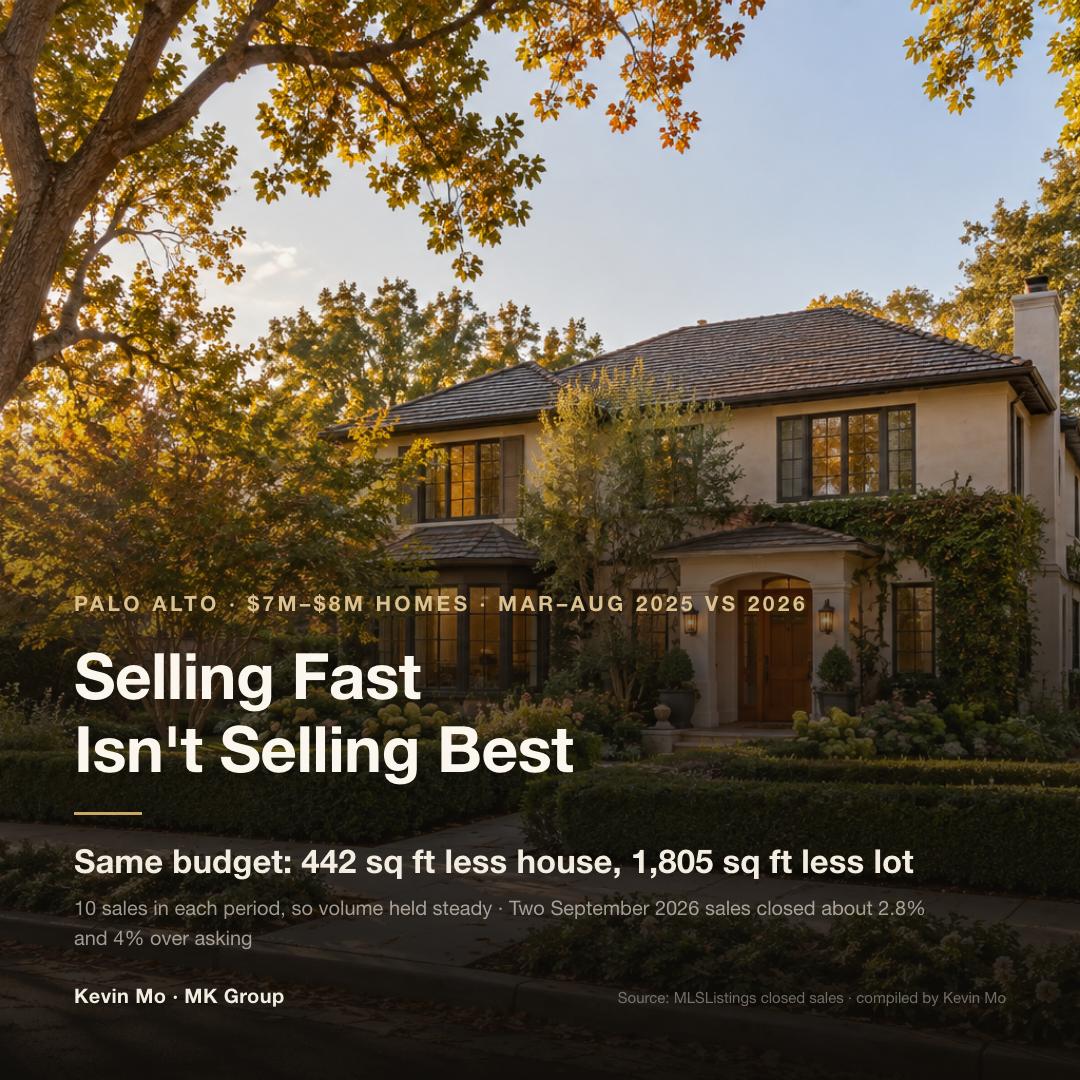
The more telling change is in the houses themselves. Palo Alto single-family homes between $7M and $8M recorded 10 sales in March–August 2025 and 10 again in the same months of 2026. Volume didn't move. What moved is what the money buys: this year, about 400 square feet less interior space and roughly 1,800 square feet less land, which is about the size of a backyard. If you own a home of around 4,000 square feet on a lot of 9,000-plus square feet, you are holding exactly what buyers at this price are finding harder and harder to get.
Dimension two: the next wave of buying power is AI equity, and it arrives in installments
AI companies have created enormous equity wealth over the past two years, and much of it is still locked in private shares. For this price point, what matters isn't when "IPO" makes the headlines. It's when that stock actually becomes cash. That process has begun. This year OpenAI let some employees sell shares early through an employee tender offer, and some of them now hold several million to more than ten million dollars in cash to deploy. But each tender releases only a portion. The bulk waits for a public listing, and after an IPO employees typically face a lockup of about six months (commonly 180 days). The money comes in waves.
Public research on the 2012 Facebook IPO cited in the video, measured at the census-tract level, found that in the year after the listing, home values in tracts where Facebook employees were concentrated rose about 20.9%, against about 16.8% elsewhere in the Bay Area. Kevin notes that this doesn't prove the IPO drove the whole increase. But some of the newly liquid money did go into housing, and it went first to where employees lived. Facebook's headquarters is in Menlo Park, a few minutes' drive from Palo Alto.
Today's example is San Francisco. OpenAI and Anthropic are both headquartered there, and under the same interest rates the city rose about a quarter in a year, while San Mateo County gained about 10% and the other counties barely moved. Kevin's read is that the same thing is likely to play out in communities like Palo Alto, where AI professionals are concentrated and good houses are scarce, and most visibly in the $6M–$8M tier. Above that, the buyer pool is narrower, so the effect is likely to be smaller.
Dimension three: whether a year's wait pays comes down to carrying cost
Waiting isn't free. Interest, property tax and maintenance add up to your carrying cost. For a home recently bought at $7M, an effective tax rate of about 1.1%–1.2% puts property tax alone at around $80,000 a year. For a long-time owner with a low Prop 13 basis and no large mortgage, the math is far lighter. There is only one rule: once the cost of holding another year exceeds what you expect to gain by waiting, stop waiting.
The numbers: this tier sells, but the same money buys less
The short version: Palo Alto single-family homes between $7M and $8M recorded 10 sales in March–August of both 2025 and 2026, yet the median interior size of homes sold at that price fell from 3,934 to 3,492 square feet, and the median lot from 9,350 to 7,545 square feet. Over the same period, San Francisco's median sale price rose about 25% year over year, and San Mateo County's about 10%.
| Metric | Figure | Basis |
|---|---|---|
| Typical September 2026 sale, No. 1 | Listed $7,295,000 → sold $7,500,000 (about +2.8%) | Closed about 10 days to two weeks after listing |
| Typical September 2026 sale, No. 2 | Listed $7,500,000 → sold $7,800,000 (+4.0%) | Closed about 10 days to two weeks after listing |
| Palo Alto $7M–$8M single-family sales | 10 → 10 | March–August 2025 vs. March–August 2026 |
| Median interior size of homes sold at this price | 3,934 → 3,492 sq ft (−442) | Same periods |
| Median lot of homes sold at this price | 9,350 → 7,545 sq ft (−1,805) | Same periods |
| 94301 single-family median sale price | $5.47M → $5.46M (−0.3%) | Same periods, larger sample |
| 94301 like-for-like home price | About +12% | Statistical estimate holding size, lot and age constant |
| San Francisco median sale price | About $2.05M, about +25% year over year | Through August 2026 |
| San Mateo County median sale price | About +10% year over year | Same period |
| Other Bay Area counties | Roughly flat | Same period |
Basis: Palo Alto figures are MLSListings single-family closed sales. The $7M–$8M subsample has only 10 sales per year and is directional only. The size, lot and 94301 figures come from Kevin Mo's September 2026 video analysis. The two September sales are public market sales, not MK Group transactions. San Francisco and county figures are Compass data as cited in the video and have not been independently verified.
What matters most: a flat median doesn't mean flat prices. In 94301 the median sale price went from $5.47M to $5.46M in a year, yet a home of the same size, lot and age cost about 12% more (for the method, see My $5 Million Palo Alto Budget From Last Year — Will It Still Buy the Same House in 2026?). In Palo Alto the increase hides in the shrinking house rather than showing up on the median, as it does in San Francisco. A home close to last year's size is scarcer in buyers' eyes than any price sheet suggests.
Wait for signals, not a date: four changes worth watching
Rather than circling a date ("we'll list next spring"), watch for four signals. When they appear together, the window is better:
- An AI company IPO or employee buyback actually closes. Employees come away with cash, not just a headline.
- Bidding at this price gets noticeably more competitive. Premiums move from three or four points over asking to a routine 5%–10%, and the time from listing to close keeps shrinking.
- Good homes at this price still aren't noticeably more plentiful. More buyers against the same supply is what concentrates competition on the few good houses.
- San Francisco's heat keeps moving south. San Mateo County is already up about 10%. If sales on the southern Peninsula also clearly accelerate, the money is spreading toward Palo Alto.
Conversely, if a year of carrying cost already exceeds what you expect to gain, there's no need to wait for the signals.
Three situations where selling now is the right call
1. You bought to rebuild, but you aren't a professional builder
Permits, design, contractors and financing turn out to be far more complicated than most owners expect, and the project can easily become a burden. Don't spend another year of time and carrying cost betting on a slightly higher price later. On a home bought at $7M, property tax alone runs around $80,000 a year, before interest and maintenance.
2. You're trading up to a more expensive home
The year you wait, the next house is appreciating too. Kevin's example: sell at $7M, buy at $10M, and both rise 7%. You gain about $490,000 on the sale but pay $700,000 more on the purchase, so the upgrade gap widens by about $210,000 (Kevin rounds these to $500,000 and $200,000). By the same math, if the next home is $12M, the gap widens by about $350,000. The sale and the purchase have to be run as one calculation.
3. Your timing is already set
A move is coming, whether a job relocation or a move overseas; an asset plan needs to be completed first; the next home is already secured; or a buyer has offered clearly above market. Certainty has real value. There's no reason to disrupt a settled plan for a future that hasn't happened yet.
What MK Group sees on the ground: not selling yet doesn't mean doing nothing
Kevin stresses in the video that holding off doesn't mean sitting still; selling well actually calls for planning earlier. His example is a single-family home MK Group sold this year in Palo Alto's Midtown. It sat at a lower price point than the $6M–$8M range this article covers, so the lesson is the preparation, not the price.
The house had no serious flaws, and nothing especially distinctive either. Once the owners moved out, there were only about three weeks for refresh work. In the two-plus months between signing and listing, the team first shared the home privately with about 25 local buyer groups with cash capacity, then built anticipation with two to three pieces of content on the neighborhood, the house and the market, and finally held four days of open houses that drew about 110 groups in total. Listed at $3.88M, it closed in May 2026 at $4.378M: about $500,000, or roughly 12.8%, over asking, and above a $4M verbal offer one buyer had floated before launch (full breakdown in The Same Palo Alto House, a Different Listing Agent — How Much More Can It Sell For?). At $6M–$8M the logic is the same. Settle pricing, presentation and launch timing in advance, and you can list quickly when the signals appear.
Common Misconceptions
Misconception 1: "It's selling this easily, so the market must be at the top. I should sell while it's hot"
Easy sales show there are real buyers, not that prices have peaked. By Kevin's reading, only the first wave of AI equity money has arrived. For an owner without time pressure, the comparison that matters is today's price against the price once the signals appear, not whether the house will sell.
Misconception 2: "The 94301 median didn't move in a year, so Palo Alto hasn't actually gone up"
The median went from $5.47M to $5.46M, while a like-for-like home cost about 12% more. In the $7M–$8M tier, the same money bought 442 square feet less house and 1,805 square feet less lot. The increase is written into a smaller house.
Misconception 3: "I'll list the moment OpenAI announces an IPO"
An IPO announcement isn't cash in hand. Employees typically face a lockup of about six months after a listing, and only after it expires can large blocks of stock be sold. What to watch is the signals arriving together: cash actually in hand, sharper bidding, no new supply of good homes, and accelerating sales on the southern Peninsula.
Misconception 4: "If sellers are waiting, buyers can wait another year too"
For working buyers outside the AI industry who want into scarce communities like this one, the opposite holds. Sellers are willing to wait precisely because prices may still accelerate. Between buyers without equity liquidity and AI professionals holding cash, the competition is asymmetric, and the gap is widening fast. Kevin's advice to these buyers is to act with some urgency now.
Next steps
- Put three things in one table and run the numbers on waiting a year. Recent sales at your price point (list price, sale price, days to contract), the active listings you would compete with, and your annual carrying cost (interest + property tax + maintenance). If the gain you expect is smaller than a year of carrying cost, don't wait.
- If you're trading up, run the sale and the purchase together. Apply the same appreciation assumption to both, work out what you'd gain on the sale and what you'd pay extra on the purchase, and see whether the upgrade gap grows or shrinks.
- Check the four signals once a month. Has an IPO or buyback closed? Are premiums at your price routinely above 5%? Are good listings multiplying? Are sales on the southern Peninsula accelerating?
- Finish your launch preparation now. Pricing logic, repairs and paint, photography, video and pre-launch content, and launch timing, all settled in advance, so you can move as soon as the window opens.