Buying

Bilingual Homebuyer Handoff: Where Cross-Cultural Real Estate Deals Stall (MK Group on Inman)

Marie Wang & Kevin Mo | Meridian Keystone Real Estate Group

Published:

Quick Answer

Cross-cultural real estate deals rarely fail loudly. Foreign buyers purchased $45.3 billion of U.S. existing homes in the year through March 2026, down 19.1 percent (NAR 2026 International Transactions report), and 48 percent paid cash against 28 percent of buyers overall, so each cash deal lost in escrow is harder to replace. Three gaps account for most losses: comprehension of the disclosure packet, unfamiliar U.S. process conventions, and money that exists but cannot move on the day escrow needs it. The fix is verifying comprehension instead of assuming it. Marie Wang and Kevin Mo lay out the four changes in Inman.

Key Takeaways
1Foreign buyers purchased $45.3 billion of U.S. existing homes in the year through March 2026, down 19.1 percent, and 48 percent paid cash against 28 percent of all buyers (NAR 2026 International Transactions report): a shrinking pool where each cash deal lost in escrow is harder to replace.
2Three gaps account for most quiet failures: comprehension of the disclosure packet, unfamiliar U.S. process conventions, and funds that exist but cannot move on the day escrow needs them.
3The fix is verifying comprehension instead of assuming it: a comprehension check before contingencies come off, language and money on the calendar early, documents to the decision-makers who are not in the room, and saying the unwelcome thing first.

About this page

This is a short MK Group syndication summary of an article Marie Wang and Kevin Mo, Founders of MK Group, published in Inman on October 8, 2026. It is their second piece for the outlet. Inman holds the canonical English version. Read the full article on Inman →

The argument in one line: reaching a cross-cultural buyer and closing one are separate skills, and the second is decided after the offer is accepted. The industry works on reach. The deals are lost, quietly, between acceptance and a recorded deed.
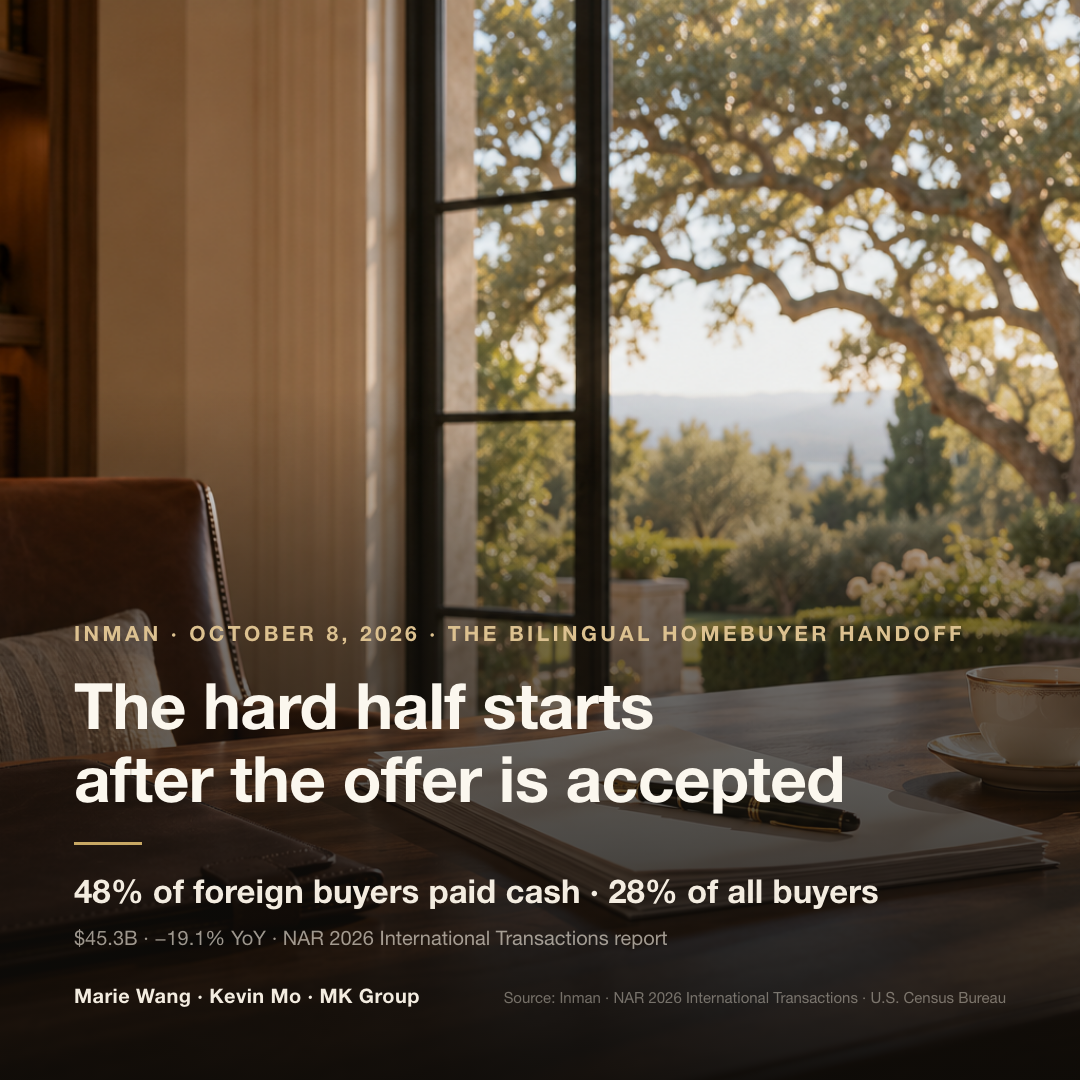
The hard half starts after the offer is accepted: 48 percent of foreign buyers paid cash against 28 percent of all buyers; foreign buyers purchased $45.3 billion of U.S. existing homes in the year through March 2026, down 19.1 percent (NAR 2026 International Transactions report)
Marie Wang and Kevin Mo in Inman (October 8, 2026) · Data: NAR 2026 International Transactions in U.S. Residential Real Estate, U.S. Census Bureau (2019)

The data anchors: foreign buyers purchased $45.3 billion of U.S. existing homes in the year through March 2026, down 19.1 percent, and 48 percent of them paid cash against 28 percent of buyers overall (NAR, 2026 International Transactions in U.S. Residential Real Estate). As of 2019, 67.8 million U.S. residents spoke a language other than English at home (U.S. Census Bureau).

Three gaps account for most of the quiet failures: comprehension of the disclosure packet, unfamiliar U.S. process conventions, and money that exists but cannot move on the day escrow needs it. The fix is verifying comprehension instead of assuming it. The four concrete changes, and how the fair-housing line applies when a buyer cannot verify a school assignment on their own, are the substance of the full article.

Read the full article on Inman →

Marie Wang (DRE# 02110980) and Kevin Mo (DRE# 02127623) are Founders of MK Group at Keller Williams, a Bay Area Peninsula and Silicon Valley luxury team. The Inman article is the canonical English version of this analysis.

Related Reading

Contact MK Group

MK Group (Meridian Keystone Real Estate Group) is a Bay Area Peninsula and South Bay luxury real estate team founded by Marie Wang and Kevin Mo, affiliated with Keller Williams. Bilingual Mandarin and English representation for buyers and sellers across Palo Alto, Atherton, Hillsborough, Los Altos, Menlo Park, and Cupertino.

Related Articles
Buying

Texas and Florida Now Restrict Chinese Citizens From Buying Homes — I Hold a Chinese Passport and Live in China. Can I Still Buy in the Bay Area in 2026?

Since Texas and Florida moved to restrict home purchases by Chinese citizens, buyers living in China have started asking whether California is next. California's rule runs the other way: state law says any person, regardless of citizenship, may buy, hold, and sell property, and three related bills in recent years touched only farmland and never became law. What actually stands in the way is moving funds out of China, choosing how to hold title, and the taxes waiting at exit.

Buying

I'm Buying a $10M Home in Palo Alto and the Seller Wants to Back Out After Signing — Can I Force Them to Close?

You are in escrow, and a new listing down the street has the seller second-guessing the price. At this stage the seller cannot simply walk: the contract offers a seller only a short list of exits, and a buyer who intends to live in the home can ask a court to compel the sale. The real exposure comes earlier — until a signed acceptance is delivered, a price agreed by phone binds the seller to nothing.

← Back to Knowledge BaseMore in Buying →

Knowledge is the starting point — your plan is what turns it into an outcome.

We offer 1:1 strategy conversations to translate methodology into your specific situation.

WeChat
Subscribe