Direct answer
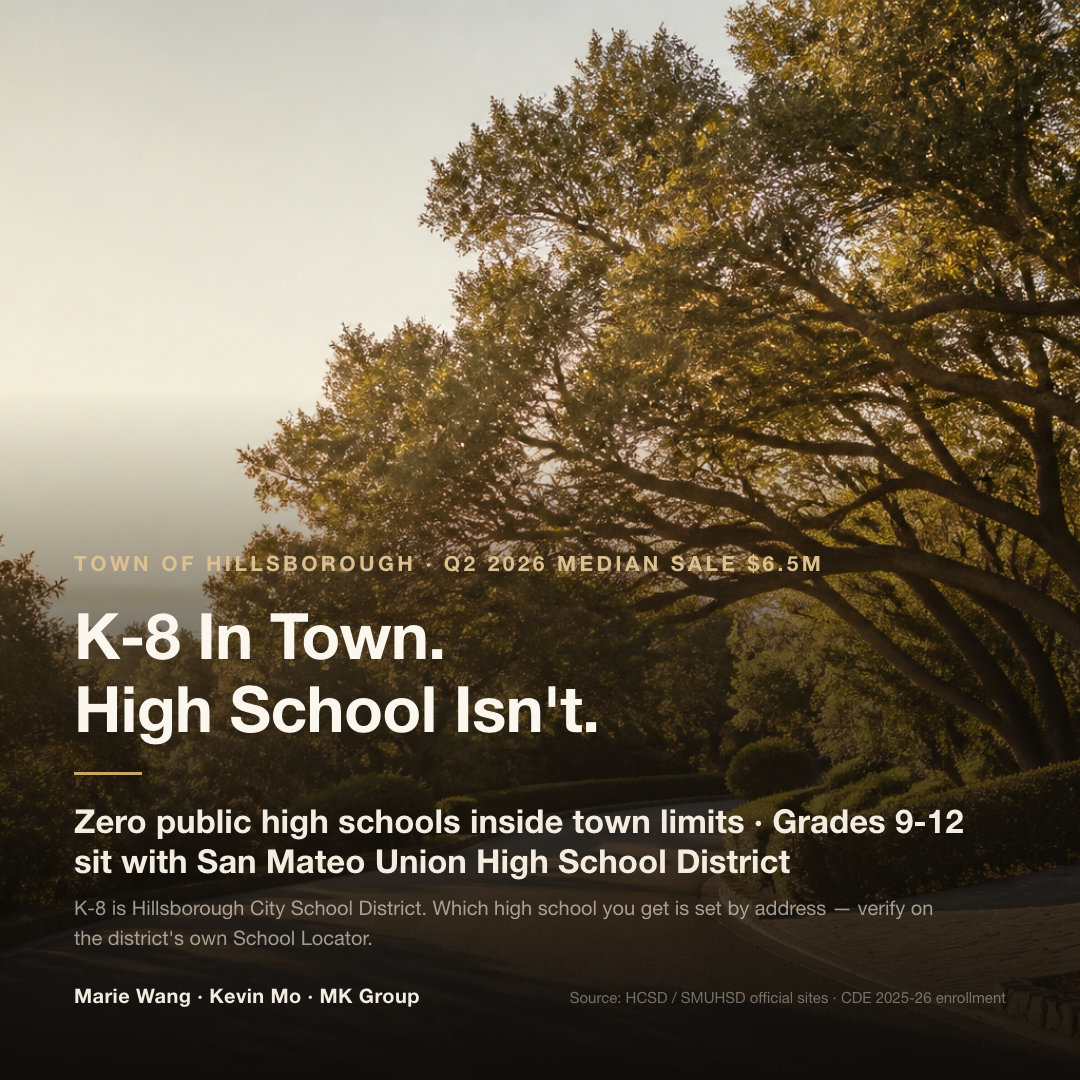
There is no public high school inside Hillsborough town limits. Grades K-8 belong to Hillsborough City School District (1,198 students enrolled in 2025-26); grades 9-12 belong to San Mateo Union High School District (9,302), a legally separate district with its own board. Which high school an address feeds is set by attendance boundary and has to be confirmed address by address on SMUHSD's official School Locator.
Who this article is for
- Families touring Hillsborough with a preschool or elementary-age child who want the whole K-12 path mapped before they commit to an address
- Local families whose child is already at Crocker Middle and who are starting to plan the move into ninth grade
- Buyers moving north from Palo Alto, Los Altos, or the South Bay who need to understand how Peninsula district structure differs from what they are used to
- Cross-border families planning to tour and decide in a single trip, who want the assignment rules settled before they board a plane
- Current Hillsborough owners who want to know what the school district parcel tax line on the annual bill funds, and what the foundation's annual campaign funds separately
Three things that actually decide this
"How good is the Hillsborough school district" is a question this town cannot answer, because the public path here is not one district. It is two districts joined end to end. Split it three ways and it becomes clear which segment you are actually buying.
One: there is a genuine handoff between K-8 and 9-12
Hillsborough City School District is registered with the California Department of Education as an elementary school district, grade span K through 8, with 1,198 students enrolled in 2025-26. It operates three K-5 elementary schools — North, South, and West Hillsborough — and one 6-8 middle school, Crocker Middle. That is the structure the district sets out in its own School Boundaries reference document (current edition HCSDSchoolBoundaries2024.pdf): three elementaries and one middle school. To this point, the entire path sits inside town limits.
Eighth grade is where the path runs out. Grades 9-12 belong to San Mateo Union High School District, registered with CDE as a high school district, with 9,302 students enrolled in 2025-26. Its home page describes the district as "10 Schools | 6 Cities | 1 District," serving San Mateo, Burlingame, Foster City, Hillsborough, Millbrae, and San Bruno. One definitional note belongs here: the CDE directory lists SMUHSD's grade span as 9 through Adult, and those 10 schools include adult education and alternative high school programs rather than 10 comprehensive 9-12 high schools. Where this article says 9-12, it means the public path a resident student follows. The two districts have no parent-subsidiary relationship and no automatic file transfer between them. SMUHSD publishes its own Enroll a New Student portal for incoming students, with its own proof-of-residence requirements and enrollment deadlines republished each school year. Moving from eighth grade to ninth is not a promotion within a system. It is a new district registration.
That same handoff is where the private path reopens. Peninsula independent school application season generally lands during the eighth-grade year, and the geography has to be read campus by campus. Crystal Springs Uplands School's 9-12 Upper School campus sits inside town at 400 Uplands Dr; its 6-8 Middle School campus is in Belmont, at 10 Davis Drive — the CDE school directory lists that campus as "Crystal Springs Uplands School-Middle School Campus," city Belmont, grades 6-8. The Nueva School runs the opposite way: PreK-8 in Hillsborough, 9-12 in San Mateo. So the town does contain a private option that carries a student through twelfth grade, on the strength of the CSUS Upper School campus. The public segment does not. From ninth grade, it is outside town limits. Families who reopen the public-versus-private comparison at this node are not being indecisive. The structure of the path puts that choice back on the table.
Two: an address guarantees the district, not a school
This is the most misread fact in Hillsborough, and it comes from the district's own paperwork. HCSD's School Boundaries document lists streets against their corresponding elementary homeschool, and the same document says at the top that the list is for reference only, that school availability and enrollment procedures must be confirmed with the district office, and — in the district's own words — Residency guarantees enrollment into our Hillsborough City Schools, not a specific school within HCSD.
The 9-12 segment runs on a different logic. SMUHSD's School Locator and Boundaries page provides an address lookup tool. Attendance boundaries are adopted by the board, weighing enrollment counts, facility capacity and design, feeder patterns, legal and court requirements, community input, student safety, transportation capacity, community and neighborhood integrity, and geography. Alongside that, Burlingame High's own school page states directly that because SMUHSD is an open-enrollment district, its students come from throughout the district. The district separately maintains intradistrict transfer and interdistrict transfer application channels.
Stack those two layers and the conclusion is plain. In Hillsborough, an address determines which district you are eligible to enter, and gives you priority placement at the school that address references. It does not lock a specific school. Listing remarks, school labels inside map apps, and neighborhood group consensus are not assignment authority. The general address-level verification procedure is written out in full in Bay Area School-District Homes: How Do You Verify Which District a House Actually Belongs To?, so we will not repeat it here. The step specific to Hillsborough is this: K-5 is checked against HCSD's street table, 9-12 is checked on SMUHSD's School Locator, and the two lookups are run separately.
Three: the money behind this path comes from two sources with different stability
Two lines in Hillsborough's public school funding behave differently from what most buyers assume, which is that school money is simply property tax.
The first is the district parcel tax. San Mateo County's official School District Parcel Tax Exemption page lists the districts that collect a parcel tax on the county's annual secured property tax bill, and Hillsborough appears there as V67 - HILLSBOROUGH ESD TAX. The county also notes that districts levying a parcel tax must publish exemption information on their own websites — meaning exemptions are processed by the district, not the county. HCSD's Parcel Tax Senior Exemption page gives a window of February 2, 2026 through 4:00 p.m. on May 29, 2026; applicants must turn 65 on or before June 30, 2026, and must supply valid photo identification showing age along with a copy of the parcel tax bill. The point for a buyer is structural: this is a flat per-parcel charge, unrelated to what you paid for the house, running on a different logic from ad valorem tax. We took that mechanism apart in Palo Alto Voters Rejected the School Parcel Tax — Will My Property Tax Go Down?. That article covers what happens after a renewal measure fails, which is the exact mirror image of this one: a parcel tax needs a two-thirds voter majority to renew, so it is money that can expire and money that can be voted down.
The second is the parent education foundation. Hillsborough Schools Foundation was established in 1980 as a 501(c)(3) independent of the district. Its IRS Form 990 (EIN 94-2634550) reports FY2025 total revenue of $5,893,210, of which $4,698,178 was contributions. Two versions of the cumulative figure are in circulation, and the difference matters: the district's website relays "more than $60 million raised for Hillsborough schools over forty years," while the foundation's own site (hsf.org) now states more than $87 million raised since its founding in 1980 and more than $4 million in the most recent year. The gap is roughly $27 million; cite the foundation's current figure. Set against a K-8 district enrolling 1,198 students, that is structural money — but it is re-raised annually. It is not a tax. It carries no compulsion and no statutory collection cycle.
What this means for a buyer is not "this district is well funded." It is that the resource stability of this path is set by two different kinds of money: one that has to clear a voter threshold and will eventually expire, and one that has to clear a giving season every year. Worth asking before you buy: what year does the current parcel tax authorization sunset, and what has the foundation's fundraising trend looked like over the last several years. Those two numbers say more about the next few years of this path than any rating does.
The structure and the market on one page
The core numbers first. Hillsborough's public school path is assembled from two legally separate districts. Hillsborough City School District enrolled 1,198 students in 2025-26 across three K-5 elementary schools and one 6-8 middle school. San Mateo Union High School District enrolled 9,302 in the same year and describes itself as 10 schools across 6 cities — none of those campuses sits inside Hillsborough town limits.
| Grade span | District (CDE registration) | 2025-26 enrollment | What decides which school |
|---|---|---|---|
| K-5 | Hillsborough City Elementary (K-8 elementary district) | 1,198 (K-8 combined) | The district publishes a street-level reference elementary, but its own document states that residency guarantees entry into the district, not a specific school |
| 6-8 | Same district, Crocker Middle | Same | The district operates a single middle school; grades 6-8 all sit there |
| 9-12 | San Mateo Union High (9-12 high school district) | 9,302 | Board-adopted attendance boundary, checked by address on the official School Locator; the district is open enrollment and also runs intradistrict and interdistrict transfers |
What to remember is the cell in that table that looks least like data: between K-8 and 9-12 there is no promotion, there is a change of district. Each district has its own board, its own enrollment portal, and its own deadlines, and ninth-grade entry runs through SMUHSD's process with proof of residence submitted again. The school district parcel tax you pay in Hillsborough and the money you give to the school foundation do not move a child into any particular high school. They support the K-8 segment.
Now the market side. Core numbers first: across the six cities served by that same 9-12 district, Q2 2026 single-family median sale prices ran from $1,454,175 in San Bruno to $6,500,000 in Hillsborough — the top roughly 4.5 times the bottom ($6,500,000 ÷ $1,454,175 ≈ 4.47). Within Hillsborough's 48 closings, 52.1% were all-cash and the median time on market was 8 days.
| City (9-12 served by SMUHSD) | Closings | Median sale price | All-cash share | Median days on market | Sale to original list |
|---|---|---|---|---|---|
| Hillsborough | 48 | $6,500,000 | 52.1% | 8 | 101.6% |
| Burlingame | 68 | $3,205,250 | 30.9% | 7 | 107.1% |
| Millbrae | 32 | $2,300,500 | 18.8% | 8 | 107.6% |
| San Mateo | 177 | $2,300,000 | 18.6% | 10 | 110.4% |
| Foster City | 16 | $2,250,000 | 12.5% | 8 | 102.7% |
| San Bruno | 52 | $1,454,175 | 21.2% | 12 | 105.0% |
What to remember: this table is not ranking cities. It flags something easy to overlook — the 9-12 public resource is one district system shared across all six of them. (The column header "9-12 served by SMUHSD" refers to district affiliation for that grade span, not to identical high school configurations across six cities.) So $6.5 million in Hillsborough buys the in-town K-8 segment, plus the land, the house, and the town itself. It does not buy a high school path exclusive to Hillsborough. Once that is clear, the median price attributes cleanly: it belongs to the housing market, not to a 9-12 district that only Hillsborough has. How to read the houses themselves at this tier — Historic District, sub-community differences, cross-border holding structures — we cover separately in Buying in Hillsborough: Complete Peninsula Apex-Tier Buyer's Guide. The 52.1% all-cash share and 8-day median tell you something else: the decision window at this tier is short, so school due diligence has to be finished during showings, not after an offer.
What MK Group sees in the field
On the Peninsula, Marie Wang (DRE# 02110980) and Kevin Mo (DRE# 02127623) treat school assignment due diligence as a pre-offer requirement at MK Group rather than a pre-closing formality — because the cost of getting this step wrong is written directly into what the house lists for later.
One archived case comes from Atherton Oaks (case-014). The client had settled on a house near the center of town. On the surface it was a standard Atherton address in the 94027 ZIP code. But Atherton spans three elementary districts, assignment is decided street by street, and the same neighborhood can jump districts a few blocks over. We pulled the attendance area by exact street address before writing the offer, and the house landed on the far side of the boundary the client had assumed. They redirected to a comparable home on the other side of that line; comparable houses on the two sides were trading roughly $1.5 million apart. Without that step, the money would not have surfaced on the day of purchase. It would have shown up years later, in full, in the list price.
Hillsborough's mechanics differ from Atherton's — Atherton's problem is one town spanning three elementary districts, which we wrote up separately in Buying in Atherton or Menlo Park — Which School District Do Your Kids Actually Land In? — but the action is identical: take the exact street address to the district's own tool, and run K-8 and 9-12 as two separate lookups.
A second observation is about pace. MK Group's archived case-023 is a Menlo Park closing ($5.25M, a school-driven buyer family, not in Hillsborough): from first showing to signed contract, that family took five years. School-driven homes at this tier do not appear on demand. Being able to wait for the right one assumes that district assignment, school path, and budget were settled long before it appeared — not researched the week it hit the market. In a market where more than half of closings are all-cash and the median listing sells in 8 days, that assumption carries even more weight.
Common mistakes
Mistake one: "Hillsborough has its own district, so it must have its own high school"
It does not. HCSD is registered with CDE as an elementary school district, its grade span stops at eighth grade, and it operates three K-5 elementary schools and one 6-8 middle school. Grades 9-12 belong to San Mateo Union High School District, which describes itself as 10 schools across 6 cities. Hillsborough is one of the communities it serves, but none of its campuses sits inside town limits. The town does contain a private option running through twelfth grade — Crystal Springs Uplands School's 9-12 Upper School is in town at 400 Uplands Dr (its 6-8 Middle School campus is in Belmont), and The Nueva School runs PreK-8 in town with 9-12 in San Mateo. That is a separate path, unrelated to public assignment.
Mistake two: "If we live in Hillsborough, our child is guaranteed the matching elementary school"
The district itself rejects that reading. HCSD's School Boundaries document publishes the street table and states in the same breath that the list is for reference only, that school availability and enrollment procedures must be confirmed with the district office, and that residency guarantees enrollment into the district's schools rather than a specific school within HCSD. Treating the street table as a reserved seat is the single most common misread in this town.
Mistake three: "Eighth grade rolls automatically into the assigned high school, so there is nothing to do"
K-8 and 9-12 are two legally separate districts with no automatic file transfer. Ninth-grade entry runs through SMUHSD's own Enroll a New Student process, which carries its own proof-of-residence requirement and enrollment deadlines republished each school year. SMUHSD is also an open-enrollment district: alongside address-based priority placement, it maintains intradistrict and interdistrict transfer channels. So this node holds both a step you must complete and options you may apply for. Neither happens on its own.
Mistake four: "School funding is mostly property tax, so the structure is stable"
In Hillsborough, at least two lines work otherwise. The first is the district parcel tax, levied flat per parcel and unrelated to sale price, listed by San Mateo County as V67 - HILLSBOROUGH ESD TAX, with exemptions processed by the district rather than the county. A California parcel tax requires a two-thirds voter majority to pass or renew, which makes it money that can expire and money that can be voted down. The second is annual giving through the parent education foundation: per IRS Form 990, Hillsborough Schools Foundation reported FY2025 total revenue of $5,893,210 and contributions of $4,698,178, and the foundation's own site puts cumulative giving since its founding above $87 million. For a K-8 district of 1,198 students that is structural scale — but it is re-raised each year, with no statutory collection cycle. Read this path's resources through both lines, not through property tax alone.
Mistake five: "The school named on the listing page or in the map app is the assignment"
School names in listing remarks and school labels on third-party map and rating sites are the data provider's own matching output, not the district's assignment authority. The only thing that counts is what the district returns for a specific address — and K-8 and 9-12 have to be looked up separately, on HCSD's and SMUHSD's own tools. The full address-level procedure is in Bay Area School-District Homes: How Do You Verify Which District a House Actually Belongs To?.
Next steps
- Once you have the exact street address, look up the K-5 reference school on HCSD's street table (current edition HCSDSchoolBoundaries2024.pdf), then run the same address through SMUHSD's School Locator and Boundaries page for 9-12. Two separate lookups, and keep a screenshot or PDF of each.
- Call or email the district office to confirm two things: current availability at that grade level, and this school year's enrollment deadline. The official document already says the street table is for reference only, so this step cannot be skipped.
- If your child is already in grades 6-8, read SMUHSD's Enroll a New Student, proof-of-residence, and transfer application requirements a full year ahead, and lay them out on one timeline alongside Peninsula independent school application dates — confirming campus by campus which grades sit where, since Crystal Springs Uplands runs 9-12 in Hillsborough and 6-8 in Belmont.
- Ask the seller or the title company for the most recent complete tax bill, find the school district parcel tax line, confirm the sunset year of the current authorization, and re-estimate first-year total tax carry at your own purchase price.
- Write every verification result into a written due-diligence checklist and finish it before the offer. At this tier, Q2 2026 ran 52.1% all-cash with a median 8 days on market. The time for due diligence is not after the offer.
This article is written for decision education and is not legal, tax, or educational placement advice. School assignment, enrollment eligibility, registration deadlines, and parcel tax levy and exemption rules are governed by the current published versions of Hillsborough City School District, San Mateo Union High School District, and County of San Mateo documents, which are revised annually. For tax and compliance treatment of cross-border funds or ownership through a trust or entity, confirm with your attorney and CPA. This article describes district structure and assignment mechanics only; it does not evaluate or rank any school.