The short answer
Yes. If you cannot appear in person, two parallel routes are open: notarize a property-specific power of attorney (POA) in mainland China and add a Hague apostille, or sign before a U.S. consular officer in China. Either way, your attorney-in-fact signs inside the United States. California requires the signer to appear in person, and the state's own remote online notarization is not open yet — by statute it arrives no later than January 1, 2030.
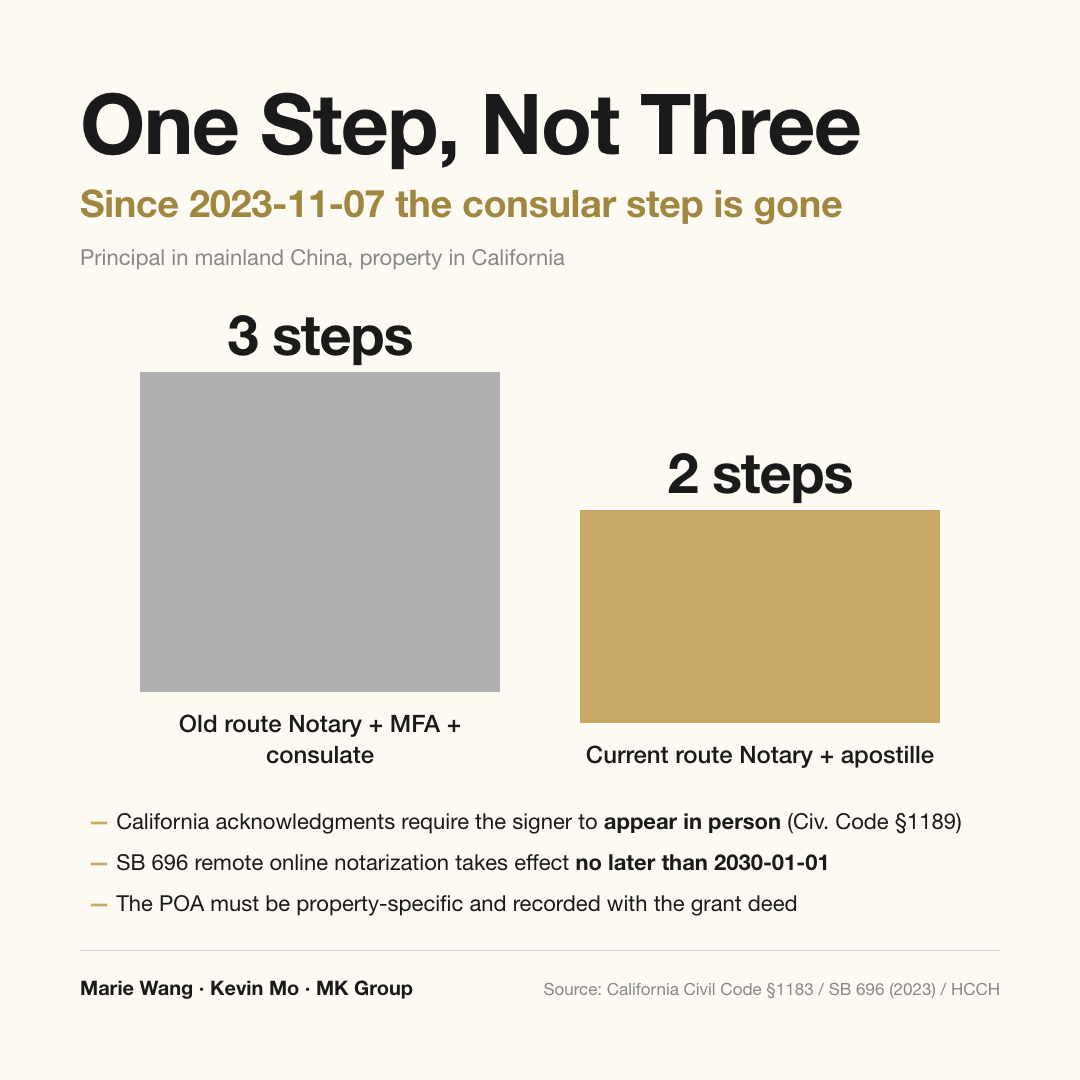
That answer is really three separate facts. First, California's certificate of acknowledgment runs on an in-person standard. The all-purpose acknowledgment form set out in Civil Code §1189 fixes the words "personally appeared," and §1185(a) requires the notary to obtain satisfactory evidence that the signer is the person described in and who signed the instrument. Those two are validity requirements. Government Code §8206 adds a separate layer aimed at the notary rather than the deed: when notarizing an instrument affecting real property — a deed, quitclaim deed, deed of trust — or a power of attorney, the notary must take the signer's right thumbprint in the journal. That is a journal duty, not an element of the deed's validity, but it means a compliant California notary has no way to complete the job with the signer absent. A video call, a shared screen, and a scanned copy satisfy neither "personally appeared" nor the thumbprint. Second, California has in fact legislated remote online notarization. SB 696 (2023) was signed, with provisions phasing in from January 1, 2024 and January 1, 2025 — but the provision that authorizes California notaries to actually perform RON waits on the Secretary of State completing its technology program, subject to a statutory backstop of January 1, 2030, whichever comes first. Checked August 2, 2026, the Secretary of State's notary division has still not opened RON to California notaries. Third, and this is the part most people miss: California never required you to notarize in California. Civil Code §1183 expressly allows an acknowledgment to be taken outside the United States, and when it is taken before a foreign notary, that notary's signature may be authenticated in any one of three ways — by a judge of a court of record in that country, by a U.S. diplomatic or consular officer, or by an apostille issued under the Hague Convention Abolishing the Requirement of Legalisation for Foreign Public Documents. China has applied that Convention since November 7, 2023. For a buyer in mainland China, an apostille and a U.S. consulate notarization are therefore two alternative channels. Pick one. Do not stack them.
Who this article is for
This is written for one very specific buyer: you live in mainland China, your budget starts around $5M, and you are looking at the Peninsula corridor — Palo Alto, Menlo Park, Los Altos, Los Altos Hills, Atherton, Hillsborough. You are not unwilling to make the trip. You simply cannot fly to California repeatedly just to sign your name. The purchase contract, the loan documents, and the final title instruments land at different points across several weeks, and a dedicated flight for each one is not a real plan.
What you want is not general advice on cross-border buying. You want four concrete answers: which steps truly require your physical presence and which are fine with an e-signature; what a power of attorney has to say before a title company and escrow will work with it; whether that document still needs a trip to a U.S. consulate after it clears a Chinese notarial office; and, counting backward from close of escrow, the date this paperwork chain has to start. This piece answers those four under the rules in force as of August 2026. It applies equally to second-generation buyers handling a purchase on behalf of parents or family, and to corporate buyers taking title through a domestic or offshore entity.
Three dimensions that decide what you actually have to do
"Can I buy remotely" invites a one-word answer, yes or no. What actually determines your work plan is three different judgments: which signings carry a hard presence requirement, whether your instrument will clear both the title company and the lender, and which authentication route you take.
One: which steps require you, and which do not
From first showing to recording, the signatures in a Bay Area purchase fall into roughly four groups. Their presence requirements are not remotely alike — and blurring them is exactly where the "I'd have to fly over four times" illusion comes from.
Touring: not required, but worth one trip. No rule anywhere says a buyer must lay eyes on a house before buying it. Above $5M, though, that trip buys more than the tour itself. For a family entering this market for the first time, a concentrated day of showings establishes a baseline — what actually separates a $7M house from a $9M one — and that baseline is hard to build through remote feedback. In competitive off-market deals, a buyer willing to get on a plane is itself a signal sellers read (the field section below has a specific example).
Purchase contract and offer: remote e-signature is fine. California residential purchase agreements (the CAR RPA family) are routinely executed through DocuSign or a comparable platform, with no notarization required. This layer carries no obstacle at all. Time zones are the only practical constraint — the Bay Area rhythm of submitting offers over a weekend and trading counters late Sunday evening lands in the small hours of Monday in China.
Loan documents: split in two, and the lender holds an independent vote. Most disclosures and application materials can be e-signed. But the deed of trust — the instrument that pledges the house to the lender — must be notarized, and it runs on the presence rules described here. So a financed purchase carries one more notarized document and one more timing checkpoint than an all-cash purchase, and that has to be counted separately when you build the schedule backward. For the financing path when you have no U.S. credit or income record, see I Have No U.S. Credit History and No U.S. Income Documents — Can I Still Get a Mortgage on a $5M+ Bay Area Home?
For a remote financed buyer, the binding constraint is usually not the notary rules — it is the lender's POA policy. This is a gate that sits entirely outside California notary law: lenders set their own requirements on whether an attorney-in-fact may sign loan documents at all. The industry benchmark is Fannie Mae Selling Guide B8-5-05, which requires the power of attorney to identify the subject property address, to state expressly that it is for obtaining a loan on that specific property not exceeding a stated amount, to name the lender, and to authorize the attorney-in-fact to sign the required loan documents. Purchases above $5M run on jumbo and non-agency paper, which is not formally bound by that guide — but individual lender POA policies are typically tighter, not looser. Two requirements come up constantly: that the POA language be approved in writing by the lender (or its designated closing department or outside counsel) before it is used, and that an attorney-in-fact may sign the deed of trust but not the note, with the borrower required to sign the note personally, whether by e-signature or wet ink. The controlling answer is your lender's current policy on this specific loan, and it has to be settled during the application, not discovered the week before closing.
That policy carries a sequencing consequence that is easy to miss. Because the POA must name the lender and the loan ceiling, the document cannot be prepared in advance and held in a drawer — the version touching the deed of trust can only be drafted after the lender is locked. So for a remote financed buyer the correct order is: choose the lender first (pre-approval plus a named institution), then have counsel draft the POA. Reverse that and you will likely run the entire cross-border authentication chain twice. All-cash buyers carry none of this, which is a quiet timing advantage in a remote purchase. The roughly $10M-financed Atherton transaction described later in this article turned on exactly this kind of timing gap.
Final title instruments and the closing package: notarization required. On the buyer's side, the usual candidates are the loan-related deed of trust and escrow's final signing package; on the seller's side, the grant deed. These instruments go to the county recorder and must carry a compliant certificate of acknowledgment. If you are not there, an attorney-in-fact signs under the POA.
The one-line version: what constrains you is not "buying a house." It is the handful of documents that must be notarized, plus whether your lender will honor your power of attorney. Those are the two problems to solve — not the whole transaction.
Two: what a POA that title and escrow will accept looks like
California law sets a fairly low bar for the power of attorney itself. Probate Code §4121 provides that a POA is legally sufficient if the principal signs it and it is either acknowledged before a notary public or signed by two qualified witnesses. But "legally sufficient" and "a title company will close on it" are two different standards, and the second is far stricter. In practice, these are the requirements that come up again and again.
Make it specific, not general. Title companies generally want the POA to identify the property (street address and legal description), the specific powers granted (to purchase, to execute a deed of trust, to execute closing documents, to accept title), and the attorney-in-fact by name. A general "full authority over all matters" power of attorney will often be sent back for redrafting. When a loan is involved, add the named lender and loan ceiling described above.
Give it a clear term or termination condition. Two California rules on the durability of authority matter here. Probate Code §4124 provides that a power of attorney is durable only if it contains language such as "this power of attorney is not affected by subsequent incapacity of the principal." Probate Code §4152 provides that the principal's death terminates the attorney-in-fact's authority. In practice: on the closing date, the principal must be alive and must not have revoked. This is not a formality — the title company will confirm it again before closing.
Record it with the grant deed. California law does not compel recording (Government Code §27280 says any instrument affecting the title to or possession of real property may be recorded), but when an attorney-in-fact is conveying, transferring, or encumbering California real property under a POA, most title companies require the POA to be recorded in the county where the property sits, usually submitted together with the grant deed. The reason is direct: recording puts the attorney-in-fact's authority on the day of signing into the public record. Both the San Mateo County and Santa Clara County recorders accept these submissions; format and fees follow each county's current published schedule. One consequence gets overlooked — once the POA is recorded, any later revocation must be recorded in the same county, or the public record continues to show it as live.
Choose your attorney-in-fact carefully — but he does not have to be in California. The attorney-in-fact must be someone you genuinely trust and must be able to appear before a compliant U.S. notary within the closing window. Here sits a very common self-imposed limit: California does not require the signing to happen in California. Civil Code §1182 permits acknowledgments taken outside California but within the United States before a judge, court clerk, notary public, or other authorized officer of that place. Civil Code §1189(b) goes further — a certificate of acknowledgment taken in another place is sufficient in California if it is taken in accordance with the laws of the place where it is taken. So in practice an attorney-in-fact signing before a notary in any U.S. state usually works. The exact form of the certificate still has to be confirmed in advance with the escrow and title company handling your transaction; some title companies specify California's all-purpose acknowledgment wording, which is a file-by-file requirement rather than a general rule. As for who: your agent is generally not an appropriate attorney-in-fact (conflict of interest). If the deal is financed, the lender adds its own restrictions on who may serve — the Fannie Mae benchmark excludes employees of the lender, the loan originator, employees of the title company, the seller, and any real estate agent with a financial interest in the transaction, unless that person is a relative of the borrower. Common choices are a spouse, an adult child, your own attorney, or a family member already in the U.S.
If the buyer is an entity, the logic is entirely different. When title is taken by an LLC, a holding company, or a trust, the signing party is not an individual at all — it is the authorized signatory designated by the entity's governing documents or an authorizing resolution. What the title company wants to see is formation documents, a certificate of good standing, an operating agreement or trust instrument, and a resolution authorizing a named person to sign for this transaction — not an individual power of attorney. The two paths are not substitutes: an individual POA offered against a deed naming an LLC as buyer will not be accepted. On choosing the holding structure itself, see Buying a Multi-Million-Dollar Silicon Valley Home Without Your Name on the Public Record.
Three: the two authentication routes — notarize in China plus apostille, or notarize at a U.S. consulate
This is the layer most worth committing to memory, because it changed fundamentally in November 2023 and a great many guides still describe the old chain.
Route A: notarization at a Chinese notarial office plus an apostille. You take the drafted power of attorney and your identity documents to a notarial office where you reside; a notary completes the notarization and issues a notarial certificate, usually with an English translation attached. You then apply for an apostille from the Department of Consular Affairs of China's Ministry of Foreign Affairs, or from a local foreign affairs office authorized by the Ministry. The Department of Consular Affairs is the competent authority issuing apostilles on the Chinese side, and it has authorized a number of provincial foreign affairs offices — and some municipal offices in cities with districts — to issue them within their jurisdictions. That authorized list has expanded repeatedly since November 2023, so confirm against the current notice on the China Consular Service Network before you go (checked August 2, 2026, for this article). Fees follow the schedule published there: CNY 50 for civil documents and CNY 100 for commercial documents, with an additional CNY 50 for expedited service; where a notarial certificate binds several notarized matters together, the fee is charged per matter. Once that is done, the document's standing in California rests on Civil Code §1183's express listing of the apostille — no consular legalization is needed, and none should be sought.
The most common Route A rejection is not about the apostille — it is about the format of the notarial certificate. A Chinese notarial office issues a 公证书, typically worded as the notary certifying that a named person signed in the notary's presence on a given date, with a bilingual translation attached. What a California title company wants is a certificate of acknowledgment that is substantively consistent with California's formulation — it should be visible on the face of the document that the signer personally appeared, that the notary verified identity, and that the place, date, notary signature, and seal are recorded. The two need not match word for word (§1183 recognizes acknowledgments taken abroad; §1189(b) recognizes certificates conforming to the law of the place taken), but when the wording sits entirely inside the Chinese template and a reviewer cannot find the California elements, rejection is a realistic outcome. The reliable approach: have your California attorney prepare, alongside the body of the POA, a certificate of acknowledgment text that title will accept (in parallel Chinese and English), and send it to escrow and the title company for pre-review together with the POA. Once approved, bring it to the notarial office to be issued with or attached to the notarial certificate. That step adds almost nothing in cost and saves you from running the entire international chain a second time.
Route B: notarial services at a U.S. embassy or consulate in China. A U.S. consular officer takes the acknowledgment directly — also one of the methods Civil Code §1183 lists by name — and because the signing happens in front of a U.S. officer, the document needs no apostille when it returns to California. U.S. notarial services in China are offered at the embassy in Beijing and the consulates general in Shanghai, Guangzhou, Shenyang, and Wuhan, are available to all nationalities, are by appointment only, cost $50 per notarial seal, and require you to bring the complete but unsigned document and sign it on site. The practical constraint on this route is appointment supply — the U.S. Consulate General in Shanghai has announced that appointment availability may be limited due to facility renovation and has suggested Beijing, Guangzhou, Shenyang, or Wuhan as alternatives. Operational notices like this change without warning; this article's status check is August 2, 2026, so confirm the post's own announcements on the day before you travel.
The two routes are alternatives, not a sequence. Which one you take depends on which is closer to your city, which has faster appointment availability, and whether the document needs a bilingual version. Since China began applying the Convention on November 7, 2023, Chinese embassies and consulates in the United States have correspondingly stopped legalizing U.S. documents, replaced by U.S.-issued apostilles. It is the same change viewed from the other side: consular legalization has been retired in both directions.
Timing pressure across the Peninsula cities: why this paperwork chain starts before you bid
The core numbers first. In Q2 2026, Palo Alto and Los Altos each ran a median 8 days on market, Menlo Park and Los Altos Hills 9 days, and even Atherton — the most expensive of the group — just 13 days. Over the same quarter Atherton's median sale price was $10.0M with 64.5% of closings all-cash, while Palo Alto's median was $4.10M with 36.0% all-cash.
| City | Q2 2026 closings | Median sale price | Median days on market | All-cash share |
|---|---|---|---|---|
| Atherton | 31 | $10,000,000 | 13 days | 64.5% |
| Los Altos Hills | 32 | $5,725,000 | 9 days | 34.4% |
| Los Altos | 97 | $4,920,000 | 8 days | 34.0% |
| Palo Alto | 139 | $4,100,000 | 8 days | 36.0% |
| Menlo Park | 94 | $3,793,500 | 9 days | 34.0% |
What to hold onto: 8 to 13 days is the time from listing to going into contract. It is not the time you have to prepare documents. Your authorization chain is a serial pipeline running through the agencies of two countries — drafting and pre-review, notarization in China, apostille, international courier of the originals, title company review, recording alongside the grant deed — and not one link speeds up because you happened to fall in love with a house. So the right moment to start is not after your offer is accepted. It is before you begin bidding seriously. The other source of pressure is capital structure: with more than six in ten Atherton closings all-cash, your competition can very likely offer a 7- to 10-day close. If you also need two extra weeks to produce a power of attorney, that disadvantage goes straight onto the calendar.
Counting backward from close of escrow, the cross-border document chain generally needs 5 to 7 weeks of runway. Only two segments have observable, conventional ranges — international courier of originals (3 to 7 calendar days) and title company review (3 to 5 business days). The notarial office and apostille segments run on the receiving agency's own timelines. And if the purchase is financed, the earliest box is not counsel's drafting — it is locking the lender and obtaining its written approval of the POA language.
| Backward anchor | What has to be done | Suggested runway |
|---|---|---|
| Close of escrow | Record the grant deed and the POA in the county recorder's office; confirm the principal is living and has not revoked | Same day |
| 3–5 business days before COE | Title company and escrow review the original POA, the apostille, and the attorney-in-fact's identification | 3–5 business days |
| 1–2 weeks before COE | Original documents arrive in California by international courier (title companies generally require originals, not scans) | 3–7 calendar days, per the carrier's published transit times |
| 2–4 weeks before COE | Apostille issued by the Department of Consular Affairs or an authorized local foreign affairs office; or U.S. consulate notarial appointment instead | Per the receiving agency's current published timelines |
| 3–5 weeks before COE | Notarial certificate issued by a notarial office where you reside (appear in person, bring identification, include translation and acknowledgment certificate text) | Per the notarial office's current published timelines |
| Before bidding | California-licensed real estate counsel drafts the POA and the acknowledgment certificate text; escrow and title pre-review the wording | 1–2 weeks |
| Before bidding, one box earlier if financed | Lock the lender (the POA must name it and state the loan ceiling), obtain written approval of the POA language, and confirm whether the lender will accept an attorney-in-fact signing the note | Per the lender's current policy |
What to hold onto: in the "suggested runway" column, only the courier and title review segments are observable conventional ranges. The notarization and apostille segments run on the receiving agency's clock, vary noticeably by city, and must be checked against the current published timelines of the notarial office and foreign affairs office where you live — this article makes no blanket promise. The two rows you actually control are the last two, and they are the ones most often skipped. If the POA language never passes a three-way pre-review by escrow, the title company, and the lender, the cost of a rejection at the end of the chain is running every step above a second time.
Sources: MLSListings (aggregated via MK Bay Area Pulse 2026 Q2) / California Civil Code §1182, §1183, §1185, §1189 / California Government Code §8206, §27280 / California Probate Code §4121, §4124, §4152 / California SB 696 (2023) and California Secretary of State notary division notices / HCCH Convention status table / China Consular Service Network (Department of Consular Affairs, Ministry of Foreign Affairs) apostille instructions and fee schedule / U.S. Mission China notarial services pages / Fannie Mae Selling Guide B8-5-05 (power of attorney requirements, cited as an industry benchmark; jumbo and non-agency loans are not bound by it and the lender's current policy controls)
Updated: August 2026 (statutory status checked August 2, 2026)
Scope: $5M+ residential purchases on the Bay Area Peninsula and South Bay; principal in mainland China, attorney-in-fact signing within the United States
This article is for decision-making education and is not legal or tax advice.
What we see in the field
Start with the touring step. In a cross-border introduction in November 2025, a Shenzhen entrepreneur's family reached Marie Wang on a morning and asked to see homes that same day. Within half an hour Marie Wang had pulled four candidates worth their time from MLS and off-market inventory, spanning four representative communities — Menlo Park, Palo Alto, Los Altos Hills, and Los Altos — and deliberately sequenced the tour from the lowest price to the highest. By the end of the half day, the client had moved from unfamiliar with the Silicon Valley luxury market to able to articulate precisely what separated the $7M house from the $9M one: lot, year of renovation, ADU and guest house, depth of the rear yard. No offer was written that day. But the baseline established on that trip is the precondition for every remote decision that follows. It is the advice we give remote buyers consistently: the touring trip is worth making, and you do not have to make a second one just to sign. (Case detail: Shenzhen entrepreneur half-day luxury tour)
The second observation comes from an Atherton off-market purchase in May 2026, with MK Group's two founders, Marie Wang (DRE# 02110980) and Kevin Mo (DRE# 02127623), acting as the buyer's agents. The buyer was in China and first fell for the house sight-unseen, deciding to write an offer on the strength of the team's detailed on-site feedback — the property had not yet hit the market and a line of showings was already forming. The seller declined at first: a buyer who had never seen the house, carrying roughly $10M of financing, when the seller was not short of all-cash bidders. So the buyer canceled a planned trip to Japan and Korea, booked the first flight the next morning, and flew in specifically to see the house — an act that became one of the turning points in the seller's reassessment of the buyer's seriousness. The transaction closed at $18M. It also illustrates the reality of the timeline: roughly $10M of financing required two bank appraisals and a 30- to 35-day cycle, against the 7- to 10-day certainty an all-cash buyer offers. That certainty gap is what a remote buyer is fighting — and if the financing also depends on an attorney-in-fact signing, the lender's review of the POA has to move even earlier in the sequence. (Case detail: Atherton $18M off-market purchase)
The third observation is about settling structure before chasing speed. In a roughly $11M all-cash Los Altos Hills purchase, also in May 2026, the buyer came in through a corporate entity. Rather than push the client toward an aggressively short close, the team first settled the title structure, the capital pathway, and the document coordination, and only then moved the transaction forward — who buys, how the money travels, how it will be held later, all placed ahead of closing speed. The deal ultimately locked all-cash in two weeks (case detail: Los Altos Hills ~$11M all-cash purchase). In a separate luxury acquisition completed through a newly formed LLC held via a BVI entity, MK Group's read was the same: the holding structure has to be settled before the offer goes in, because the moment an LLC appears on the offer, the bank, escrow, and title company simultaneously demand a full set of documents, signing authority, and an explanation of the capital pathway — and assembling that on the fly is the most reliable way to slow a deal down (case detail: luxury purchase through a newly formed BVI-held LLC). Both transactions point at one conclusion. For a remote buyer, "who signs" and "in whose name" are two questions on the same calendar, and both have to be answered.
Common mistakes
Mistake 1: "A WeChat video witness or an e-signature is basically the same as getting it notarized."
It is not, and the two halves of that sentence deserve separate answers. E-signature genuinely works at the contract layer — California purchase agreements, disclosures, and a great deal of loan application material all run through e-signature platforms, with no obstacle. But instruments headed for the county recorder need a certificate of acknowledgment, and California acknowledgments carry two validity requirements: Civil Code §1189's all-purpose form fixes the words "personally appeared," and §1185(a) requires the notary to obtain satisfactory evidence of the signer's identity. There is also a separate practice duty on the notary — Government Code §8206 requires the notary to take the signer's right thumbprint in the journal when notarizing instruments affecting real property and powers of attorney. That is a journal obligation, not an element of the acknowledgment's validity (a missing thumbprint does not by itself void the deed), but its practical effect is just as hard: a California notary in compliance simply cannot complete the job with the signer absent. A video call satisfies neither "personally appeared" nor the thumbprint. As for remote online notarization, California did legislate it — SB 696 (2023) is signed, with provisions phasing in from January 1, 2024 and January 1, 2025 — but the provision authorizing California notaries to perform RON waits on the Secretary of State's technology program, with a statutory backstop of January 1, 2030; checked August 2, 2026, the Secretary of State's notary division has not opened it. One workaround deserves a caution: some people suggest using a notary in another state that has fully opened RON. Whether your transaction's title company and lender will accept that is a file-by-file judgment and must be confirmed in writing in advance. Do not assume it works.
Mistake 2: "After the apostille, I still have to make a trip to the U.S. consulate for legalization."
You do not, and this is the single most common wasted detour. The process changed fundamentally on November 7, 2023: from that date China applies the Hague Convention Abolishing the Requirement of Legalisation for Foreign Public Documents, and the old two-step chain of "notarization plus Ministry of Foreign Affairs authentication plus consular legalization" was replaced by the one-step "notarization plus apostille." The California side states its basis plainly — Civil Code §1183 lists the apostille alongside authentication by a U.S. diplomatic or consular officer and authentication by a judge of a court of record in that country as three alternative methods. Alternatives, not a stack. In other words: take the apostille route and you need no U.S. consulate; notarize at the U.S. consulate and you need no apostille afterward. The other half of the same change is that Chinese embassies and consulates in the United States have likewise stopped legalizing U.S. documents, replaced by U.S.-issued apostilles. If the guide in front of you still says "then send it to the U.S. consulate for legalization," it predates November 2023, and following it will cost you weeks. One caveat: not every country is a party to the Convention, so if your document is issued somewhere other than mainland China, confirm which route applies there first.
Mistake 3: "I'll get one general power of attorney done now and use it whenever."
That fails on three levels. First, content: title companies generally require the POA to be property-specific — naming the property, the specific powers, and the attorney-in-fact. A blanket "full authority over all matters" instrument is likely to be sent back before closing, at a point when you no longer have time to run the international chain again. If the deal is financed the position is starker still: under industry benchmarks such as Fannie Mae Selling Guide B8-5-05, the POA must name the lender and state the loan ceiling, which means it cannot be finalized until the lender is chosen. "Prepare it in advance" is simply not available in a financed purchase. Second, duration: Probate Code §4152 provides that the principal's death terminates the attorney-in-fact's authority, and §4124 provides that the power is durable only if it contains language such as "not affected by subsequent incapacity of the principal." The title company will re-confirm before closing that the principal is living and has not revoked, and that step is not a formality. Third, recording: when the POA will be used to convey California real property, most title companies require it to be recorded in the county where the property sits, typically submitted with the grant deed (Government Code §27280 permits recording any instrument affecting title to real property) — and once recorded, a later revocation must also be recorded in the same county, or the public record still shows it as live. The right practice is one property-specific POA per transaction, with its status handled deliberately after closing. Do not expect a single document to cover everything.
Mistake 4: "My attorney-in-fact has to be in California to sign for a California house."
That limit is self-imposed and does not exist. California requires a compliant acknowledgment at signing; it does not require the act to occur inside California. Civil Code §1182 expressly permits an acknowledgment taken outside California but within the United States before a local judge, court clerk, notary public, or other authorized officer. Civil Code §1189(b) adds that a certificate of acknowledgment taken in another place is sufficient in California if it is taken in accordance with the laws of that place. So an attorney-in-fact living in New York, Seattle, or Texas can generally sign before a local notary, with no need to fly to the Bay Area to put pen to paper. Two more specific things do need confirming. One is the format of the certificate — some title companies specify California's all-purpose acknowledgment wording, a file-by-file requirement you should get in writing from escrow and the title company before signing. The other is the lender's restrictions on who may serve: under the Fannie Mae benchmark, employees of the lender, the loan originator, employees of the title company, the seller, and any real estate agent with a financial interest in the transaction cannot serve as attorney-in-fact unless they are relatives of the borrower. Settle those two in advance and your attorney-in-fact's home state stops being a question at all.
Mistake 5: "If the buyer is a company or a trust, a personal power of attorney from the principal is enough."
This is where entity buyers most often go wrong. When the offer names an LLC, a holding company, or a trust as buyer, signing authority comes from the entity's own governing documents, not from any individual power of attorney. What the title company and escrow want to see is formation documents, a certificate of good standing, an operating agreement or trust instrument, and a resolution identifying who may sign this transaction's documents on the entity's behalf. When the structure sits under an offshore parent — held through a BVI entity, for instance — the authority chain runs one level higher and gets longer, and bank account opening and the diligence on funds entering escrow proceed in parallel. All of this is triggered the moment the entity's name goes on the offer; it is not something to assemble the week before closing. And if the entity's authorized signatory is also abroad and unable to appear, what you need is the full chain — entity resolution, plus a property-specific POA from that authorized signatory, plus authentication — one layer more than an individual buyer, with the schedule extended accordingly. The choice of holding structure itself pulls on privacy, liability, and tax, which is a separate subject; see Buying a Multi-Million-Dollar Silicon Valley Home Without Your Name on the Public Record.
Next steps
- First, count how many documents in your transaction actually require notarization. In an all-cash purchase, the buyer's side is usually a handful of items in escrow's final signing package; a financed purchase adds a deed of trust. Ask escrow for the list once, and in the same round put three questions to the lender: will you accept an attorney-in-fact signing under a POA, does the POA language need your written approval first, and must the borrower personally sign the note? You will find the list far shorter than you feared — but skipping the lender layer is the most expensive omission of the three.
- Before you start bidding seriously, have California-licensed real estate counsel draft the POA and send it to escrow and the title company for pre-review. Have counsel prepare, at the same time, a certificate of acknowledgment text that title will accept, in parallel Chinese and English, and submit it for pre-review with the POA. That certificate is the most common rejection point on Route A, because a Chinese notarial office's 公证书 format does not naturally contain the California elements. This is the only link in the whole chain fully under your control; clear pre-review first, and your trip to the notarial office is not wasted.
- Choose your attorney-in-fact, and confirm he can appear before a compliant U.S. notary within the closing window. He does not have to be in California — acknowledgments taken in other states are broadly accepted here (Civil Code §1182, §1189(b)) — but the exact certificate format still needs advance confirmation from escrow and the title company. Prefer a spouse, an adult child, your own attorney, or a family member already in the U.S.; avoid anyone with an interest in the transaction, and on a financed purchase, check the lender's list of excluded parties.
- Build your own backward schedule against the current published timelines of your city's notarial office and foreign affairs office. Apostilles are issued by the Department of Consular Affairs or an authorized local foreign affairs office; check the current list of authorized offices on the China Consular Service Network. Fees follow the published schedule: CNY 50 for civil documents, CNY 100 for commercial, plus CNY 50 for expedited service. If a U.S. embassy or consulate is closer or has faster appointments, the consular notarization route is an equally valid substitute ($50 per seal, appointment only, bring the unsigned document and sign on site). Take one route, not both.
- If the buyer is an entity, treat the authorizing resolution and the individual POA as two parallel tasks. At the same time, assemble the capital pathway — which entity, which account funds the purchase, who has authority to move it, and how each cross-border hop is documented — because the bank, escrow, and the title company will all ask for it. An entity or trust buying all-cash may also trigger beneficial ownership reporting; see I'm Buying a Bay Area Home All-Cash Through an LLC or a Trust — Do I Have to Report My Beneficial Owners to FinCEN as of March 2026?
The statutory positions cited here are current as of the August 2, 2026 review date. California's remote online notarization commencement, the agencies and timelines for apostilles, individual county recorder and title company formatting requirements for powers of attorney, and lender POA approval policies are all subject to change. The Fannie Mae Selling Guide provision cited here serves only as an industry benchmark; jumbo and non-agency loans are not bound by it. Drafting and executing a power of attorney should be confirmed with California-licensed real estate counsel, with written sign-off obtained from the title company, escrow, and lender handling your transaction before signing. Where entity or trust ownership and cross-border funding are involved, review each item with a CPA and cross-border tax counsel as well.
Further reading: Buying a Multi-Million-Dollar Silicon Valley Home Without Your Name on the Public Record, I Have No U.S. Credit History and No U.S. Income Documents — Can I Still Get a Mortgage on a $5M+ Bay Area Home?, A Non-Resident Foreign National Bought a $5M+ Bay Area Home — Does the Estate Owe 40% U.S. Estate Tax?