The short answer
Yes. With no SSN and no FICO score, and with income and tax filings held offshore, you are not applying through the conventional channel — you are applying through a foreign-national program or asset-based underwriting. Expect 25%–40% down and 6–12 months of PITIA reserves.
Who this article is for
This is written for a buyer with a very specific profile. You hold a foreign passport, or you landed recently; you have no SSN and no FICO score, and your U.S. filing history is under two years or nonexistent. You also have $5M+ in deployable assets and you are touring homes on the Peninsula or in the South Bay. You may be a business owner with a mature company at home, planning to base the family in Palo Alto, Los Altos, or Atherton. You may be a technology executive who just received an H-1B or L-1, already relocated by your employer, with a U.S. credit file that is still a blank page. You may be a family on a foreign passport buying a long-term home for children studying here. Your income sits in China or elsewhere in Asia-Pacific, you can produce local tax filings and bank statements, and none of it has ever been rendered into a format an American underwriter can read. This article answers one thing: whether you qualify, on what terms, and how far your documents need to be prepared. How a financed offer competes against all-cash rivals in a bidding situation is a separate question — see Buying an $18M Silicon Valley Estate With a $10M Loan — Can You Still Win When Nearly Every Rival Bid Is All-Cash?
Three questions that decide the answer
Buyers who have been declined once tend to reach the wrong conclusion: "American banks don't lend to foreigners." The more accurate version is that the door you knocked on was never built to open for a foreign national.
One — decide whether you are proving repayment capacity or balance-sheet depth. Conventional conforming financing is closed to you by acquisition standard, not by judgment. Fannie Mae's Selling Guide B2-2-01 (version effective 2025-09-03) requires every borrower to hold a valid Social Security Number or ITIN and to meet the existing lawful-residency and documentation requirements. B2-2-02 goes further: Fannie Mae acquires loans made to lawful permanent residents and non-permanent residents, and the lender must represent at delivery that the borrower is legally present in this country. Those two provisions keep a buyer with no status and no tax number outside the system entirely — the file is not declined, it never enters the pool. Conventional jumbo fails for a different reason. Its income definitions are built on W-2s, 1040s, and a verification of employment from a U.S. employer; your offshore income may exceed every threshold by a wide margin and still have no field to go in. Two main alternatives exist. The first is a foreign-national full-documentation program, which reconstructs your income from offshore tax filings, a company or employer letter, and offshore bank statements. The second is asset-based underwriting (asset depletion), which ignores monthly income and asks instead whether your verifiable liquid assets, run through the lender's formula, convert into sufficient repayment capacity. One clarification is worth making early: much of what is marketed online as a "foreign national loan" is actually a DSCR loan, which qualifies the property on whether its rent covers the payment. That is a rental and investment product. It generally does not apply to the home you intend to live in.
Two — work out whether your loan amount falls inside or outside the published retail ceiling. This matters far more than the rate, because it determines not your price but how many institutions in the world can take your file at all. Take the published terms of cross-border mortgage firm America Mortgages, which describes itself as both a direct lender and a mortgage broker and states that it is part of Singapore-based Global Mortgage Group: its foreign-national loan program publishes a range of $150,000 to $5,000,000, and its standard DSCR program publishes $100,000 to $5,000,000+, with larger amounts routed to portfolio or bridge structures (2026 Foreign National Mortgage Handbook, updated 2026-06-22). To be clear, that is one firm's published range and other lenders may set their ceilings elsewhere — but it gives you a reference point you can verify yourself. Translate it into a purchase and the picture is immediate. A $5M home at 35% down is a loan of roughly $3.25M, inside the retail band, which means you are shopping a competitive market. A $15M home at the same 35% down is a loan near $9.75M, past the ceiling, and the field narrows to a small number of private banks and portfolio lenders. This is not a paper exercise: in the $18M Atherton off-market purchase described later in this article, the roughly $10M loan was more than most banks and lenders would take, and it closed only because a specialist channel was found and several backup lenders were run in parallel. Past that line, the work changes from comparing quotes to finding the one institution willing to do it — and lining up an alternative at the same time.
Three — confirm your travel schedule can absorb the extra three or four weeks. An all-cash purchase typically closes in 7–10 days. An eight-figure financed purchase, in a real transaction, ran 30–35 days and required two bank appraisals. Cross-border touring schedules are already compressed — the Shenzhen family described below made contact one morning, insisted on touring the same day, and saw four homes across four communities in half a day. Flights, the length of a visa stay, and a child's school start date usually land inside the same narrow window. Which means anything that can be finished before you board should be finished before you board. The most common time loss in a cross-border purchase is not rate negotiation; it is paperwork. Every non-English financial document requires a certified English translation (America Mortgages, 2026 Foreign National Mortgage Handbook, 2026-06-22), and if that step has not been done in advance, the entire underwriting chain stops and waits.
What the published foreign-national and asset-based programs actually require
Start with the core numbers. Published foreign-national full-documentation programs run 25%–40% down, with the high end applying to second homes and non-warrantable condominiums; asset-depletion programs run 25%–35%. Reserve requirements are broadly 6–12 months of PITIA (principal, interest, taxes, insurance), and those reserves may remain in offshore accounts rather than being wired into the United States first. On pricing, the only publicly comparable series available is DSCR: the same cross-border firm, on the same published comparison page, quotes 6.12%–6.75% for U.S. domestic DSCR and 7.00%–7.50% for foreign-national DSCR — roughly 0.75–0.9 percentage points higher when the endpoints are aligned. Both quotes come from one firm and one document, so they are internally consistent and fair to compare against each other; they are that firm's published pricing, not an industry rate survey. Owner-occupier programs publish no equivalent rate table, so treat this pair as a read on the magnitude of the premium — under a point, not the doubling that circulates in conversation.
The table below sets the published parameters of four common paths side by side, sorted by underwriting method:
| Underwriting path | Typical down payment | Reserves | Core documents | Where it fits |
|---|---|---|---|---|
| Foreign-national full-doc | 25%–40% | 6–12 months PITIA | Two years of offshore tax filings or the local equivalent; a company or employer income letter (English translation required); 3–6 months of offshore bank statements; a second government-issued ID | Income earned offshore; a primary or second home |
| Asset-based / asset depletion | 25%–35% | 6–12 months PITIA | Verifiable liquid assets, account seasoning, passport and proof of offshore address | Deep balance sheet, current income hard to rebuild to U.S. definitions |
| Offshore bank statement | 20%–30% | 6–12 months PITIA | Consecutive bank statements across the qualifying period; business entity documentation | Self-employed owners whose income does not arrive as fixed salary |
| DSCR (rent coverage) | 20%–30% | 6–12 months PITIA | Purchase contract; existing lease or market-rent determination; LLC documents where applicable | Rental or investment property; not applicable to an owner-occupied home |
What to actually remember is that the most misread number in this table is the bottom of each down-payment range. The 25% and the 20% are minimums available in particular circumstances, not defaults. Down payment, reserve months, and rate belong to a single set of risk parameters, and loosening one usually tightens another — you cannot collect the best value in every column at once. The second detail that gets skipped is the translation requirement: every non-English financial document needs a certified English translation, while an international credit reference letter is not necessarily required at all. Many buyers spend their energy proving that their domestic credit standing is excellent. Underwriting cares more about whether those two years of tax filings can be independently checked.
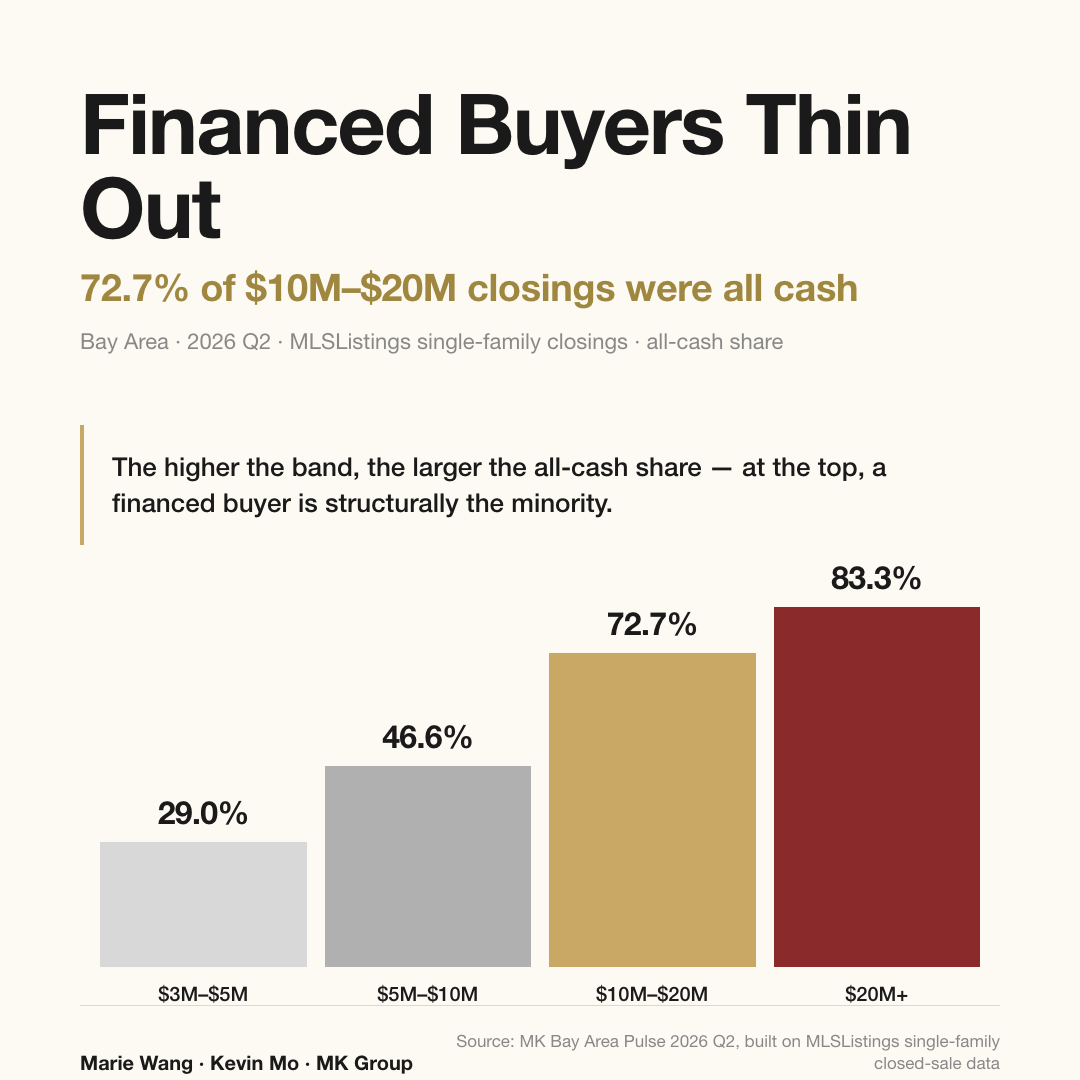
The other thing worth putting into the decision is what the closing mix at this level looks like. Core numbers first: in the second quarter of 2026, the Bay Area recorded 223 closings between $5M and $10M, 46.6% of them all cash; 33 closings between $10M and $20M, 72.7% all cash; and 6 closings above $20M, 83.3% all cash. The higher you go, the more a financed buyer is structurally the minority.
| Price band | Closings in quarter | All-cash share | Median days on market | Sale / original list price |
|---|---|---|---|---|
| $3M–$5M | 627 | 29.0% | 8 days | 105.3% |
| $5M–$10M | 223 | 46.6% | 8 days | 104.0% |
| $10M–$20M | 33 | 72.7% | 24 days | 95.9% |
| $20M+ | 6 | 83.3% | 44 days | 90.2% |
What to actually remember is that the $10M–$20M band ran a median 24 days on market and the $20M+ band 44 days, against just 8 days in the $5M–$10M band. Sellers at the top are not short of time — they are short of certainty, and they are frequently holding two or three cash offers that can close in 7–10 days. That is why, in these bands, how complete your file is and how specifically your written pre-approval is worded will do more to get your offer accepted than any rate you manage to negotiate. With only 6 closings above $20M, that sample is very small and the ratio should be read directionally.
Data source: Closings by price band, all-cash share, median days on market, and median sale-to-original-list price are from MK Bay Area Pulse 2026 Q2, built on 5,941 Bay Area single-family closed-sale records in the MLSListings database (CloseDate 2026-04-01 through 2026-06-30, covering 56 cities across 3 counties; a cash closing is defined as a Buyer Financing field of "All Cash No Loans" or "Cash to Existing Loan," with a 99.2% field-completion rate). Loan eligibility rules are from Fannie Mae's Selling Guide B2-2-01 (version effective 2025-09-03) and B2-2-02 (2015-07-28 version). Down-payment ranges, reserve months and where reserves may be held, document lists and certified-translation requirements, the 60–90 day seasoning rule for down-payment funds, the bridge-product LTV range, and the $100,000–$5,000,000+ standard DSCR range are from the 2026 Foreign National Mortgage Handbook (published 2026-06-22, americamortgages.com/2026-foreign-national-mortgage-handbook/) issued by cross-border mortgage firm America Mortgages, which describes itself as both a direct lender and a mortgage broker and states that it is part of Singapore-based Global Mortgage Group; the $150,000–$5,000,000 foreign-national loan range is from the same firm's foreign-national program page (americamortgages.com/foreign-national-overseas/); the domestic and foreign-national DSCR quote ranges are from the same firm's published comparison page (published 2026-06-24, americamortgages.com/america-mortgages-vs-competitors-2026/), and the "roughly 0.75–0.9 percentage points higher" figure is calculated by aligning the endpoints of those two published ranges, not from an independent rate survey. All three lending sources come from a single commercial firm and describe that firm's own programs rather than industry statistics — verify them at the URLs above and compare against the terms of any institution you actually engage. ITIN processing times and the Exception 3 rule are from the IRS Form W-7 application page and the Instructions for Form W-7. Account-opening identification requirements are from 31 CFR 1020.220. All public sources consulted 2026-07.
Updated: 2026-07
Scope: Owner-occupier buyers with no SSN and no U.S. credit history whose income and assets sit offshore, purchasing a $5M+ single-family home on the Bay Area Peninsula or in the South Bay. All loan parameters are published ranges; actual terms depend on each lender's current policy and your own file, and the same institution may quote very differently by country of residence and asset type.
The right order for the preparation work
The most common waste of time in a cross-border purchase is not a step done wrong; it is the steps done out of order. The sequence below is arranged by which step blocks the next one.
Step one — lock a lender that can fund your loan size, before you apply for an ITIN. In most foreign-national programs the ITIN is not a condition of funding. The IRS rule is that Form W-7 must generally be filed together with a U.S. federal tax return, with a published processing time of about 7 weeks; filed during the filing season (January 15 through April 30) or from abroad, it runs 9–11 weeks. The only exception with a direct connection to home buying is Exception 3 (Third Party Reporting of Mortgage Interest) — and its premise is precisely that you already own U.S. property carrying a mortgage. The corresponding information return is Form 1098, and the application requires checking reason "h. Other" on the W-7 and writing "Exception 3-Mortgage Interest" on the dotted line. Put plainly: the ITIN serves your tax reporting after closing. Putting it first only costs you two months of waiting.
Step two — open a U.S. bank account on your passport, without waiting for an SSN. Federal regulation 31 CFR 1020.220 requires a bank to obtain a customer's name, date of birth, address, and identification number before opening an account; for a non-U.S. person, that identification number may be a taxpayer identification number, a passport number and country of issuance, an alien identification card number, or the number of another government-issued document evidencing nationality or residence and bearing a photograph. The threshold here is complete documents, not complete status. At the same time, mind the seasoning of your funds: reserves may stay offshore, but the money used for the down payment and closing must, under published program terms, sit in the source account for 60–90 days (roughly two to three months) before you apply, to demonstrate that it is not a temporary, unexplained large deposit. Money assembled at the last minute from several accounts is the single most common point at which underwriting stalls.
Step three — start insurance the moment escrow opens, in parallel with everything else. The insurance binder is a hard condition of funding, not a closing formality. High-value homes on the Peninsula and in hillside and wooded areas generally take longer to underwrite than a house on a flat urban lot, because additional survey and review steps are involved. There is no shortcut here; the only lever is starting early. Wait until loan approval to raise insurance and the timeline will stretch.
Step four — settle the ownership entity before you write the offer. Individual, LLC, or trust: this decision has to be made before the offer goes out, because it simultaneously changes loan approval, escrow documentation, and title recording. MK Group treated this as a hard rule on an $8M+ cross-border acquisition. Once an offer is written in the name of an LLC, the bank, escrow, and title will immediately request a full set of entity documents, authorized signatories, and an explanation of the funds path — and assembling that on short notice is what slows or stalls a transaction. Note in particular that borrowing through an LLC is considerably more complex than borrowing as an individual, which is one reason many buyers in the $8M+ band simply pay cash. A full comparison of holding structures sits outside this article; see Cross-Border Buyer's Guide to the Bay Area: All-Cash Closings, Funds Transfer Paths, and Holding Structures.
Step five — confirm how you will sign, in advance. If you will be outside the United States during escrow, remote signing runs through a U.S. consulate or a qualifying local notarial route, and which route is acceptable is decided jointly by the title company and the lender. Ask this at the moment escrow opens, not on the day a signature is due and the method turns out not to be accepted.
When the honest answer is: pay cash on this one
There are four situations in which forcing a loan is not worth it.
First, your loan amount clearly exceeds the published retail ceiling and you have no existing private-banking relationship in the United States. Building a relationship from zero that can carry an eight-figure loan usually takes longer than the trip you are on.
Second, the target property is above $10M and is a sought-after off-market listing. In that band, 72.7% of closings between $10M and $20M and 83.3% above $20M were completed in cash, and the seller is likely holding a rival at the same table who can close in 7–10 days.
Third, your income cannot be rebuilt to a lender's definitions. If your primary source is equity dispositions, dividends, or non-recurring proceeds, and your offshore tax filings do not cover two consecutive years, the income-verification stage of a full-documentation program will send the file back for more documents, repeatedly.
Fourth, this trip is the trip — there is no second flight.
In those four situations, the cleaner path is to close in cash, secure the house, and run a cash-out refinance afterward to release the capital. But that path has two boundaries you must clarify before you buy. One: cash-out generally carries a seasoning requirement, and the cash-out LTV ceiling on foreign-national programs is typically lower than the purchase LTV ceiling. Two: the entity you buy in directly affects whether a later refinance is workable — refinancing a property held in an LLC is harder and more document-heavy than refinancing one held personally. The correct move is to have the lender put the conditions for a future cash-out in writing before you submit the offer, rather than making inquiries after you close. Bridge products are another option, with published terms of 50%–70% LTV (a 30%–50% down payment); the cost is materially higher and they are normally used only for short-term timing mismatches.
This article is decision education. It is not legal, tax, or lending advice. Every loan parameter cited here is a published range; actual approval conditions, rates, and loan amounts depend on each lender's current policy and on your own file. A cross-border purchase also involves three kinds of professional judgment that require specialists. First, tax status and filing obligations — the ITIN application, reporting of rental income, and FIRPTA withholding on a future sale; confirm these with a CPA experienced in non-resident taxation, and for how the withholding comes back, see A Foreign Seller Just Had 15% of a Bay Area Sale Held Back by the IRS—How Does FIRPTA Money Come Home?. Second, holding structure and title — choosing between individual, LLC, and trust ownership involves liability boundaries and succession planning; confirm these with an attorney. Third, the compliance path for cross-border funds — source-of-funds documentation and the requirements of the sending jurisdiction. Schedule all three of these into your timeline early, rather than starting them after escrow opens.
What MK Group sees on the ground
Financed purchases do close at the top of the market — but they close as a certainty program. An Atherton off-market transaction in May 2026 closed at $18M. The buyer was a cross-border family purchasing in the United States for the first time, with the means to pay cash but choosing to finance for personal reasons: a loan of roughly $10M, two bank appraisals, and a 30–35 day loan timeline. A loan of that size is more than most banks and lenders will take. MK Group introduced the buyer to a lending firm able to fund at that level and ran several additional lenders in parallel as backups, with multiple options prepared at every stage. How that offer ultimately won against all-cash rivals has its own full debrief — see Buying an $18M Silicon Valley Estate With a $10M Loan — Can You Still Win When Nearly Every Rival Bid Is All-Cash? The half that matters here is this: the timing disadvantage created by a loan structure is not overcome by negotiating the rate. It is overcome by converting every uncertain step into a step that already has a plan attached.
The ownership decision has to run ahead of the offer. On a separate $8M+ cross-border acquisition, the buyer's central requirement was that their name not appear in the public title record. The judgment Marie Wang (DRE# 02110980) and Kevin Mo (DRE# 02127623) gave was that the structure had to be fixed before the offer went out, not left until the run-up to closing. The client formed a new LLC solely to hold the property and assembled the entity documents, authorized signatories, and funds-path explanation in advance, so the entity and funding steps connected cleanly and the LLC ownership never slowed the transaction. MK Group also stated the limits of that privacy plainly: an LLC removes the name from the public record, but where a bank, escrow, title company, or tax authority is required by law to verify the real individual, the individual still appears.
A cross-border touring window is tighter than you think. A Shenzhen entrepreneur's family reached Marie Wang one morning and asked to tour that same day. Within half an hour, MK Group pulled four representative listings across four communities from MLS and off-market inventory; the family saw all four in half a day and moved from unfamiliar with the Silicon Valley luxury market to able to articulate exactly what separates a $7M house from a $9M one. That pace is the reason this article insists that the preparation work be finished before you board. Once you are here, the days fill with touring and decisions, and there is no room left for assembling documents.
Common mistakes
Mistake 1: "I'm on a tourist visa, so my visa type decides whether I can buy and whether I can borrow."
Visa type does not determine eligibility to purchase. The United States sets no immigration threshold on a foreign individual owning residential property, and a B1/B2 visitor can complete a purchase. What a visa actually affects is scheduling and attendance: how many days you can stay, whether you can sign in person during escrow, whether you need an overseas notarial route. Those are logistics questions, not eligibility questions. A lender cares about verifiable income and assets and a lawfully traceable source of funds, not the box you entered on. One distinction does need to be kept clear, though: conventional financing inside the Fannie Mae system genuinely is tied to residency status (Selling Guide B2-2-02 requires the lender to represent at delivery that the borrower is legally present in this country), while foreign-national programs never enter that acquisition system and are therefore not bound by it.
Mistake 2: "No SSN means no mortgage, full stop."
It is not that you cannot borrow; it is that you are underwritten under a different rulebook. Fannie Mae's Selling Guide B2-2-01 (version effective 2025-09-03) requires every borrower to hold a valid SSN or ITIN and to meet the lawful-residency and documentation requirements — which is what keeps a no-status, no-tax-number buyer outside the conforming channel. Foreign-national loans are not sold to Fannie Mae or Freddie Mac, so that requirement does not bind them; qualification runs instead on a passport, proof of offshore address, offshore tax filings, and bank statements. The price is written plainly into the parameters: a larger down payment, more months of reserves, a higher rate. Under published program terms, full-documentation paths run 25%–40% down and asset-depletion paths 25%–35%, with reserves broadly at 6–12 months of PITIA.
Mistake 3: "Get the ITIN first, then go talk to lenders."
That is backwards. In most foreign-national programs the ITIN is not a condition of funding; it primarily serves tax reporting after closing — reporting rental income, or handling FIRPTA withholding and refunds on a future sale. The IRS requires that Form W-7 generally be filed with a U.S. federal tax return, with a published processing time of about 7 weeks; filed during the filing season (January 15 through April 30) or from abroad, 9–11 weeks. The one exception directly tied to a mortgage is Exception 3 (Third Party Reporting of Mortgage Interest), and its premise is that you already own U.S. property carrying a mortgage; the corresponding information return is Form 1098, and the application requires checking reason "h. Other" on the W-7 and noting "Exception 3-Mortgage Interest." Putting the ITIN first spends two months at the very beginning of the process for nothing.
Mistake 4: "All the money has to be wired into the U.S. before a bank will underwrite."
Not all of it. Published program terms state clearly that reserves (6–12 months of PITIA) may remain in offshore accounts — the standard is verifiable, not deposited domestically. What must genuinely be in place ahead of time is the down payment and closing funds, and they need seasoning: the same published terms require that money to sit in the source account for 60–90 days (roughly two to three months) before you apply, demonstrating that it is not a temporary, unexplained large deposit. Large sums assembled at the last minute from multiple accounts are the most common stall point in underwriting. Opening the bank account does not require waiting for an SSN either: 31 CFR 1020.220 requires a bank to obtain name, date of birth, address, and an identification number before opening an account, and for a non-U.S. person a passport number with country of issuance, or an alien identification card number, satisfies that requirement.
Mistake 5: "The rate will be outrageous, so financing isn't worth it."
The premium is real, but usually smaller than the rumor. On one cross-border lender's published quote page, U.S. domestic DSCR runs 6.12%–6.75% and foreign-national DSCR 7.00%–7.50% — roughly 0.75–0.9 percentage points higher with the endpoints aligned (published 2026-06-24; these are that firm's own quotes, and actual terms depend on each lender's current policy). DSCR is currently the only path with a publicly comparable rate table; owner-occupier programs have to be quoted case by case, so read this pair as a gauge of magnitude. What really decides whether financing is worth it is rarely that sub-point spread. It is two more structural questions: whether your loan amount clears the published retail ceiling (that firm publishes a foreign-national maximum of $5,000,000), and whether the seller will accept a 30–35 day timeline with two appraisals. In a market where 72.7% of $10M–$20M closings are all cash, the second question usually carries more weight than the first.
Next steps
- Run a loan-size test first. Multiply your target price by (1 − down payment percentage) to get the loan amount, then check whether it falls inside or outside the published retail foreign-national ceiling (the firm cited here publishes $5,000,000). That single calculation decides whether you are looking for a retail lender or a private bank, and how much lead time you need to reserve.
- Get three documents translated and certified before you book the flight. Two years of offshore tax filings or the local equivalent; a company or employer income letter; 3–6 months of offshore bank statements. Every non-English financial document requires a certified English translation.
- Position your down-payment funds 60–90 days ahead. Published program terms require down-payment and closing funds to sit in the source account for 60–90 days before you apply, so plan this by counting back roughly three months from your intended application date — not from the day you find the house.
- Get a written pre-approval with real specifics in it. It should state the down-payment percentage, the reserve-month requirement, the rate range, the number of appraisals, and the expected funding timeline — that document does far more work in a top-tier offer than a verbal assurance. Open the U.S. bank account in parallel; a passport and proof of offshore address are enough to start.
- Fix the ownership entity before you write the offer, and circulate that decision to the lender, escrow, and title at the same time. While you are there, ask what the seasoning and LTV conditions would be if you closed this one in cash and ran a cash-out refinance afterward — so the fallback plan already exists at the moment you submit the offer, rather than being improvised later.