Quick Answer
Yes, and it is often the better house to live in. A home with a north-facing front door has a south-facing backyard, so the living spaces get the winter sun. For a single-family home, read the backyard and the main windows. For a townhouse, read both open sides. For a condo, read the main windows.
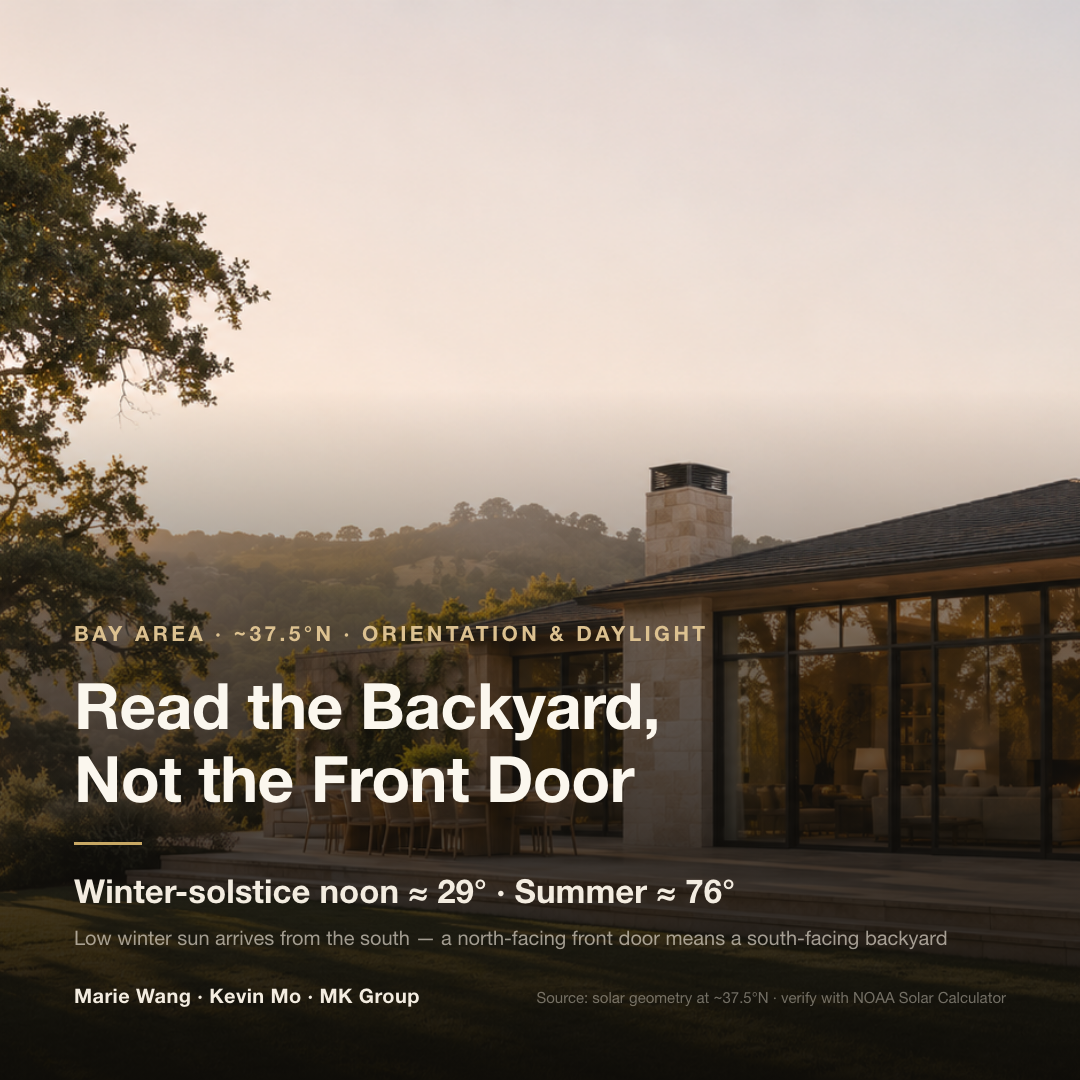
That is the view of MK Group co-founder Kevin Mo (YouTube @KevinMoRE, 24K+ subscribers) in a November 2026 video. The reasoning comes from the angle of the sun. The Bay Area sits at about 37.5°N. At noon on the winter solstice, the sun is only about 29° above the horizon; at noon on the summer solstice, it climbs to about 76°. Low winter light slants in from the south, so the thing worth having is a south-facing window, not a south-facing front door. The two get confused all the time. The last step is to adjust for local climate: in San Francisco's fog belt, take all the sun you can get; in the Tri-Valley heat, shade matters more than sun.
Who this article is for
- Owner-occupant buyers touring single-family homes, townhouses or condos in the Bay Area whose first question is still "does it face south or north?"
- Families who have found a home with the right location and floor plan, but with a north-facing front door or a west-facing backyard, and can't decide whether to let it go
- Buyers looking at hillside lots and view homes in Hillsborough, Woodside, Portola Valley, Los Altos Hills and similar hill towns
- Families moving from San Francisco to the Peninsula, the South Bay or the Tri-Valley who want to know whether their old rules on orientation still apply
Three core dimensions
Dimension one: start with the type of home, and ask each type one question
For a single-family home, ask about the backyard. A detached house is open to the outdoors on all four sides, so an east-facing house does not get sun only in the morning. With the front door facing east, the backyard usually faces west: the morning sun lands on the front yard, and the afternoon sun moves to the back. Many Bay Area houses today open the living room, kitchen and family room onto the backyard and concentrate the big glass there. Which way the backyard faces often shapes daily life more than which way the front door does.
For a townhouse, ask about the front and back, then ask whether it is an end unit. A townhouse shares walls with its neighbors on both sides, so windows usually go only on the front and back. If those two sides face east and west, sun comes in at both ends of the day. If they face north and south and a taller building happens to block the south side, the north side gets little direct light to begin with, and the stairs, hallway and middle rooms may need the lights on all year. An end unit has one more exterior wall and usually far better light.
For a condo, ask about the main windows. Orientation matters most here, because many interior units have every window on the same side. A condo with only north-facing windows gets almost no direct sun in winter. The same floor plan facing south with nothing in front may stay bright all day. West-facing floor-to-ceiling glass on a high floor gives beautiful afternoon light and sunsets, but summer glare and indoor heat have to be part of the math. Corner units and floor plans that run through from front to back are the exception, with windows on two or even three sides.
Dimension two: where does the sun land when it is strongest, and is that where you want to be?
Each of the four orientations of a single-family home comes with its own cost. With the front door facing south and the backyard facing north, the front rooms get plenty of winter sun. But the winter sun sits low, and the house casts a long shadow across its own backyard. Make the yard a little shallower or the neighbor's house a little taller, and the yard may stay in shade all day through the winter. In a place with hot summers, that cool backyard turns into an advantage.
With the front door facing north and the backyard facing south, many buyers hesitate at the word "north." Yet the living spaces face a south-facing yard with warm winter sun, and a well-designed overhang still blocks the high summer sun. The price is darker bedrooms at the front of the house.
With the front door facing east and the backyard facing west, the front yard is bright in the morning and the backyard bakes in the afternoon. If you work during the day and come home at 5 or 6 pm wanting to eat outside, grill or let the children play in the yard, that is exactly when the western sun is at its harshest. In the South Bay and the Tri-Valley, summer western sun is not just glare. It is heat. With the front door facing west and the backyard facing east, morning coffee and breakfast in the yard are a pleasure; in the afternoon the sun moves to the front of the house and the yard cools off. That works well in hot cities, though a west-facing living room needs protection from the afternoon sun.
Windows deserve the same separate reading. East-facing windows take the morning sun and miss the hottest part of the afternoon. North-facing windows get almost no direct light, but the light they do get is soft and even, which suits a study or a workroom. Kevin's reminder: the size of the window, the quality of the glass, whether there is shading and what the room is used for all matter more than orientation alone.
Dimension three: then adjust for the city's climate and the terrain
In the Bay Area, a few dozen miles or a single ridge can mean a different climate. In San Francisco's Outer Sunset and Outer Richmond, and in parts of Daly City and Pacifica, ocean fog often hangs in even in summer. These neighborhoods start out cool and get fewer clear days, so daylight in the main living areas goes to the top of the list. Farther south, on the flatlands of Redwood City, Palo Alto, Sunnyvale, Cupertino and San Jose, you want sun in winter and protection from heat in summer; large west-facing windows with no shading will push indoor temperatures up noticeably. Inland, in Dublin, Pleasanton and Livermore, summers run very hot, and a house with an east- or north-facing backyard deserves a careful look. What you want there is a backyard you can actually use on a summer afternoon, not one that bakes from early afternoon until sunset while everyone stays inside.
A hillside home needs two more checks: which way the slope faces, and whether a ridge rises behind it. The Peninsula's hills lie on the west side of the bay, so in towns like Hillsborough, Woodside, Portola Valley and Los Altos Hills, the slopes facing the bay mostly face east. Mornings are bright. But once the sun swings west in the afternoon, some homes fall into the ridge's shadow early, and in winter, with the sun already low, those hill shadows stretch long. The East Bay runs the other way: slopes in the Oakland Hills and Berkeley Hills that face the bay mostly face west or southwest. Both sides sell a bay view, but on the Peninsula the view comes with morning light, and in the East Bay it comes with afternoon sun and sunsets, and the summer western heat that follows.
The numbers: the four orientations of a single-family home in winter and in summer
The headline numbers: the Bay Area sits at about 37.5°N. At noon on the winter solstice, the sun stands only about 29° above the horizon; at noon on the summer solstice, about 76°. That is a gap of about 47°. Winter light therefore comes in low from the south, which is why a house with a north-facing front door and a south-facing backyard catches the most winter sun in its living room and family room, while a properly designed south-facing overhang can block the high summer sun.
| Single-family orientation (front door / backyard) | Winter | Backyard on a summer afternoon | Climate it suits best | Common remedies |
|---|---|---|---|---|
| Front faces south / backyard faces north | Front rooms get good sun; a shallow yard next to taller neighbors may stay shaded all day | Shaded and cool | Places with hot summers | Favor a deeper yard and a plan with the main living areas at the front |
| Front faces north / backyard faces south | Warm sun in the living room, kitchen and family room | Sunny; the high sun can be blocked by the overhang | Most Bay Area cities, especially fog-belt neighborhoods | An overhang of the right depth; accept darker north-facing bedrooms |
| Front faces east / backyard faces west | Afternoon sun in the backyard | Harshest western sun; real heat in the South Bay and Tri-Valley | Fog belt and cooler neighborhoods | Adjustable-louver pergola, deciduous trees, side shading, insulated glass |
| Front faces west / backyard faces east | Morning sun in the backyard | Cool, with the sun on the front of the house | Hot inland cities such as Dublin, Pleasanton and Livermore | Shading on the west-facing living-room windows |
Basis: solar altitudes are calculated from solar geometry at about 37.5°N and can be checked for any address with the NOAA Solar Calculator. The winter and summer behavior of each orientation and the climates each suits are Kevin Mo's professional judgment from his November 2026 video; actual conditions also depend on yard depth, neighboring house heights, trees and overhang design.
What to take from this: no orientation in the table is "always best." The same west-facing backyard is rare afternoon sunshine in San Francisco's fog belt and an unusable summer evening in Livermore. The same north-facing backyard is welcome shade in a hot inland city and a yard that never sees winter sun in the fog. And because the western sun comes in low, a horizontal overhang can't block it, which is why fixing western exposure usually takes side shading and insulated glass together.
What MK Group has seen: the four questions Kevin asks at a showing
Kevin Mo (DRE# 02127623) suggests retiring the question "does it face south or north?" at showings and asking four questions instead.
First: what kind of home is it?
For a single-family home, look at how the sun moves around all four sides. For a townhouse, look at the front and back, and whether it is an end unit. For a condo, look at how many exterior walls can bring in light.
Second: which way do the main living areas and the backyard face?
If the backyard faces west, check for shading. If it faces north, check whether the winter sun reaches the part of the yard you actually plan to use. If it faces south, don't cross the house off just because the front door faces north. Kevin's judgment is blunt: when you buy a single-family home in the Bay Area, the direction of the backyard and the main windows matters more than the direction of the front door. When you buy a condo, the direction of the main windows is the whole story.
Third: what is the city's climate?
In San Francisco's fog belt, take all the sun you can get. In hot cities like Pleasanton and Livermore, shade matters more than sun. A west-facing backyard that already has mature trees or a shade structure works just as well in the heat.
Fourth: what can be changed, and what can't?
Western exposure can be eased with shading, trees, insulated glass and air conditioning. The orientation of the lot, the ridge behind it, the shadows of neighboring houses and the layout of the whole house are, for practical purposes, fixed. If improving the light would mean spending heavily on structural work, settle that number before you write an offer. For buyers planning to tear down and rebuild on a large lot, the list of fixed items can grow longer. When MK Group was evaluating a lot split for the owner of a 2-acre estate in Atherton, the Town of Atherton responded that two protected trees on the property could not be removed, and where they stood directly limited the footprint and orientation of any new house. On a large lot, then, which way a new home can face is a question for the town and its tree rules first, not something you can assume you are free to choose.
Hillside lots: check the shadows three times around the winter solstice
When clients look at homes in hill towns like Hillsborough, Woodside, Portola Valley and Los Altos Hills, Kevin warns them about one kind of house in particular: one on a steep north-facing slope with a high ridge to the south, which may go months in winter without direct sun. At the bottom of a valley, cold air can also pool, leaving the house damp and poorly ventilated. His approach is to have clients visit around the winter solstice at 9 am, at noon and at 3 pm to see where the shadows fall. What truly can't be changed on a hillside, though, is the drainage, the slope stability, the fire risk and the insurance, and those deserve confirmation before orientation or the view. For what insuring a hillside estate involves, see wildfire risk and home insurance for estates in Woodside, Portola Valley and Los Altos Hills.
Unless the lot itself has a problem that can't be fixed, such as a north-facing slope under a ridge to the south, Kevin won't advise a client to give up a bright house with a south-facing backyard just because its front door faces north. When he is unsure about a home, he first looks up its approximate sun exposure from the address, then decides how much weight orientation should carry in the overall decision.
Common Misconceptions
Misconception 1: "South-facing houses are best, so look for a south-facing front door"
What helps is a south-facing window, not a south-facing front door. A house whose front door faces south usually has a north-facing backyard. In winter the sun sits low and the house shades its own yard; with a slightly shallower yard or a slightly taller neighbor, the backyard may stay in shade all winter. Daily comfort is decided by which way the living room, kitchen, family room and largest windows face.
Misconception 2: "Never buy a house with a north-facing front door"
A north-facing front door means a south-facing backyard. The living spaces get warm winter sun, and a well-designed overhang still blocks the high summer sun. The cost is darker bedrooms at the front. In foggy, cooler neighborhoods, a house like this is often more comfortable than one with a south-facing front door.
Misconception 3: "An overhang will take care of the western sun"
The western sun comes in low, below the reach of a horizontal overhang, so side shading and insulated glass usually have to go with it. In the backyard, an adjustable-louver pergola or deciduous trees do the job: leaves give shade in summer, and once they drop in winter, the sun comes back in.
Misconception 4: "In feng shui, a house that sits north and faces south is always best"
The preference for sitting north and facing south grew out of the winter sun in northern China. The Xuan Kong ("Flying Star") school that Kevin has studied holds that favorable orientations shift over time, in periods of 20 years. Under the method in common use today, a new period runs from 2024 to 2043. In this school, sitting due north and facing due south ranks best in only one period out of 180 years, most recently 1944 to 1963, so "always best" doesn't hold up. The door's orientation also has to be read together with the interior layout. In Kevin's experience, for most homes the feng shui difference is the difference between a 70 and a 75, and he won't tell a client to buy or pass on the strength of one feng shui point; location, structure and sunlight, the things you can't change, come first. For how to handle specific concerns such as front and back doors in line, a road ending at the front door or stairs facing the entry, see which feng shui issues in a Bay Area home are cheap to fix.
Misconception 5: "Orientation rules that work in San Francisco work everywhere"
In San Francisco's fog belt, you want all the sun you can get; a condo with only north-facing windows on the foggiest blocks will feel gloomy and cold over the long run. In Dublin, Pleasanton and Livermore, what a summer backyard needs is shade, and a yard facing east or north is often the more usable one. Change cities, and the standard has to change with it.
Next steps
- Confirm which way the backyard and the main windows face, not just the front door. Use a satellite map or a compass to note which direction the front door, the backyard and the large windows of the living room and family room each face. For a condo, note only the main windows.
- Add one question for the home type. For a townhouse, ask whether it is an end unit and whether a taller building blocks the south side. For a condo, ask whether it is a corner unit or a floor plan that runs front to back.
- Visit at the hour you would use the space most. If you usually spend 5 or 6 pm in the backyard, go at that time and see where the western sun lands and how hot it gets. Enter the address in the NOAA Solar Calculator to check the sun angles at the winter and summer solstices.
- For a hillside home, check the shadows three times around the winter solstice. Go at 9 am, at noon and at 3 pm, and check drainage, slope stability, fire hazard rating and insurance quotes first.
- Price the fixed items before you offer. Western exposure can be eased with shading, trees, insulated glass and air conditioning, and you can estimate what those cost. The lot's orientation, the ridge behind it and the neighbors' shadows can't be changed. If better light would require structural work, build that into your price before you write the offer.