Quick Answer
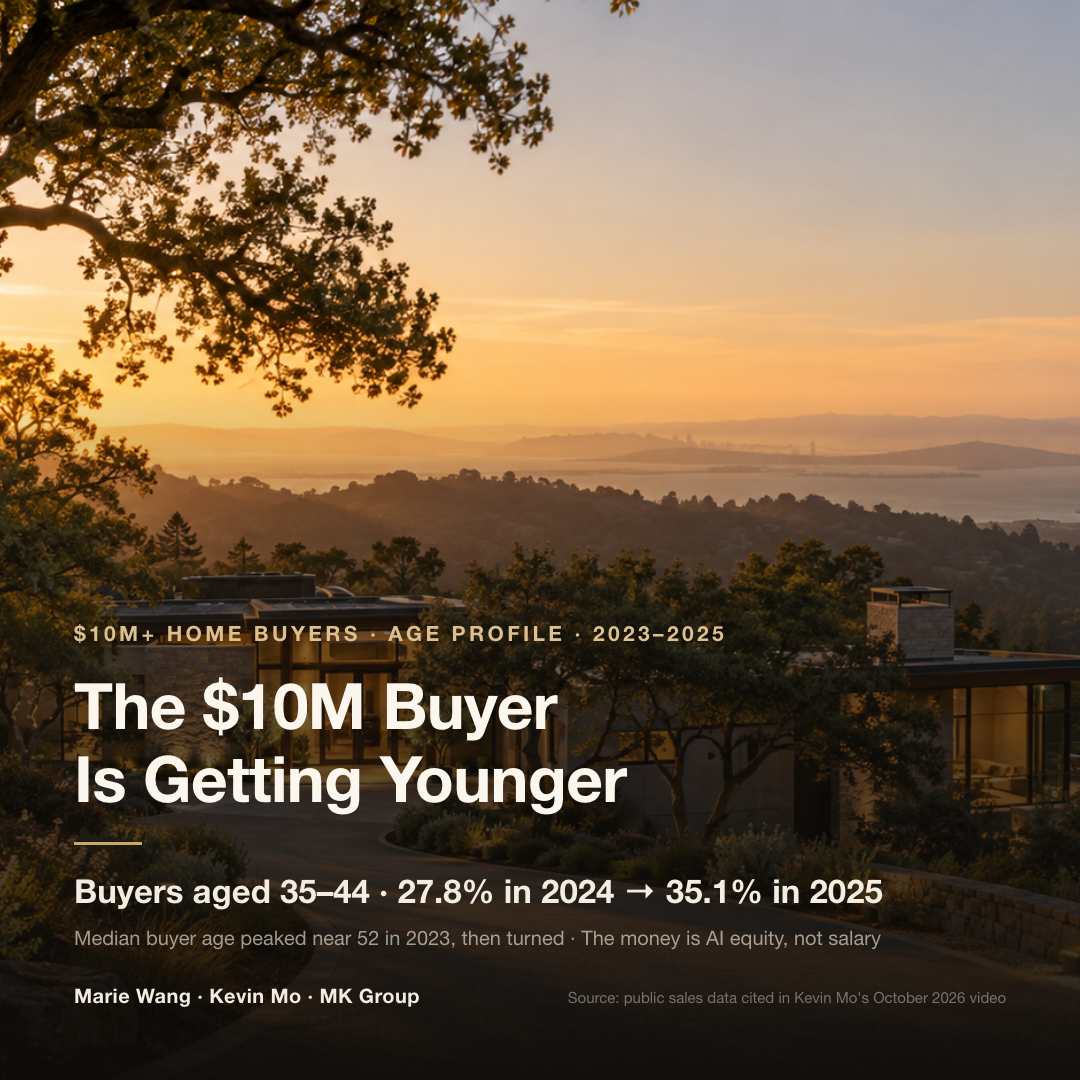
Because their money comes from AI equity and the chance to sell it, not from salary. Among buyers of $10M-plus Bay Area homes, the share aged 35–44 rose from 27.8% in 2024 to 35.1% in 2025.
Those figures come from an October 2026 market-analysis video by Kevin Mo, co-founder of MK Group (YouTube @KevinMoRE, 24K+ subscribers). A Bay Area home above $10M used to go, more often than not, to a founder or senior executive in their 50s whose company had already gone public. In 2023, the median buyer age at this level peaked at about 52; in 2024, it turned. In August 2026, SF Standard reported the sale of a Hillsborough estate for about $70M to a 31-year-old buyer from the AI industry. The case is extreme, but it points the same way as the data: for a very small number of AI founders, wealth that took others twenty or thirty years to build has been compressed into a few.
Who this article is for
- Owners of homes worth $5M or more in Atherton, Palo Alto, Los Altos Hills, Woodside or Hillsborough who plan to sell in the next year or two
- Buyers with a budget above $10M who are trying to gauge how competitive this tier has become
- Families holding equity in an AI company who want to understand how that equity connects to a high-end Bay Area home
- Readers who see headlines about people leaving the Bay Area and tech layoffs, and can't square them with buyers still competing for luxury homes
Three core dimensions
Making sense of younger buyers above $10M comes down to three questions: where the money comes from, why a handful of people can reshape this tier, and whether it is even the same market as the rest of the Bay Area.
Dimension one: buying power comes from equity and the timing of liquidity, not from salary
Kevin puts it plainly: this is an equity story, not a salary story. A job at a large company can build real wealth, but it comes with waiting — for shares to vest, for the stock price, for a trading window. AI startups divide the pie differently. Per Carta, 40% of venture investment on its platform in 2025 went to AI companies. At the same time, many late-stage companies now employ noticeably fewer people than at their 2023 peak, and the median seed-stage team is just 4 people. Fewer people sharing in more highly valued companies means a bigger stake for each of them.
Nor does liquidity have to wait for an IPO. Employee tender offers and secondary sales can turn paper wealth into a down payment earlier — and sometimes into an all-cash offer. For the financing and ownership structures that sit between equity and a home, see Turning Pre-IPO Stock into a Bay Area Luxury Home: Financing and Holding Structures for Pre-IPO Employees.
Dimension two: the $10M tier is a thin market, and a few dozen new buyers can change the competition
Isn't the Bay Area still losing people? According to U.S. Census Bureau metro-area estimates, the San Francisco–Oakland–Fremont metro area's population had still not fully recovered to pre-pandemic levels as of 2024. But the companies are still here, and so are the capital and the talent networks. Above $10M, what matters isn't another hundred thousand residents. It's a few dozen more people at the right companies, holding the right equity, who happen to reach the point of buying a home. The market is small to begin with, so even a little new buying power shows up quickly in prices and competition.
Dimension three: younger buyers and more cash are arriving together — in a different market
Housing economist Mike Simonsen has noted that many AI executives are only in their 30s to early 40s, and that in San Francisco even a $25M all-cash offer has lost out. Youth alone doesn't necessarily change a market. More money with no change in age is just the familiar luxury cycle. What's new is both happening at once.
It also explains a picture that looks contradictory: layoffs and cost-of-living pressure on one side, young AI founders competing with cash and large down payments for $10M homes on the other. The two were never in the same market.
The numbers: who is buying above $10M, and where the money comes from
Key numbers first: the median age of buyers of $10M-plus homes peaked at about 52 in 2023 and turned in 2024. The share of buyers aged 35–44 rose from 27.8% in 2024 to 35.1% in 2025, a gain of 7.3 percentage points in a single year. As of August 2026, Kevin Mo's market read is that buyer age now centers around 45, with a few buyers already in their early 30s.
| Metric | Figure | Period | Source |
|---|---|---|---|
| Median age of buyers of $10M-plus homes (recent peak) | About 52 | 2023 | Public sales data cited in the video |
| Share of buyers aged 35–44 | 27.8% | 2024 | Public sales data cited in the video |
| Share of buyers aged 35–44 | 35.1% | 2025 | Public sales data cited in the video |
| Where buyer age centers (market read, not a statistic) | About 45; a few buyers in their early 30s | As of August 2026 | Kevin Mo, from public sales and market signals |
| Publicly reported single sale (Hillsborough) | About $70M; buyer aged 31, from the AI industry | August 2026 | SF Standard |
| Share of platform venture investment going to AI companies | 40% | 2025 | Carta |
| Median seed-stage team size | 4 people | Recent | Carta |
| Share of wealth held by Silicon Valley's top 10% / bottom 50% of households | About 75% / less than 1% | 2026 report | Silicon Valley Pain Index |
Scope: age figures are the public sales data for $10M-plus homes cited in Kevin Mo's October 2026 video; this article restates them as cited and has not re-derived them. The video does not detail the geography or method behind them, and this article does not fill those gaps. "About 45" is Kevin's market read, not a statistical result. The $70M sale is per SF Standard's August 2026 report; title is held in an LLC, and the buyer's identity is the publication's inference.
What to remember: 35.1% does not mean young people across the Bay Area have suddenly become wealthy. Only a limited number of homes above $10M sell in any year, so a few dozen AI professionals with a chance to cash out equity are enough to pull the age profile down. Read it alongside how wealth is distributed. San José State University's Human Rights Institute, in its 2026 Silicon Valley Pain Index, finds that the top 10% of Silicon Valley households hold about 75% of the wealth and the bottom 50% less than 1%. The new buying power sits with very few people — which is why it stands out above $10M and barely registers in the broader market.
What MK Group sees on the ground
The three points below come from Kevin Mo's reading in the video and from one real inquiry. They are not a review of any single transaction.
An unusual inquiry: a year or two out of school, with a budget of about $5M
Kevin mentions that MK Group was recently approached by a buyer who had graduated only a year or two earlier, needed no family support, and came to talk about buying a home with a budget of about $5M. Kevin is careful to say this is not common. But it shows the direction: a price point that once took a decade or more of work to even consider, some people now reach within a few years. For how a younger buyer can gauge real purchasing power, see One Year Out of School, Buying a $5M Silicon Valley Home — How?
A valuation reaches the housing market only once it becomes cash
Kevin's core point is that what changes luxury buying power is equity combined with a moment when it can be sold. A valuation in the headlines, once it actually turns into cash, flows into real estate. That is why national mortgage rates and the Bay Area median price say less and less about how hot the $10M tier is running. How the coming IPO wave bears on luxury demand is covered in SpaceX, OpenAI and Anthropic Are All About to Go Public — Will Trillion-Dollar AI Wealth Really Buy Up Silicon Valley Luxury Homes?, so it isn't repeated here.
For sellers: prepare for what buyers will scrutinize
Kevin's reminder to owners of high-end homes: the people touring your house today may not be who you picture. They may be younger than you expect, more direct, and very focused on finishes and condition. That doesn't mean a seller should favor one kind of buyer over another. It means pricing, privacy, presentation and negotiating pace should be settled before the house goes on the market, so it holds up to item-by-item scrutiny from every qualified buyer.
Common Misconceptions
Misconception 1: "The Bay Area's population still hasn't recovered from the pandemic, so no one will compete for $10M homes"
Population and luxury demand are two different things. Between 2020 and 2024, population in the San Francisco–Oakland–Fremont metro area did not fully return to pre-pandemic levels. But the $10M tier doesn't depend on another hundred thousand residents; it depends on a few dozen more buyers with equity they can sell. The thinner the market, the more visibly a little new buying power moves prices and competition.
Misconception 2: "Younger buyers mean young people in the Bay Area are getting richer across the board"
No. The share of buyers aged 35–44 rose from 27.8% in 2024 to 35.1% in 2025, but that shift happened only in the narrow market above $10M. Meanwhile, the 2026 Silicon Valley Pain Index finds the top 10% of Silicon Valley households holding about 75% of the wealth and the bottom 50% less than 1%. Layoffs and cost pressure in the broader market, and cash competition above $10M, are happening at the same time — in two different markets.
Misconception 3: "Until an AI company goes public, its equity can't become money for a house"
Liquidity doesn't have to wait for an IPO. Employee tender offers and secondary sales can turn paper wealth into a down payment earlier — or into an all-cash offer. Per Carta, 40% of venture investment on its platform in 2025 went to AI companies, and the median seed-stage team was just 4 people: plenty of capital, few people, and equity concentrated in a small number of hands. Whether a particular stake can be sold, and when, depends on the company's own arrangements.
Misconception 4: "National mortgage rates and the Bay Area median price tell you whether the $10M tier is hot"
National rates mostly affect the majority of buyers who finance with a mortgage, and the Bay Area median reflects the broad market. Buyers above $10M rely far more on equity liquidity and cash. To judge a luxury home, ask whether it is merely expensive or a genuinely scarce asset that buyers will compete for — then check land, location, privacy, schools and future resale, one by one.
Next steps
- If you plan to sell, settle four things before you list. Prepare pricing, privacy, presentation and negotiating pace one at a time, rather than listing first and waiting to see how the market reacts.
- Don't presume who the buyer will be. Get the condition, the finishes and the disclosure documents ready to withstand item-by-item scrutiny, and treat every qualified buyer the same way.
- When you look at $10M homes, separate "merely expensive" from "genuinely scarce." Write down land, location, privacy, schools and future resale for each house, and compare them side by side.
- If your family holds AI equity, line up the liquidity path with the purchase timeline first. Find out whether a tender offer or secondary sale is possible and roughly when, then set the pace of your search; take tax and agreement questions to a CPA and an attorney.
- Track the $10M tier's own data. Watch sales volume, the share of all-cash purchases and the share of homes selling above list at this level — not national rates or the citywide median.