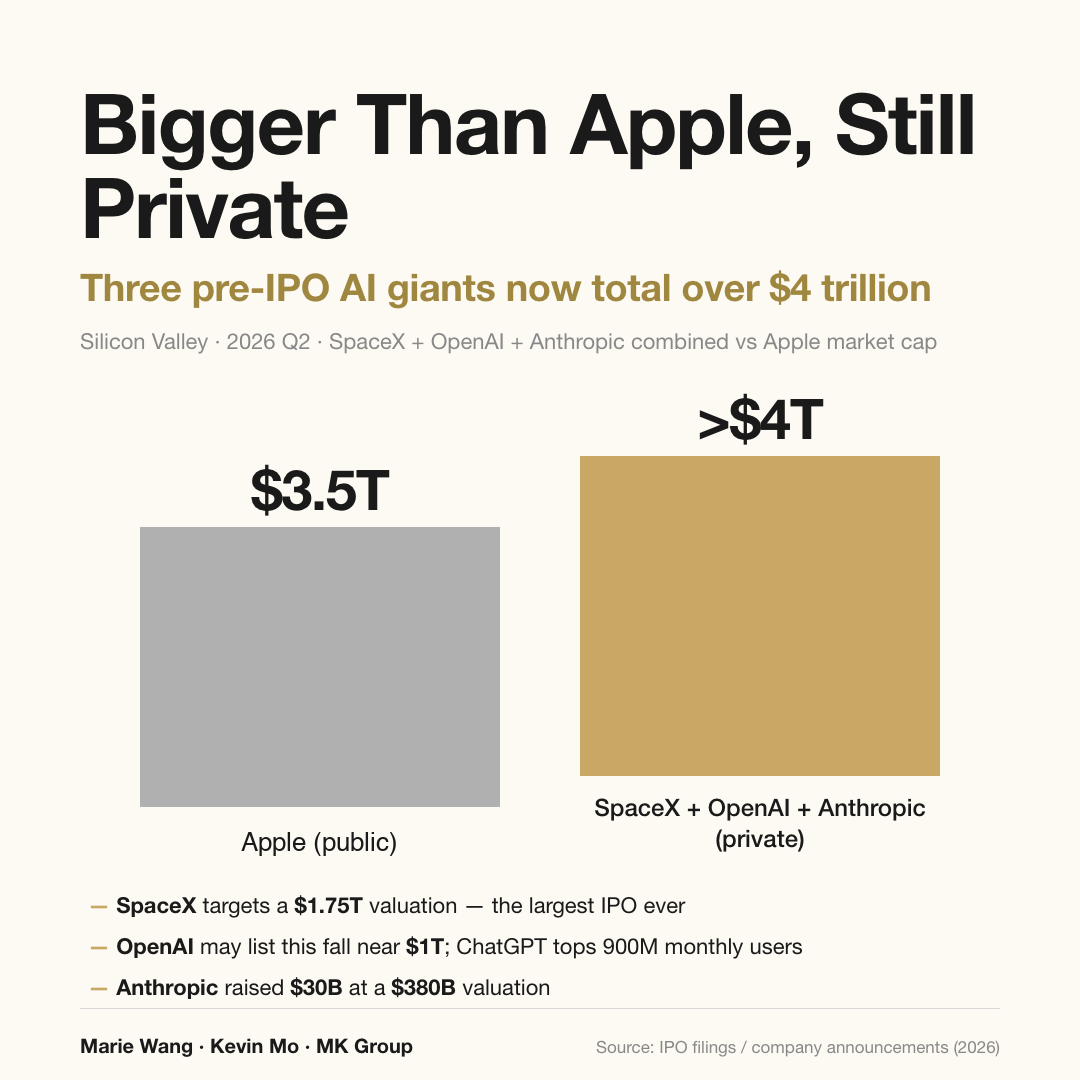
Yes — but the real buying moment isn't listing day. SpaceX ($1.75 trillion), OpenAI (approaching $1 trillion) and Anthropic ($380B) are together worth more than $4 trillion, ahead of Apple, and none of them has gone public yet. But an IPO doesn't mean employees can sell the next morning — lockups typically run 6–12 months. The buyers actually driving luxury closings are the ones cashing out early through the secondary market, ahead of the lockup.
Who this is for
- Families at AI and tech companies holding a large pre-IPO equity or option position, with a listing on the horizon, trying to work out when to buy and whether to wait for liquidity.
- High-net-worth buyers weighing whether this IPO wave will push $5M+ luxury prices higher, and timing their entry.
- Buyers worried that once the IPO hits, a wave of newly wealthy colleagues will clear out the scarce inventory before they can lock in a home.
- Anyone trying to understand how the secondary-market-to-all-cash money path actually works.
Three dimensions for reading this wave
1. This isn't one company listing — it's a stack of trillion-dollar offerings
The 2019 "one company goes public" story doesn't apply here. SpaceX filed to go public on June 1, 2026 and lists June 12 at a target valuation of $1.75 trillion — the largest IPO in history. OpenAI may list this fall or winter at a target approaching $1 trillion, and its product ChatGPT is already past 900 million monthly active users — better than one in ten people on Earth. Anthropic, the maker of Claude, just closed a $30 billion round at a $380 billion valuation, one of the largest private rounds in tech history. Add the three together and they're worth more than $4 trillion, while Apple sits around $3.5 trillion. In other words: before any of these three has even listed, their combined value already exceeds Apple's entire market cap.
2. An IPO isn't next-day liquidity — the lockup is the variable that matters
Most people assume that once a company lists, employees can sell their shares the next day and go buy a house. That's a misread. Almost every newly public company has a lockup period — typically 6–12 months — during which employees can't sell. So even though SpaceX lists June 12, many employees likely can't cash out until December, or next year. If you're watching "listing day" to predict when luxury demand spikes, you'll probably get the timing wrong. The real demand comes either from the wave that hits after the lockup lifts — or from the group below, the ones who skip the lockup entirely and cash out early.
3. The secondary market: turning paper wealth into cash before the lockup
Silicon Valley has a secondary market that outsiders rarely see but that is, in practice, quite mature. Before a company formally lists, professional investment firms and investors buy pre-IPO shares directly from employees in private transactions, letting them convert their position into cash and take some chips off the table early. Not every employee knows how to run this play; it takes the right institutional buyer and the right trading window. The value of it is this: you don't have to sit and wait out the lockup. You can lock in a home before IPO pricing takes off — and before a wave of newly wealthy colleagues clears out the scarce inventory. This is the money path actually driving high-end closings in the current wave.
How this differs from 2019: four ways
Start with the core number. In 2019, Uber, Lyft, Pinterest and Slack all listed, and the press lined up to predict a Bay Area price surge — yet that year, Bay Area prices actually dipped slightly. This wave is different in both scale and structure. SpaceX alone targets a $1.75 trillion valuation (the largest IPO in history), and the three together exceed $4 trillion, while the 2019 cohort combined came nowhere near that. The table below lays out the four key differences.
| Dimension | 2019 (Uber/Lyft/Pinterest/Slack) | 2026 (SpaceX/OpenAI/Anthropic) |
|---|---|---|
| Scale | Well-known but limited; combined nowhere near trillions | SpaceX alone at $1.75T, the largest ever; three together exceed $4T |
| Geography | Relatively spread out | Anthropic, OpenAI and SpaceX all in San Francisco — global capital and attention focused on the Bay Area |
| Inventory | Relatively loose | Far tighter than 2019, especially above $5M — the most expensive, fastest-selling stretch on record |
| Buyer profile | Mostly established tech professionals | Many young buyers — some first-time buyers purchasing at $10M |
The one point to hold onto: the 2019 names were well known, but neither the scale of the industrial shift nor the capital behind them comes close to this AI wave — this is innovation at an unprecedented scale. What matters even more is supply. Four or five years ago, a $20M home might have taken roughly six months to sell. Today, luxury is selling at its most expensive and its fastest ever: an $18M home sold off-market on day three before it ever formally listed. Land the same demand shock on a supply that's been locked up, and prices move very differently than they did in the relatively loose market of 2019. Atherton's median is currently around $10.2M — a town of just over 7,000 residents and just over 2,000 homes, with no developable land left. That structural scarcity leaves demand almost nowhere to disperse.
Data source
- Sources: SpaceX / OpenAI / Anthropic public offering filings and company announcements (2026); MLSListings 2026 closed-sale data; lockup practice, secondary-market liquidity paths and absorption speed are MK Group field estimates.
- Updated: 2026-06
- Scope: Silicon Valley Peninsula / South Bay $5M+ luxury market · AI and tech new-money buyers
NVIDIA is the optimistic comp; 2019 is the cautious one — history runs both ways
"Does an IPO or a stock run-up push home prices higher?" has had two answers historically, and both are worth a look. The optimistic side is NVIDIA: after the run-up, this roughly 36,000-person company saw most of its people become millionaires — and well beyond that. By common estimates, nearly half of employees hold wealth above $25M, and perhaps a quarter above $50M. Jensen Huang has noted the company has around 25,000 employees; do the math on what that means for the size of the buying pool. When Atherton, Los Altos and Palo Alto entered their strongest closing season on record in 2025, all-cash buyers picking up homes to renovate were everywhere — the classic move of an early IPO winner.
The cautious side is 2019: Uber, Lyft, Pinterest and Slack all listed, the press predicted a price surge, and Bay Area prices instead dipped slightly that year (macro and local factors both played a part). Put the two together and the conclusion isn't "an IPO always lifts prices." It's that three variables — scale, supply tightness and buyer mix — decide the outcome, and all three point toward stronger upward pressure in 2026 than in 2019.
What we see in the field
In the first half of 2026, we helped three "lock in the home before the company lists" buyers cash out early and close
We see this anxiety up close. In the first half of 2026, MK Group has already helped three buyers facing the same situation — a company about to list, and a desire to lock in a home before prices take off — cash out early and close on a purchase. One was an OpenAI-tier client (see our anonymized case study, case-007): their pre-IPO stock was trading actively on the secondary market, but the paper wealth hadn't yet become spendable cash. We connected them with secondary-market investment specialists who converted their not-yet-listed shares into cash in tranches, so they could buy all-cash — avoiding the wait for the lockup, and sidestepping the conservative valuations traditional banks apply to pre-IPO stock. The client locked in a home in Los Altos Hills, and in negotiation we brought the price down by more than $1M from the original ask.
Two takeaways from this case apply to any pre-IPO buyer. First, the liquidity-timing trap is real: most employees assume they have to wait for the IPO to unlock, but they overlook the opportunity cost of the post-IPO demand crunch — cashing out through the secondary market before the IPO is often the better timing strategy. Second, the money path for these buyers looks nothing like a conventional down-payment-plus-mortgage. It calls for a team fluent in private banking, the secondary market, and trust/CPA coordination — not a standard brokerage workflow.
An $18M off-market home closed on day three: luxury is selling at its most expensive and fastest
How tight the luxury market is right now is best told by one field anecdote: a few days ago, an $18M home that never formally hit the MLS closed for our client on day three. Four or five years ago, a $20M home might have taken roughly six months to sell. That shift in absorption speed is the direct result of supply being locked while demand thickens — and it's exactly why we say this wave is landing on a far tighter supply base than 2019.
Common misconceptions
Misconception 1: "Once the company lists, employees can cash out and buy the next day."
Listing isn't next-day liquidity. Almost every newly public company has a 6–12 month lockup during which employees can't sell. SpaceX lists June 12, but employees may not be able to cash out until December or next year. So predicting the luxury demand spike off "listing day" will probably miss. The people buying early take the secondary-market route — converting and closing outside the lockup, before IPO pricing takes off.
Misconception 2: "Prices didn't move much after the 2019 IPOs, so this time is probably the same."
This isn't 2019. The year Uber, Lyft, Pinterest and Slack all listed, Bay Area prices actually dipped slightly — but that cohort's combined scale comes nowhere near today's. SpaceX alone targets $1.75 trillion, and the three together exceed $4 trillion. More important is supply: homes above $5M are far tighter now than in 2019, in the most expensive, fastest-selling stretch on record. Land the same demand shock on a locked-up supply and prices move very differently than in the looser market of 2019.
Misconception 3: "Just sell the stock first, then take your time finding a home."
That order carries real risk. Liquidate first and then search, and you can miss out twice: the stock keeps climbing (quality tech names are still rising), and you walk into a post-IPO window where newly wealthy colleagues are clearing out the scarce inventory. The steadier approach is to plan first — decide where you're buying, your budget, and the kind of home you can live in — then work backward to when and how much to sell, and how to convert (the secondary market during a lockup; a private-banking solution while cash isn't yet in hand). Get "what to buy" clear before you decide "how to sell."
Next steps
- Plan the purchase before you touch the stock: pin down the city, the budget range and the target home type, then work backward to the liquidation schedule — so you don't sell first and miss the run-up.
- Know your company's lockup: 6–12 months is common. If the lockup is long, assess whether cashing out early through the secondary market is the better timing strategy.
- Learn the financing path for the "cash isn't in hand yet" period early: pre-IPO equity is an asset private banking will recognize — don't lose a financing window for lack of information.
- Shortlist with a "5 from 50" discipline: based on a clear positioning brief, narrow to the few homes that genuinely fit, and spend your time where it counts.
- Bring the holding structure into the decision early: a luxury home is the start of carrying cost and wealth transfer — trust setup, financial planning and CPA tax structuring should be aligned with your attorney and CPA before closing, not after.
- Confirm whether your agent has off-market inventory and first-hand offline access: supply is extremely tight in this wave, and the best homes often never appear on the public MLS.