Quick Answer
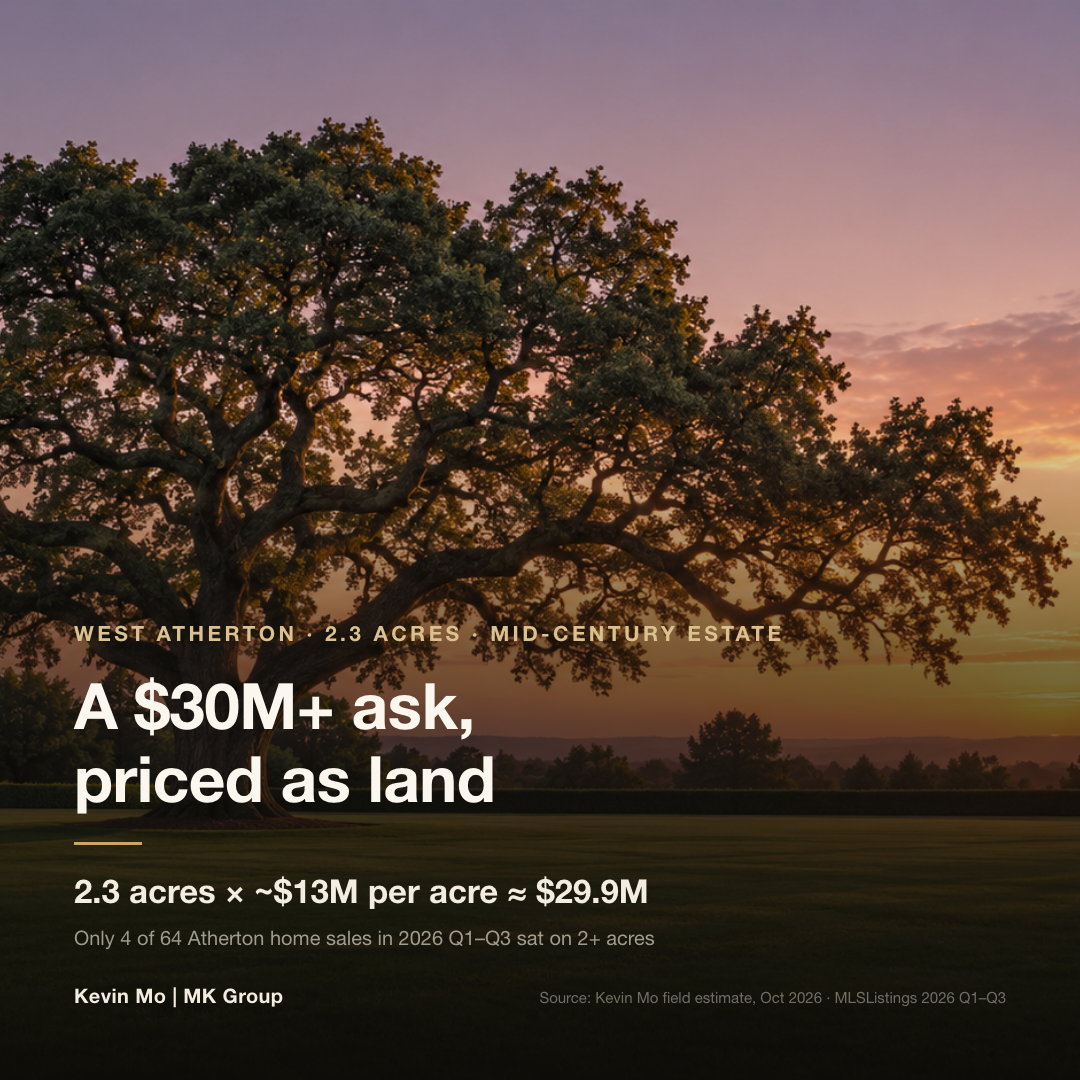
Mostly the land. By Kevin Mo's estimate, flat interior-street land at the top of West Atherton now runs about $13M an acre, which puts 2.3 acres close to $30M on its own. The 1950s house will most likely be rebuilt. It suits developers and Atherton owners land-banking a large parcel, but don't assume a lot split.
This is an estate that Kevin Mo (DRE# 02127623), co-founder of MK Group, toured in October 2026 for his channel on YouTube @KevinMoRE (24K+): 2.3 acres in West Atherton, built in the 1950s, asking above $30M. The roof is solid natural slate, and Kevin felt it would be a waste to tear it down. Inside, the house is dated, with too many rooms opening one into the next, like a maze. What carries the price is the land. It sits on an interior street, it is flat, and apart from a few trees along one side and one oak that can't be removed, it is almost clear.
Who this article is for
- Buyers with $20M to $40M to deploy who are looking at two-acre estates in Atherton and want to know how much of the ask is land and how much is house
- Atherton owners weighing a second large parcel in the most central part of town to hold for the long term
- Developers, family offices and investors underwriting a rebuild or lot split on a large Atherton parcel
- Cross-border all-cash buyers based overseas who need to judge from a distance whether a large Atherton parcel is worth its price
Three core dimensions
Dimension one: break the ask into land value × acreage, plus whatever the house is worth
Kevin's math is direct. An acre in West Atherton already runs about $13M. At 2.3 acres that is about $29.9M, and there is a large house on top. So an ask above $30M makes sense: it is essentially market, with perhaps a little room to negotiate.
That ruler needs two corrections. First, $13M is the top of the range, the figure for flat lots on West Atherton's most central interior streets. It is not a town-wide price per acre. Our June 2026 article, I Own a Two-Acre Lot in Atherton — Can I Split Off Half to Sell or Rebuild for Value?, cites about $9M–$10M per acre for core Atherton. That is a broader average, and the two numbers are different points on the same price band.
Second, land value doesn't scale in a straight line with size. The extra 1.3 acres is worth a full per-acre price only if it can be used or sold on its own. What the house is worth depends on your plan. Rebuild, and it is worth close to nothing, less the cost of demolition. Keep the shell and renovate, and only then does it count.
Dimension two: three scarcity tests, and very few parcels pass all three
The first test is size. By Kevin's estimate, Atherton has 2,000-plus parcels; about 10% are 1.5 acres or larger, and only a few percent are 2 acres or larger. The second is location: a quiet interior street, away from the main roads. The third is buildable area: flat ground with few trees.
Flatness matters for more than construction, because Atherton ties its subdivision minimums to slope. Where the average slope is under 20%, each new lot needs only 1 acre, 175 feet of width and 200 feet of depth. At 20%–34.9%, the minimum rises to 2 acres per lot.
Few trees means the buildable area isn't carved up. Under Atherton's tree protection standards, the protection zone has a radius of 10 times the trunk diameter, so a single 30-inch oak takes roughly 1,960 square feet of ground out of play. A parcel that passes all three tests and actually comes to market is what gives this ask its confidence.
Dimension three: the upside of a split sits under a few hard limits
Cut 2.3 acres in two and each lot is about 1.15 acres, just over the 1-acre minimum on paper. Whether it can actually be cut depends on the town's hard limits. Each new lot needs its own access and cannot share the existing driveway. Protected oaks cannot be removed. Each lot also has to meet setbacks and the width and depth minimums.
A split doesn't add floor area, either. On Atherton lots of an acre or more, above-ground floor area is capped at 18% of lot area: about 18,000 square feet on 2.3 acres as one lot, or about 9,000 square feet on each of two halves. What a split changes is the ability to sell twice, not the ability to build more. Basements are counted separately; see If I Buy an Acre in Atherton and Rebuild, How Big Can the House Be?
The SB 9 fast-track split also requires the applicant to sign an affidavit committing to live in one of the units as a principal residence for at least 3 years from approval. Developers, and owners with no plan to move in, usually go through Atherton's standard subdivision process instead.
The numbers: how the math on this land works
The short version: by Kevin's estimate, $13M an acre at the top of West Atherton times 2.3 acres is about $29.9M, almost exactly the ask. Yet in MLSListings closings for the first three quarters of 2026, only 4 of 64 Atherton single-family sales sat on 2 acres or more, and the 6 sales on 1.5+ acres worked out to a median of about $11M per acre, house included. None reached $13M.
| Item | Figure | Basis and source |
|---|---|---|
| Total parcels in Atherton | 2,000-plus | Kevin Mo's rough estimate, not an MLS statistic |
| Share of parcels on 1.5+ acres | About 10% | Kevin Mo's estimate |
| Share of parcels on 2+ acres | Only a few percent | Kevin Mo's estimate |
| Cross-check: large lots among 2026 Q1–Q3 closings | Of 64 single-family closings, 6 on 1.5+ acres (about 9%) and 4 on 2+ acres (about 6%) | MLSListings closed-sale records |
| Top-tier West Atherton land value | About $13M per acre | Kevin Mo's October 2026 field observation; flat lots on the most central interior streets |
| Core Atherton average | About $9M–$10M per acre | Valuation basis from a real MK Group case (this site's June 2026 subdivision article) |
| Sales on 1.5+ acres, per acre (house included) | $6.26M–$11.54M; median about $11M | MLSListings 2026 Q1–Q3, 6 sales |
| 2.3 acres × $13M | About $29.9M | Straight-line extrapolation from the top-tier price; an upper-bound value |
| Size conversion | About 100,188 sq ft (about 9,300 m²), roughly 1.3 times a regulation international soccer pitch | 1 acre = 43,560 sq ft; regulation pitch 105 × 68 m |
| Above-ground floor area cap | About 18,000 sq ft as one lot; about 9,000 sq ft each if split evenly | Atherton Municipal Code §17.32.040, 18% FAR |
| Subdivision minimums (average slope under 20%) | At least 1 acre, 175 ft wide and 200 ft deep per lot, plus independent access | Atherton Municipal Code Table 16.24.050; the town's response in an MK Group case |
| Town-wide reference: Atherton 2026 Q3 | 21 closings, $12.25M median, 61.9% all-cash, 9-day median days on market | MK Bay Area Pulse 2026 Q3 (MLSListings) |
Basis: the total parcel count, the lot-size shares and the per-acre land values are Kevin Mo's field observations and estimates, not MLS statistics. The MLS cross-check counts only Atherton single-family homes closed January–September 2026; the large-lot sample is very small and serves only as a range reference.
What matters most: $29.9M is the ceiling, not the median. $13M an acre belongs only to flat lots on West Atherton's most central interior streets. The median the market actually paid per acre for parcels of 1.5 acres or more was about $11M, which tells you the extra acreage isn't priced at full value unless it can be split off and used or sold on its own. For this ask to hold, a buyer is betting on two things: the location premium of this particular parcel, and whether a split can actually get done.
Who should step in: three buyers, three ways to price it
Start with two sets of closings. In the first three quarters of 2026, Atherton recorded 3 sales above $30M, from $32.5M to $38M. All three were homes on about an acre, built in 2015 or later, at about 11,500–12,900 square feet, and all west of El Camino Real.
The 4 sales on 2+ acres closed between $13.13M and $27.75M. Every one sold below its original list price, at about 80%–97%, after 21 to 190 days on market. Across town over the same period, the median sale closed at roughly its original list price in under 10 days. Put plainly, the precedent for $30M+ in Atherton is a new house, not land with an old house on it.
Developers and investors: work back to the land value with the residual method
A developer pays for land, and the method is the residual: the projected sale price of the finished homes, minus construction, carrying and financing costs and profit. What remains is the most the developer can pay (see A Developer Knocked and Offered to Buy My Old Bay Area House to Tear Down — Is the Number He Gave Me High or Low?).
Those three $30M+ new-build sales are the exit benchmark. If the parcel splits cleanly into two lots of about 1.15 acres each, each lot has a shot at that tier. But entitlement and construction risk both carry a discount, and a second lot that hasn't been approved is hard to count at full value.
Owners land-banking in Atherton: bid as if the split fails, and treat it as an option
The other buyer Kevin describes already lives in Atherton and wants to hold a large parcel in the most central part of town. Buy now, let the land appreciate, and decide later whether to split it or build one large house.
That logic works only at a price you can live with if the split never happens. The split is an extra option, not the base return. Count the carrying cost, too: under Prop 13, the 1% base rate alone on a $30M purchase comes to about $300K a year in property tax, before local assessments are added.
Buyers keeping the shell to renovate and live in: run the floor plan before the sentiment
The slate roof and the symmetrical classical façade are the parts of this house most worth keeping. But Kevin's read is that the floor plan is hard to change. Rooms open one into the next, and short of a rebuild, the layout needs major work. A renovation buyer should set the cost of reworking the plan against the cost of rebuilding, and then against new homes at the same price.
What MK Group has seen: the value anchor on large lots, and the limits on splitting them
In the video, Kevin Mo mentions that MK Group is currently representing several Atherton listings. The two real cases below, from the team Kevin leads with co-founder Marie Wang (DRE# 02110980), speak to the two questions this estate turns on: can it be split, and is the land really worth the money.
Before you plan a split, ask the town
An owner held a 2-acre Atherton estate. After evaluating it, the team recommended splitting it into two 1-acre lots: keep one to live on, and sell the other on its own. They asked the Town of Atherton directly about the conditions and received two firm answers. Any new lot needs its own independently designed access and cannot share the existing driveway. And 2 protected trees on the property cannot be removed, which directly limits where a new house can sit and which way it can face.
Atherton typically responds in about a week, where Hillsborough often takes a month. But the constraints decide how much value a split actually releases, and when the case was recorded, the owner was still weighing whether to proceed. The lesson: in estate-grade parts of West Atherton, where lots start at an acre, the room to subdivide is usually the smallest. A land-banking plan shouldn't rest on the assumption of a clean split into two.
In West Atherton, the value anchor is the land, not the age of the house
In 2023, MK Group helped a family buy an older home of about 7,000 square feet in a part of West Atherton where lots start at one acre, for $12M-plus. At the time, a new home of about 8,000 square feet in the same area was listed at $20M.
At its 2025 market valuation, the home was worth $18M-plus, roughly 50% appreciation. The family is still holding it and has not listed. The takeaway for West Atherton: the gap between a new house and an old one on comparable land is mostly the cost of construction and finishes. The location itself is already priced in.
Common Misconceptions
Misconception 1: "At $13M an acre, 2.3 acres must be worth $29.9M"
That is the top-tier price scaled up in a straight line, which makes it the upper bound. The 6 Atherton sales on 1.5+ acres in the first three quarters of 2026 worked out to a median of about $11M per acre, house included, with a high of about $11.54M. Extra acreage is worth full value only when it can be used or sold on its own.
Misconception 2: "Anything over 2 acres can simply be cut in two"
Where the average slope is under 20%, each new lot needs at least 1 acre, 175 feet of width and 200 feet of depth, plus its own access, its protected trees left in place and its setbacks met. If the parcel's shape or street frontage doesn't work, enough acreage still won't produce two lots. And the SB 9 fast track requires the applicant to commit to living in one of the units for at least 3 years.
Misconception 3: "A façade this beautiful has to be worth a few million"
For a buyer planning to rebuild, the old house is worth close to nothing, less the cost of demolition. It only counts for a buyer who intends to keep the shell and renovate. The same house can carry very different values in the eyes of a developer and a renovation buyer.
Misconception 4: "A large parcel that has sat on the market can be negotiated down hard"
All 4 Atherton sales on 2+ acres in the first three quarters of 2026 did close below original list. But the discounts ranged from about 3% to about 20%, and 3 of the 4 were all-cash. The seller across the table usually has no pressure to move. A lower price is won with a specific argument about the parcel's constraints, not by waiting. For what to mark down on homes in the $10M range, see Buying at $10M to $14M in Atherton — Why Did Every One of These Homes Close Below Asking, and What Should I Be Marking Down at a Showing?
Next steps
- Split the ask into two calculations. Use recent sales in the same area that closed close to pure land value to estimate a price per acre. Run it once assuming no split and once assuming a successful split, then judge whether the house adds value or subtracts it.
- Confirm split feasibility with the Town of Atherton before you make an offer. Ask about the parcel's average slope, whether both lots can each meet 175 feet of width and 200 feet of depth, which street independent access would come from, and where the protected trees stand and how large their trunks are.
- Have a licensed land surveyor map the boundaries and the trees. Draw each protected tree's protection zone (radius = trunk diameter × 10) on the site plan, and see how much buildable area each lot keeps.
- Set your ceiling by the kind of buyer you are. Developers work back with the residual method. Land-banking owners bid at a price that still works if the split fails, and budget property tax from about 1% a year. Renovation buyers compare the cost of reworking the plan with $30M+ new-build sales.
- Write the split check into the contract timeline. Confirm with your attorney that the due diligence period is long enough to get the town's written response before you remove the contingency.
This article is for decision education and is not legal or tax advice; confirm specifics with your attorney/CPA and the Town of Atherton planning department. Subdivision, SB 9 and zoning questions are governed by the Town of Atherton's current code and the planning department's written responses. The per-acre land values and parcel counts in this article are Kevin Mo's field observations and estimates, not MLS statistics.