Direct answer
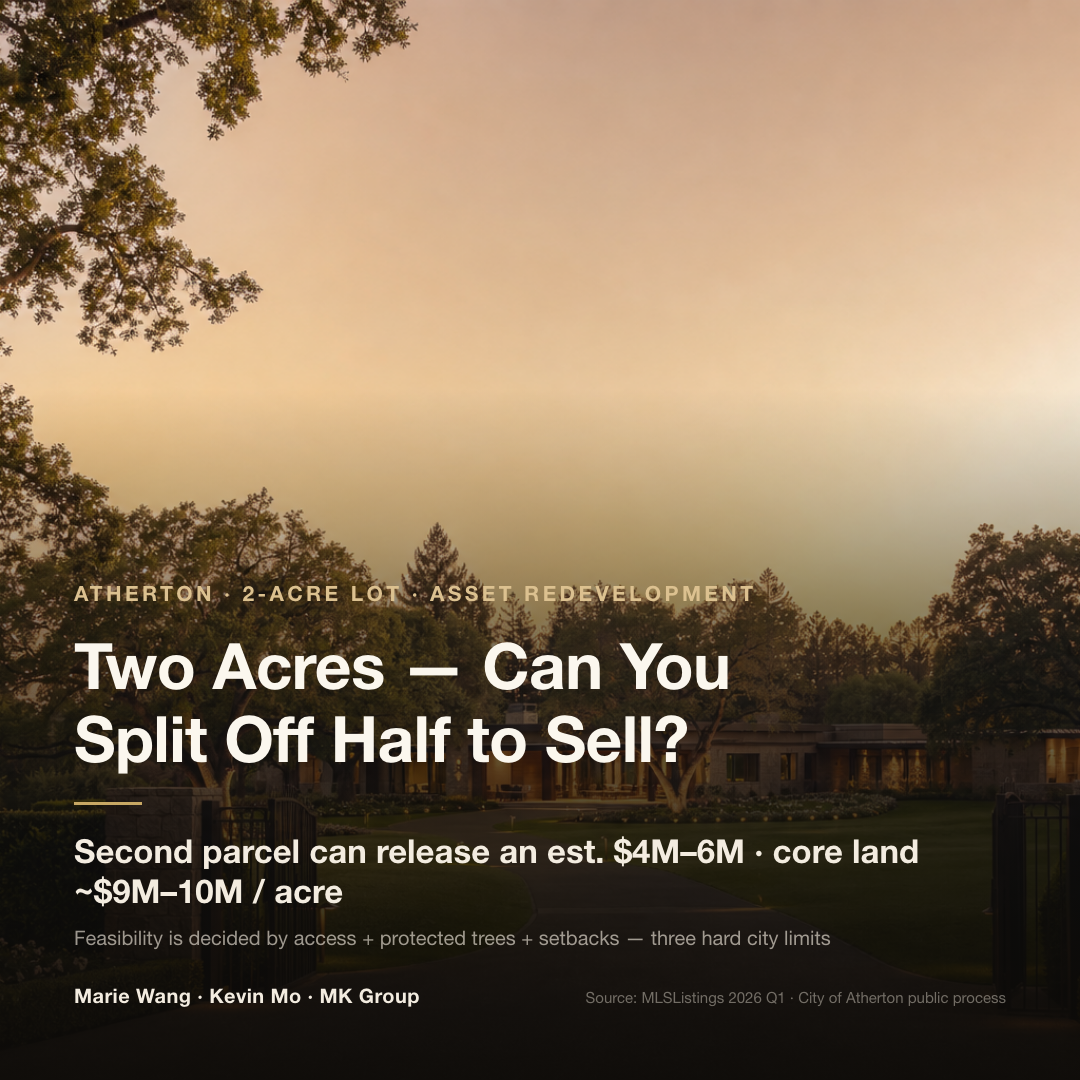
Whether you can split the lot isn't a question of willingness — it's decided by three hard limits set by the City of Atherton: the new parcel must have its own independent access, protected trees cannot be removed, and setbacks must clear. Pass all three and the second parcel can release an estimated $4M–6M, with core land running roughly $9M–10M per acre.
Who this article is for
This is written for owners who already hold a large parcel in Atherton or on the Peninsula — especially anyone sitting on 1.5 acres or more, or a full 2-acre estate, who is weighing whether the idle half can be carved off to cash out or rebuilt for value. If you bought purely to live in the home and never thought of the land itself as a second, developable asset, this gives you the framework to see whether that move is even possible and how much value it can release.
It also serves cross-border buyers about to purchase a large Atherton lot who want to judge the split potential before they commit. At the same total price, a parcel with room to subdivide is worth far more over time than its paper price-per-square-foot suggests.
Three core decisions
Whether a split works is decided by three dimensions together — none of them optional. The order below is also the order to evaluate them. If any one is blocked, there's no point running the next.
First: can the new parcel get its own access. This is the limit most owners overlook and the one that most often kills the split outright. The City of Atherton requires the new parcel to have its own street connection — it cannot share the existing driveway. That means the new parcel has to front a street it can tie into, and that independent access eats into usable area and reshapes the buildable footprint. Many lots that look like "one clean cut makes two" fail right here: the geometry of the land simply won't yield a second, independent street connection.
Second: are there protected trees on the lot. Atherton protects mature trees — oaks are the typical case — and a protected tree cannot be removed. (Note that this applies to lot splits and main-residence projects; under Government Code section 66323 three categories of ADU in the town code are exempt from the Heritage Tree Ordinance, which is a different standard — see what an Atherton lot and its neighbors can legally become.) Where a protected oak stands and how wide its canopy reaches directly governs the footprint and orientation of any new home. A single tree can "squeeze" a lot that is technically large enough into one that no longer holds the house you'd want to build. Before estimating any number, map every protected tree on the land — that comes before pricing.
Third: setbacks and the final buildable size. Independent access and protected trees, taken together and then layered with Atherton's setback requirements, decide how big a home the second parcel can actually hold. That buildable size — not the acreage — is the real variable that sets the second parcel's eventual price-per-square-foot, and therefore whether the entire split is worth pursuing at all.
How much value a split releases: the core-land math
The headline number first: Atherton's median sale price in 2026 Q1 was $15.71M (10 closings, source MLSListings 2026 Q1), and core-land value runs roughly $9M–10M per acre. That means once a 2-acre estate can be legally split into two independent 1-acre lots, the second parcel — valued on land alone — sits in the $4M–6M range. That is the estimate MK Group gives clients in real cases, not a promised sale price; the final number is set by the buildable size that survives the three hard limits above.
| Variable | Value / basis | Source |
|---|---|---|
| Atherton median sale price, 2026 Q1 | $15.71M (10 closings) | MLSListings 2026 Q1 |
| Atherton all-cash share, 2026 Q1 | 80% | MLSListings 2026 Q1 |
| Atherton median days on market, 2026 Q1 | 9 days | MLSListings 2026 Q1 |
| Core-land value per acre | roughly $9M–10M / acre | MK Group case-based estimate |
| Second parcel released after 2-acre split | roughly $4M–6M | MK Group case-based estimate |
| City of Atherton review feedback | about 1 week | City of Atherton public process / MK case |
| Hillsborough review feedback (for contrast) | about 1 month | MK case comparison |
The difference to remember: the second parcel's $4M–6M is not the 2-acre total cut in half. It's the net release after protected trees and independent access have already eaten into the buildable size. In other words, the value of a split lies not in the acreage itself but in how much house you can build once the three hard limits are cleared. Two identical 2-acre lots — one that splits cleanly, one blocked on independent access — release wildly different value.
Data sources: MLSListings 2026 Q1 (Atherton median sale price / all-cash share / days on market); City of Atherton public planning process; MK Group case-based estimate (core-land value per acre and second-parcel release).
Last updated: 2026-06
Scope: feasibility assessment for splitting Atherton lots of 1.5 acres or more; pricing reflects core-land value, and non-core areas require a separate estimate.
What MK Group has seen in the field
MK Group (Marie Wang, DRE# 02110980, and Kevin Mo, DRE# 02127623) assessed the split plan on a real 2-acre Atherton estate. The owner had been using it as a single estate and wanted to divide it into two 1-acre parcels — keep one to live in, sell the other. Marie and Kevin didn't stop at "go ask a lawyer." They called the City of Atherton planning department directly and got the conditions in writing. The city named two hard limits: the new 1-acre parcel could not share the existing driveway and required an independent access design, and the lot held two protected trees that could not be removed, which directly constrained the footprint and orientation of any new home. From there the team worked with the owner to judge the real value that could be released and whether a listing strategy held up — exactly the point where "can this be split" moves from vague to actionable.
In another real case, a cross-border high-net-worth buyer planning to live in the home long-term had locked onto a 2-acre, $13.5M new build in Atherton — then, after two viewings, wanted to walk away because "the garden is too big, I don't have the energy to maintain it." MK Group read the real concern: it wasn't price, it was a lack of imagination about how to use a large lot. The team introduced the California SB9 / SB10 split path and confirmed directly with Atherton planning that this lot's split needed only city approval — no county or state review, with the constraints being the new access design and a protected oak on the land. The buyer's frame was reset — from "it's too big" to "$13.5M for 2 acres is a great buy." If the split is ever executed, the separated second parcel is estimated to release $4M–6M at core-land pricing. Put the two cases side by side and the same truth shows from both angles: a split is a real asset-release option for owners of large Atherton lots, but whether it works is always decided by the city's three limits — access, protected trees, and setbacks.
Common mistakes
Mistake 1: "It's 2 acres — just cut it in half into two 1-acre lots."
Wrong. Whether it can be cut depends not on acreage but on geometry and the three hard city limits. The most counterintuitive part: estate-grade, 1-acre-baseline core areas like West Atherton are actually the hardest to split — the lot already sits near the minimum divisible unit, the estate trees are mature, and there's little room for independent access. The areas genuinely suited to a split are East Atherton, Fair Oaks, or select large-lot pockets. Same "Atherton," different sub-community, wildly different split potential. So "I have 2 acres" does not equal "I can split." First check which sub-community your lot sits in and whether its geometry can yield a second, independent street connection.
Mistake 2: "An SB9 split means layers of county and state review — too much hassle."
Wrong. California SB9 (passed 2021, effective 2022) allows a single lot to be divided into at most two, and in Atherton the split needs only City of Atherton approval — no county or state review. That's the answer MK Group confirmed by calling Atherton planning directly. (The final map is still recorded with the San Mateo County Recorder, but that is a recordation step, not a second layer of approval.) And because Atherton has just over 7,000 residents and a small caseload, its review feedback runs about a week — clearly faster than Hillsborough's roughly one month. Keep the distinction clear, though: that week is how long the town takes to come back with review comments, not the full tentative-map-to-final-map process. The town's own SB 9 project table listed 20 filings as of August 2026, of which only 7 were marked RECORDED — see what an Atherton lot and its neighbors can legally become. The procedural barrier is far smaller than most owners imagine; what actually blocks a split is never "do I have to escalate to the county," but the three physical limits: independent access, protected trees, and setbacks.
Mistake 3: "A lot split and adding an ADU are the same thing."
They aren't. Adding an ADU means building one more accessory dwelling on your existing single lot — the title stays as one parcel. A lot split divides one lot into two independent parcels, each separately sellable, with two titles. The mechanics, approval paths, and value logic are entirely different. To "sell half" you must do a lot split; adding an ADU will never give you a second, independently sellable parcel. Deciding which one you actually want is the first step of the assessment.
Next steps
- Locate your sub-community and lot geometry first. Confirm whether your land sits in West Atherton (hard to split) or in East Atherton / Fair Oaks / a large-lot pocket (more likely splittable), and whether the shape can yield a second, independent street access point.
- Map every protected tree on the land. Protected trees — typically oaks — cannot be removed, so fix their positions and canopy spread before estimating the second parcel's buildable footprint. This comes before pricing.
- Separate a lot split from an ADU. If you want to "sell half" or carry an independent parcel, you need a lot split; if you only want one more accessory dwelling, that's an ADU — completely different approval and value logic.
- Confirm your lot's specific conditions with the City of Atherton planning department. Get the three limits — independent access, setbacks, protected trees — pinned down to "actionable" for your specific land. The SB9 path needs only city approval, not county or state review.
- Estimate the second parcel's release on buildable size, not acreage. Core land runs roughly $9M–10M per acre, but the final number is set by the buildable size that survives the three hard limits — and that's what tells you whether the split's ROI is worth pursuing.
This article is for decision-making education and is not legal or tax advice. The applicability of SB9 / SB10, split approvals, protected-tree ordinances, and title structure vary by specific lot; confirm execution with a partnering attorney, CPA, and the city planning department.
Further reading
- Atherton Isn't One Luxury Market — How Different Are Its 7 Sub-Communities, and How Do You Pick the Right One?
- What Do Atherton's High-Net-Worth Buyers Actually Care About? Privacy, Scarcity, and the Order of the Decision
- Why Does $10M Buy Only a "Tear-Down" in Old Palo Alto? The Jobs House and the 70/30 Land-Value Law of Bay Area Luxury
- Is $6.5M for a 2,800 sqft New Build + ADU Worth It in Palo Alto? A New-Construction Decision Framework