The Direct Answer
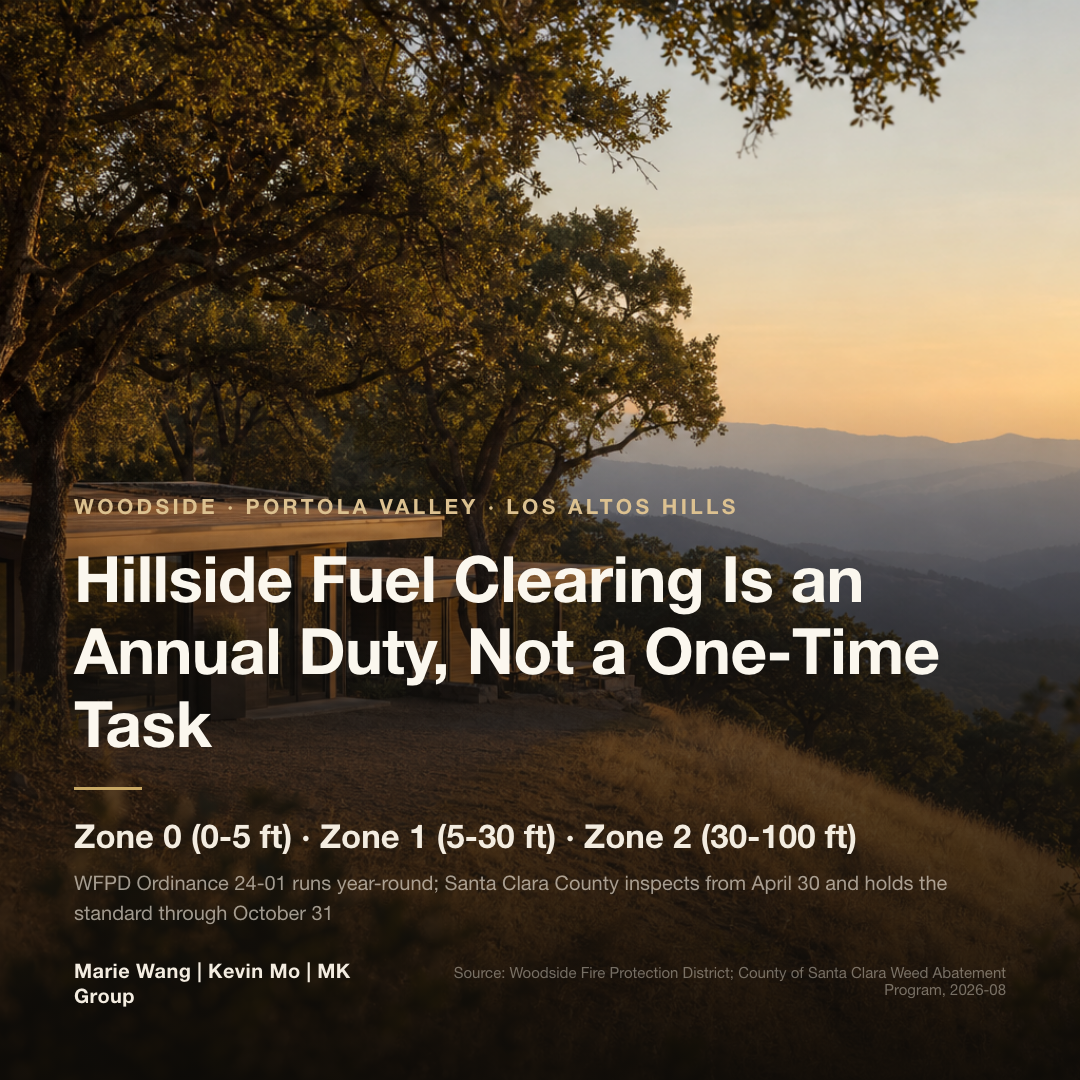
In these three hillside towns, wildfire fuel clearing is a legal obligation you repeat every year — not a task you complete once before closing. Woodside and Portola Valley fall under Woodside Fire Protection District Ordinance 24-01, which runs year-round and manages the full 100 feet around a structure in three bands: Zone 0, Zone 1, and Zone 2. Los Altos Hills runs on the Santa Clara County Weed Abatement Program, where the inspection window opens April 30 and the standard has to hold through October 31. Miss either and the agency does the work for you and bills you — landing on your next property-tax statement in one case, and — if it goes unpaid — becoming a lien against the property in the other.
Who this article is for
- Buyers touring large-lot properties in Woodside, Portola Valley, or Los Altos Hills. You have priced the house, the property tax, and the insurance. You have not yet priced what it costs to clear this land every single year.
- New owners who just received their first official notice. The envelope says Notice and Order to Abate, or it is a county weed-abatement inspection notice, and you want to know the clock, the standard, and what happens if you set it aside.
- Owners planning a remodel on an older hillside house. Portola Valley's material requirements for roofs, siding, deck surfaces, and fences will change both your budget and your specification.
- Cross-border and out-of-state buyers meeting California fire rules for the first time. Nowhere else you have owned treats brush clearance as a recurring legal duty that can turn into a lien on the property.
Three dimensions that decide the outcome
Dimension one: Which fire jurisdiction you land in sets your calendar and your penalties
Same hillside, same large lots wrapped in woodland and open space — two entirely different rulebooks. Woodside and Portola Valley are both served by the Woodside Fire Protection District, which also covers part of unincorporated San Mateo County. The governing instrument is the district's own local ordinance: Ordinance 24-01 (fuel mitigation), adopted April 30, 2024 and effective May 30, 2024, requires 100 feet of defensible space around every structure, managed in three bands — Zone 0 (0-5 feet), Zone 1 (5-30 feet), and Zone 2 (30-100 feet). A companion ordinance, 23-02, declares combustible vegetation and accumulated debris a public nuisance, applies year-round, and covers vacant lots the same way. There is no date after which you are finished for the year. The duty is continuous.
Los Altos Hills works through an entirely different channel. The town's annual mandatory mechanism is the Santa Clara County Weed Abatement Program, authorized by California Health and Safety Code sections 14875-14922. The county assigns each jurisdiction a date on which its inspection window opens; Los Altos Hills shares April 30 with Cupertino, Los Altos, Palo Alto, and Saratoga. Every part of the county must then hold the minimum fire safety standard through October 31 each year. Getting off the program list takes three consecutive years of compliance. The 0-5 / 5-30 / 30-100 home ignition zones do appear in Los Altos Hills, but through the county fire district (LAHCFD) as guidance and support programs — a Home Ignition Zone assessment and rebate, monthly brush chipping, and a vegetation drop-off at Foothill College Parking Lot 1 on the third Saturday of each month, 9:00 am to 2:00 pm.
Put plainly: a buyer choosing between these towns is not only choosing between two pieces of land. They are choosing between two annual calendars and two penalty regimes. That belongs in pre-offer diligence, not in the week the first letter arrives.
Dimension two: The state Zone 0 rule is still a draft — your town may have been enforcing it for two years
The rule that no combustible material sits in the first five feet around a structure is now called Zone 0. It traces to AB 3074 (2020), which directed the California Board of Forestry and Fire Protection to write the implementing regulations; SB 504 (2024) added that new and existing structures meet the same standard, and that the rules themselves must address the cost of compliance. Executive Order N-18-25 set a deadline of December 31, 2025 for the Board to finish. That deadline passed. In April 2026 the Board released a revised draft that splits the five feet into a noncombustible band beneath the eaves and a low-combustible area for the remainder — small potted plants, in-ground non-woody plants under 18 inches, lawn or ground cover under 3 inches, and well-maintained trees are all allowed — with a phase-in of three years for the easier clearing work and five years for the harder material swaps like gates, fencing, and sheds. As of August 12, 2026, the statewide rule has not been adopted; the Board is scheduled to consider adoption at its August 19 meeting.
None of which matters much if you own in Woodside or Portola Valley, because WFPD Ordinance 24-01 made Zone 0 a local legal duty on May 30, 2024 — more than two years ahead of the state. The district is blunt about the framing: within this ordinance, Zone 0 is the only genuinely new requirement. Zones 1 and 2 have existed for years; what changed is that they moved from recommended to required. Enforcement is still rolling out in stages. The district works through home assessments on a three-year rotation, properties that have not yet been assessed are not subject to enforcement action, and once assessed, an owner demonstrating substantial progress has roughly a year to come into compliance. For a buyer who just closed, that window is worth knowing about — not as a reason to skip the work, but as room to do it properly.
Dimension three: Clear it, but do not cut it — both rules apply to you at once
The gap hillside buyers most often underestimate sits between the duty to clear and the ordinance protecting the trees. Portola Valley requires a permit to remove a significant tree, with thresholds set by species: oak and bay laurel over 11.5 inches in diameter, redwood and fir over 17.2 inches, maple and madrone over 7.6 inches. Woodside measures differently. Under Section 153.005 of the town's zoning ordinance, trunk circumference is measured 48 inches above mean natural grade: slower-growing natives (alder, big leaf maple, blue oak, buckeye, Fremont cottonwood, madrone, tan bark oak) qualify at 24 inches of circumference, roughly 7.6 inches in diameter; faster-growing natives (black oak, California bay laurel, coast live oak, coast redwood, Douglas fir, valley oak, western sycamore) at 30 inches, roughly 9.5 inches; everything else at 36 inches, roughly 11.5 inches. Removal requires a Tree Destruction Permit. Los Altos Hills protects Heritage Oaks: under town code section 12-2.101, any tree of the genus Quercus with a trunk circumference of 36 inches — about 12 inches in diameter — measured 4 feet above the root crown is protected, and removal requires a permit.
Portola Valley also regulates from the planting side. Since May 2021 the town has banned new plantings of the "Flammable Five" — juniper, cypress, acacia, pine, and eucalyptus. WFPD's annual abatement requirements name the same group plus bamboo, and recommend clearing that vegetation within 10 feet of the roadway.
The good news is that these two duties are reconcilable. The Board of Forestry's own Zone 0 FAQ (September 2025) states explicitly that trees may remain within Zone 0 provided they are well maintained, limbed up, free of dead branches, and kept clear of the roof and walls by 5 feet and the chimney by 10 feet — and that single-specimen trees, along with trees protected by local ordinance, are exempted. The correct order of operations is to identify the trees and their measurements first, then design the clearing plan around them. Not to have a crew take them down and apply for the permit afterward. In Woodside, removing a significant tree requires a Tree Destruction Permit under section 153.435 of the zoning ordinance, and by the town's own application form an issued permit lapses two years after issuance unless extended (section 153.917).
Three towns, two enforcement regimes: the annual obligations side by side
The core figures first: both regimes clear the same 100 feet around the structure, and WFPD further splits it into Zone 0 (0-5 ft), Zone 1 (5-30 ft), and Zone 2 (30-100 ft). In Woodside and Portola Valley the duty runs year-round with no "done for the season" date, and if you fall behind, the district clears the property and bills you — with unpaid amounts converting after 30 days into a special assessment and a lien against the property. In Los Altos Hills the inspection window opens April 30 and the standard holds through October 31; for a parcel on the county's weed-abatement list, comply on time in 2026 and the only fee is the $296 initial inspection, while non-compliance adds a $953 work-order processing fee, a $1,383 administrative fee, and the contractor's actual cost, all placed on your next property-tax statement.
| Whose rules apply | The annual clock | What non-compliance costs |
|---|---|---|
| Woodside and Portola Valley (WFPD Ordinances 24-01 and 23-02) | Year-round, no single deadline; home assessments roll out on a three-year rotation. Portola Valley adds a town-level weed-abatement deadline of July 1 | 10 days to correct after a notice; if a re-inspection still fails, the district hires a contractor and bills the work. Unpaid 30 days, it becomes a special assessment and a lien against the property, reported to the San Mateo County Clerk-Recorder |
| Los Altos Hills (Santa Clara County Weed Abatement Program) | Inspection window opens April 30; the standard must hold through October 31; three consecutive compliant years to exit the program | 2026: $296 initial inspection; non-compliance adds a $953 work order, a $1,383 administrative fee, a $3,006 warrant fee and 100% of the contractor invoice, collected on your next property-tax statement |
The table lists only obligations already in force. The statewide Zone 0 rule was still a draft as of August 12, 2026 — the California Board of Forestry and Fire Protection is scheduled to consider adoption at its August 19 meeting — so it is not yet an obligation in any of these towns. WFPD's jurisdiction, by contrast, has enforced Zone 0 under local ordinance since May 30, 2024, as covered in dimension two above.
The one thing to remember: what changes your financial position here is not the clearing — it is the accounting treatment of not clearing. Santa Clara County attaches the unpaid amount to your next property-tax statement. WFPD, after 30 days, converts it into a special assessment and a lien against the property and reports it to the county recorder. Both routes leave a record tied to title or to tax, and records of that kind surface again when you refinance, when you sell, and when a title search runs. On a hillside property, fuel clearing is not a soft line in the landscaping budget. It sits with property tax and insurance as a hard cost of holding the asset.
What MK Group sees on the ground
On a hillside property, the annual obligations are a work stream that begins after closing, not before it. In May 2026 MK Group — founders Marie Wang (DRE# 02110980) and Kevin Mo (DRE# 02127623) — represented a buyer purchasing through a corporate entity on an all-cash basis in Los Altos Hills, at roughly $11M. The hard part of that transaction was structure rather than speed: the team worked through the holding entity, the funds path, and the authorization documents first, then moved the closing forward — and after handover continued to help coordinate the fixture replacement, track furniture shipped from overseas, and arrange the move-in setup. The point MK Group draws from that case is simple. Closing is not the finish line; it is where the holding period starts.
Applied to fire obligations, that has a concrete meaning. Once title to a large Los Altos Hills parcel is in your name, the county's inspection window arrives on its own April 30 rhythm and the standard runs through October 31 — regardless of what month you closed, whether you are living there yet, or how recently the house was finished. Buyers holding through an entity or a trust carry one extra layer of risk: official notices go to the owner of record at the address on file, and if that address is a law firm or a registered agent, half of a 10-day correction window can be gone before the notice reaches anyone who can act on it. So on a hillside property, three things — confirming the fire jurisdiction, confirming where official notices will be delivered, and lining up an annual clearing contractor — belong on the post-closing list alongside the fixtures and the furniture, rather than waiting for the first letter to raise the subject.
For clarity: what is recapped here is the buyer profile and the obligations common to hillside property. It does not imply this buyer encountered any specific problem with fuel clearing, notice delivery or tree permits, or that the property appears on any abatement list. The actual requirement on any given property follows the on-site assessment by its own fire agency.
Common misconceptions
"Isn't fuel clearing something the seller handles before handover?"
What happens before handover is usually the AB 38 defensible space inspection, which exists to give the buyer documentation of compliance — and WFPD has extended that inspection across its whole district, no longer limiting it to very-high fire hazard zones. But that is a one-time transaction document, not the duty of ownership. What follows the house is the annual clearing. WFPD's jurisdiction runs year-round; Portola Valley adds a town-level weed-abatement deadline of July 1 that sits on top of that duty rather than replacing it; and the Los Altos Hills county window opens April 30 and holds through October 31. None of those dates bend around your closing date, and none of them defer because you only just bought.
"I'm in Los Altos Hills — does Woodside's Zone 0 ordinance have anything to do with me?"
True as stated, and usually followed by the wrong conclusion. Zone 0 is not a local mandate in Los Altos Hills today, and as of August 12, 2026 the statewide rule is still a draft with adoption scheduled for consideration on August 19. But if it is adopted, it reaches the State Responsibility Area plus locally designated very-high fire hazard zones, with a three-to-five-year phase-in for existing structures. The question worth answering is not "does this bind me today," it is "under the current draft, what does this parcel have to look like in three years, and what will that cost." Fences, gates, and sheds are exactly the items given the five-year runway — because replacing them is the expensive part.
"If I ignore the notice, isn't the worst case just a fine?"
Neither mechanism is a simple ticket. WFPD's sequence: 10 days to correct after the notice, a re-inspection 10 to 15 days later, then a Notice and Intent to Abate with another 10 days, after which the district sends a contractor and issues an invoice that may include a non-compliance fee, an administrative fee and the contractor’s abatement cost. Unpaid for 30 days, that becomes a special assessment and a lien against the property, reported to the San Mateo County Clerk-Recorder. Santa Clara County simply attaches the cost to your next property-tax statement — in 2026, $953 for the non-compliant work order, $1,383 in administrative fees, $3,006 for a warrant, plus the contractor's invoice passed through in full. Both routes leave a record bound to title or to tax.
"Do I really need a permit to cut a tree on my own land?"
All three towns set tree-permit thresholds, and the thresholds are measured differently in each. Portola Valley works in diameter: oak and bay laurel at 11.5 inches, redwood and fir at 17.2 inches, maple and madrone at 7.6 inches. Woodside works in circumference measured 48 inches above grade, in three tiers — 24 inches for slower-growing natives, 30 inches for faster-growing natives, 36 inches for everything else — and removal requires a Tree Destruction Permit under section 153.435 of the zoning ordinance. Los Altos Hills protects Heritage Oaks at 36 inches of circumference measured 4 feet above the root crown. The state's own Zone 0 draft exempts trees protected by local ordinance and allows well-maintained trees to stay inside the five feet. Identify species and measurements first, design the clearing plan second, and file for permits alongside.
"Isn't all 100 feet of my defensible space on my own land anyway?"
Large hillside parcels frequently back onto Midpeninsula Regional Open Space District land, and the buffer crosses the boundary easily. WFPD's guidance is explicit: reducing vegetation on Midpen land within 100 feet of an occupied structure requires a separate Neighbor Defensible Space Permit. On some parcels, in other words, part of your ability to comply depends on a permit from a third-party agency rather than on whether you can hire a crew. Read the parcel map and the adjoining ownership while you are still touring.
Next steps
- Confirm which fire jurisdiction the property sits in. For a Woodside or Portola Valley address, check WFPD Ordinance 24-01 and where the property sits in the home-assessment rotation. For a Los Altos Hills address, check the Santa Clara County Weed Abatement Program's inspection window and whether the parcel is already on the list. The calendars and the penalties are not the same.
- Put the annual clearing on a calendar, and confirm where official notices will land. If you hold through an entity or a trust, verify that a notice can reach a decision-maker inside the 10-day correction window; on the structure choice itself, see holding a Bay Area home in a trust versus an LLC.
- Check material requirements before you remodel. Since January 2022 Portola Valley has required Class A roofing, noncombustible siding, noncombustible deck walking surfaces (wood composites such as Trex and TimberTech are not permitted), noncombustible fences and gates within 10 feet of the home, and enclosed eaves. These change both specification and budget — plan them alongside the seven-town Bay Area remodel permit comparison.
- Price fuel clearing and insurance together. Clearing is one of the conditions of remaining insurable, and insurance availability and cost in these towns is its own separate problem — see why a multi-million-dollar estate in Woodside or Portola Valley may not be insurable (or affordable to insure).
- Fold both into the total holding-cost sheet. The annual labor for clearing behaves like the premium: a fixed line in the long-term hold. See the full picture of the total cost of homeownership: the hidden costs beyond your monthly payment.
- Add it to the post-closing list. Jurisdiction, notice address, and annual contractor belong next to the finishes, the furniture, and the ownership structure — see after you close on a multi-million-dollar Silicon Valley home, which headaches still need lining up in advance?.