Direct answer
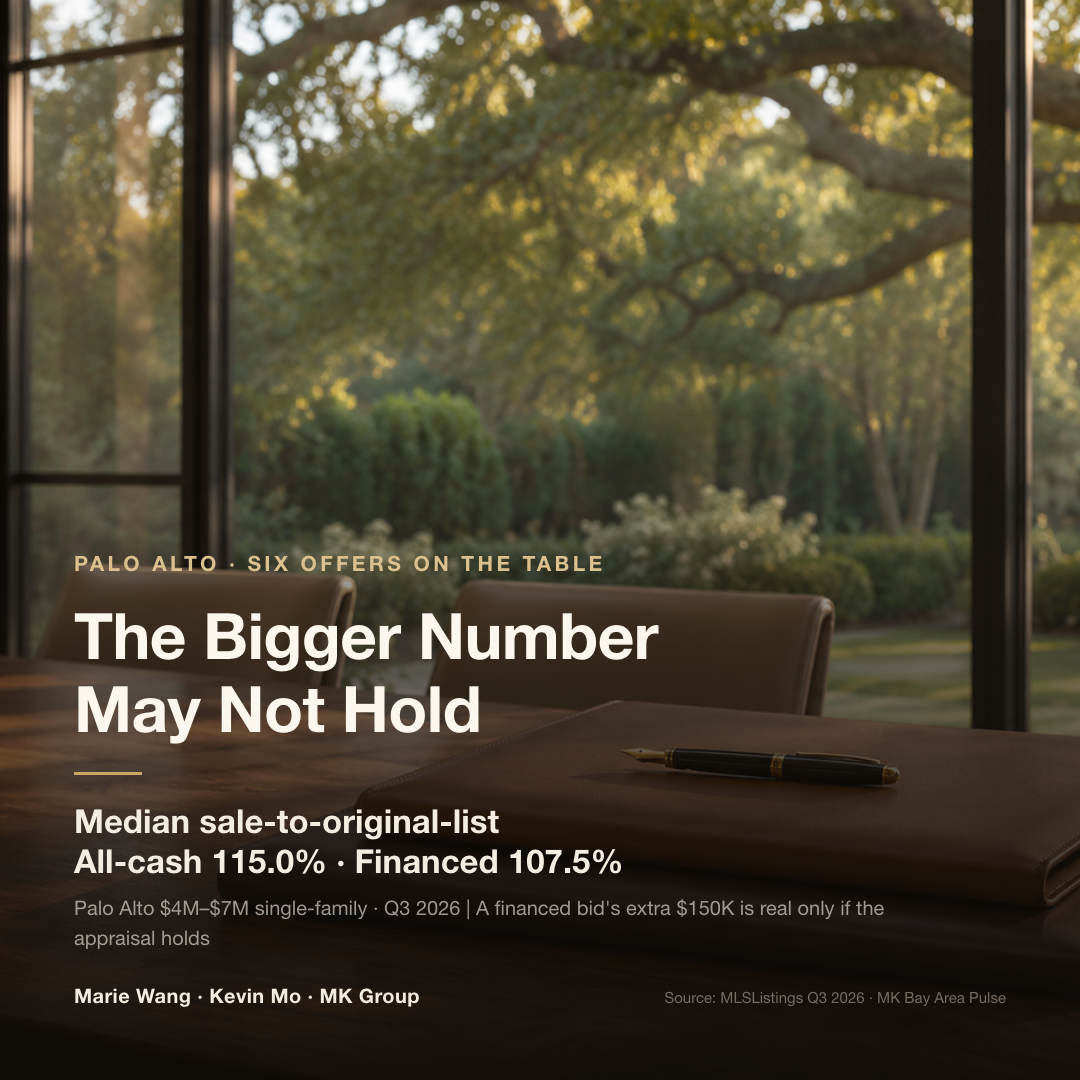
Not necessarily the highest one. Rank offers by their floor under an appraisal stress test. With a $5M list price, a $5.6M financed offer and a $5.45M all-cash offer, if the appraisal only reaches list, the financed buyer must guarantee at least $450K of the gap in writing just to tie the cash offer. In Q3 2026, Palo Alto single-family homes at $4M–$7M sold at a median 115.0% of original list price when all-cash, against 107.5% with a conventional loan (MLSListings).
And yes, you can counter several buyers at once. C.A.R.'s Seller Multiple Counter Offer (SMCO) lets you counter the top two or three at the same time. When a buyer signs one back, there is still no contract until you sign last and deliver it. The ranking itself comes down to three things: the price spread, the written appraisal-gap guarantee and the contingency days. Run the numbers above. If the appraisal only meets list, the financed offer is $600K short. With a written guarantee of just $300K, the unguaranteed $300K is larger than the $150K between the two offers, so the cash offer has the higher floor. In the same quarter, 11 of the 29 conventional-loan sales in this band closed at 110% or more of original list price (MLSListings). Here, a financed buyer bidding 10% over list is nothing unusual. Whether the appraisal keeps up is the math a seller should finish before signing.
Who this article is for
- Sellers of $4M–$7M single-family homes in Palo Alto, Los Altos or Menlo Park who are past the offer deadline with several offers in hand and need to rank them
- Owners whose highest offer is financed and whose runner-up is all-cash, and who can't tell which one is safer
- Sellers who want one more round with the top two or three buyers without accidentally ending up in two contracts
- Families selling a home held in a trust that needs several trustees to sign, or owners out of state or overseas who have to compare offers and sign remotely
Three dimensions that decide the ranking
Ranking multiple offers comes down to one question: in the worst plausible case, how much does this offer still put in your pocket? Call it the certainty-weighted net. Three things set it: the price spread, whether an appraisal gap is guaranteed in writing, and how many contingency days remain, together with how strong the proof of funds is.
Dimension one: how big the spread is, and what to measure it against
In the example, the two offers are $150K apart, about 2.8% of the cash offer. Measure that number against two things. One is the gap an appraisal stress test leaves uncovered by the buyer's guarantee. The other is what local cash buyers typically pay. In Q3 2026, Palo Alto single-family homes at $4M–$7M sold at a median 115.0% of original list price across 20 all-cash sales, against 107.5% across 29 conventional-loan sales (MLSListings). Cash buyers at this price point don't bid low. So when a financed offer sits on top and cash comes in second, that $150K is more likely the premium a financed buyer added to outbid the certainty of cash. Whether you actually collect it depends on the appraisal.
Dimension two: whether the appraisal gap is guaranteed in writing, and up to what amount
A lender lends against the lower of the contract price and the appraised value. When the appraisal comes in under the contract price, the buyer has to cover the difference in cash; if they can't, the deal goes back to negotiation or the buyer cancels. For how the gap and the exits look from the buyer's side, see I Won a $5M Palo Alto Home With a Loan by Bidding 10% Over Asking, but the Appraisal Came In Low — Do I Have to Cover the Gap in Cash, and Can I Still Back Out? So only two parts of a financed offer's price are solid: the part the appraisal supports, and the part the buyer has agreed in writing to cover. In the C.A.R. California Residential Purchase Agreement (RPA), the appraisal contingency line is printed as "appraised value at a minimum of purchase price," with a box to enter a different dollar amount instead. In the publicly available 12/21 version this is paragraph 3L(2), and paragraph 8B(1) makes the contract contingent on an appraisal at no less than that amount. A $5.6M offer that enters $5.3M on that line has the buyer carrying up to $300K of any gap under the contract. Some buyers instead add a term saying they will cover an appraisal shortfall up to a stated cap, which works much the same way. What happens beyond the cap, whether renegotiation, cancellation or something else, depends on the exact wording, so read it line by line.
Read any guarantee for three things. First, it counts only if it's in the contract. A verbal or emailed promise binds no one once the appraisal arrives. Second, the cap. Subtract it from the offer price to get the break-even appraisal: $5.3M here, or 106% of list. At or above that number you collect the full $5.6M; below it, the deal is back on the negotiating table. Third, whether the buyer can actually pay. If the appraisal lands at $5.3M, the 80% loan ceiling drops from $4.48M to $4.24M, and the buyer's cash requirement rises from $1.12M to $1.36M. The proof of funds needs to cover that figure plus closing costs. A $4.48M loan sits far above FHFA's 2026 conforming limit of $1,249,125 for Santa Clara County, which makes it a jumbo loan, and the appraisal follows the lender's own rules. Above a certain loan size, lenders commonly order two appraisals and use the lower one; the threshold varies by lender.
Dimension three: how many contingency days remain, and how strong the proof of funds is
Every contingency not yet removed is a door the buyer can use to leave with the deposit. The RPA's printed default for the loan, appraisal and investigation (inspection) contingencies is 17 days after acceptance. That's in the 12/21 version; the blanks can be changed, and the loan and appraisal lines each carry a box to waive the contingency entirely. When comparing offers, compute one number: the day after acceptance on which the buyer no longer has a contractual reason to walk. In the example, it's day 17 for the financed offer and day 5 for cash. Even then, a contingency doesn't disappear when its deadline passes without a written removal. The seller usually has to deliver a Notice to Buyer to Perform (C.A.R. Form NBP) and give the buyer at least 2 days before gaining the right to cancel, so in practice the exposure runs past 17 days. The pace to closing differs too. In Q3 2026, Palo Alto single-family homes at $4M–$7M took a median 10.5 days from pending to close when all-cash, against 21 days with a conventional loan (MLSListings).
Proof of funds comes in grades. On the financed side, a pre-qualification built mostly on what the buyer reports is the weakest. A pre-approval, with credit and income documents reviewed, sits in the middle. An approval letter from a lender that has finished underwriting, with only property conditions such as appraisal and title left open, is the strongest. On the cash side, an account screenshot is the weakest, a proof-of-funds letter you can verify by calling the bank sits in the middle, and funds already in escrow are the strongest. When the buyer is an LLC or a trust, or the money sits overseas, see A Buyer Sent an All-Cash Offer in the Name of an LLC — How Do I Verify, as the Seller, That They Can Really Pay and Close on Time? Check the amounts on both sides. A financed buyer's proof should cover the down payment, the guaranteed gap and closing costs; a cash buyer's should cover the full price plus closing costs.
Worked example: $5.6M financed vs. $5.45M cash, and what you net at each appraisal
Key numbers first: the list price is $5M. The financed offer is $5.6M (12% over list), and the buyer carries up to $300K of any appraisal gap in writing. The cash offer is $5.45M (9% over list). As long as the appraisal comes in at $5.3M or higher, the financed offer nets you $150K more. If it only reaches the $5M list price, $300K of the $600K gap is unguaranteed. Concede all of it and you're left with $5.3M, $150K less than the cash offer, and the buyer can still choose to cancel.
| Item | Financed offer | All-cash offer |
|---|---|---|
| Price | $5,600,000 (12% over list) | $5,450,000 (9% over list) |
| Financing | 80% loan, $4,480,000; down payment $1,120,000 | All cash, no loan |
| Appraisal contingency | Kept, set at $5,300,000, so the buyer carries up to $300,000 of any gap; 10 days | None (no lender, so no lender appraisal) |
| Loan contingency | 17 days | None |
| Investigation (inspection) contingency | Waived (buyer reviewed the seller's pre-listing inspection report) | 5 days |
| Last day the buyer can cancel under a contingency | Day 17 after acceptance | Day 5 after acceptance |
| Proof of funds | Lender approval letter after underwriting; deposit statements covering $1,360,000 plus closing costs | Bank proof-of-funds letter, verifiable by phone, covering the full price plus closing costs |
| Appraisal at $5,300,000 or higher | $5,600,000; buyer covers any gap | $5,450,000 |
| Appraisal at $5,000,000 (equal to list) | $600,000 gap, $300,000 guaranteed; the rest goes to renegotiation, a seller concession or buyer cancellation; a full concession nets $5,300,000 | $5,450,000 |
| Floor under the stress test | $5,300,000, and the buyer can still cancel under the appraisal contingency | $5,450,000 |
What to remember: set the gap the stress test leaves unguaranteed directly against the spread between the two offers. Here the unguaranteed gap is $300K, larger than the $150K spread, so the cash offer has the higher floor. If the buyer raises the guarantee to $450K, the two offers tie at an appraisal equal to list. At $600K, the buyer pays the full $5.6M even if the appraisal only meets list; only then is the financed offer better in every scenario, and the buyer needs $1.6M in cash. A financed offer with no guarantee at all, with the appraisal contingency kept at the purchase price, puts the whole $600K gap back on the table at an appraisal equal to list, and the worst case lands at $5M. Using list price as the appraisal floor is a conservative stress test. Of 49 sales in this Palo Alto band this quarter, only 5 closed below original list price, so list usually sits under the final price. For a more realistic floor, have your agent estimate one from comparable closed sales over the past 3–6 months. The table leaves out closing-related costs; they scale roughly with price and don't change the ranking.
Palo Alto at $4M–$7M: cash buyers already pay up
Key numbers first: Palo Alto recorded 49 single-family sales at $4M–$7M in Q3 2026. The 20 all-cash sales closed at a median 115.0% of original list price, and none closed below it. The 29 conventional-loan sales closed at a median 107.5%; 11 reached 110% or more and 5 closed below original list (MLSListings, compiled by MK Bay Area Pulse).
| Scope · terms | Sales | Sale / original list (median) | At 110% or more | Below original list | Median days on market | Pending to close (median) |
|---|---|---|---|---|---|---|
| Palo Alto · all-cash | 20 | 115.0% | 14 | 0 | 7 days | 10.5 days |
| Palo Alto · conventional loan | 29 | 107.5% | 11 | 5 | 9 days | 21 days |
| Four cities · all-cash | 58 | 108.1% | 24 | 7 | 7 days | 9 days |
| Four cities · conventional loan | 91 | 104.1% | 23 | 24 | 8 days | 21 days |
What to remember: these are different homes, not two offers on the same home. Cash buyers cluster on the most sought-after homes, and those sell high anyway. Still, the numbers are enough to retire the instinct that a cash offer should come in a little lower because cash earns a discount. Widen the lens to the same price band across Palo Alto, Los Altos, Menlo Park and Saratoga and the direction holds: cash at 108.1%, financed at 104.1%, with Palo Alto showing the widest gap between the two buyer types of the four. The four-city ratios count only the 56 cash and 88 financed sales with an original list price. A same-city, same-band comparison across three Bay Area counties points the same way: in Q3 2026, in the $3M–$10M range, all-cash sales closed on average about 3.2 percentage points higher relative to original list price than financed sales. See I'm Buying a $5M Bay Area Home All-Cash — Will the Seller Give Me a Discount for Paying Cash? So when your cash offer comes in $150K below the financed one, that $150K is most likely what the financed buyer added to offset appraisal and loan uncertainty, which is exactly the part dimension two asks you to verify.
After the ranking: counter one buyer, or several at once
Step 1: decide how many buyers get a counter
Of six offers, first set aside the ones clearly behind: those contingent on the buyer selling another home, those whose proof of funds is a single screenshot, and those with contingency periods far longer than the rest. Rank what remains by floor, using the method above. If the leader is clearly ahead even in the worst case, accept it outright, or counter it alone to adjust a term or two. Countering several at once only makes sense when the top two or three floors are close. C.A.R.'s Seller Counter Offer (SCO) is built for one-to-one counters: once the buyer signs it back and delivers it within the deadline, a contract may form. To counter several buyers at once, use the Seller Multiple Counter Offer (SMCO). After a buyer signs it back, the seller must still sign the final acceptance on the form and deliver it before a contract forms. For how the two forms differ, and how they're used when a buyer pushes a preemptive offer, see I Just Listed in Palo Alto and, Two Days In, a Buyer Wants Me to Sign a Preemptive Offer Before the Offer Deadline — Should I Take It?
Step 2: what every SMCO in the round should ask for
Each buyer gets their own SMCO, and the terms can differ. It works better to ask everyone in the same round for the same set of terms, so the signed-back versions line up side by side. The usual items:
- Price: each buyer's highest and best price for this round
- Appraisal: financed buyers set the appraisal contingency at a specific dollar amount, or sign a written gap guarantee with a stated cap. Work the amount back from the break-even appraisal in dimension two; in the example, the guarantee needs to be at least $450K for the floor to match the cash offer
- Contingency periods: bring appraisal, loan and investigation to one common number of days, or state which ones are waived
- Deposit: the initial deposit amount and when it reaches escrow (the RPA default is within 3 business days after acceptance)
- Proof of funds: financed buyers attach the lender's latest approval letter, cash buyers a proof of funds covering the full price, and the amounts on both should reconcile with the down payment, the guaranteed gap and closing costs
- The closing date, and whether you need a rent-back after closing
Step 3: how to set the deadlines
Give every SMCO in the round the same response deadline. Don't stagger it between buyers. Staggering forces whoever expires first to commit with less information, and it invites questions about fairness. Under NAR Code of Ethics Standard of Practice 1-6, the listing broker should present offers and counter-offers objectively and as quickly as possible in any case. The gap worth building in is between the buyers' deadline and your own final signature. Leave a few hours after the deadline to call each lender and confirm the approval level, and to check the updated proof of funds, then sign. If the home is held in a trust that needs several trustees to sign, or you're out of state or overseas, agree on the timing and method of the final signature in advance. Otherwise the ranking is done but the signature never happens.
Step 4: once counters come back, whom to sign
The order in which counters come back doesn't set priority. The SMCO gives no priority to the first buyer to sign back, and the seller has no obligation to sign any returned SMCO. Run each buyer's new terms back through the stress test, re-rank, and sign the final acceptance only on the leader's form, then deliver it. Until it's delivered, no contract exists, and a buyer who signed back can usually still withdraw. So sign once the ranking is done rather than sitting on it. Tell the others in writing that you've gone with another buyer, or ask the runner-up to convert to a back-up offer in writing. Until closing, the listing broker must still pass new offers and counter-offers to you, unless you've waived that in writing (NAR Standard of Practice 1-7). NAR's guidance on multiple offers also says that whether to counter, and which offer if any to accept, is decided by the seller, not by the listing broker.
MK Group in practice
Three transactions MK Group has handled show the same thing from different positions: when a seller decides, price isn't the only thing on the scale.
The first is an off-market Atherton home of about $18M in May 2026, where Marie Wang (DRE# 02110980) and Kevin Mo (DRE# 02127623) represented the buyer. The buyer was financing about $10M, the offer was not the highest on the table at the time, and the seller had no shortage of well-capitalized all-cash buyers. The owner felt this buyer met his expectations in many ways; after meeting in person, he accepted the offer that same evening. The case record credits the outcome to a close fit between buyer and home, plus a buyer side that made each element of closing certainty concrete. This is an $18M off-market buy-side case, a different situation from a $5M Palo Alto listing drawing multiple offers. Read from the seller's chair, though, what the owner weighed in ranking went beyond price (case details).
The other two serve only as supporting evidence. One is a Palo Alto relocation sale, reviewed in February 2026. After about three weeks on the market it had drawn a single low offer, and the owner, under time pressure from an out-of-state job, was close to taking it. Signing needed approval from the relocation company, which held things up for 10 days. The team kept marketing and matching buyers through those 10 days, found a higher-quality buyer, and sold for about $100K more than the offer the owner had been ready to accept (case details). The principle is the same one behind the SMCO: until the final signature, the choice stays with the seller. The other is a sale in a gated Palo Alto community. A single pre-listing video brought a buyer who made an all-cash offer within 48 hours of the showing, with no open house held at all. The review credits two things: speed, and an all-cash buyer who took loan-approval uncertainty off the table. The sale price wasn't disclosed, and the case is cited here only to show that the value of a cash offer lies mainly in its certainty (case details).
Common mistakes
Mistake 1: "The highest offer is the best offer"
Price is the best-case number. In a financed offer, the slice the appraisal can't support and the buyer hasn't guaranteed in writing comes due later: you concede it, you renegotiate, or the buyer walks under the appraisal contingency. Convert each offer to its floor under the appraisal stress test before ranking. In the example, the $5.6M financed offer with only a $300K guarantee has a floor of $5.3M, below the $5.45M cash offer. Fold in the contingency days and the closing date as well: is an extra week of waiting, plus one more appraisal risk, being paid for?
Mistake 2: "A cash offer comes in lower because cash buyers expect a discount"
In Palo Alto at $4M–$7M, the data points the other way. In Q3 2026, all-cash sales closed at a median 115.0% of original list price against 107.5% for conventional loans, and none of the 20 cash sales closed below original list (MLSListings). Cash buyers here can pay up; they simply price their own certainty into the bid, with no appraisal contingency, no loan contingency and a median 10.5 days to close. When comparing, put a dollar value on that certainty and weigh it against the spread.
Mistake 3: "The buyer said they'd cover an appraisal gap, so it's guaranteed"
It counts only if it's in the contract. Two forms are common: entering a dollar amount below the price on the RPA's appraisal contingency line, or adding a term that caps how much of the gap the buyer will cover. A verbal assurance, or an email saying they're willing to cover it, binds no one once the appraisal arrives. A buyer can also check the box for no appraisal contingency. The RPA's printed terms say that in that case, if the buyer can't obtain the loan solely because the appraisal came in below the specified amount, the buyer can't use the loan contingency to cancel, and the seller may be entitled to the deposit or other remedies. But the deposit only goes so far. Even with a signed liquidated damages clause, for a buyer-occupied 1–4 unit home the RPA caps it at 3% of the purchase price (see also California Civil Code §1675). On a $5.6M contract that's about $168K, which doesn't make up for the time and the buyers lost by relisting.
Mistake 4: "If I counter several buyers at once, I have to sell to whoever signs back first"
Not with an SMCO. A buyer signing back is only a statement of intent; a contract forms after the seller signs the final acceptance on the form and delivers it. Signing back first carries no priority, and the seller has no obligation to sign any returned SMCO. Once the counters are back, run each buyer's new terms through the stress test again and sign only for the leader. The flip side: until delivery, there's no contract. Sign as soon as the ranking is done. Sit on it, and the leading buyer may withdraw first.
Mistake 5: "Once a contingency deadline passes without removal, I can turn around and sign the next buyer"
Not directly. Under the RPA, the buyer removes contingencies in writing. If the deadline passes without a removal, the contingency stays in place. To cancel, the seller usually delivers a Notice to Buyer to Perform (C.A.R. Form NBP) first and gives the buyer at least 2 days; only if the buyer still doesn't act does the seller gain the right to cancel. Sign a second contract before then and you may owe obligations to two buyers at once. If you're holding a back-up offer, confirm that the original contract has been properly cancelled and the cancellation is signed before the back-up steps in.
Next steps
- Put every offer in one table: price, loan-to-value, whether the appraisal contingency is set at the price or at a dollar amount, the gap-guarantee cap, the loan, appraisal and investigation periods, proof-of-funds grade, deposit and closing date. Move offers contingent on selling another home, or backed by only an account screenshot, to the bottom.
- Ask your listing agent to estimate a conservative appraisal range from comparable closed sales over the past 3–6 months. For each financed offer, compute the break-even appraisal (price minus guarantee cap) and the gap the stress test leaves unguaranteed, and set them beside that offer's spread over the cash offer.
- Verify proof of funds for the top two or three. For financed buyers, call the lender directly, with the buyer's agent's consent, to confirm the approval level and which conditions are still open. For cash buyers, first check that the proof-of-funds letter can be verified by calling the bank; if the buyer is an LLC or a trust, verify signing authority as well.
- If the top two or three floors are close, send those buyers SMCOs with one deadline and one set of terms: highest and best price, an appraisal amount or written gap cap, the three contingency periods, the deposit and updated proof of funds. Leave a few hours after the deadline to verify, then sign.
- Sign the final acceptance for the leader only, and deliver it. Notify the others in writing, or ask the runner-up to convert to a back-up offer in writing. After acceptance, track each contingency deadline; if the buyer misses a removal, have your agent deliver an NBP before deciding the next step.
This article is for decision-making education and is not legal, tax or lending advice. Appraisal contingencies, gap guarantees, contingency periods, how an SMCO forms a contract, and liquidated damages all depend on the version, checked boxes and actual wording of your own contract and forms. Dollar figures are illustrative and exclude closing-related costs. Confirm specifics with a California-licensed real estate attorney, your lender and your CPA. C.A.R. standard forms are revised from year to year; the default periods and terms cited here are subject to the version in your hands.