Direct answer
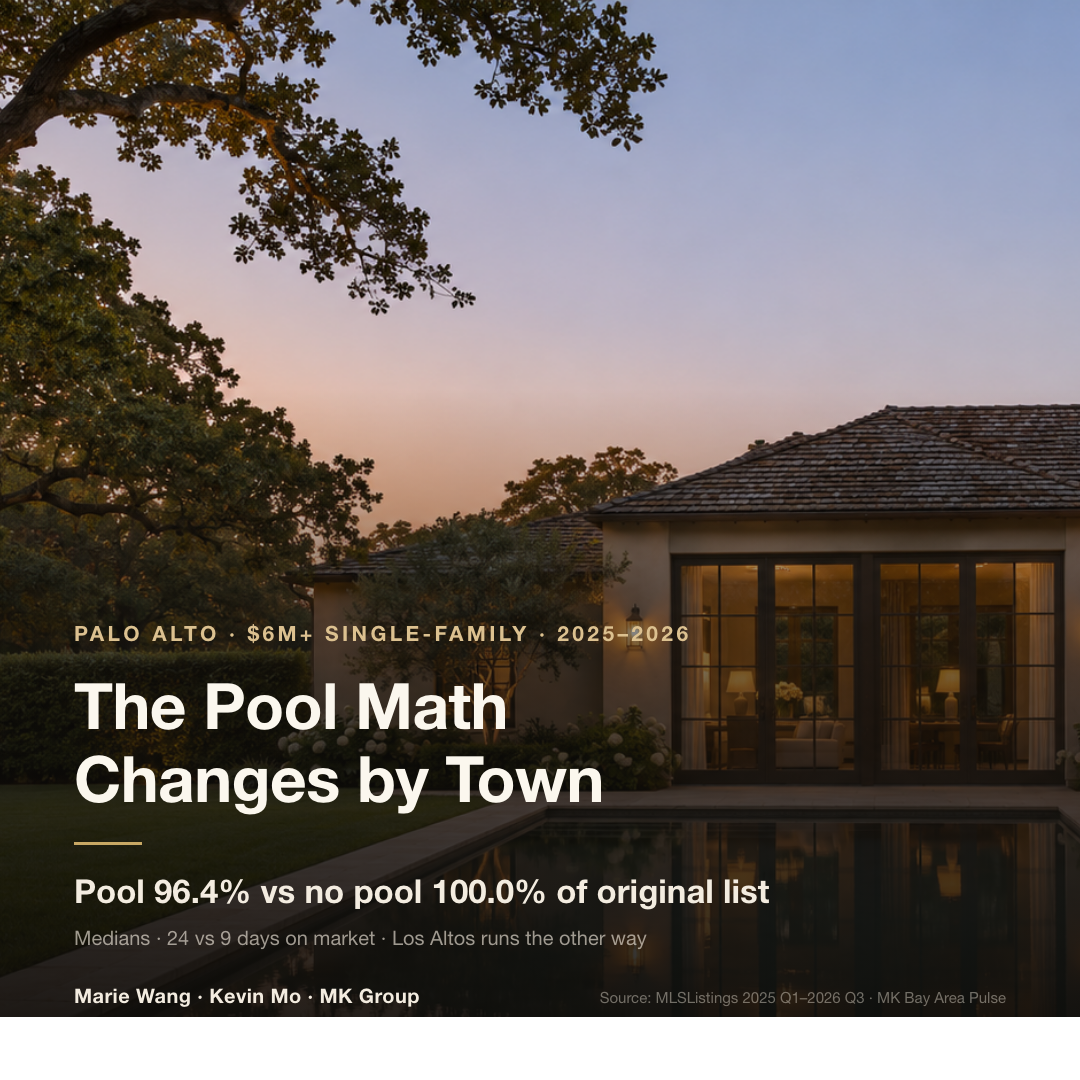
It depends on the town. Above $6M in Palo Alto, homes with a pool closed at a median 96.4% of original list; homes without, 100.0%. In Los Altos it runs the other way. Don't fill in the pool yet.
The figures come from seven quarters of MLSListings single-family sales, January 2025 through September 2026. In Palo Alto above $6M, the 30 homes listed with a pool spent a median 24 days on market; the 93 listed without one spent 9. Los Altos Hills and Portola Valley show the same direction in that price band. Los Altos and Menlo Park show the opposite. In Atherton, more than eight in ten sales had a pool, and the two groups closed at the same ratio. Between $4M and $6M, the gap in Palo Alto, Los Altos and Los Altos Hills narrows to within a percentage point. None of this proves cause: pool homes tend to have bigger lots and higher prices to begin with. And in Palo Alto, filling in a pool means removing the entire shell, with a geotechnical engineer certifying the compaction. It is a permitted construction project, and no public data can tell you how much more a home sells for once the pool is gone.
Who this article is for
This article is for one reader: the owner of a single-family home with a pool in Palo Alto, Los Altos Hills, Portola Valley, Los Altos, Menlo Park or Atherton, valued around $6M or higher, who plans to list in the coming months and is weighing whether to do something about the pool first. In particular:
- The pool is fifteen or twenty years old, the children are grown, and hardly anyone swims anymore. You want to know whether buyers will see it as an asset or a burden.
- You've heard that "buyers today don't want pools, fill it in and it'll sell faster," and you'd like to see real sales data before spending money on it.
- The house is older and the lot is strong, and you can't decide between preparing it for market and selling it on the value of the land.
Three dimensions that decide it
Dimension one: town and price band — the same pool reads differently in each town
There is no single answer to what a pool does to a sale. In Palo Alto, Los Altos Hills, Portola Valley, Los Altos and Menlo Park, the difference shows up above $6M, and its direction depends on the town. In Palo Alto, Los Altos Hills and Portola Valley, pool homes closed 3–6 percentage points lower against original list and stayed on market longer. In Los Altos, pool homes closed 3.3 points higher; in Menlo Park, 5.5 points higher (on 16 pool sales). In Atherton and Hillsborough, where a pool is standard on most homes, the two groups closed at the same ratio above $6M. Drop to $4M–$6M and Palo Alto barely moves: 106.6% with a pool, 107.4% without. Hillsborough is the exception in that band, at 103.3% with a pool and 100.0% without. Find your home's box first, then decide whether the pool needs attention.
Dimension two: how much of the lot the pool takes
How much a pool weighs with a buyer depends on how much yard it uses. Above $6M, the median lot for a Palo Alto home without a pool is 10,000 sq ft, under a quarter acre; a pool and its decking can easily take most of the backyard. In Atherton, the median lot in the same price band is about 44,000 sq ft, close to an acre, and the pool is one part of the grounds. On a small lot, some buyers see a pool as lost lawn and ongoing upkeep. On a large one, it reads as an amenity. This is a reading of the direction in the data, not a statistical finding. How your buyers see it is something to test with market feedback before you list.
Dimension three: the pool's condition and paperwork
A pool with aging equipment and a cracked surface and a pool with working systems and full records are two different things in a buyer's inspection report. Under California Business & Professions Code §7195, a home inspection that includes a pool must identify which of the state's drowning prevention safety features it has, and must say so explicitly if it has fewer than two. When a pool is built or remodeled, Health & Safety Code §115922 requires at least two of the seven features. Before listing, establishing the pool's condition and its safety features matters more than deciding whether to fill it in.
Town by price band: how homes with and without a pool sold
The key numbers first. From January 2025 through September 2026, the 30 Palo Alto single-family homes above $6M with a pool closed at a median 96.4% of original list price after 24 days on market; the 93 without a pool closed at 100.0% after 9 days. Los Altos Hills came in at 96.8% against 100.0%, and Portola Valley at 93.4% against 99.7%. Los Altos ran the other way, at 107.6% with a pool and 104.3% without. Menlo Park pool homes also closed higher, at 105.5% against 100.0%.
| Town | Price band (sale price) | With pool: median sale-to-list · median days on market (sales) | No pool: median sale-to-list · median days on market (sales) | Gap |
|---|---|---|---|---|
| Palo Alto | $4M–$6M | 106.6% · 9 days (15) | 107.4% · 8 days (164) | -0.8 points |
| Palo Alto | $6M and above | 96.4% · 24 days (30) | 100.0% · 9 days (93) | -3.6 points |
| Los Altos Hills | $4M–$6M | 100.0% · 12 days (34) | 100.0% · 14 days (45) | 0 |
| Los Altos Hills | $6M and above | 96.8% · 18 days (50) | 100.0% · 11 days (24) | -3.2 points |
| Portola Valley | $6M and above | 93.4% · 46 days (19) | 99.7% · 16 days (14, under 15) | -6.3 points (direction only) |
| Los Altos | $4M–$6M | 106.3% · 8 days (71) | 107.2% · 8 days (159) | -0.9 points |
| Los Altos | $6M and above | 107.6% · 8 days (39) | 104.3% · 8 days (75) | +3.3 points |
| Menlo Park | $4M–$6M | 100.0% · 8 days (19) | 100.0% · 10 days (86) | 0 |
| Menlo Park | $6M and above | 105.5% · 8 days (16) | 100.0% · 10 days (50) | +5.5 points |
| Atherton | $6M and above | 100.0% · 14 days (93) | 100.4% · 9 days (16) | -0.4 points |
| Hillsborough | $4M–$6M | 103.3% · 11 days (36) | 100.0% · 13 days (41) | +3.3 points |
| Hillsborough | $6M and above | 100.0% · 9 days (75) | 100.0% · 27 days (25) | 0 |
Sale-to-list is sale price divided by original list price, taken as the median of individual sales. Pool status follows the PoolYN field the listing agent enters in MLS; blank entries are counted separately and excluded from both groups (13 Palo Alto sales above $6M were blank). Portola Valley and Atherton at $4M–$6M are omitted because both groups had fewer than 15 sales. The same data also covers Woodside, Saratoga and Cupertino, none of which appear above: Woodside's no-pool group above $6M had only 7 sales, Saratoga's with/without gap was within 1.2 points in both bands, and Cupertino had only 3 sales above $6M.
What to remember: the gap is concentrated above $6M in Palo Alto, Los Altos Hills and Portola Valley, and the pool homes in that band are pricier and larger to begin with. In Palo Alto, pool homes above $6M had a median sale price of $8.38M on a median lot of 11,572 sq ft; the no-pool group, $7.35M on 10,000 sq ft. In Los Altos Hills, the median pool sale was $9.03M against $6.78M without. Price alone pulls the ratio down. Among Palo Alto homes without a pool, the median was 102.8% between $6M and $8M and 99.1% above $8M, so this data can't separate how much of the 3.6 points belongs to the pool and how much to price and condition. Split Palo Alto above $6M into two tiers and the direction holds: between $6M and $8M, 100.0% with a pool against 102.8% without; above $8M, 93.8% with a pool after a median 53 days on market, against 99.1% and 13 days without. Each tier, though, rests on just 13–57 sales.
The reversal in Los Altos also needs to be read through the lot. In that price band, the median lot for a Los Altos pool home is about 17,000 sq ft, against about 13,300 sq ft without. Menlo Park follows the same pattern, at about 12,200 sq ft with a pool and 10,400 without. In both towns, a pool often means more yard for the same price. Sometimes the land and the yard count for more than the pool itself. One cross-border buyer compared two homes in a single day: a Palo Alto home above $7M and a Los Altos home above $9M. The Los Altos home was built in 2016 on a lot of more than 15,000 sq ft, with a backyard deep enough to add a pool. The buyer's verdict was that the $9M home was far better value: a bigger lot, newer finishes and no major flaws.
Three ways to handle the pool
Route one: keep it, and make it work on paper and in person
This fits towns where pools are standard or where pool homes don't sell at a discount, such as Los Altos, Atherton and Hillsborough, and homes where the pool is in reasonable shape. The goal is a pool that buyers and inspectors can see running properly: the equipment starts, the water is clean, the surface has no obvious damage. Walk through the drowning prevention features against the §7195 checklist yourself, and gather the repair and maintenance records into a single file for the disclosure package. The point is to keep the pool from turning into a list of repair items in the inspection report.
Route two: fill it in, and complete the full municipal process
Palo Alto has clear rules for this. The city's Building Division inspection guidelines require an in-ground pool to be removed entirely; abandoning it in place is not accepted. A shell left in the ground can act like a bowl, holding water and keeping the soil saturated, and substandard fill won't carry the load of a future structure built on that spot. Exceptions are considered case by case only on a geotechnical engineer's recommendation. The process runs through two inspections. Inspection 901, before backfill, confirms that equipment and decking are removed, gas, water and electrical lines are capped as required, and the pool has been drained to the sanitary sewer, not the storm drain. Final inspection 902 requires a report from a California licensed geotechnical engineer confirming that the shell has been fully removed and the site backfilled with clean, non-expansive fill, compacted to 90% in 6–12 inch layers. Broken concrete from the demolition can't be used as fill.
The cost is time and construction; the return is a level yard. Two things are worth knowing, though. MLS has no field for "pool filled in," so public data can't measure what a filled pool adds to the price. And to many buyers, a large yard with room for a pool is an asset in its own right; it doesn't have to be a yard where a pool used to be. Requirements differ in other towns, so confirm current rules with the local building department before work begins.
Route three: spend nothing on the pool, and reposition for buyers of the land
This fits an older house on a strong lot, where the pool is one item on a long repair list. The value of a home like this sits mostly in the land, and whether the pool gets fixed barely matters to the buyers who will actually bid. The case in the next section took this route. For how to judge a developer's offer, see A Developer Knocked and Offered to Buy My Old Bay Area House to Tear Down — Is the Number He Gave Me High or Low?
MK Group in practice
Marie Wang (DRE# 02110980), Kevin Mo (DRE# 02127623) and their team sold a Spanish-style home in Atherton built in the 1940s or 1950s. The original plan was to prepare the house, the grounds and the pool before a public listing. The list kept growing: the insulation, the pool, the landscaping and a large number of trees all needed work. Bringing it to market in that condition would have taken at least six weeks of preparation, and the sellers had long lived outside the Bay Area, which made overseeing the work in person difficult.
MK Group didn't start the preparation. The team first worked out where the property's value actually came from. The lot had three points of access, which gave a developer far more room to replan the site; the land was worth more than the house. The target buyer changed from a family looking for a home to a local developer, and before any listing preparation began, the property sold off-market for $8M with 0 days on market. For that buyer, whether the pool needed refurbishing never entered the picture. The whole site was going to be replanned.
Another transaction shows the other side of the same logic. Marie Wang and Kevin Mo represented a buyer in an $18M off-market purchase of an architect-built home in Atherton. Much of that home's value sat out of sight: a dedicated mechanical room in the basement, wiring built in throughout, a smart system tying together lighting, security and irrigation, and two full boxes of manuals. Even the poolside speakers were shaped as stones and set into the landscape. Buyers at that level look at systems and craftsmanship, not at how the pool photographs. For a seller, documenting the systems, maintenance and records behind a pool does more than a last-minute cosmetic touch-up.
Both sales took place in Atherton and can't be mapped directly onto the Palo Alto or Los Altos Hills figures. What they show is the order of decisions: work out why a buyer would want this home, then decide how much to spend on the pool.
Common mistakes
Mistake 1: "Filling in the pool always helps; the house will sell faster and for more"
No public data supports this. MLS records whether a home had a pool when it was listed, not whether a pool was filled in, so what filling it in adds can't currently be measured. What the data does show: between $4M and $6M, the with/without gap in Palo Alto, Los Altos, Los Altos Hills and Menlo Park is within 1 percentage point, and above $6M in Los Altos and Menlo Park, pool homes actually closed higher. In Palo Alto, filling in a pool means removing the entire shell, compacting the backfill and filing a geotechnical engineer's report. It isn't something to fit into the week or two before listing. Use pre-listing buyer feedback to confirm that the pool is really costing you before you start work.
Mistake 2: "A pool is standard on luxury homes, so a pool always earns a premium"
Standard isn't the same as a premium. In Atherton, 93 of 114 sales above $6M had a pool; the pool group closed at a median 100.0% of original list and the no-pool group at 100.4%, so there was no premium. In Hillsborough, both groups in the same band closed at 100.0%. Above $6M in Palo Alto, Los Altos Hills and Portola Valley, pool homes closed 3–6 points lower. In a town where nearly every home has a pool, the pool is a baseline feature. What buyers pay more for is land, location, systems and craftsmanship.
Mistake 3: "The data says pool homes sell 3.6 points lower, so my $6M house will lose $200K-plus"
That calculation turns a correlation into a cause. Palo Alto pool homes above $6M had a median sale price of $8.38M and a median lot of 11,572 sq ft, larger and pricier than the no-pool group to begin with, and the higher the price, the more likely a home sells below original list (Palo Alto no-pool homes fell from 102.8% between $6M and $8M to 99.1% above $8M). The sample is also only 30 sales, and PoolYN is entered by hand by the listing agent, so it can be left blank or entered wrong. What the figures can say is that in this price band, pool homes didn't sell for more because of the pool, and they took longer to sell. They can't tell you how much any one home will lose. What yours will sell for depends on comparable sales on the same streets, with similar lot size and condition.
Mistake 4: "An older pool is fine; the buyer's inspector won't look closely"
They will, and one item is required by law to be in the report. Under California Business & Professions Code §7195, a home inspection that includes a pool must involve a noninvasive check of which of the seven drowning prevention features the pool has, and the report must state it explicitly if there are fewer than two. Aging equipment and a damaged surface fall within a standard inspection and will also appear in the report the buyer receives, where they become leverage in negotiation. Rather than wait for the buyer's inspector to list them, check the pool yourself before listing, then repair or disclose accurately.
Next steps
- Place your home first: identify your town and expected sale price band, check the table above, and see whether a pool in your box reads as neutral, a slight negative or a slight positive. For why the overall relationship between list and sale price differs from town to town, compare with Why Do Homes in Los Altos Hills Close Below Asking While Los Altos Is Still Being Bid Over List?
- Have a pool technician and a home inspector each take a look: does the equipment run properly, is there damage to the surface or decking, and which of the seven drowning prevention features are in place? Put the results and the maintenance history into a single file.
- If you're seriously considering filling it in, confirm current requirements with the local building department first. In Palo Alto, schedule around full shell removal, inspection 901 before backfill and final inspection 902 with a geotechnical engineer's report, and put the final sign-off and the engineer's report in the seller disclosure package.
- If the house is older and the lot is strong, find out whether a developer or rebuild buyer would bid before deciding how much to spend on the pool and other preparation. For which projects are worth it, see What Should I Actually Fix Before Selling a Bay Area Home — and What's a Waste of Money?
- When pricing, use comparable sales on the same streets, with similar lot size and the same pool status. Don't apply a citywide median or the percentages in this article directly to your home.