Direct answer
For a Palo Alto home above $4M, look for a buyer on the open market first, through the BVO or amended value option, and keep the GBO as your floor. In Q3 2026, the 58 single-family homes that sold in this segment closed at a median 107.9% of original list price.
A GBO buys your home at the average of two as-is appraisals. The comparable sales an appraiser works from already carry Palo Alto's bidding premium. But the appraisal values the house as it stands, with no preparation and no staging, over a marketing period of up to 120 days, and averaging two reports produces a single number. The upper half of the range, the part a well-prepared launch and two weeks of competitive bidding can reach, sits above that number. Among those 58 sales, the middle half closed between 100.4% and 115.2% of original list, after a median 8 days on market (MLSListings).
The tax line comes from IRS Revenue Ruling 2005-74. In a compliant program, you sell the home to your employer, with the relocation company acting as its agent, and the employer then sells it to an outside buyer. That counts as two separate sales, and your proceeds are treated as the sale of a home, not as wages. Selling on your own gives you the most freedom: you set the price, choose the agent and run the negotiation. The selling costs, though, are either yours to pay or reimbursed by your employer and taxed as wages.
Who this article is for
This article is written for one reader: a tech executive's family whose employer is transferring them out of state, with a move date already set and a Palo Alto primary residence worth $4M or more that has to be sold. In particular, families who:
- Have a relocation package that includes a home sale program, with documents that mention GBO, BVO, amended value or direct reimbursement, and haven't signed yet
- Have already had the relocation company's appraisers through the house, or are holding a guaranteed offer and deciding whether to accept it
- Face a start date in the new role and have to trade off sale price, the timing of the proceeds and the tax bill
Three dimensions that decide it: price, certainty and time, and tax
Start by confirming which routes your package actually offers. In the 2026 U.S. domestic home sale program benchmark from relocation management company Graebel, 88% of programs offered a BVO, 44% a GBO and 84% direct reimbursement. Companies usually vary the mix by employee tier, which is why the three add up to more than 100%.
Then pin down the terms. A GBO (guaranteed buyout) is a floor: the relocation company offers to buy the home at an appraised price. Amended value sits on top of that floor: if you find a buyer offering more, the relocation company amends its purchase price to that buyer's offer. A BVO (buyer value option) has no appraised floor at all; the relocation company buys only after you've found a buyer, at that buyer's price. Rev. Rul. 2005-74 speaks directly to the first two. A BVO-only program, with no guaranteed offer, is structured by the industry on the same principles and has no ruling of its own.
Once you know the options, the three routes differ on three questions. Who sets the price? Who carries the market risk and the clock? And who pays the selling costs, and do they count as your income?
Dimension one: price. A guaranteed offer is one number; Palo Alto sells across a range
A GBO price comes from appraisals. In the ruling's example, the employee picks two appraisers from a list kept by the relocation company, and the average of the two becomes the company's offer. If the two land too far apart, a third is ordered. In Graebel's benchmark, 62% of programs set that threshold at 5%, 23% at 7% and 15% at 7.5%. When a third appraisal comes in, 69% of programs average the two closest values, 23% the two highest and 8% all three.
Nor is the appraiser estimating what you'd call market value. Relocation appraisals follow the definition on the Employee Relocation Council form (ERC, now WERC, formerly Worldwide ERC): the anticipated sales price. That is the price the home is expected to fetch in its as-is condition on the appraisal date, over a reasonable marketing period that starts that day and runs no longer than 120 days. The definition assumes no repairs, no pre-listing preparation and no staging. The appraiser works from closed comparables, and Palo Alto comparables already include bidding premiums. Even so, the average of two appraisals is one point in the range, and it won't sit in the upper half. Once you accept the GBO, anything the relocation company earns above that price on resale belongs to the company; the ruling states that none of it is paid to the employee.
Palo Alto sales, by contrast, land across a range. Of the 58 single-family homes that sold at $4M and above in Q3 2026, the middle half closed between 100.4% and 115.2% of original list. Against this segment's median original list price of about $4.49M, the 25th and 75th percentiles sit more than $660K apart. Where a home lands depends largely on how well it was prepared for market and how many buyers showed up in the first two weeks. An appraisal built on as-is condition and up to 120 days of marketing gives you one point. It won't capture the upper half of the range for you.
With a BVO or amended value, the price is a real offer from an outside buyer, though the list price is usually capped. In Graebel's benchmark, 74% of BVO programs cap the list price at 105% of the broker market analysis (BMA) or the most likely sales price (MLSP). The cap applies to the list price, not the sale price. If a buyer bids above list, the relocation company takes over at that bona fide offer.
Dimension two: certainty and time. Who carries the risk, and when the money arrives
A GBO sells certainty. As Rev. Rul. 2005-74 describes it, the relocation company's purchase contract isn't contingent on its ability to resell. From the settlement date, the later of the contract date and the day you vacate, maintenance, property taxes, insurance and every risk of loss pass to the relocation company. Your net equity is paid at closing, ready for the purchase in your new state. The cost is time. A GBO program usually gives you a marketing period to find your own buyer first. In Graebel's benchmark, 60 days is the most common (47%), followed by 90 days (33%) and 30 days (20%). And 54% of programs require a minimum period of listing and marketing before appraisals are ordered, half of them setting it at 30 days.
The pace of a BVO depends on how quickly you find a buyer, and in Palo Alto that is rarely the bottleneck: single-family homes at $4M and above sold in a median 8 days. The added time is the relocation company's review. Each offer goes to the relocation company first, which confirms it is bona fide and then amends its purchase contract with you at that price. The payoff comes afterward. Once you've signed the amended contract, you don't have to return any of the money even if the outside buyer later fails to close (Situation 2 in Rev. Rul. 2005-74).
Selling on your own means no relocation company review; you and the buyer set the pace. But from contract to closing, the risk of the buyer walking away and the cost of carrying the house stay with you, even after you've started work in another state.
Dimension three: tax. Do the selling costs count as your income?
Moving-related expenses an employer pays or reimburses are income to the employee under IRC §82. The 2026 edition of IRS Publication 15-B states that P.L. 119-21, the One Big Beautiful Bill Act, permanently eliminated the exclusion for qualified moving expense reimbursements. The only exceptions left are active-duty military and members of the intelligence community, which leaves out nearly every tech executive's family.
A GBO or BVO gets around that rule through a two-sale structure. Rev. Rul. 2005-74 holds that in Situation 1 (a buyout at the appraised price) and Situation 2 (the purchase price amended to an outside buyer's offer), the employee's sale to the employer is one sale and the employer's sale to the buyer is another. The employee's proceeds are treated as the sale of a home, not as wages, and the commissions and closing costs on resale are costs of the company's own transaction. The same ruling sets out the counterexample in Situation 3. There, the relocation company won't amend the price until it has signed with the buyer, the employee keeps the right to approve or reject offers and counteroffers, and the higher price is paid only once the buyer closes. The whole thing is then treated as one sale, from employee to buyer, and the maintenance, property taxes, insurance, losses and other costs the company paid all become the employee's taxable compensation.
Sell on your own and take a direct reimbursement, and that reimbursement is wages. Publication 15-B sets federal withholding on supplemental wages at 22%, and 37% on the portion above $1M in a calendar year. At the 37% top federal marginal rate, every $100K of selling costs counted as wages means about $37K in federal income tax alone, before state tax and Medicare. If the company grosses up the payment, that cost moves to the company, and Graebel's benchmark notes that gross-ups significantly increase the total cost of direct reimbursement. Commissions you pay yourself do reduce your gain on the sale. But if the gain already falls within the primary-residence exclusion (the rules are in Selling a Long-Held Bay Area Home, the $500K Gain Exclusion Barely Dents It—How Much Tax Is Owed on the Rest?), that deduction saves you nothing, while the reimbursement is still taxed in full as wages.
The three routes side by side
In one sentence: a GBO gives up the top of the range in exchange for certainty; a BVO spends extra time in the relocation company's review and gets market price plus two-sale tax treatment in return; selling on your own keeps full control, but the selling costs are either paid by you or taxed as wages.
| Dimension | GBO (guaranteed buyout) | BVO / amended value | Selling on your own |
|---|---|---|---|
| Price ceiling | The average of two appraisals (as-is, marketing period assumed at no more than 120 days); any gain on resale goes to the company | A real offer from an outside buyer; agent chosen from the relocation company's list, list price often capped (74% of BVO programs: 105% of BMA/MLSP) | Market price; you set the price, choose the agent and run the negotiation |
| Certainty of closing | Highest: the purchase isn't contingent on resale; risk and carrying costs pass to the relocation company from the settlement date | High once the amended purchase contract is signed: if the buyer later defaults, you keep the money; before that, it depends on the buyer | Depends on the buyer; default risk and carrying costs stay with you until closing |
| Time | The program's marketing period first (60 days is most common), then the guaranteed offer if no outside buyer emerges | Depends on how fast you find a buyer (Palo Alto at $4M and above: median 8 days on market), plus the relocation company's offer review | No relocation company review; you and the buyer set the pace |
| Tax treatment | Two sales: your sale to the company is a home sale, not wages; resale commissions and closing costs are the company's transaction costs (Rev. Rul. 2005-74, Situation 1) | Also two sales (amended value under Situation 2; a pure BVO on the same principles), provided you sign nothing with the buyer and accept no deposit | Selling costs the company reimburses are income under IRC §82, taxed as wages |
What to remember: the GBO and the BVO get their tax treatment from the same two-sale structure. Your employer and the relocation company build that structure, but whether it holds depends on what you do during the sale. Sign a contract with the buyer or accept a deposit yourself, and the whole transaction may be treated as a single sale.
Palo Alto data: a 15-point gap between homes that sold within 14 days and those that took longer
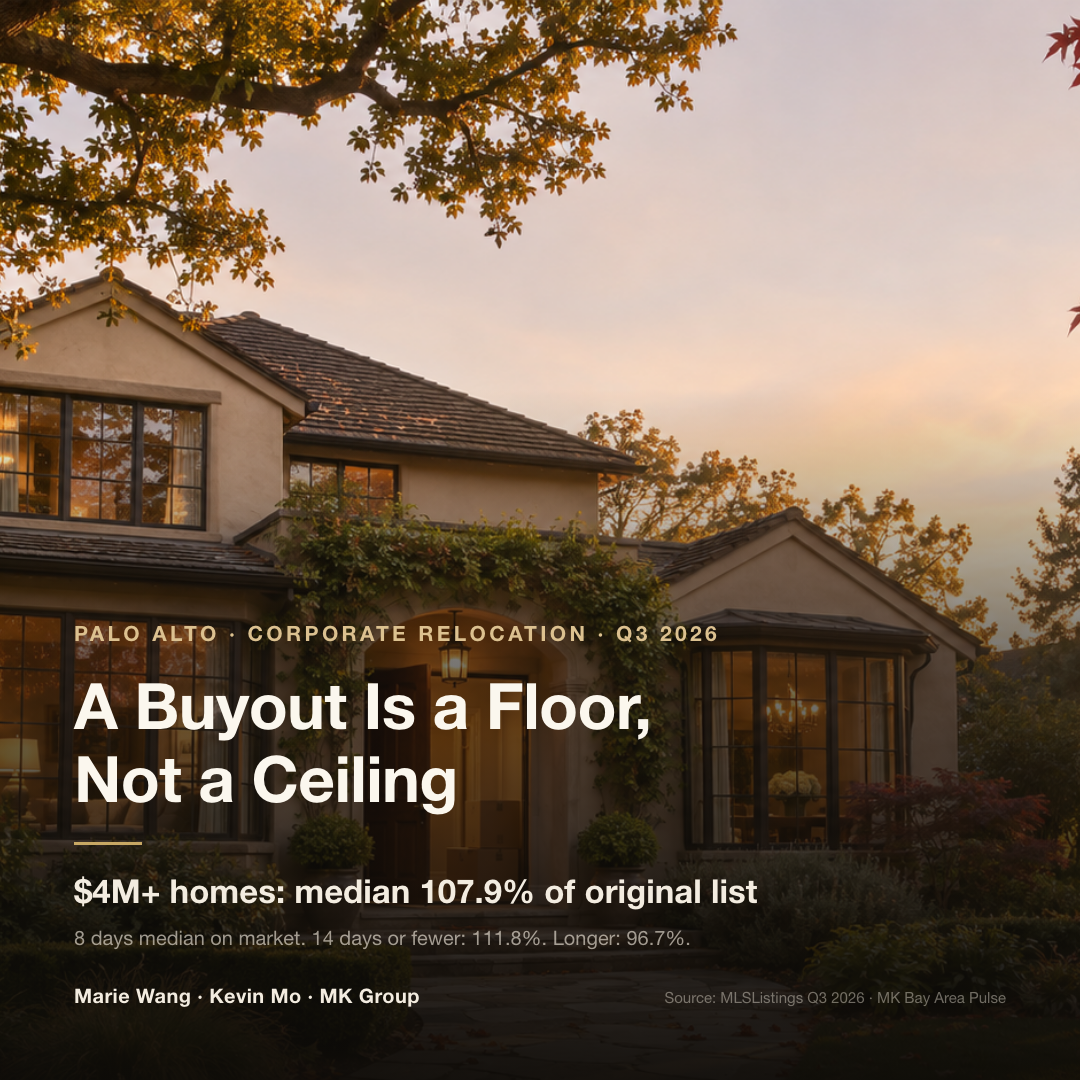
Key numbers first: in Q3 2026, Palo Alto recorded 58 single-family sales at $4M and above. They closed at a median 107.9% of original list price after a median 8 days on market. The 44 that sold within 14 days closed at a median 111.8%, and not one went below original list. The 14 that stayed on market longer closed at a median of just 96.7%, and 10 of them sold below original list.
| Scope (single-family, closed July–September 2026) | Sales | Median sale price | Sale-to-original-list (median) | Median days on market |
|---|---|---|---|---|
| Palo Alto, all | 103 | $4,200,000 | 107.6% | 9 days |
| Palo Alto, $4M and above | 58 | $4,812,500 | 107.9% | 8 days |
| Of which: on market 14 days or fewer | 44 | $4,912,000 | 111.8% | 7.5 days |
| Of which: on market more than 14 days | 14 | $4,662,500 | 96.7% | 27 days |
| Three counties, $3M–$5M | 593 | $3,675,000 | 105.6% | 9 days |
| Three counties, $5M–$10M | 187 | $6,210,000 | 102.0% | 9 days |
What to remember: prices split in the first two weeks. Of the 14 Palo Alto homes at $4M and above that stayed on market past two weeks, 10 sold below original list. That is a correlation, not a cause. Many homes still on market after two weeks were priced high or had condition issues from the start, so the numbers say that no sale in the first two weeks often ends in a price cut. They don't say a few extra days on market will necessarily cost you. Part of any sale-to-list ratio also reflects listing strategy (list low and the ratio rises on its own), so these figures can't be converted into how far below market a guaranteed offer lands. Public data can't produce that gap.
What they do show is this. In this market, the upper half of the range is won with a well-prepared launch and two weeks of bidding, while a GBO appraisal takes one point, set on as-is condition and up to 120 days of marketing. Bidding in this Palo Alto segment also runs clearly hotter than in the same price bands across Santa Clara, San Mateo and Alameda counties, where the median ratio was 105.6% at $3M–$5M and 102.0% at $5M–$10M. Estimate your range from three-county experience and you'll come in low.
MK Group in practice
Marie Wang (DRE# 02110980), Kevin Mo (DRE# 02127623) and their team handled a Palo Alto relocation sale. A promotion had brought the owner a role out of state, and the family was leaving the Bay Area. After about three weeks on the market, the home had drawn a single low offer, and the owner, pressed by the move, was ready to accept it. Signing required review by a third-party relocation company, whose process was slow, and the contract sat for about 10 days. The case record doesn't say which type of home sale program the owner used, and the sale price wasn't disclosed, so this sale isn't among the 58 above. The position, though, is the one the data describes: more than two weeks on market, and only a low offer to show for it.
MK Group didn't treat those 10 days as a wait. Marketing continued, exposure held, and conversations with interested buyers went on. The result was a stronger buyer and a price about $100K above the low offer the owner had been ready to take (the full account is in Forced to Sell My Bay Area Home for a Relocation — Should I Take the First Lowball Offer?).
If you're on a BVO, that review corresponds to the step where the relocation company confirms the buyer's offer and amends its purchase contract with you. The compliant structure Rev. Rul. 2005-74 describes requires that during this period you sign nothing with the buyer and accept no deposit. Legally, the home hasn't been sold to anyone yet, so there's no reason for showings and marketing to stop. Set that against the data above: 10 of the 14 Palo Alto homes at $4M and above that stayed on market past two weeks sold below original list. The days a review adds shouldn't become the days a listing goes cold.
Common mistakes
Mistake 1: "The GBO's guaranteed price is what my home is worth on the market"
The guaranteed price is the average of two appraisals, each estimating what the home would sell for in its as-is condition, without preparation or staging, over a marketing period of up to 120 days. The comparables behind it include Palo Alto's bidding premiums, but averaging two reports yields a single point. The upper half of the range, which a well-prepared launch and two weeks of bidding can reach, isn't in that number. In Q3 2026, the middle half of Palo Alto single-family sales at $4M and above closed between 100.4% and 115.2% of original list, and once you accept the guaranteed price, whatever the relocation company earns above it on resale belongs to the company. What a GBO is worth is certainty. If the market turns suddenly, or an inspection turns up a major problem, that floor catches you.
Mistake 2: "With a BVO, I don't need a listing agent; the relocation company sells the house for me"
A BVO starts with you finding a buyer on the open market; the relocation company only takes over at that buyer's price. In the process Rev. Rul. 2005-74 describes, the employee picks a listing broker from the relocation company's list of qualified brokers, and the listing agreement must include an exclusion clause: if the home is sold to the relocation company, the listing ends and the broker collects no commission from you. The BVO price is whatever that agent negotiates on the open market. In Palo Alto at $4M and above, the 25th and 75th percentile sales sit more than $660K apart. Pricing, preparation and how offers are handled in the first two weeks are the part of that range you control.
Mistake 3: "If the buyer's terms look right, I'll sign the purchase contract and take the deposit, then hand it to the relocation company to process"
That step alone can change the tax outcome. In the two-sale structure Rev. Rul. 2005-74 accepts, the employee signs no contract, binder or other document with the outside buyer and accepts no down payment, deposit or earnest money. The relocation company signs the purchase contract with you and, in its own name, the resale contract with the buyer. Sign with the buyer or take a deposit yourself, and the whole transaction may be treated as a single sale from you to the buyer, with the costs the company paid becoming your taxable income. Settle this with your agent before the home is listed: every offer goes to the relocation company first.
Mistake 4: "If I sell on my own, the company still reimburses the commission, so the tax comes out the same"
The difference is what that money is. Under a GBO or BVO, the commission is a cost the company pays on its own resale. Sell the home yourself and have the company reimburse you, and the reimbursement is income to you under IRC §82; the 2026 edition of Publication 15-B states that the exclusion for these reimbursements has been permanently eliminated. At the 37% top federal marginal rate, every $100K reimbursed means about $37K in federal income tax alone. If the company agrees to a gross-up, the cost moves to the company. Whether it does, and by how much, is set by the policy terms you receive.
Next steps
- The day the relocation package arrives, get the full terms of the home sale program and confirm each point: which options it offers (GBO, amended value, BVO, direct reimbursement); the marketing period required before a GBO; how far apart two appraisals can be before a third is ordered, and how the third is used; whether the list price is capped, and at what percentage of BMA/MLSP; and which list the listing agent must come from.
- Fix obvious condition issues before the appraisers arrive. Appraisals reflect the home as-is on the appraisal date. A leak, termite damage or a foundation problem still present that day lowers the guaranteed price, and it will lower buyers' offers once you list.
- From the relocation company's list, choose a listing agent who knows Palo Alto at $4M and above, and ask how they'll prepare the home and handle offers in the first two weeks. Put the exclusion clause in the listing agreement, and agree in writing that every offer goes to the relocation company first, that you won't sign buyer documents or accept a deposit yourself, and that showings and marketing continue during the review.
- Before signing any program document, have a CPA review the program contract to confirm it follows the two-sale structure in Rev. Rul. 2005-74, and work out how much of the gain on this sale the primary-residence exclusion will cover.
- If the sale will close after you've moved out of state, read whether California still taxes the sale once you've moved first, then set the closing date with your CPA.
This article is for decision-making education and is not legal or tax advice; confirm specifics with your attorney or CPA. The program structures and tax treatment described here follow the public text of IRS Rev. Rul. 2005-74, IRC §82 and the 2026 edition of Publication 15-B. Program-term percentages come from Graebel's 2026 benchmark sample; home sale programs vary widely from company to company, and the documents you receive govern. Tax illustrations use the 2026 top federal marginal rate and exclude state tax and Medicare.