Quick Answer
When you interview listing agents, don't start by comparing price opinions and commission. Ask seven things, in this order: your home's biggest weakness, how the price was built, where to spend before listing, who the buyer is, who runs the listing after you sign, how to choose among multiple offers — and only then, commission.
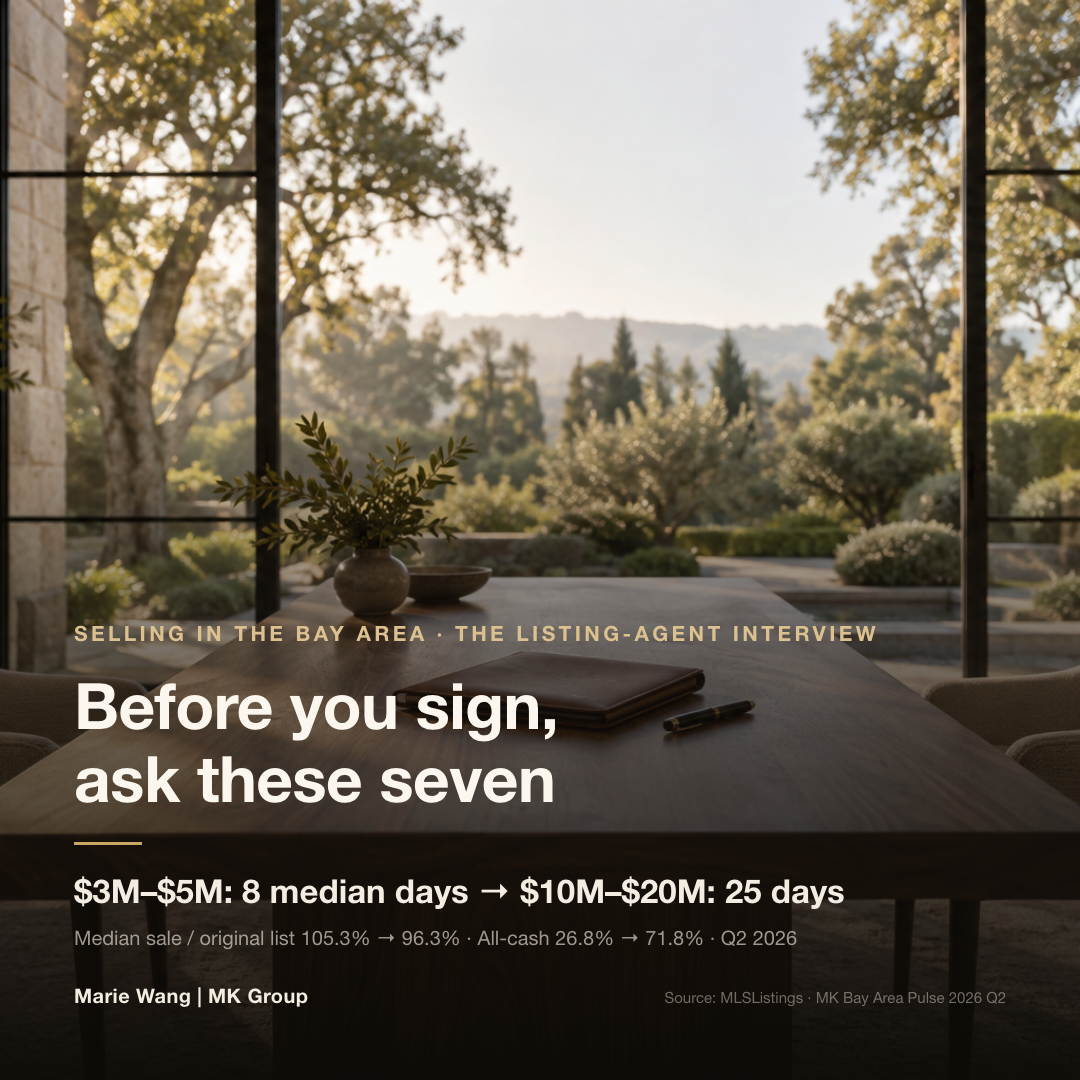
The higher the price, the harder you should press on each one. In MLSListings Q2 2026 single-family sales across three counties, the $3M–$5M band sold in a median 8 days, at a median 105.3% of original list price. In the $10M–$20M band, median time on market stretched to 25 days, and the median sale came in at just 96.3% of original list.
Who this article is for
- Owners planning to sell a $3M-plus single-family home in Palo Alto, Los Altos, Menlo Park, Atherton or another Peninsula or South Bay city within the next six to twelve months, and about to meet two or three listing agents
- Sellers who already hold listing proposals from several agents and want a single yardstick for comparing them, beyond whose price is higher and whose commission is lower
- Owners of a home with no serious flaws and no standout feature, concerned it will disappear among similarly priced listings once it reaches the market
- Sellers living overseas or out of the area who need a local team to run repairs, photography and the listing schedule on their behalf
Three core dimensions
Near the end of the video, Marie Wang reduces a listing agent's real value to three things: judgment, negotiating skill, and someone who has your back when it counts. Following that logic, the seven interview questions sort into three groups: judgment, execution (including who has your back), and negotiation and terms. The order is deliberate, too. Commission comes last.
Dimension one: judgment — can the agent see your home clearly? (Questions 1–3)
Question 1: "What do you see as the biggest problem with my home?" No house is perfect. Even a $30 million home has something — thin natural light, a dated interior, an irregular lot, a floor plan that doesn't quite work. Buyers will notice whether or not the agent says so. An experienced listing agent sorts those weaknesses into three groups: what has to be fixed, what staging can solve, and what cannot be changed and simply has to be priced into your expectations. Be wary of an agent who won't name a single flaw in the interview. Once the home is on the market, that agent will face the same issues across the table from buyers. If they won't discuss them now, they likely won't have a plan for them then. The moment those flaws land on the table most directly is when a buyer comes back with an inspection report and asks for concessions — for how a seller can respond, see The buyer came back after inspection asking for money and a list of repairs — can I just say no?
Question 2: "How did you arrive at this price?" Ask the agent to bring nearby closed sales — the comps — and to explain why those particular homes were chosen, where your home is stronger than the competition, and where it falls short. The least advisable approach is to sign with whoever quotes highest. If one agent says $3M and the other two say $2.8M and $2.7M, the high number guarantees nothing; the market sets the final price. A good listing agent gives you the most realistic number, not the one you most want to hear. The "buying the listing" tactic behind an inflated quote, and the cost of listing high and cutting later, are taken apart in I interviewed three listing agents and one suggested a price $400,000 higher than the others — should I sign with the highest quote?, so we won't repeat them here.
Question 3: "Before we list, what's worth fixing — and what's worth spending money on?" Preparing a home for sale does not mean doing everything. Ask the agent for a three-column list: must do, could do, don't bother. Marie Wang describes one example in the video. With roughly two weeks left before a listing, the kitchen countertop had a crack, and the contractor quoted a full replacement. The team judged that a repair would do the job. The repair cost $300, more than $5,000 less than replacing the whole slab. The old fence in the yard got the same treatment: the structure was sound, so instead of tearing it out, it was pressure-washed, and it looked different immediately. What is worth remembering here is the judgment itself — which dollars come back in the sale price, and which only eat into pre-listing weeks that are already tight. If an agent walks through your home and says nothing on this front, or plainly lacks the experience, weigh that carefully.
Dimension two: execution — knowing who will buy, and having someone to get it done (Questions 4–5)
Question 4: "Who is the most likely buyer for this house?" This tests whether the agent can read the buyer pool and what those buyers need — why they would buy this particular house: the commute, the schools, a large lot, privacy, or room to expand. An agent who can't describe the buyer is largely guessing with the marketing that follows. The question matters more as the price rises. In Q2 2026, 822 single-family homes sold in the $3M–$5M band across Santa Clara, San Mateo and Alameda counties; the $10M–$20M band saw just 39 sales, and $20M+ only 8 (MLSListings). The narrower the pool, the more you need an agent who knows exactly who those few buyers are, what they can spend, and why it has to be this city.
Question 5: "Once I sign, who actually manages my home?" Whether you are interviewing an independent agent or a team, get three things straight: how the timeline will run and whether there is a complete listing plan; who handles repairs, photography, marketing and open houses; and who takes over when the lead agent is out of town. The person sitting across from you in the interview is not necessarily the person moving your listing forward every day after you sign. Settle that before you put pen to paper.
Dimension three: negotiation and terms — who protects you when it matters (Questions 6–7)
Question 6: "If three offers come in at once, how will you help me choose?" The highest price is not always the best offer. Weigh it against the down payment, loan versus cash, proof of funds, the buyer's background, contingencies and their deadlines, how quickly the deal closes, the buyer's credit and background check, and whether a rent-back is requested (the seller stays on as a renter after closing). Two offers a few tens of thousands of dollars apart can carry entirely different levels of risk. This question tests the agent's judgment on offers and their negotiating skill, and the most direct check is to ask for a real case they have handled. The buyer mix also shifts with price. In the same quarter, 26.8% of three-county single-family sales in the $3M–$5M band were all-cash, rising to 71.8% in the $10M–$20M band. In the lower band, compare loan terms and contingencies closely; in the upper band, the details that matter most are proof of funds, closing timing and terms like rent-back.
Question 7: "How is your commission calculated, and what does it include?" Commission matters, but raise it last, and don't look only at the number. Ask what services the fee covers, who handles each piece of work, who pays for staging, what you owe if the home doesn't sell, how long the agreement runs, and under what circumstances you can terminate the listing agreement. Those last two should be written into terms you understand before you sign. For the limits you face if you want to change agents after listing, see My house has been listed three months with nothing to show — can I change agents under an exclusive listing agreement? For how buyer-agent compensation is handled after the 2024 NAR settlement, see After the NAR settlement, do sellers still cover the buyer's agent commission?
Beyond commission, one thing sellers often overlook is the agent's reputation among other agents. Many Bay Area transactions are not completed by the listing agent alone. Private showings, receiving offers, negotiating price and terms, handling whatever goes wrong — agents on both sides often have to push the deal forward together. Ask the agent's past clients, and ask around among other agents. Sales figures can be made to look very good; the experience of working with that person may not match. When an agent's reputation is "professional, reliable, responsive, does what they say," a great deal goes more smoothly once the real negotiation begins.
The numbers: in Q2 2026, the higher the price band, the lower sales landed against list price
Key numbers first: MLSListings recorded 5,941 single-family sales across Santa Clara, San Mateo and Alameda counties in Q2 2026 (April 1 through June 30). The $3M–$5M band accounted for 822 of them, selling in a median 8 days at a median 105.3% of original list price. The $10M–$20M band had only 39 sales: 71.8% were all-cash, median time on market was 25 days, and the median sale fell to 96.3% of original list. The $20M+ band had 8 sales, a median 44 days on market, and a median sale at 91.5% of original list.
| Price band | Sales | All-cash share | Median days on market | Median sale / original list price |
|---|---|---|---|---|
| $3M–$5M | 822 | 26.8% | 8 days | 105.3% |
| $5M–$10M | 279 | 44.4% | 8 days | 103.8% |
| $10M–$20M | 39 | 71.8% | 25 days | 96.3% |
| $20M+ | 8 | 75.0% | 44 days | 91.5% |
Scope: MLSListings closed single-family sales with close dates April 1–June 30, 2026, across 57 cities in Santa Clara, San Mateo and Alameda counties, compiled through MK Bay Area Pulse 2026 Q2. All-cash share is based on the payment terms (Sold Terms) recorded in the MLS closing data. "Sale / original list price" uses the original list price as the denominator, so any price reductions during the listing are already reflected. The two bands above $10M have small samples (39 and 8 sales), so their readings swing more than those of the lower bands.
What to remember: two things. First, above $10M the median sale already sits below original list price — 96.3% in the $10M–$20M band and 91.5% at $20M+, against 105.3% in the $3M–$5M band. The higher the price, the more directly pricing judgment and the negotiation that follows show up in the final number. That is a correlation in the market's structure; it does not mean any one agent can change the outcome single-handedly. Second, the all-cash share climbs from 26.8% all the way to 75.0%. When you sell at $3M to $5M, about 73% of sales are not all-cash, so comparing offers centers on loan terms and contingencies. Above $10M, cash buyers are the majority, and the comparison turns to proof of funds, closing timing and terms such as rent-back.
Key numbers first: in the same quarter, readings across several high-end Peninsula and South Bay cities diverged sharply. Palo Alto recorded 139 sales at a median price of $4,100,000, with the median sale at 105.6% of original list. Atherton recorded 31 sales at a median $10,000,000, with 64.5% all-cash and the median sale at 97.1% of original list. In Woodside, the all-cash share reached 74.2%, with a median 21 days on market.
| City | Sales | Median sale price | All-cash share | Median days on market | Median sale / original list price |
|---|---|---|---|---|---|
| Palo Alto | 139 | $4,100,000 | 36.0% | 8 days | 105.6% |
| Los Altos | 97 | $4,920,000 | 34.0% | 8 days | 105.1% |
| Menlo Park | 94 | $3,793,500 | 34.0% | 9 days | 102.1% |
| Hillsborough | 48 | $6,500,000 | 52.1% | 8 days | 101.6% |
| Los Altos Hills | 32 | $5,725,000 | 34.4% | 9 days | 97.5% |
| Atherton | 31 | $10,000,000 | 64.5% | 13 days | 97.1% |
| Woodside | 31 | $4,500,000 | 74.2% | 21 days | 97.3% |
Scope: as above — MLSListings single-family closings in Q2 2026, summarized by city (MK Bay Area Pulse 2026 Q2). City-level samples are small and reflect this quarter's reading only.
What to remember: these are all high-end Peninsula and South Bay cities, yet Palo Alto and Los Altos still closed above original list price at the median (105.6% and 105.1%), while Los Altos Hills, Atherton and Woodside all closed below it (97.5%, 97.1% and 97.3%). When you interview agents, ask for the readings in your city and your price band; a Bay Area-wide average tells you little about your own pricing. An agent who can tie these numbers to the specifics of your home will usually give stronger answers to Questions 2 and 6 as well.
What MK Group sees on the ground
How Question 4 played out on an unremarkable Palo Alto house
MK Group represented a single-family home in Midtown Palo Alto: four bedrooms, three baths, last renovated a decade or two earlier. It had no serious flaws, and no standout features either. The owner's own description was "a perfectly good house with nothing remarkable about it." (Translated from Mandarin.) The risk with a house like that is being forgotten. A buyer who tours five or six Palo Alto homes in one afternoon may not remember this one by the time they're back in the car. The owner interviewed several large local teams before signing with MK Group.
Before the listing went live, the team answered "who will buy" first. Working from roughly 25 families who were genuinely shopping in Palo Alto, it established their budgets, the floor plans they wanted and why it had to be Palo Alto, then sent the house directly to the buyers who fit. At the same time, the team built anticipation with its own video and social content. After launch it ran four consecutive days of open houses — a broker preview on Thursday, public open houses Friday through Sunday — and drew about 110 groups in total. The home was listed at $3.88M, and during the off-market phase a buyer had already made a verbal offer of $4M. It closed in May 2026 at $4,378,000, roughly $500K, or about 12.8%, above the asking price. The full breakdown is in The same Palo Alto house, a different listing agent — how much more can it sell for?
Signed in 24 hours, crews in the next day: Question 5 in practice
In the video, Marie Wang also recounts an urgent listing. From the first conversation to a signed listing agreement took 24 hours, and the contractors were on site the next day. She was overseas at the time. Kevin Mo led the team in Silicon Valley and carried repairs, photography, marketing and open houses through in sequence, and the home went to market without a hitch and sold. That is precisely what Question 5 is meant to draw out: on the days the lead agent is away, does the timeline keep moving, and does every step have a named person responsible for it?
Common Misconceptions
Misconception 1: "The agent says my home has no real weaknesses, so they must believe in it"
Buyers can see the flaws anyway. An agent who sidesteps them in the interview has no plan for them in the negotiation. Even a $30 million home falls short somewhere — light, finishes, lot or layout. The more reliable test: can the agent name your home's one or two biggest problems outright, and explain how each will be handled — fixed, solved with staging, or priced into your expectations ahead of time? An agent willing to put the problems on the table is usually better prepared when buyers raise them after launch.
Misconception 2: "Fix everything you can before listing, or the house won't command its price"
Preparation is about trade-offs. Ask the agent for a three-column list — must do, could do, don't bother — with a reason for every item. The countertop in Question 3 is the example: a $300 repair instead of a replacement, saving more than $5,000. In a market where the $3M–$5M band sells in a median 8 days, time spent on what actually shapes a buyer's judgment is worth more than covering every base.
Misconception 3: "With three offers on the table, just take the highest one"
Two offers only a few tens of thousands of dollars apart can carry entirely different levels of risk. Compare the down payment, loan or cash, proof of funds, the buyer's background, contingencies and their deadlines, the closing timeline, the buyer's credit and background check, and any rent-back request. In Q2 2026, 71.8% of three-county single-family sales in the $10M–$20M band were all-cash. At that level, cash on its own is unremarkable; what separates offers is how solid the proof of funds is, whether the closing timeline fits, and how many contingencies are attached. Asking an agent to walk you through a real multiple-offer case they have handled tells you far more than hearing them describe their negotiating style.
Misconception 4: "The lower the commission I negotiate, the better my sale"
Commission belongs next to the sale price in the math. On a $4M home, every 1% of sale price is $40,000. So when comparing commission, the better question is what the fee includes: who handles each piece of work, who pays for staging, what you owe if the home doesn't sell, how long the agreement runs, and when it can be terminated. Compare only the rate — not the service or the contract terms — and what you save may be far less than what you lose on pricing, marketing or negotiation.
Misconception 5: "An agent with impressive sales numbers will be easy to work with"
Sales numbers can be made to look very good, and that says little about the working experience. A Bay Area transaction — from private showings and receiving offers to negotiating price and terms and handling surprises — usually needs agents on both sides moving it forward together, and an agent's reputation among peers directly affects how smoothly those steps go. Before signing, contact one or two of the agent's past clients, and ask around among other agents about how this person works with others.
Next steps
- Before the first meeting, write down your own three bottom lines. The latest date you can list, the most you are willing to spend on preparation, and roughly where your price range sits. Walk into the interviews with those three, and a single price quote won't carry you off.
- Meet two or three agents, and ask each one the same questions in the same order. Go through all seven, commission last, and record every agent's answers on one sheet so you can compare them side by side.
- Ask each agent for four things in writing. Comps with a line-by-line comparison, the three-column pre-listing list (must do / could do / don't bother), a buyer profile, and a post-signing timeline naming who owns each step.
- Have each agent walk you through a real multiple-offer case. Listen for how they weighed down payment, loan versus cash, proof of funds, contingencies, closing timeline and rent-back — and why they chose as they did.
- Read the listing agreement line by line before you sign, and check references. What the fee covers, what you owe if the home doesn't sell, the term and the termination conditions should all be in writing and clear to you. Then call one or two past clients and ask what working with the agent was actually like.