The short answer
Yes, you can change agents — but not by announcing it. Ending an exclusive listing before its stated date requires the brokerage's written consent. Palo Alto single-family homes closed at a median 8 days on market in Q2 2026 (MLSListings), so ninety days is a serious deviation. Who earns the commission after you switch, however, is decided by one paragraph in your agreement: the safety clause, measured in days.
In California an exclusive listing agreement must be in writing and must carry a definite expiration date. Most sellers picture the exit as a straight line: I'm unhappy → I cancel → I hire someone new → the new agent earns the fee. Each of those steps has its own threshold. Cancellation needs a countersignature. Withdrawal is not cancellation. And commission entitlement can survive the agreement's end by weeks or months. Sort those three mechanical facts out before you decide anything — get the order wrong and the worst case is paying twice.
Who this article is for
This is written for a seller in a narrow and uncomfortable position. You own a home currently on the market somewhere in the Peninsula and Silicon Valley corridor — Palo Alto, Menlo Park, Los Altos, Cupertino, Atherton. It has been listed two or three months. Showing traffic is trending down. You have no offers, or one offer far below your ask. You have started to suspect the problem is not the house, and you are already quietly asking around about who else you could hire.
What you need right now is not a framework for choosing an agent. It is four facts: which type of exclusive you actually signed; whether the agreement can end before its stated date and whose signature that takes; what a withdrawal leaves behind in the MLS and on the aggregator sites; and — the one that costs real money — who is owed the commission if the house sells after you switch. This article answers those four.
It applies just as well if your listing has not expired and you are weighing whether to "pull it down and rest for a while," and to an owner who has not listed yet but is about to sign an exclusive and wants to understand the exit mechanics first. Reading this before you sign is far cheaper than reading it after.
Three questions that decide the answer
One: which kind of exclusive you signed decides who you have to negotiate with
California residential listings come in two common exclusive forms, and the legal consequences differ sharply.
Exclusive Right to Sell is what the overwhelming majority of Bay Area residential listings use, and almost certainly what you signed. Under it, during the term of the agreement the listing broker is entitled to the agreed commission no matter who ultimately produces the buyer — your listing agent, an agent from another brokerage, or a neighbor you talked to over a backyard barbecue. What it buys you is a broker willing to front the cost of staging, photography, pre-marketing and advertising, because the return is locked.
Exclusive Agency leaves one door open: if you find the buyer entirely on your own, with no agent involved on either side, you may owe no listing commission. It is uncommon in residential practice, because "who introduced the buyer" is difficult to establish in the real world and tends to become a dispute.
What they share is the point to confirm first: California law requires this kind of agreement to be in writing. Civil Code §1624(a)(4) places an agreement authorizing or employing an agent or broker to purchase or sell real estate, or to find a purchaser or seller for compensation or a commission, inside the statute of frauds — an oral arrangement is not enforceable. More consequentially, Business & Professions Code §10176(f) provides that an exclusive listing must contain a definite, specified date of final and complete termination; claiming, demanding or receiving a commission under an exclusive listing that lacks one is grounds for discipline by the California Department of Real Estate.
The practical consequence for you: your agreement has an expiration date, and it is written down. Turn to that line and copy the date out. Every calculation that follows starts from it.
Two: withdraw, cancel and expire are three different acts, not three words for one
This is where most of the confusion lives. The three exits produce entirely different results, both contractually and in the MLS.
Withdraw. The listing disappears from active MLS search; buyers and buyer's agents can no longer find it. That is all it is — a status change. Your listing agreement continues in force, untouched. Same termination date, same commission terms, same exclusive authorization. Pulling the home down is not the same as being free of the contract. The legitimate use of a withdrawal is taking the home out of the market's line of sight for a while — to complete a round of preparation work, or to reset pricing. It is not a tool for changing agents.
Cancel. This is the act that actually ends the agreement, and it takes both sides. You may revoke your agent's authority to act for you at any time, but revoking authority is not the same as erasing contractual liability: the agreement remains in force until its termination date, and the brokerage may still assert a claim for commission or for costs already advanced. To end it cleanly, the standard practice is a written release signed by both parties — California brokerage practice generally uses the cancellation-of-listing form within the C.A.R. system — spelling out the effective termination date, whether the commission obligation is waived, and how the safety-clause buyer list will be handled. Whether the brokerage signed that document is the entire difference between "I cancelled" and "I thought I cancelled."
Expire. Wait for the definite termination date stated in the agreement and it ends on its own, with no signature required from anyone. If communication with your agent has broken down and they will not sign a release, this is often the cheapest and least contentious route: withdraw the listing, wait quietly for the date, then relist with someone new. The only price is time.
There is a related record-keeping question here — a technical detail rather than the main thread, but the direction of the answer is unambiguous: whether a short withdrawal and relist resets your days on market is something to verify in the rules, not to act on by rumor. Alongside original days on market (DOM), there may also be a cumulative measure, often labeled CDOM. Whether your MLS maintains that field, whether a relist restarts the count, and how long a home must be off market before it does, are all governed by that MLS's current rules manual — Peninsula and South Bay listings are mostly in MLSListings, so have your agent pull the rule text and confirm. The same applies to price and status history on aggregators like Zillow and Redfin: how long it is retained, and whether a seller can remove it, is governed by each platform's current help documentation. The safe planning assumption is that a history reading listed 90 days → two price cuts → withdrawn will still be findable after you switch agents and relist. Which is why "pull it down, go quiet, come back as a fresh listing" should not be treated as a default Bay Area strategy — that is a data-persistence problem, not a strategy question.
Three: the safety clause — the one paragraph you must read word for word before switching
If this article gets you to do exactly one thing, make it this: turn to the safety-clause paragraph in your listing agreement, read it word for word, and copy down the number of days.
The mechanism of a safety clause (also called a protection period or carry-over clause) works like this. If during the term your listing agent showed the property to a prospective buyer, or otherwise introduced that buyer to the property, and delivered those buyer names to you in writing in the manner and within the time the agreement specifies, then for a stated number of days after the agreement ends, a sale to anyone on that list can still entitle the prior agent to the commission.
The clause exists for a defensible reason. It prevents a seller from cancelling the day before ratification, after the agent has done all the marketing work and delivered a ready buyer, purely to avoid the fee. But for a seller considering a change of representation, it carries a very concrete risk: you hire a new agent, the new agent sells the house, and the buyer happens to be the person who toured three months ago whose name sits on the prior agent's written list — and you face two competing commission claims.
At the execution level, verify five things. How many days the protection period runs (residential listings commonly fall somewhere between a few weeks and a few months, but there is no statutory number — it is whatever your document says). What day the clock starts from: the expiration date, or the effective date of cancellation? Whether the prior agent actually delivered the buyer list as the agreement requires, in what form, and within what time. Who is on it. And whether the release document says anything different about the protection period — negotiating the safety clause into the written release is the single most valuable piece of bargaining in this entire process. The substance of most cancellation negotiations is not whether you may leave. It is how the list is treated.
Because the wording, the day count and the disclosure requirements all vary across form versions and brokerage addenda, this article describes only the mechanism and its legal consequences and reproduces no form text — the document you actually signed governs.
Median days on market by city: the benchmark for "how long is genuinely too long"
Before you decide to switch, one prior question needs answering: is three months actually a failure? Not by feel, and not by comparison with the neighbor's house that sold in two weeks — by the median for your city and your price band.
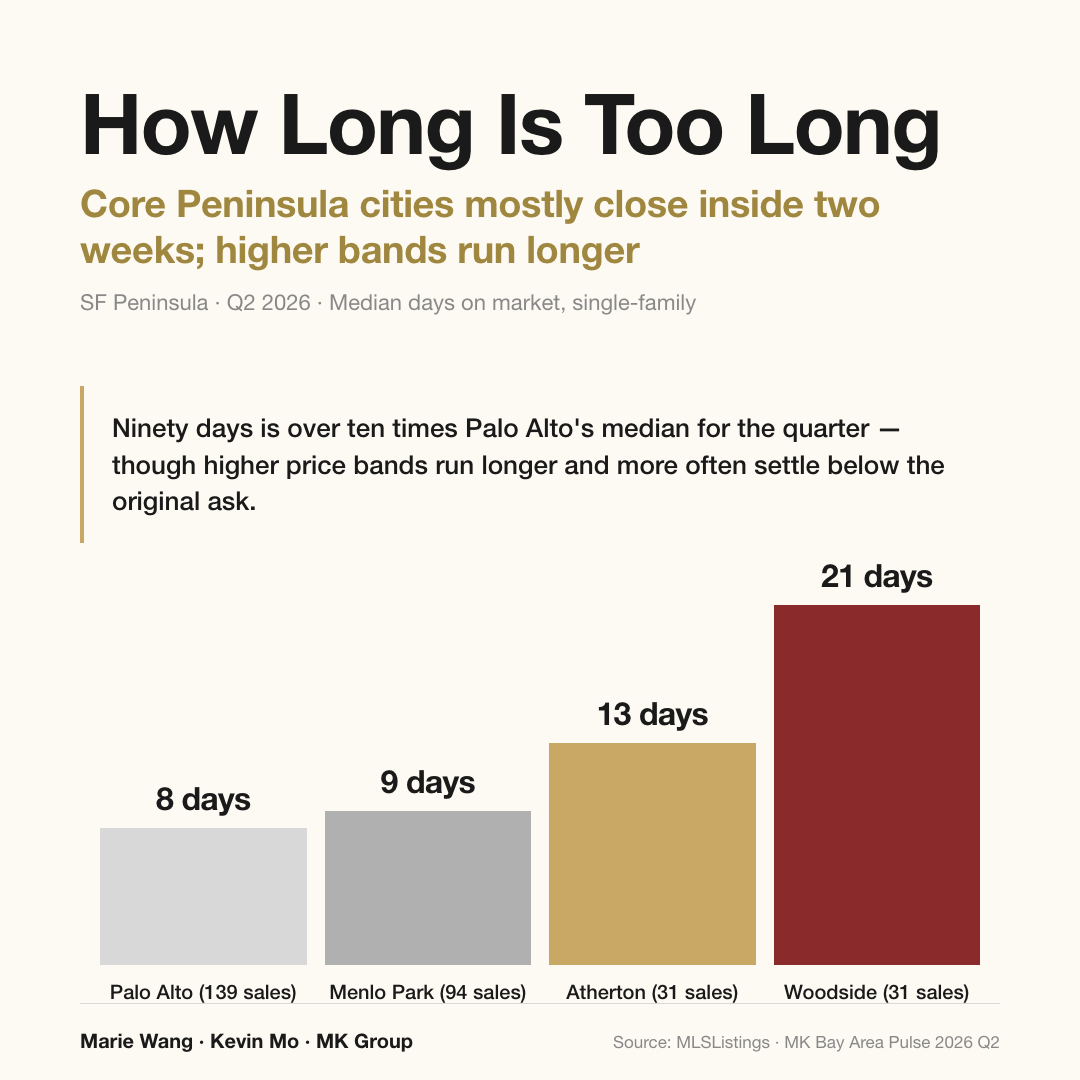
The core numbers first. In Q2 2026 (April 1 through June 30), Palo Alto recorded 139 single-family closes at a median 8 days on market, with the median sale landing at 105.6% of original list. Menlo Park recorded 94 closes, a median 9 days, and 102.1%. Atherton recorded 31 closes, a median 13 days, and 97.1%. Put plainly: in the core Peninsula cities, a home whose price and distribution are both sound normally has a result inside two weeks — and ninety days is more than ten times Palo Alto's median for the same quarter.
| City | Closes in quarter | Median sale price | Median days on market | Sale / original list |
|---|---|---|---|---|
| Palo Alto | 139 | $4,100,000 | 8 days | 105.6% |
| Los Altos | 97 | $4,920,000 | 8 days | 105.1% |
| Menlo Park | 94 | $3,793,500 | 9 days | 102.1% |
| Hillsborough | 48 | $6,500,000 | 8 days | 101.6% |
| Atherton | 31 | $10,000,000 | 13 days | 97.1% |
| Woodside | 31 | $4,500,000 | 21 days | 97.3% |
What to take from it. The two rows most often misread are Atherton and Woodside. Their medians on market are longer and their median sale prices land below original list — 97.1% and 97.3%. That is not a market turning; that is normal behavior at the top. The price bands make it clearer. In Q2 2026 the $3M-$5M band recorded 822 closes at a median 8 days and 105.3% of original list; the $10M-$20M band recorded just 39 closes at a median 25 days and 96.3%; the $20M+ band recorded 8 closes at a median 44 days and 91.5%. The higher you go, the more normal a long marketing period becomes — and the more normal it is to settle below the original ask. So ninety days, standing alone, supports no conclusion at all. On a $12M home it is roughly 3.6 times the band median. On a $4M Palo Alto single-family it is more than ten times. Those two situations call for completely different actions.
Data source: MLSListings (Santa Clara / San Mateo / Alameda counties), compiled in MK Bay Area Pulse 2026 Q2
Period: Closed single-family sales, April 1 - June 30, 2026
How median days on market is measured: days from listing to offer acceptance, counted only among homes that closed within the quarter; listings that did not sell, were withdrawn, or remain active are excluded. It answers "how long did the homes that sold take," not "how long does the average listing sit."
Scope: SF Peninsula and Silicon Valley cities; medians and sale-to-original-list ratios are reported by city and by price band and are not predictive of any individual home
Statutory status checked: August 5, 2026
Two diagnoses, and only one of them is fixed by changing agents
With the benchmark in hand, split "it won't move" into two causes. Their remedies point in opposite directions.
Cause one: the price is wrong. The signature pattern is normal traffic and no bids. Showings and online views in the first two weeks were in a reasonable range, people came through, and yet no offers arrived — or only one far below ask. Comparable homes in the same city closed inside the median in the same period. You have already cut once, and the cut did not catch up to where the market actually sits. In this scenario a new agent almost never solves the problem — what needs to change is the price, not the person. And price cuts carry a tempo cost: the longer you wait and the more times you cut, the worse the public price history reads, and the more buyers wait for the next one. For how three-tier pricing works and how to read first-week data, pricing strategy for a Bay Area sale goes deeper.
Cause two: distribution never opened. The signature pattern is that traffic itself was low. Showing counts were wrong from week one. The listing appeared on the MLS and one or two aggregators and nowhere else, with no targeted reach into the actual buyer pool. Cross-border and Mandarin-reading buyers were never touched. Photography, video and Chinese-language materials were missing or perfunctory. Open houses were sparsely scheduled and badly timed. This is the case where changing representation can genuinely matter — what you are short of is not a price adjustment, it is distribution. A prior question sits underneath it: should this home be publicly listed at all, or is it better suited to a narrow, targeted channel? Public listing or off-market takes that trade-off apart — the scarcer the home and the narrower its buyer pool, the more likely the answer is the latter. And for which dimensions to test in a replacement agent, and which of them can be verified in a single meeting, how to choose a Bay Area real estate agent sets out the list.
What we see in the field
Across Marie Wang (DRE# 02110980) and Kevin Mo's (DRE# 02127623) Peninsula and Silicon Valley sell-side work, three files map cleanly onto the three diagnoses above.
The first shows that "it went cold" does not automatically mean "change agents." A Palo Alto owner had to move the family out of state for a promotion. Three weeks on market brought a cold response and a single lowball offer, and under time pressure the owner was close to accepting it. The turn came at ratification: the transaction involved a third-party relocation company's review, the process was slow, and signing stalled for ten days. MK Group did not spend those ten days waiting. Marketing continued, new interested buyers kept being matched, and inside that dead window a stronger buyer emerged — closing roughly $100,000 above the lowball offer the owner had been ready to take. The full account is in a relocation forced sale and the first lowball offer. What it means for the question in front of you: a contract's timeline is itself price leverage. A passive waiting window can be converted into an active second round of negotiation, provided the seller's agent is still willing to work after an offer is in hand. When a listing goes cold, the first thing to examine is execution intensity, not the cancellation clause.
The second shows that sometimes the right answer is not to be on the market at all. An owner in 94087 wanted to move up to Los Altos, and the three agents consulted before had all recommended listing quickly. After walking the property, Marie Wang and Kevin Mo said the opposite: do not sell now. The reasoning was that the home had no defect in location or school assignment, the mortgage rate on it was extremely low, and the owner's next city and financing were both still unsettled — selling would permanently surrender that rate, with a real chance of landing in the "sold, now waiting on the market, priced out for two years" trap. The owner's words were: "My God, you're the only one telling him not to sell." For a seller ninety days in, that file points at an uncomfortable but necessary question: is it possible this home, at this moment, should not be listed at all? If that is the case, changing agents changes nothing.
The third shows that "distribution never opened" really does have another path. An Atherton owner was talking to other teams alongside MK Group, was guarded, and was still holding three open questions: whether to sell, who should sell it, and where to price it. The day after the meeting, the team told her there were several buyers who had been following Atherton inventory for a long time, and at least one with explicit interest in this kind of property. Her response: "You move fast." The transaction ultimately closed entirely off-market — no public listing, no broad open houses. That speed was not a buyer produced on demand; it was a standing buyer pool built up over years of published work, including the founders' YouTube channels @MarieWang (44K+) and @KevinMoRE (23K+), where trust accumulates conversation by conversation. If your diagnosis is that distribution never opened, the testable question is not whether a new agent seems eager. It is whether they have people right now. That question gets answered in the first meeting.
Common mistakes
Mistake one: "The termination date hasn't arrived, but I can cancel unilaterally whenever I want"
You cannot. You may revoke your agent's authority to act for you, but revoking authority does not extinguish the contract — an exclusive listing remains in force until the termination date it states, and the brokerage may still assert a claim for commission or for marketing costs already advanced. There are exactly two clean endings: a written release carrying the brokerage's signature, or the agreement's own expiration. A third option, "I'll text them that we're done," accomplishes nothing at the contract level.
Mistake two: "Once I hire a new agent, the old one has nothing to do with this sale"
This is the most expensive misunderstanding on the list. A safety clause reaches past the end of the agreement. If the buyer was introduced by the prior agent during the term, and that agent delivered the buyer list to you in writing as the agreement requires, a close within the protection period can still entitle them to the commission — even though a new agent wrote the deal. Two things must be finished before you switch: obtain that written buyer list, and state in the release exactly how the protection period will be handled.
Mistake three: "I'll withdraw it, go quiet for two months, and relist as a brand-new listing"
Neither half holds. Contractually, a withdrawal only removes the home from active search; your listing agreement continues in force with its termination date and commission terms unchanged, word for word. On the data side, days on market may exist as a cumulative field as well as an original one (commonly labeled CDOM), and whether a short absence resets it — and how long the absence must be — is governed by your MLS's current rules manual. Have your agent pull the rule text and confirm. Building a plan on "it definitely resets" as a settled fact is the most common way this step goes wrong. And if the goal is actually to end the agreement, a withdrawal is simply the wrong instrument.
Mistake four: "Once the agreement is cancelled, the price-cut history on the public sites disappears with it"
Do not assume that. How long price and status history is retained on aggregators like Zillow and Redfin, and whether a seller can remove it, is governed by each platform's current help documentation; pages for delisted homes generally remain findable. The prudent planning premise is that "listed 90 days, two price reductions, then withdrawn" travels with the property into your next launch, and any buyer's agent who looks will see it. What actually changes a buyer's read is not an erased history — it is a home, a price and a presentation that are demonstrably different the second time.
Mistake five: "Three months without a sale must be the agent's fault"
Not necessarily, and the test should be the median for your city and price band rather than a feeling. Palo Alto single-family closes ran a median 8 days on market in Q2 2026 and Menlo Park 9 (MLSListings), so ninety days on a $4M home is indeed a severe deviation. But in the same quarter the $10M-$20M band ran a median 25 days and the $20M+ band 44 — ninety days on a $12M home is a completely different order of deviation. More important is separating the cause first: normal traffic with no bids is a pricing problem and a new agent will not help; low traffic with an untouched buyer pool is a distribution problem, and that is when switching means something.
Cancelling a listing agreement, commission entitlement and safety-clause disputes are, at bottom, questions of contract and agency law. This article describes mechanism types and legal consequences only; the actual effect of any clause is governed by the text of the document you signed, and no general explanation substitutes for reading your own agreement word for word. Confirm before acting with your California licensed attorney, and review any tax consequences with your CPA. The status of the California statutes cited reflects the public versions available on the check date of August 5, 2026; statutes, form versions and MLS rules are all subject to change.
Next steps
- Find the original agreement and copy out three numbers: the termination date, the commission rate, and the number of days in the safety clause. Those three numbers determine every option you have from here, and recollection is not good enough — read the paper.
- Request the buyer list in writing. Ask your current listing agent, in writing (email is fine), for the list of prospective buyers shown or introduced to the property during the term, and keep the timestamp. That list is your only basis for assessing protection-period exposure later.
- Run a diagnosis against your own city and price band. Pull this quarter's median days on market and sale-to-original-list ratio for your city and band, plus how comparable homes actually closed. Then set that against your own first-two-weeks showing counts and online traffic and decide whether the cause is price or distribution.
- If you are leaving, negotiate the written release before you pull the listing. Settle three things in one conversation and put them in the document: the effective termination date, the scope of any commission waiver, and how the protection-period list will be treated. If that fails, price out the "withdraw quietly and wait for expiration" route — it is the least contentious path available.
- Interview replacement agents with two verifiable questions. Do you have specific buyers for this home right now — not "we have reach," but how many and what profile? And in the distribution plan for this particular home, which channels beyond the MLS are you using, and who does each one reach? An agent who cannot answer is a change of name only.