Quick Answer
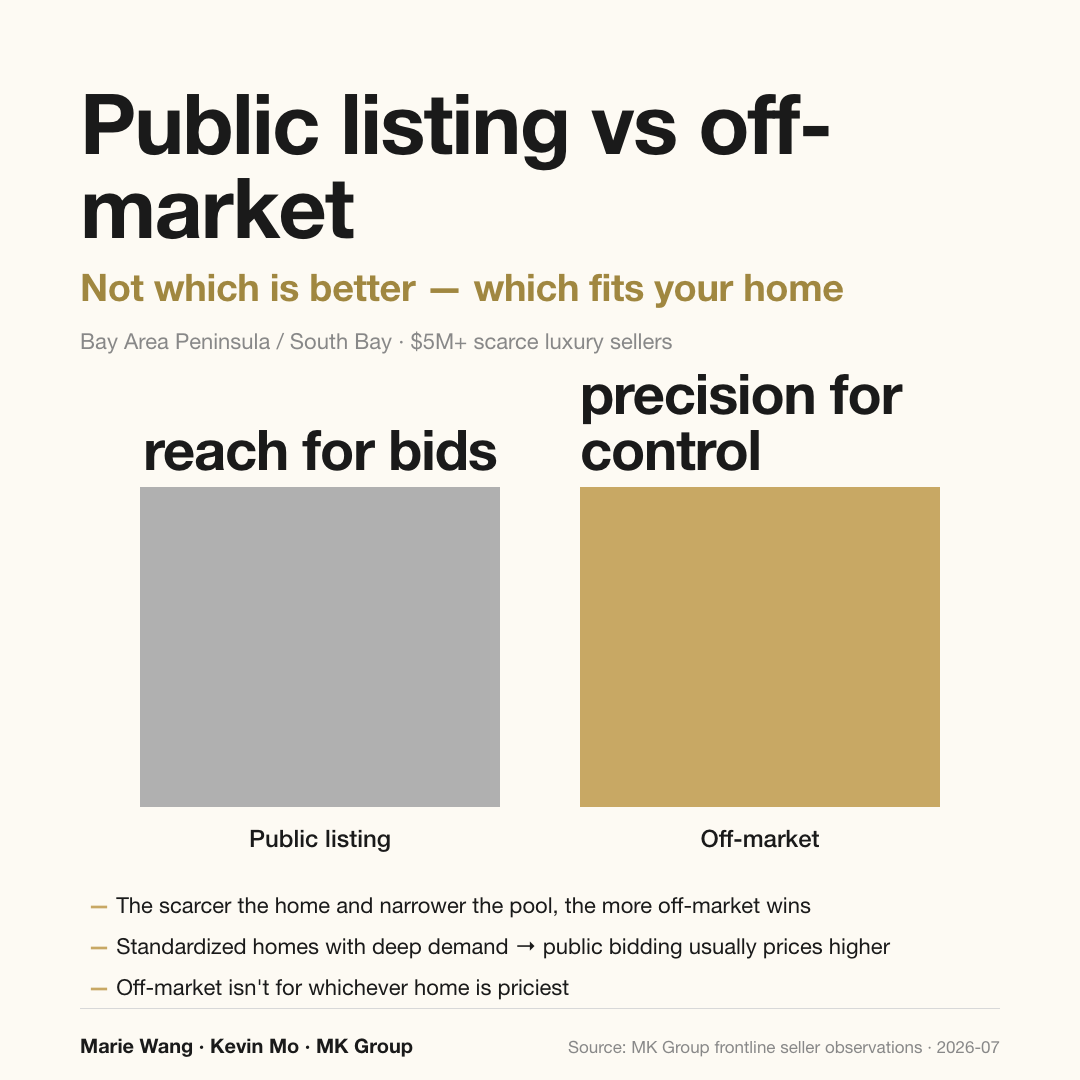
It depends. Off-market versus a public listing isn't a question of which is better — it's which one fits this house. Only two things decide it: what you want, and what your house actually is. The rule that trips people up: off-market works best not for the most expensive homes, but for the scarcest ones with the narrowest buyer pool.
Who this article is for
- Owners of $5M+ homes around Atherton, Woodside, Los Altos Hills, Palo Alto, or Menlo Park who are weighing a public listing against a quiet sale
- Sellers who care about privacy — who don't want photos of their home on the internet and don't want wave after wave of strangers walking through the house
- Owners who want to control how often and how fast showings happen, and to deal only with pre-screened buyers
- Sellers with a distinctive, highly personalized, or renovation-ready home who worry that a few photos can't convey what it's really worth
- Sellers whose goal is the highest possible price and who want to know whether they should be capturing the public-bidding premium
Three ways to judge it
1. First, understand this is a trade-off — not "which one wins"
There are two things people like to say about off-market. One is that selling quietly is the only way to protect your privacy. The other is that a public listing is the only way to get top dollar. Each is half right. This isn't a "which is better" question. It's a trade — and whether the trade is worth it depends on your house and what you want.
A public listing's real strength is competition. Broad exposure pulls as many buyers as possible in front of the same house and lets them bid against each other. Several buyers chasing one home gives price room to run. But there's a premise people skip: if the home goes public and only one or two buyers actually show up, that bidding premium never materializes. You've spent the exposure and the time and gotten nothing for it.
Off-market's real strength is precision and control. It doesn't chase a crowd. It takes the home directly to a handful of buyers who genuinely match and genuinely have the means — and in return you get privacy, pace, and certainty. No photos on the internet. No open house every weekend. No stream of strangers through your home.
So which one gets the higher price? Honestly: it depends. For most standardized homes with lots of buyers, public bidding will probably push price higher — no argument there. But the scarcer the home and the narrower its buyer pool, the more likely that flips. A one-of-a-kind home is hard to price to begin with, and the longer it sits publicly, the more the market reads it as "something must be wrong" and marks it down. Quietly finding the one buyer who truly understands it — and who happens to be looking for exactly it — can produce a higher number, not a lower one.
The truth of the trade, then: a public listing spends competition to chase price; off-market spends public exposure to buy precision and peace of mind, and the price is not necessarily lower — especially for a scarce home. Which trade is worth it for you comes down to two self-checks.
2. Step 1 — look at your goals (three situations point to off-market)
Start with what you actually want. Three situations make off-market the better fit:
First, you have real requirements around privacy and the intimacy of your home. You don't want photos of it online, and you don't want strangers walking through repeatedly. The hassle you're spared is itself worth something to you.
Second, you care more about a controlled process. You want to set how often and how fast showings happen, and to engage only with buyers who've been screened — rather than handing your home over to an uncertain open market.
Third, your home has something distinctive that needs a person to explain its value face to face, instead of being scrolled past as a few thumbnails.
But here's the honest counter-note: if your goal is purely to maximize price and you genuinely don't mind the public display, you're probably better off with a public listing, capturing the bidding premium. On this first check, get clear on which priority ranks first.
3. Step 2 — look at your house (what makes off-market efficient)
Not every home sells well off-market. Homes with these traits usually have the edge in a private sale:
First, a scarce location. Top-tier communities like Atherton, Woodside, and Los Altos Hills, or homes on unusual lots or with rare views — the buyers for these are already concentrated in a very small circle. Matching precisely beats casting a wide net.
Second, a home that's highly individual, architecturally distinctive, or in need of renovation. The value of these homes usually isn't in the photos — it's in the in-person walkthrough. A private conversation shows what the home is actually worth far better than a listing page.
Third, whether the house lines up with the goals you named above. If you happen to want a low-hassle process and to work only with screened buyers, then house and goals point the same way.
The reverse is just as important. If your home is a standardized product with plenty of buyers, a public listing's bidding mechanism will usually get you a better price. Which brings us to the point most people get backward: off-market isn't for the most expensive homes — it's for the scarcest ones with the narrowest buyer pool. Don't assume a home should sell quietly just because it carries a big price tag. Scarce and buyer-pool-narrow is the test, not the number on the sticker.
A self-diagnostic: which way does your house lean
Here's the takeaway before the table: what decides your path isn't how expensive the home is — it's how six dimensions combine. The stronger your need for privacy, the more you want to control the process, the scarcer the home, the more its value needs to be shown in person, and the narrower the buyer pool, the more the balance tips toward off-market. Flip all of that — your one goal is top price and the home is a standardized product with many buyers — and a public listing's bidding premium usually wins. The table below lays out those six dimensions in one view.
| Dimension | Leans public listing | Leans off-market |
|---|---|---|
| Privacy | Fine with photos online and strangers touring | Highly protective of privacy, doesn't want public exposure |
| Process control | Willing to hand it to the open market, pace set by the market | Wants to control showing frequency and pace |
| Home scarcity | Standardized product, many comparable homes | Scarce location / special lot or view / one of a kind |
| Value explained in person | Photos convey the selling points | Value isn't in the photos, needs a face-to-face walkthrough |
| Is price the only goal | Maximizing price is the single goal | Privacy and certainty matter as much as price |
| Buyer-pool width | Many potential buyers, room for a bidding war | Real buyers cluster in a very small circle |
What to remember: these six rows aren't a scorecard where more checks in the right column automatically means off-market. What matters is how many of them your specific house hits at once. The classic combination is scarce location + narrow buyer pool + an owner who cares deeply about privacy — when those three stack up, off-market is almost certainly the right key. But the moment "maximize price" sits at the top of your list and the home is a standardized product with many buyers, the public-bidding premium is probably worth more to you than the privacy. Don't pull any single row out and treat it as the whole answer.
What MK Group saw
Last month, the team led by Marie Wang (DRE# 02110980) and Kevin Mo (DRE# 02127623) closed an Atherton home that was a textbook case of hitting two points at once.
The location was extremely scarce, and the pool of real buyers was already narrow. What the owner cared about most was privacy — she was clear that she couldn't accept strangers moving through her home in waves. For a home like that — scarce, and with an owner who valued privacy this highly — a public listing wouldn't necessarily produce genuine multi-party competition, so the price wouldn't necessarily come out higher. Quietly connecting with one buyer who truly understood its value was the steadier path.
So the team didn't list it publicly. They matched it precisely from a local buyer pool they'd maintained for a long time — buyers whose qualifications, budgets, and needs the team already knew well. By the day after meeting the seller, they could tell her they already had several buyers who had been tracking Atherton for a while, ready to move toward an offer as soon as the terms fit. The seller, a little surprised, remarked, "You move fast." (Translated from Mandarin.) In the end there were zero open houses; the home traded without ever being formally listed, fully private — the two things she cared about most, privacy and a controlled process, were never compromised. And that bears out the read on scarce homes: matched privately to a buyer who genuinely understands the property, the price need not come in below what an open bidding war would have produced. The house was right, the goals were right, and that's when the trade is worth making.
That's the point we want to make: in Silicon Valley, no single playbook fits every seller. A public listing, off-market, even "test quietly first, then go public" (a coming-soon warm-up) — each has the scenario it fits best. What actually matters is having someone put your specific house and your specific goals side by side and run the math for you. For a fuller breakdown of selling strategy, Marie also shares on YouTube at @MarieWang (44K+ subscribers).
Common misconceptions
Do the most expensive homes always belong off-market?
No. Expensive and scarce aren't the same thing. What decides whether off-market is efficient is scarcity and how narrow the buyer pool is — not the price tag. A very expensive but very standardized home, with several similar listings in the same neighborhood and plenty of potential buyers, will often reach a higher price through a public listing's bidding mechanism. Off-market's real value is with scarce homes that are hard to price publicly and whose buyers already sit in a small circle.
Does off-market always mean leaving money on the table?
That treats public bidding as the only mechanism that can lift price. For standardized homes with many buyers, it's broadly true. But for a scarce home, a public listing won't necessarily generate real multi-party competition, and the longer it sits, the more the market may read it as "something's wrong" and mark it down. Connecting privately with a buyer who truly understands the home — and who's looking for exactly it — can land a price that's higher, not lower. Not necessarily lower is precisely where off-market earns its keep for scarce homes.
Is off-market just "skip the MLS and sell privately," with nothing more to it?
Staying off the open market is only the surface. The real bar is whether you can precisely reach the right buyer. Asking around ad hoc — "who wants to buy?" — is a different thing entirely from having a local buyer pool you've maintained for a long time, whose qualifications, budgets, and needs you already know. The first usually turns into "selling quietly on the cheap." The second is why off-market actually works — it runs on matching efficiency, not on the act of "being private" itself.
If I care about privacy, does that alone mean I should go off-market?
Privacy is "what you want." Fit is "what your house is." Both have to hold at once. If you care about privacy but your home is a standardized product with many buyers, forcing off-market may cost you the bidding premium and limit exposure at the same time. In that case, the more practical move is usually to stay in a public-listing framework and balance privacy through controlled showing arrangements — rather than walking away from the open market entirely. Your goals and your house both have to stand up.
Next steps
- Rank your own priorities first. Put privacy, process control, and price maximization in order — whichever ranks first often decides your main direction.
- Give your house a "scarcity + buyer pool" check-up. How many similar homes in the same neighborhood or price band have sold in the past year, and are potential buyers plentiful or clustered in a very small circle? That tells you more about which path to take than the home's absolute price does.
- Don't treat off-market as the default luxury option. If your home is a standardized product with many buyers and your goal is top price, the public-bidding premium is probably the better deal.
- Know there are more than two paths. Beyond a public listing and off-market, there's the "test quietly first, then go public" coming-soon warm-up. For which strategy fits which home and whether they can be combined, read Bay Area Luxury Selling: Public Listing, Private Warm-Up, and Off-Market — What Fits Which Home — that's the full strategy menu; this article is the self-diagnostic for which menu to enter.
- Break your specific worries apart. Worried about whether a home can sell without an open house at all, read Can You Sell a Bay Area Home Without an Open House?; to understand from the buyer's side why the highest offer isn't the one that wins an off-market deal, read My Offer Wasn't the Highest — Why Did I Win the Atherton Off-Market Home?.