Direct answer
Yes, and especially for an older home. With inspection and termite reports in the file before you list, you disclose the problems and you price them. Without them, buyers working to an 8-day contract clock can only keep an inspection contingency or bid lower.
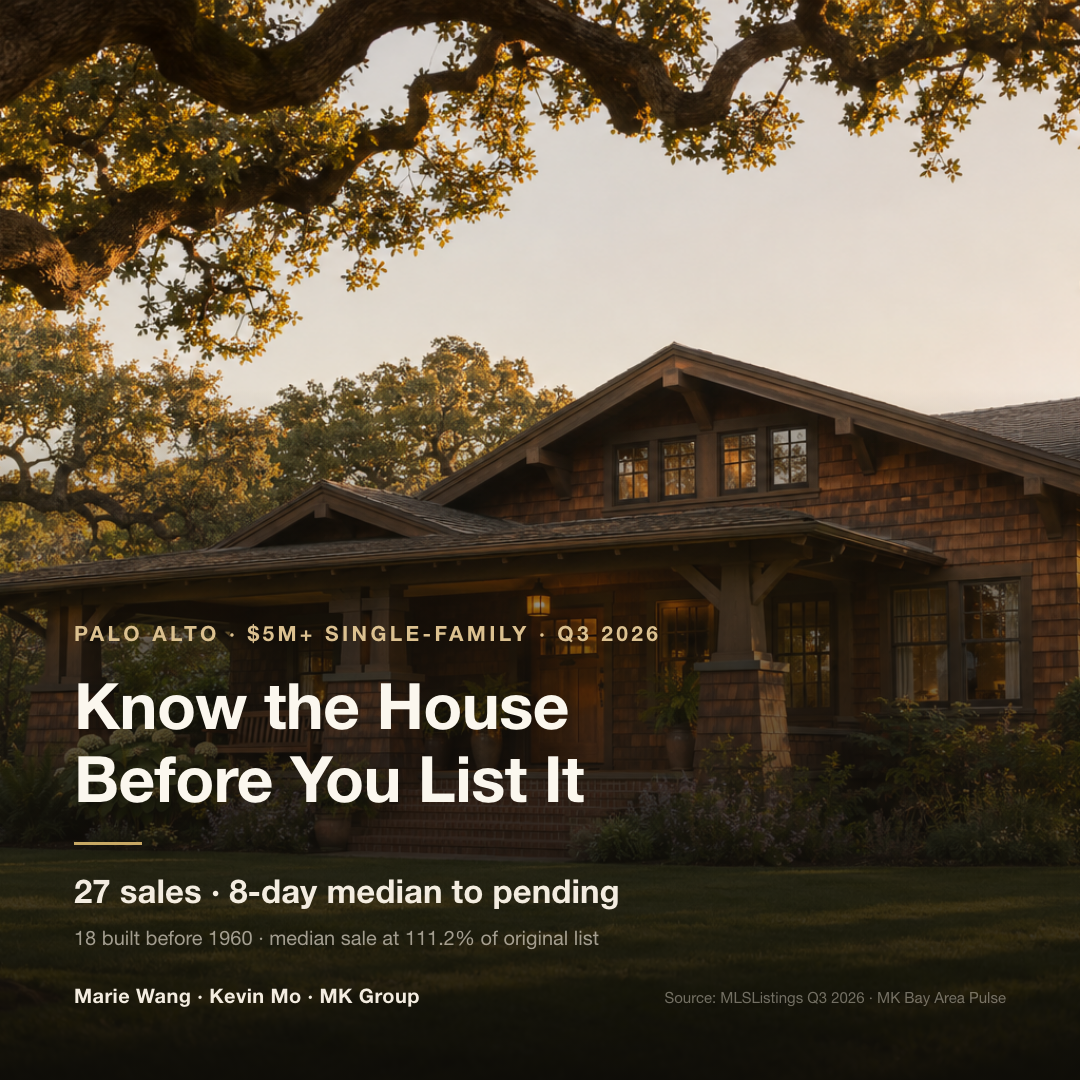
In Q3 2026, Palo Alto recorded 27 single-family sales above $5M. The median home went from listing to pending in 8 days, and 13 went pending within a week; 18 of the 27 were built before 1960 (MLSListings, compiled by MK Bay Area Pulse). Buyers need to read the reports before they sign, so for an older home, a seller's pre-inspection decides whether buyers feel safe waiving the inspection contingency. As for scaring buyers away: those 18 pre-1960 homes still sold at a median of 113.1% of original list price. Age alone did not make them sell slower or for less. What moves price is the condition of the house. A report simply lets buyers know that condition before they make an offer.
Who this article is for
- Owners preparing to sell a Palo Alto single-family home above $5M that was built before 1960 and has not had major work in decades
- Adult children who have inherited a parent's older home, do not know its plumbing, wiring or structure well, and are deciding what to do before listing
- Sellers who live outside the Bay Area or overseas and cannot easily fly back during the listing period to answer buyers' questions
- Sellers who have already had one inspection, received a report they did not like, and are weighing whether to repair, cut the price or list as is
This article covers only how to prepare and use pre-listing reports. For pricing, staging and the first-week launch plan as a whole, see How to Sell a Home in Palo Alto — Pricing, Staging, First-Week Rhythm, and Maximizing Final Sale Price.
Three core decision dimensions
Whether to order reports before listing, and which ones, comes down to three things. The age of the house determines what an inspector is likely to find. The number of days buyers have determines who should commission the reports, and when. And because a report cannot be taken back once it exists, you have to decide before listing how you will handle bad news.
Dimension 1: The age of the house decides what will be found
Most homes built before 1960 have been through several rounds of additions and remodeling, so original systems sit alongside later work. On these houses, inspectors usually focus on a handful of things: whether the wood frame is bolted to the foundation, whether original wiring and the old electrical panel are still in service, what the supply and drain pipes are made of, whether the sewer lateral (the pipe running from the house to the city main) is old clay, the condition of a brick chimney, and which additions were never permitted. Owners who have lived with these issues for years often do not notice them. A buyer's inspector always looks. On homes built in 2000 or later, the systems are newer and the permit history is complete, so the scope can be narrower.
Dimension 2: The days buyers have decide who commissions the reports
Above $5M in Palo Alto, the median home goes from listing to contract in just 8 days. At this level it is common to set a single offer date at listing, and buyers must decide by then whether to bid, how much, and with what conditions. Bringing in their own inspector takes time. If they run out of it, buyers have two ways to protect themselves. One is to keep an inspection contingency in the offer (17 days after acceptance by default under paragraph 3L(3) of the C.A.R. residential purchase agreement), then inspect and negotiate after signing. The other is to waive the contingency but discount the offer for the risks they cannot see. Neither is good for the seller. The first leaves the opening 17 days of escrow open to renegotiation; the second has you discounting for problems even you do not know about. Put the report package in the disclosure file on launch day, and buyers can read it before the offer date and decide whether to waive the inspection contingency.
Dimension 3: Once a report exists, it cannot be taken back
This is why sellers hesitate. Once a report is prepared, what it says is information you know about the house, and California's seller disclosure rules require you to provide it to the buyer. For which problems must go into the disclosure documents, see Selling a Bay Area House — Which Problems Must Go Into the Disclosures, and Can a Buyer Sue Me If I Leave One Out? Termite reports carry an extra layer. Licensed pest control companies file their inspections with the California Structural Pest Control Board (SPCB). The Board's address search shows whether a property has been inspected in the past two years, and anyone can request copies of the reports and completion notices. Reports also protect the seller. Under California Civil Code §1102.4, when a report prepared by a licensed professional (such as a pest control operator, contractor or engineer) or another expert within the scope of their license or expertise is provided to the buyer, the seller may claim relief from liability for errors in that information that were not within the seller's personal knowledge. Replacing your own description, written from memory, with a professional report can reduce the risk of being held responsible for an inaccurate one.
Palo Alto single-family homes above $5M: age of the house and pace of sale
The key numbers first. In Q3 2026, Palo Alto recorded 27 single-family sales above $5M. The median home went from listing to pending in 8 days, 21 went pending within 14 days, and the median sale price was 111.2% of original list price. The 18 built before 1960 went pending in a median of 7 days, sold at a median of 113.1% of original list, and 15 of the 18 closed at or above original list (MLSListings, compiled by MK Bay Area Pulse).
| Year built | Sales | Median days to pending | Pending within 7 days | Pending within 14 days | Sale price ÷ original list (median) | At or above original list |
|---|---|---|---|---|---|---|
| All | 27 | 8 days | 13 | 21 | 111.2% | 21 |
| Before 1960 | 18 | 7 days | 11 | 15 | 113.1% | 15 |
| 1960–1999 | 2 | 17 days | 1 | 1 | 102.7% | 1 |
| 2000 or later | 7 | 10 days | 1 | 5 | 114.9% | 5 |
What to remember: at this level in Palo Alto, two-thirds of the homes that sold were built before 1960. They went into contract no slower than newer homes, and their premium over original list was in the same range. Buyers are not avoiding older homes. They are avoiding older homes they know nothing about. One caveat: the MLS does not record which listings had inspections before going on the market, so these figures describe pace and cannot be used to prove how much more a pre-inspection earns. The 1960–1999 group has only 2 sales, too few to draw a conclusion. Neighboring cities move at a similar pace at the same tier: Los Altos had 34 sales above $5M at a median of 7 days to contract, Menlo Park 21 at 8 days, and Atherton 19 at 9 days.
The pre-listing report package: which reports to order
The key points first. The basic pre-listing package is two reports: a general home inspection and a termite report. Homes built before 1960 usually add a sewer lateral camera inspection, a roof inspection and a chimney inspection. The termite report follows a set format that sorts findings into two groups: Section I is infestation and damage you can already see; Section II is conditions likely to lead to infestation where no evidence has yet been found.
| Report | Most relevant for | Common findings | Once it exists |
|---|---|---|---|
| General home inspection | Homes of any age; strongly recommended before 1960 | Foundation-to-frame connection, original wiring and electrical panel, supply and drain pipe materials, roof drainage, unpermitted additions | Becomes information the seller knows and goes to the buyer with the disclosures; a report from a licensed professional or other expert can reduce the seller's risk of liability for an inaccurate description |
| Termite / wood-destroying pests and organisms report | Homes of any age | Section I: visible active infestation, fungal decay or damage already done; Section II: conditions likely to lead to infestation, such as persistent moisture or wood in contact with soil; Further inspection: areas the inspector could not reach | Filed with the SPCB; anyone can look up an address for inspections in the past two years and request copies; buyers usually negotiate from the Section I repair cost |
| Roof inspection | Roofs near the end of their service life; wood shake roofs | Remaining service life, leak points, flashing and gutters | Buyers use the written estimate of remaining life to project when a new roof is due and what it will cost |
| Sewer lateral camera inspection | Homes built before 1960; lots with large trees | Offset joints in clay pipe, root intrusion, sagging or collapsed sections | Some cities require testing at transfer: Burlingame for homes more than 25 years old (Municipal Code Chapter 15.12); San Mateo lists sale as a triggering event (§7.38.432); elsewhere, check local city or sanitary district requirements |
| Chimney inspection (Level II) | Brick chimneys; fireplaces unused for years | Cracked mortar joints, damaged flue liner, leaks where the chimney meets the roof | The NFPA 211 standard recommends a Level II inspection when a property is sold; problems with a brick chimney often involve structural reinforcement |
What to remember: Section I and Section II of a termite report are not a scale of severity. They separate what has already happened from what could happen. California Business & Professions Code §8516(b) requires a termite report to list visible infestation and infection separately from conditions likely to lead to them, with a recommendation for each item; SPCB regulation 16 CCR §1990(f) calls the first group Section I and the second Section II. A buyer's agent reading the report looks first at the Section I repair cost and then at the Further inspection line. An attic no one could get into, or a crawl space blocked by storage, leaves a blank in the report, and buyers will fill that blank with the worst case. Clearing those areas before listing so the inspector can finish the job is often worth more than fixing one or two Section II items.
By age of home: older and newer houses need different packages
For a home built before 1960, order the full set: a general home inspection, a termite report and a sewer lateral camera inspection, plus a roof inspection if the roof is near the end of its life and a chimney inspection if there is a brick chimney. These homes make up two-thirds of Palo Alto sales above $5M. Buyers assume the plumbing, wiring and structure are suspect, and the more complete the package, the more grounds they have to waive the inspection contingency.
For a home built between 1960 and 1999, a general home inspection and a termite report are the baseline, and the roof depends on its age. If the house has been substantially remodeled, adding the permits and final sign-offs from that work to the disclosure file can do as much as a new report.
For a home built in 2000 or later, a general home inspection and a termite report are usually enough. Buyers of newer homes care more about build quality and whether the permit record is complete. Building permits, final inspections, and any appliance or waterproofing warranties still in force belong in the file, and they answer those buyers' questions better than extra specialty inspections would.
When the report brings bad news: three paths
When a report turns up problems, the seller has three paths. Which one fits depends on the nature of the problem and how long the fix takes, not on whether you would like buyers to know about it. Whichever you choose, you already know.
Path one: repair, then list. This suits work with clear limits that can be finished in a few weeks, such as localized Section I treatment and wood replacement, or one damaged section of sewer lateral. After the work, have the pest control company issue a completion notice, and put it in the file with the invoices, permits, and before-and-after photos. Give buyers both the original report and the repair records. What buyers should see is that the problem was dealt with, not that it vanished.
Path two: disclose and absorb it in the price. This suits problems that take a long time to fix, have more than one possible solution, or are large enough to change what the house is for, such as a foundation that needs full retrofitting or structural damage. Rather than hiring contractors and spending months on repairs, put the problem and the bids on the table and price the house as it actually is. For whether to spend on a renovation before listing, and which costs come back, see Should I Spend Six Figures Renovating Before Selling in the Bay Area? Which Costs Come Back, and Which Are Sunk?
Path three: disclose and hold the price, and let buyers weigh it. This suits problems that are small relative to the price and easy for buyers to estimate, such as Section II moisture conditions or a roof with a few years left. At this level in Palo Alto, buyers often build the repair cost into their offer, or bid high anyway when several offers are competing. This path depends on the report being in the file on launch day rather than turning up later in the buyer's own inspection after signing. Repair and price negotiations in that second situation are a separate matter, covered in I'm Selling in the Bay Area and the Buyer Came Back After Inspection Asking for $150,000 and a List of Repairs — Can I Just Say No?
MK Group in practice
MK Group's published case library has no transaction built around a seller's pre-listing inspection. The three below, from the buyer's side and the seller's, show why the report package affects speed and price.
The first is a Palo Alto buyer-side case from April 2026, with the team as buyer's agent. The client, an all-cash buyer at $10M, toured a home listed at $10M, liked it, and wanted one more night to think it over. By the next morning, another buyer had the house under contract. One conclusion from the debrief: before the next showing, have the inspection, the disclosures and proof of funds ready, so the time from seeing a house to signing an offer drops from 24 hours to 4–6 hours (case details). Seen from the seller's side, the strongest buyers at this level read the inspection and disclosures before they walk in. A complete report package on launch day is what lets those buyers decide within a few hours.
The second is an Old Palo Alto buyer-advisory case from July 2026. The house, built in 1926 and listed above $8M, had a threshold hollowed out by termites, a pronounced musty smell inside, and structural damage from years of exposure. Its only real use was as a teardown. Marie Wang (DRE# 02110980) and Kevin Mo (DRE# 02127623) ran the rebuild numbers to the end for their client. About 5,000 square feet without a basement: roughly $4M to build, about $12M all in. With a basement and full landscaping: roughly $6M to build, about $14M all in, before carrying costs. Ideal resale three years out: $21M–$22M. Their conclusion was that a build-to-sell plan only worked if the price came down to around $7M, and for an owner building to live in, about $8M was the break-even point (case details). For a seller, the lesson is that once a house's condition is exposed to that degree, buyers price it as land value = post-rebuild sale price − rebuild cost − carrying cost. A report does not change that outcome; it only decides who does the math first. A seller who has run the numbers first will set a price that lines up with how buyers calculate.
The third is a seller-side case from a gated Palo Alto community in February 2026. Before the formal listing, the team released a preview video. One buyer reached out after watching it, toured the home, and made an all-cash offer within 48 hours of the showing, with no open house at all; the sale price was not disclosed (case details). The published write-up does not say whether the home had a pre-listing inspection, and none is assumed here. The case shows that a buyer's decision window at this level can be as short as 48 hours. The shorter the window, the more the material a seller has ready before listing decides whether buyers feel safe making a clean offer.
Common mistakes
Mistake 1: "If I don't inspect, I don't have to disclose problems"
Skipping inspections only means there is no new report. Problems you already know about, such as a past leak, replaced pipes, or termite evidence you have seen, still have to be disclosed. Buyers will not skip inspecting either. They will keep an inspection contingency in the offer and send their own inspector in after signing. The same problem, raised by you before listing, is part of the price. Found by the buyer after signing, it becomes negotiating leverage in their hands, and by then the other buyers are gone.
Mistake 2: "Putting the report out there will scare buyers away"
What scares buyers is usually not the report but its blanks and its unexplained problems. Of the 27 Palo Alto sales above $5M in Q3 2026, 18 were homes built before 1960, and they still sold at a median of 113.1% of original list price. Buyers at this level expect an older home to have issues. What they cannot price is the unknown: a Further inspection line, or a note recommending evaluation by a structural engineer with nothing after it. Make the report complete, have the inspector go back into the areas they could not reach, and attach contractor bids to the larger problems. Then buyers can turn each problem into a number and still make an offer.
Mistake 3: "Section II of the termite report doesn't matter; only Section I does"
Section I is infestation and damage that has already happened; Section II is conditions that could lead to it. The difference is between what has happened and what could, not between serious and minor. On an older house, Section II conditions such as persistent moisture or wood touching soil mean a new Section I item may show up in the next report. A buyer's agent reads both sections, and the Further inspection line is often more unsettling than Section II, because it marks places no one has looked.
Mistake 4: "If I don't like the report, I'll get another one and show buyers only the better version"
You have already read the first report, so its contents are information you know. Ordering a second one does not make them disappear. Licensed pest control companies file their inspections with the California Structural Pest Control Board, and anyone can look up an address to see whether it was inspected in the past two years and request copies. When two reports disagree, the right move is to provide both and have the inspectors explain why they differ.
Next steps
- Start with the year built and the permit history, then use the age tiers in this article to list the reports you need. For a home built before 1960, schedule the sewer lateral camera inspection and the chimney inspection along with the rest.
- Book inspections before you set a listing date, leaving time to find problems and choose a path. For anything you will repair first, work back from the contractor's schedule to the launch date.
- Before the inspections, clear the attic, crawl space and garage storage so the inspector can get in, and keep Further inspection items in the report to a minimum.
- Once you have the reports, decide for each significant problem whether to repair it, absorb it in the price or hold the price. For anything you will not repair, get a written contractor bid and put it in the disclosure file alongside the report.
- Put the complete report package in the disclosure file on launch day so buyers can read it before the offer date. Have an attorney confirm, item by item, any questions about disclosure obligations and the scope of liability relief.
This article is for decision-making education and does not constitute legal or tax advice. Confirm the scope of seller disclosure obligations, the conditions under which Civil Code §1102.4 relief applies, C.A.R. contract terms and form versions, and each city's point-of-sale sewer lateral requirements, item by item with your attorney and agent. Market figures are from Q3 2026 MLS closed-sale data; written November 2026.