Direct answer
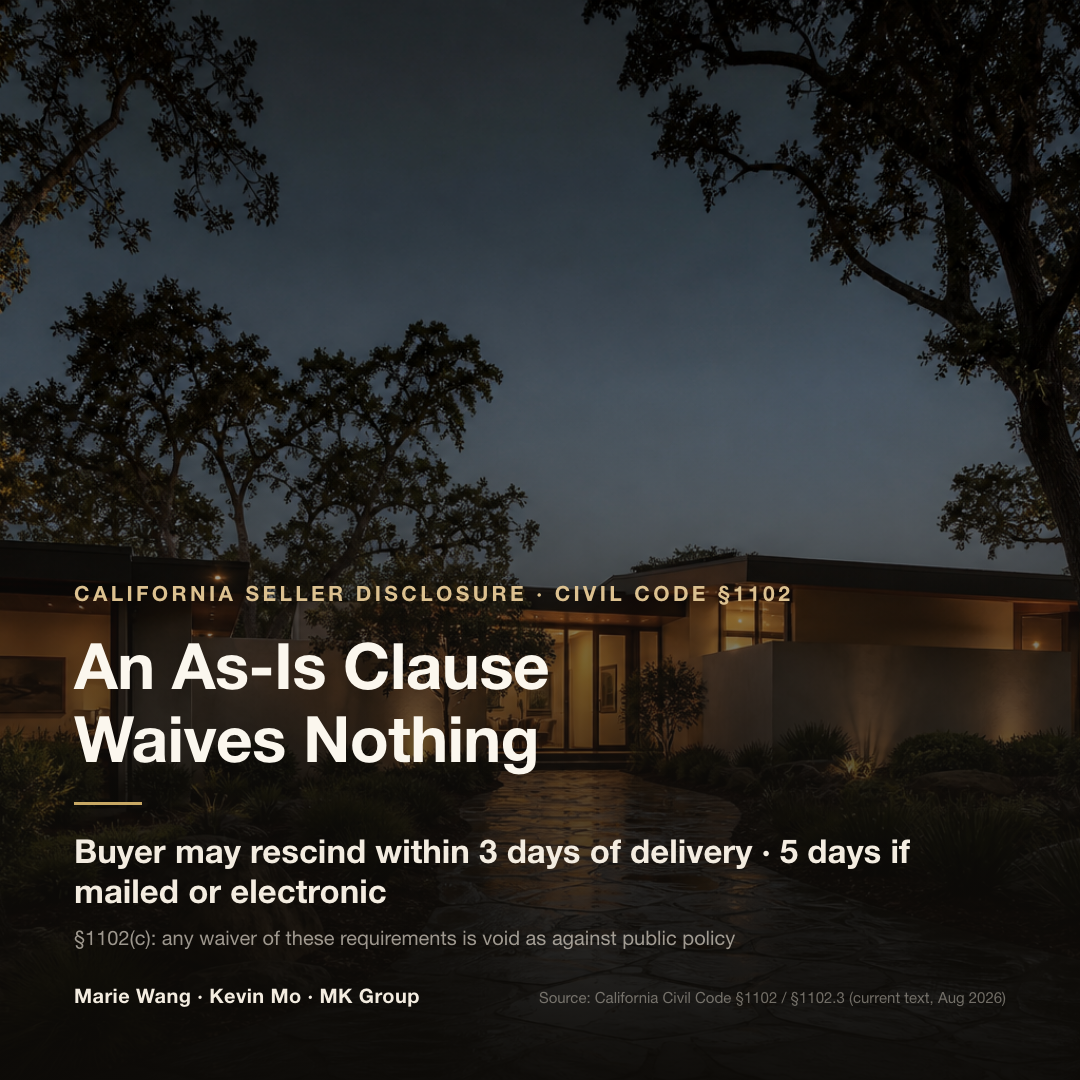
Two tests: do you know about it, and is it material. Both true means it goes in writing. California's Transfer Disclosure Statement is a statutory form under the Civil Code §1102 article, and §1102(c) provides that any waiver of the article's requirements is void as against public policy — an as-is clause does not remove it. Under §1102.3 the buyer may terminate in writing within three days of delivery, five if the disclosure is mailed or sent electronically.
Who this article is for
- Owners preparing to sell a primary residence on the Bay Area Peninsula or in the South Bay who want the disclosure package assembled before the listing goes live
- Sellers whose house carries a documented history — a leak that was repaired, a termite treatment, an addition that never went through permitting — who are unsure how far the write-up has to go
- Sellers planning to sell in as-is condition who want a clear account of what as-is actually removes and what it leaves in place
- Owners in Woodside, Portola Valley, Los Altos Hills and other statutory fire or flood zones who need the natural hazard report and defensible space documentation ready in advance
- Owners holding title in a living revocable trust of which they are the trustee, on the assumption that a trust sale is exempt from disclosure
- Sellers weighing a private off-market sale who want to know whether that channel changes their statutory obligations
Three judgments, in order
The question sellers ask most is whether a particular item has to be mentioned, and it cannot be answered directly. It has to be broken into three judgments taken in a fixed order. Reverse them and the first wrong call voids the other two.
Judgment one: do I actually know about it?
The legal character of the TDS is a statement by the seller about the scope of the seller's own actual knowledge. It is not a warranty, and it does not substitute for the inspections a buyer may want to run — the standard language at the top of the form settles that. Every one of the sixteen questions in Section II C opens by asking whether the seller is aware of the item. The question is what is in your head, not what is in the house.
The most common misreading here is that a repair erases the duty. You know the primary bedroom's exterior wall took water in 2019. You know a localized termite treatment replaced a threshold in 2021. You know the studio in the back was built without a permit. Those facts are inside your knowledge, and repairing the condition does not delete them from your memory. Repair records belong attached to the disclosure — alongside it, not instead of it.
Judgment two: is it material?
Civil Code §1102.1(a) is explicit. The Legislature did not intend to alter the existing duty of the parties to a real property contract, and their agents, to disclose any fact materially affecting the value and desirability of the property. In practical terms, the checkboxes on the TDS set the floor of the obligation, not the ceiling. If a fact is material, you disclose it whether or not the form has a box for it.
The working test is a single sentence: if a buyer learning this would likely change the price, change the terms, or walk, it is material. A cabinet door whose handle was replaced a decade ago is not. The test reads subjective, but the way it gets applied in a dispute is remarkably objective — looking back, materiality is almost always established by what the buyer actually did once they knew.
Judgment three: which form does it land on?
Seller disclosure is not one form. It is a stack. Two are required by statute. The TDS uses the form prescribed by Civil Code §1102.6 and covers the condition of the house itself. The natural hazard disclosure, under §1103 and §1103.2, covers six statutory hazard zones and is normally produced by a third-party hazard report company. Two more arrive by contract or by agency: the C.A.R. Seller Property Questionnaire (SPQ) asks a finer set of questions designed to surface known facts that fall outside the TDS boxes, while the Agent Visual Inspection Disclosure (AVID) records the agent's visual inspection of accessible areas. The AVID is the agent's obligation, not yours.
Sellers in fire zones should note that two separate obligations live here and are usually missed together. A home located in a high or very high fire hazard severity zone and built before January 1, 2010 requires a home hardening disclosure under Civil Code §1102.6f — as of July 1, 2025 that disclosure also lists low-cost retrofit items and identifies which have been completed during the seller's ownership. That is a form to fill in. Separately, any home in a high or very high fire hazard severity zone, regardless of the year it was built, requires the seller to deliver defensible space compliance documentation to the buyer under §1102.19. That is a document to hand over, not a box to check. Neither substitutes for the other.
One more provision turns on how long you have held the property. If the date the buyer's offer is accepted falls less than 18 months after you took title, and a contractor performed an addition, structural change or other alteration or repair during that holding period, §1102.6h applies (operative for offers accepted on or after July 1, 2024) and requires disclosure of the contractor's name and contact information along with the permit position. Owners outside California who sign through an agent should also note that an authorization settles who may sign; it does not change what you know, and the disclosure content still has to come from you. How a remote seller fits this sequence into the pre-listing calendar is covered in I Live Out of State (or Overseas) — Can I Sell My Bay Area House Without Ever Flying Back?
The six disclosure items that generate the most disputes
The core numbers first. The mandatory character of California seller disclosure is locked by one sentence in Civil Code §1102(c): any waiver of the requirements of the article (Article 1.5, §1102–1102.19) is void as against public policy. The natural hazard disclosure covers six statutory zones. The statutory line for a death in the home is three years and does not turn on the manner of death — inside three years it is treated as a material fact to be disclosed, and beyond three years a direct question still cannot be answered falsely. And a home in a high or very high fire hazard severity zone carries, on top of the form, a defensible space compliance document that has to be placed in the buyer's hands (§1102.19). The six items below are where disputes actually arise.
| High-dispute item | Disclosure required? | Statutory basis | Consequence of omission |
|---|---|---|---|
| Chronic leaks, roof and foundation water intrusion | Required once you know, with the extent and any repairs described | TDS Section II B material defect checkboxes (Roof(s), Foundation, Interior Walls, Ceilings and others); Section II C item 8, flooding, drainage or grading problems | The transfer is not invalidated (§1102.13), but a willful or negligent violation makes the seller liable for the buyer's actual damages; if the conduct amounts to fraud, the three-year period under CCP §338(d) runs from the buyer's discovery |
| Termite infestation and structural repair history | Required once you know, including structural repairs already completed | TDS Section II B, Other Structural Components; the common law duty preserved by §1102.1(a) covering facts materially affecting value and desirability | Same as above; pest reports and construction records usually sit with third parties, which makes an omission easy to reconstruct after the fact |
| Unpermitted additions and non-conforming work | Required | TDS Section II C item 4 (made without necessary permits) and item 5 (not in compliance with building codes); §1102.6h also applies where the offer is accepted less than 18 months after you took title and a contractor performed the work | Civil damages, potentially compounded by the municipal abatement notice or citation contemplated by item 15 |
| Neighbor disputes and boundary questions | Required where boundary lines, shared facilities, easements, ongoing noise or litigation affecting the property are involved | TDS Section II C item 2 (shared walls, fences, driveways), item 3 (encroachments, easements), item 11 (neighborhood noise problems or other nuisances), item 16 (lawsuits affecting the property) | The same actual-damages exposure under §1102.13; boundary disputes typically surface once the buyer receives the title report or completes a survey, which lands mid-escrow |
| A death that occurred in the home, any manner | Within three years §1710.2 gives no protection and the material-fact duty applies; beyond three years it need not be volunteered, but a direct question cannot be answered falsely | Civil Code §1710.2 — subdivision (a) sets the three-year line, subdivision (d) preserves liability on direct inquiry | An omission inside three years, or an intentional misrepresentation in response to a direct question, falls outside the section's protection entirely |
| Wildfire, flood and other statutory hazard zones | Required on the natural hazard disclosure once the property falls in any of the six statutory zones; a property in a high or very high fire hazard severity zone additionally requires delivery of defensible space compliance documentation | Civil Code §1103 and §1103.2 for the six zones; §1102.19 for the defensible space delivery duty, regardless of year built; §1102.6f home hardening disclosure for homes built before January 1, 2010 | §1103.13 mirrors §1102.13 exactly: the transfer is not invalidated, and a willful or negligent violation makes the seller liable for the buyer's actual damages |
What to remember: the column most often misread is the last one. §1102.13 and §1103.13 use identical language — a transfer is not invalidated solely because of a disclosure failure, but a seller who violates the duty willfully or negligently is liable for the actual damages the buyer suffers. In other words, an omission generally does not cost you the property. It leaves you carrying an open exposure after the money has moved. And because CCP §338(d) runs its three-year fraud period from the buyer's discovery rather than from the closing date, that is the actual mechanism behind sellers who hear from a buyer three years after the sale. The second easy misread is row three: the trouble with an unpermitted addition is not the addition. One piece of non-conforming work triggers TDS item 4 and item 5 at once, and can pull in the municipal notice contemplated by item 15 — a single structure occupying three boxes on the form. The third is the last row. A fire zone property carries more than a checkbox: §1102.6f is a form to complete and §1102.19 is a document to hand over, and doing the first does not finish the second.
Data source: California Civil Code §1102 / §1102.1 / §1102.2 / §1102.3 / §1102.6 / §1102.6f / §1102.6h / §1102.13 / §1102.19 / §1103 / §1103.2 / §1103.13 / §1710.2; California Code of Civil Procedure §338(d); California Business and Professions Code §7027.2; California Public Resources Code §4291 and California Government Code §51182 (the authority under which state and local agencies enforce defensible space requirements, referenced at §1102.19(c)); MLSListings Q2 2026 closed sales, compiled in MK Bay Area Pulse
Updated: 2026-08 (each statute checked line by line against the current text at leginfo.legislature.ca.gov)
Scope: Voluntary sales of single-family residential property in California. §1102.2 separately exempts court-ordered sales, foreclosures, and sales by a fiduciary administering an estate or trust, within which a revocable trust is itself an exception
What MK Group has seen
Older houses carry the highest density of disclosure items, and older houses in the very best locations carry more still. In July 2026, MK Group ran the numbers for a client on a century-old house in Old Palo Alto — built in 1926, exactly one hundred years old in 2026, listed above $8 million, on a roughly 10,000-square-foot lot with a long, narrow shape. The condition left no room for renovation: thresholds hollowed out by termites, a clear mold odor indoors, and structural damage accumulated from decades of weather exposure. Map those three facts back onto the form and each has a home. Termite-hollowed thresholds and structural damage land in TDS Section II B under Foundation and Other Structural Components; the mold odor points at Section II C item 1. Marie Wang (DRE# 02110980) and Kevin Mo (DRE# 02127623) were running a buy-side rebuild analysis on that property, but the conclusion holds identically from the seller's chair. Nearly all of the value in a house like that sits in the land, and the disclosure duty does not shrink by one box because the buyer intends to take the structure down. The statute attaches the duty to your actual knowledge and to the materiality of the fact — not to what the buyer plans to do with the house.
The instinct that writing the problems down means selling for less is worth calibrating against a specific outcome. In May 2026, MK Group handled a Midtown Palo Alto single-family home — four bedrooms, three baths, renovated once somewhere between ten and twenty years ago, described by the owner himself as an unremarkable good house. It listed at $3.88 million and closed at $4.378 million, roughly $500,000 above asking, about +12.8%. Four days of open houses drew around 110 visiting groups. The premium came from pre-listing outreach to a private buyer pool, owned-channel distribution, and open house execution. Put differently, the ceiling on a sale price is set by distribution and execution — it is not bought by leaving lines off a disclosure form. When a house has neither a defect nor a distinguishing feature, whether it sells high depends almost entirely on how many of the right buyers actually saw it.
The last scenario sellers press on is the private sale. The structure is real: in July 2026, an Atherton property sold off-market at $8 million before any listing preparation began, to a local developer who valued the site for the replanning latitude created by its three separate points of access. But whether the deal runs publicly or privately does not change the reach of the disclosure duty. The §1102.2 exemption list is organized by transaction type — court-ordered sales, foreclosures, sales by a fiduciary in the administration of an estate or trust (with a revocable trust exception, discussed under mistake 3 below) and similar categories. Not one entry reads "never publicly listed." How the buy side reviews the same package is covered in Luxury Buyer Due Diligence: Building Quality, Security Systems, and Long-Term Holding Risk.
Common mistakes
Mistake 1: "The contract says as-is, so I don't have to disclose"
As-is changes who pays for repairs. It does not change who has to speak. Civil Code §1102.1(a) states plainly that delivery of the TDS cannot be waived in an as-is transaction, and §1102(c) goes further — any waiver of the article's requirements is void as against public policy. What as-is actually does is leave the repair burden on the buyer's side, and that arrangement holds up precisely because the buyer accepted the current condition knowingly. Write the problems down and the as-is clause stands. Bury them and the same clause becomes the backdrop to an argument that you knew and concealed.
Mistake 2: "The house never goes on MLS — I'm selling privately to a developer I know, so none of this applies"
It applies. The §1102.2 exemption list is organized by the nature of the transaction, not by how the property was marketed: sales ordered by a court (including a probate court in the administration of an estate); foreclosure sales following default and dispositions by a lender after taking title; sales by a fiduciary in the course of administering a trust, guardianship, conservatorship or estate (though a revocable trust is expressly outside that exemption where the trustee is a natural person who is a former owner of the property or occupied it within the preceding year); transfers between co-owners; transfers to a spouse or a direct lineal blood relative; spousal transfers arising from a dissolution decree; and transfers to or from a governmental entity. "Never listed publicly," "the buyer is someone I know" and "no agent involved" appear nowhere on that list. Nor does a buyer who happens to be a developer planning a teardown — the statute ties the duty to your actual knowledge and the materiality of the fact. What an off-market channel spares you is listing preparation and public exposure. It does not spare you this document.
Mistake 3: "The house is in our living trust, and trust sales are exempt"
Most likely not. The §1102.2 entry covering sales by a fiduciary administering a trust, guardianship, conservatorship or estate is immediately followed by a limitation: the exemption does not apply where the trustee is a natural person, is the trustee of a revocable trust, and is a former owner of the property or has occupied it within the preceding year. A very large share of Bay Area primary residences sit in exactly that structure — a living revocable trust with the owner as trustee, set up to avoid probate — which places those sellers squarely inside the exception, with the full TDS still due. The sellers who genuinely land inside the exemption are usually those whose trustee has no residential connection to the property: a successor trustee who took over administration, an institutional trustee, or a sale during estate administration. Which category your trust falls into is a question for your attorney or title company to answer from the trust instrument before the transaction, not something to infer from the fact that the house is held in trust.
Mistake 4: "I'm not fixing any of this — if I disclose it, the buyer walks"
The reverse happens more often. Under §1102.3 the buyer already holds three days after delivery — five if mailed or sent electronically — to terminate in writing. That window exists either way. The only thing you control is when it opens: after you disclose (the buyer is prepared, and it usually converts into a price negotiation), or after their own inspector finds it (at which point the buyer loses confidence in the house and in you at the same time). The cost has a visible shape in the data, provided you read the curve rather than a single number. Per MLSListings Q2 2026 closed sales, compiled in MK Bay Area Pulse, every Bay Area price band below $10 million ran a median of 8 to 15 days on market and a median sale price at 101.3% to 105.3% of the original list price — the $5M–$10M band recorded 279 closings, a median of 8 days, and a 103.8% ratio. The curve turns at $10 million: the $10M–$20M band recorded 39 closings, a 25-day median, and a 96.3% ratio, and the $20M+ band recorded 8 closings, a 44-day median, and 91.5%. Below $10 million the market still clears fast and above list; from $10 million up, time on market lengthens and pricing moves to a discount against the original list. The upper two bands rest on 39 and 8 sales respectively, so treat them as directional rather than precise. None of these figures measures a relisting after a cancelled escrow directly. What they show is that the higher the band, the longer the curve a relisted house has to walk again — and this time it walks it carrying a problem that an inspector found. Which items are worth repairing and which are cheaper to simply disclose is covered in Should I Spend Six Figures Renovating Before Selling in the Bay Area? Which Costs Come Back, and Which Are Sunk?
Mistake 5: "Someone died in this house years ago, so I'll have to disclose it forever"
No. Civil Code §1710.2 draws a three-year line, and the line does not distinguish between manners of death: where the death occurred more than three years before the buyer's offer to purchase, lease or rent, neither the fact of the death nor its manner is a required disclosure. The same section leaves a door open in the other direction — it expressly does not immunize an owner or an agent who makes an intentional misrepresentation in response to a direct inquiry from a buyer or prospective buyer about a death in the home. Conversely, a death inside three years gets no protection from the section, and whether it must be disclosed returns to the second judgment above: is it a fact materially affecting value and desirability. Standard practice is to disclose it. So the correct posture is straightforward. Inside three years, disclose. Beyond three years, do not volunteer it, but do not lie when asked directly, and do not deflect with "I'm not sure" about something you know.
Next steps
- Start with a written recall of what you know. List every leak, pest treatment, structural repair, insurance claim, addition and alteration that occurred during your ownership, with the year and the contractor. Items that were fixed go on the list too — the duty attaches to your knowledge, not to whether the problem still exists.
- Map each line to a specific box on the TDS: the material defect checkboxes in Section II B and the sixteen questions in Section II C. Anything with no matching box that you judge would change a buyer's offer goes into the SPQ or a separate written statement, because the common law duty preserved by §1102.1(a) is not bounded by the edges of the form.
- Order the natural hazard report before you list, and confirm whether the property falls into any of the six statutory zones under §1103.2. If it sits in a high or very high fire hazard severity zone, Civil Code §1102.19 requires you to deliver defensible space compliance documentation under PRC §4291 or a local vegetation management ordinance: where a local ordinance exists, deliver documentation under it and tell the buyer which local agency issues copies; where no ordinance exists but a state or local agency, other governmental entity or qualified nonprofit performs inspections, deliver documentation you obtained within six months before entering into the sale contract; where neither is available, sign a written agreement with the buyer that the buyer will obtain compliance documentation within one year of closing. If the house was also built before January 1, 2010, prepare the §1102.6f home hardening disclosure alongside it. Properties in Woodside, Portola Valley and Los Altos Hills especially warrant an early check — §1102.19(c) also makes clear that an agreement between buyer and seller does not limit enforcement of defensible space requirements by state or local agencies under Gov. Code §51182 and PRC §4291.
- If the buyer's offer is accepted less than 18 months after you took title, and a contractor performed an addition, structural change or repair during that period, assemble the contractor's name and contact information under §1102.6h — the provision reaches work where the contract price exceeds the threshold set by Bus. & Prof. Code §7027.2 (currently $1,000). Copies of permits obtained, or (if you do not hold copies) a statement telling the buyer where permit information can be obtained, are provided separately.
- Put the disclosure package on the pre-listing schedule rather than starting it when an offer arrives. How to fit it into the week before the listing goes live is covered in Bay Area Home Selling Process: The 1-Week High-Intensity Launch Plan, From Prep to Live Listing.
The California statutes cited here reflect the current text as read at leginfo.legislature.ca.gov in August 2026 and are subject to amendment. Application to any individual transaction varies with the deal structure, the holding entity, and the practice of the county in which the property sits. Confirm the specifics with your own attorney or tax adviser before relying on them.