Direct answer
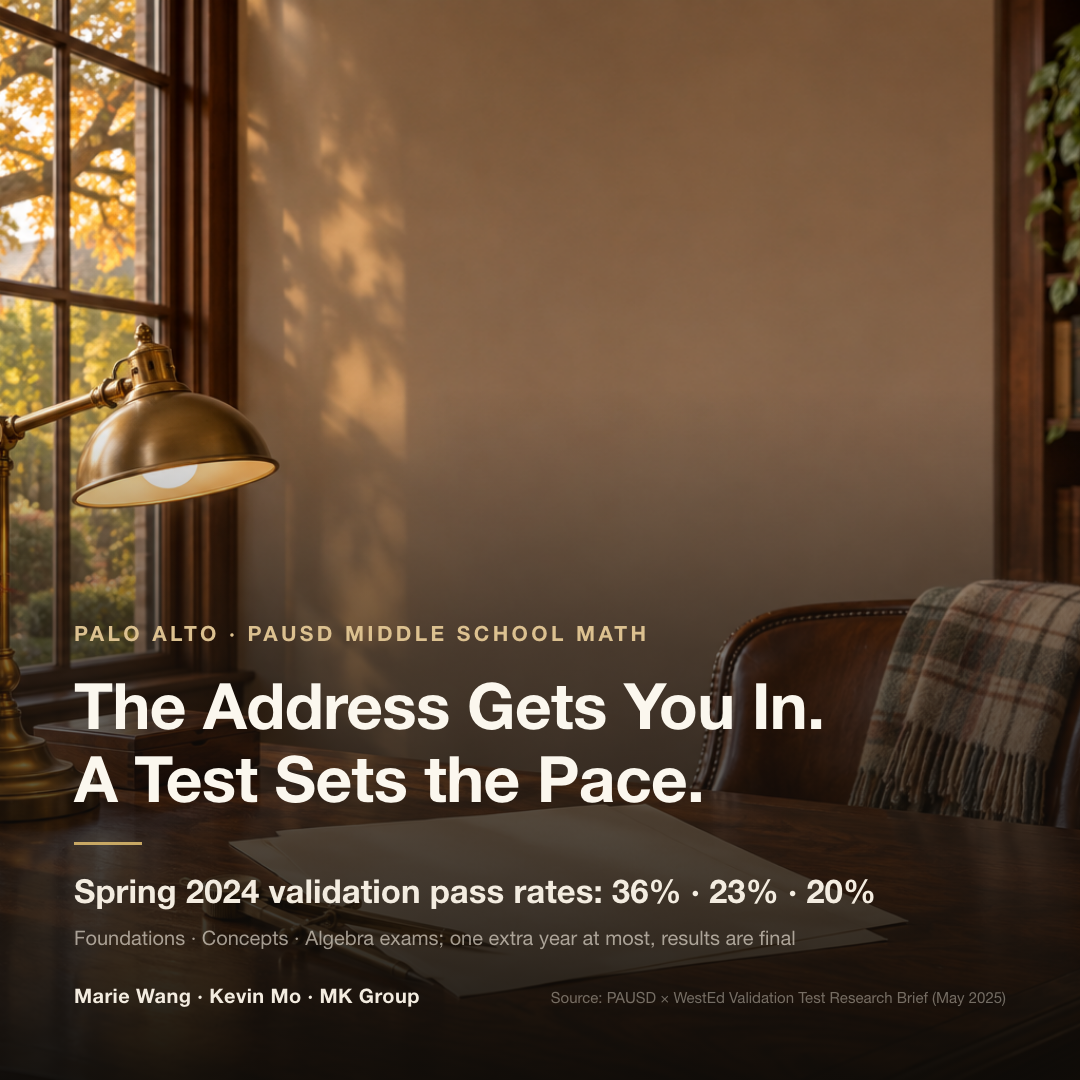
Yes, but in PAUSD the earliest a student takes Algebra 1 is 7th grade, and only after passing a math validation test. The district's standard middle school path is already compacted to reach Algebra 1 in 8th grade, and students may accelerate at most one additional year. In spring 2024, pass rates on the three validation exams were 36%, 23% and 20%.
The home secures enrollment; acceleration is earned on a test. A research brief from the district and WestEd (May 2025 edition) reports that in spring 2024, 293, 191 and 109 students sat the Foundations, Concepts and Algebra exams, and 106, 44 and 22 of them passed. The result rests on a single sitting. There are no retakes and no appeals.
The fastest route is Algebra 1 in 7th grade and Geometry Honors in 8th, a path district materials say can lead to AP Calculus BC by junior year of high school. Algebra 1 in 6th grade has no corresponding path in PAUSD middle schools. The spring round closes registration at the end of February; students who enroll after that take a fall validation in the first weeks of the school year.
Who this article is for
- Families with a child in grades 5 to 7 who is clearly working above grade level in math, and who plan to buy a Palo Alto home at around $5M and move into PAUSD
- Families transferring in from another state, from overseas or from a private school, whose child has already taken Algebra 1 or even geometry, and who want to know how PAUSD will treat that coursework
- Buyers lining up closing, move-in and registration dates who want their child to make a validation testing window
- Families with a child about to start 9th grade who want to understand how math placement is decided at Gunn and Paly
Three questions that decide it: the baseline, the test and the timing
It works the same way as PAUSD's Mandarin immersion program: the home buys eligibility to enroll, and admission to a program follows its own rules (see I Bought a Home in Palo Alto — Does That Get My Child Into Ohlone's Mandarin Immersion Program?). In PAUSD, "can my child skip ahead?" breaks into three questions. Ahead of what, exactly? Which test does the district use to verify it, and how high is the bar? And when does the child enroll, which decides the round of testing they can catch?
Question 1: Recalibrate "ahead," because PAUSD's standard path is already a year fast
PAUSD middle school math is a compacted program that covers four years of Common Core math in three: Foundational Math in 6th grade, Concepts in Math in 7th, Algebra 1 in 8th, then Geometry or Geometry Honors in 9th. The district's Math Placement Plan Policy & Protocols, revised in May 2025, states that all PAUSD students take Algebra 1 or Geometry in 8th grade. A presentation by PAUSD and WestEd at the California Educational Research Association (CERA) conference in November 2025 draws the contrast plainly. On a conventional, uncompacted path, students study grade-level standards in 6th, 7th and 8th grades and begin Algebra 1 in 9th.
Run the conversion, and a child who is "two years ahead" at their current school, say one who has finished Algebra 1 by 7th grade, is only one year ahead of PAUSD's standard path. That is exactly the district's limit. Students who pass validation may accelerate only one additional year in middle school, and rising 7th and 8th graders who have already accelerated a year can't register again. The ceiling in PAUSD middle school is Geometry Honors in 8th grade.
Course names don't line up one to one either. PAUSD's Foundational Math and Concepts in Mathematics each combine standards from Math 6, Math 7 and Math 8. A "Math 7" or "Pre-Algebra" on a transcript from another school doesn't correspond to any single PAUSD course.
Question 2: How the validation test works, and why one paper exam settles it
PAUSD's Math Validation Process covers three middle school courses, with one exam per course. A 5th grader takes the Foundations exam; passing means Concepts in Math in 6th grade. A 6th grader takes the Concepts exam; passing means Algebra 1 in 7th grade, alongside 8th graders. A 7th grader takes the Algebra exam; passing means Geometry Honors in 8th grade. Students who don't pass are scheduled in grade-level sequence. A student who doesn't pass, and hasn't yet accelerated, can register again the following year.
According to the district's FAQ, the test is optional and taken on paper, with both multiple-choice and open-response questions. It runs about 1.5 to 2 hours after school at JLS Middle School, is scored by PAUSD math teachers, and results are shared with families. The district provides no study materials, only the standards of the course being challenged. There are no retakes, parents may not accompany students, and parents may not review the test to check the scoring. The May 2025 placement policy classifies the test as a high-stakes measure and states that results are final, with no appeal process.
The current exams were redeveloped by WestEd on the district's commission during the 2023–24 school year. The old version came in two sittings, and only students who passed the multiple-choice part qualified for the open-response part; from spring 2024 the two were merged into one. Cut scores are set as a share of possible points: 70% for Foundations, 60% for Concepts and 70% for Algebra. The Concepts cut score sits below the other two because WestEd's statistical analysis found that exam the hardest of the three.
Question 3: Your enrollment date decides which round your child can catch
For the spring round, the district sends registration information in late January through ParentSquare to parents of current 5th, 6th and 7th graders. The 2026 calendar ran as follows: notice on January 29, registration closed February 26, rising 7th and 8th graders tested on March 23, and rising 6th graders on March 25. For spring 2027, the district's site says only that registration "opens in early 2027."
New PAUSD students entering grades 6, 7 or 8 who started school on or after February 26, 2026 can take the Fall Validation Test in the first weeks of the new school year. For a child entering 9th grade, middle school validation doesn't apply; high school placement follows the SB 359 framework covered below. All dates and rules here are subject to PAUSD's official placement documents for the current school year, which the district updates annually.
How many students take the validation test, and how many pass
The headline numbers: in spring 2024, 593 students sat PAUSD's three math validation exams and 172 passed, an overall pass rate of about 29%. The largest group took the 5th-grade Foundations exam, where 106 of 293 passed (36%). The higher the grade, the harder it got: 44 of 191 passed Concepts (23%), and 22 of 109 passed Algebra (20%).
| Exam | Taken by | Placement if passed | Cut score | Test-takers | Passed | Pass rate | Average score |
|---|---|---|---|---|---|---|---|
| Foundations | 5th grade (rising 6th) | Concepts in Math in 6th grade | 70% | 293 | 106 | 36% | 58.5% |
| Concepts | 6th grade (rising 7th) | Algebra 1 in 7th grade | 60% | 191 | 44 | 23% | 40.3% |
| Algebra | 7th grade (rising 8th) | Geometry Honors in 8th grade | 70% | 109 | 22 | 20% | 46.5% |
What to remember: everyone in the room had opted in, so these were students whose families believed they were ready, and still only a fifth to a little over a third passed. Concepts test-takers averaged just 40.3% of possible points. The brief notes that Concepts was the hardest exam in both the cut-score study sample and the operational sample, which is why its cut score was set lower, at 60%; even so, only 23% cleared it.
The same brief compared first-semester grades in 2024–25. The 22 students who reached 8th-grade geometry through the Algebra exam earned a B or better at a rate similar to the 132 classmates who took Algebra 1 before geometry (students the report notes had already accelerated a year earlier), but they earned an A less often. Worked out from the counts in the report, about 86% and 89% of the two groups earned a B or better, and about 45% and 60% earned an A. As of November 2026, the most recent research brief posted on the district's math page covers only the spring 2024 round; pass rates for later rounds depend on what the district publishes next.
In high school: how 9th-grade math actually breaks down
The headline numbers: according to the report the district publishes under SB 359 for 2025–26 (as of September 22, 2025), 554 of PAUSD's 856 9th graders, or 64.7%, were in Geometry or Geometry Honors. About a quarter, 221 students (25.8%), had already moved past geometry into Algebra 2 (including Algebra 2/Trig) or higher. Another 81, or 9.5%, were in Algebra 1.
| 9th-grade math course (2025–26) | Students | Share |
|---|---|---|
| Algebra 1 | 81 | 9.5% |
| Geometry | 297 | 34.7% |
| Geometry Honors | 257 | 30.0% |
| Algebra 2/Trig A | 39 | 4.6% |
| Algebra 2/Trig Honors | 174 | 20.3% |
| Algebra 2, Analysis H and AP Calculus BC (combined) | 8 | 0.9% |
| Total | 856 | 100% |
What to remember: geometry in 9th grade is the PAUSD norm, where nearly two-thirds of students sit. A 9th grader in Algebra 2/Trig (A or Honors) finished geometry before high school, and in 2025–26 that described roughly 1 in 4 9th graders. Very few reach Analysis H or AP Calculus BC in 9th grade. To protect privacy, the district shows only an asterisk for any cell of 10 or fewer students, and those two cells together with Algebra 2 total just 8 students (derived from the overall total). The report doesn't distinguish whether a student got there through middle school validation, an approved off-campus course, or placement after transferring in from another school.
SB 359 and the PAUSD math placement lawsuit: which rules have legal backing
SB 359, the California Mathematics Placement Act of 2015 (codified at California Education Code §51224.7), required every district enrolling 9th graders to adopt, in a public meeting before the 2016–17 school year, a "fair, objective, and transparent" math placement policy. The policy must systematically weigh multiple objective academic measures, including statewide assessments, placement tests aligned to state standards, classroom work and grades, and transcripts. It must include at least one placement checkpoint within the first month of the school year. Placement data must be reviewed each year by race, ethnicity, gender and socioeconomic background to make sure qualified students aren't disproportionately held back. Students and parents must have a clear and timely means of recourse, and the policy must be posted on the district website. For the move from elementary to middle school, the law says only that districts "may" adopt the same kind of policy.
A group of PAUSD parents petitioned Santa Clara County Superior Court for a writ of mandate (Case No. 21CV385694), arguing that the district's 9th-grade placement policy didn't meet SB 359. The court heard the petition in December 2022, held compliance hearings in March and June 2023, and issued its order in July 2023, along with a 9th-grade math placement policy it had revised itself (marked CT Revised 7/21/2023) and directed the district to post. The key provisions the court added: students who earn a C or better in 8th-grade math, or score proficient on the state test, won't be required to repeat 8th-grade math; in the 9th-grade placement checkpoint, the district's undefined "90%" threshold for considering a higher placement was replaced with proficiency; and the district must report data on students completing calculus or advanced statistics by 12th grade. The court found the parents' other requested changes went beyond what SB 359 requires and denied them. In a July 30, 2023 announcement, the district said the ruling required no changes to anything related to students in grades 6 to 8.
For a home purchase, this comes down to two points. The middle school validation test is district policy, not a state mandate; its rules can change as the district adjusts them, and its results can't be appealed. Ninth-grade placement is bound by SB 359 and the court's order, with a placement checkpoint in the first month of school and the right to appeal a placement within 10 school days. According to an April 2026 report in The Campanile, Paly's student newspaper, the district said no immediate changes to the validation test are planned.
Lining up closing and enrollment dates with the testing window
The headline numbers: under the 2026 rules, 5th to 7th graders already enrolled before February 26 go through the spring validation (registration closes February 26, testing in March); new students entering grades 6 to 8 who enroll on or after February 26 go through the fall validation in the first weeks of school; and rising 9th graders don't take middle school validation at all. On the market side, Palo Alto recorded 103 single-family sales in Q3 2026 (July–September) at a median $4,200,000, 27 of them at $5M or more. Median days on market was 9, the median sale price was 107.6% of original list price, and 36.9% of sales were all-cash. The same quarter a year earlier saw 105 sales at a median $4,100,000 and a median 105.2% of original list price (MK Bay Area Pulse, MLSListings data). By closing month, there were 31 sales in July, 32 in August and 40 in September.
| When your child enrolls in PAUSD (2026 rules as the example) | Grade | How placement is decided |
|---|---|---|
| Enrolled before February 26, 2026 | Grades 5, 6 and 7 | Spring validation: register by February 26, test in March |
| Enrolled on or after February 26, 2026 | Rising grades 6, 7 and 8 | Fall validation: first weeks of the new school year |
| Any time | Rising 9th grade | No middle school validation; placed on SB 359 multiple measures, with an MDTP placement check in the first month of school |
What to remember: a family that closes over the summer and starts school in August counts, under the 2026 rules, among the "new students enrolling on or after February 26," so a child entering grades 6 to 8 needs to catch the fall validation in the first weeks of school. To make the spring round, the child has to already be an enrolled PAUSD student before registration closes. The late-January notice goes out through ParentSquare to current families, so a family that enrolls in February may never receive it and should ask the school directly how to register. With a 9-day median on market in Palo Alto, there's little room to find the home first and sort out enrollment afterward. For the residency documents enrollment requires, and how they sequence with closing and move-in, see Relocating to the Bay Area for School: When Do You Have to Close and Move In to Make Fall Enrollment?
Transferring in from another state or a private school: how prior coursework counts
In middle school, the only acceleration route the district's public documents describe is the validation test. Nothing in them provides for skipping a course on the strength of another school's transcript. Students who don't take or don't pass validation are scheduled in grade-level sequence. A child who has finished Algebra 1 elsewhere and wants Geometry Honors in 8th grade at PAUSD still has to pass the Algebra exam.
For transfer students entering 9th grade, placement draws on the SB 359 set of multiple measures: grades and tests in the current math course, the ability to work independently and persist, the level reached on end-of-year assessments, the MDTP diagnostic test, CAASPP state test scores, a range of formative and summative assessments, and how the student balances coursework with outside commitments. Students from other states and most private schools have no CAASPP scores, so what they can bring is mainly a transcript, course syllabi and MDTP results. In the first month of school, every 9th grader takes an MDTP placement check. A student who reaches proficient is tested at the next level up, and so on until they reach the highest lane they qualify for.
A few more high school rules bear directly on outside coursework. Courses taken outside PAUSD must be approved in advance, or they won't appear on the transcript. The prerequisite for Algebra 2/Trig Honors is worded differently in two official documents. The district's July 2023 9th-grade placement policy accepts "a PAUSD Geometry course or an off-campus course previously approved by PAUSD." The May 2025 revision of the overall placement policy names only "a PAUSD Geometry course" and cautions that an off-campus geometry course may not fully prepare students for this highest lane. Both documents are posted on the district site, so whether geometry taken at another school before enrollment satisfies the requirement should be confirmed in writing by the school counselor.
High school students can also challenge a course by examination under Board Policy BP 6155; a passed challenge is noted on the transcript as a requirement met by examination. A family that disagrees with a placement can appeal to the Superintendent or a designee within 10 school days of the decision. That appeal applies only to high school, not to middle school validation.
Once enrollment is confirmed, give the counselor at the assigned high school your child's transcript, course syllabi and textbook titles, and ask the school to state in writing how the course will be credited and how the first-month placement check will be scheduled. Whether a child attends Gunn or Paly is set by the house address; for how to check, see Buying a Palo Alto School-District Home: How Do I Know Whether an Address Feeds Gunn or Paly?
MK Group in practice
The closest match in MK Group's anonymized case library is a married couple in Seattle, both working in AI research at a major tech employer (case-015). Their employer also has teams in the Bay Area, so neither job had to change. What drove the move was their 8-year-old daughter's education: the window for choosing a path from elementary into middle school was coming up. They chose Palo Alto because PAUSD's public schools gave them a reliable fallback, and because it is close to Stanford. The team led by Marie Wang (DRE# 02110980) and Kevin Mo (DRE# 02127623) walked them through PAUSD elementary attendance boundaries, the path from elementary into middle school, and how Paly and Gunn differ. Flying in from out of state, the couple had only 3 to 5 days per trip, so the team ran remote video walkthroughs and data screening in advance and saved time on the ground for homes that genuinely fit. The family closed in early May 2026 (case details).
The case didn't involve math placement. What it shows is something adjacent: for education-driven families moving across state lines, the timing of a move is usually set by the child's next school transition rather than by the house. The math validation test slices that transition finer. Each spring brings a round for 5th, 6th and 7th graders, with registration closing at the end of February; miss it, and the fall validation in the first weeks of school is still there. Closing date, move-in date and enrollment date are best mapped against this calendar before you write an offer.
Common mistakes
Mistake 1: "Once we buy into PAUSD, my child's head start will carry over automatically"
The home secures eligibility to enroll. The only middle school acceleration route PAUSD publishes is the validation test. There is no provision for skipping a course on the strength of another school's transcript, and students who don't take or don't pass the test are scheduled in grade-level sequence. Wherever your child got to at their old school, they have to prove it again in a PAUSD exam room.
Mistake 2: "My child is two years ahead, so they can skip two years at PAUSD too"
PAUSD's standard path already puts Algebra 1 in 8th grade, a year earlier than the conventional 9th. District rules let students who pass validation accelerate only one additional year in middle school, and rising 7th and 8th graders who have already accelerated can't register again. The middle school ceiling is Geometry Honors in 8th grade, two years ahead of the conventional path. Beyond that, PAUSD middle schools have no course to place a student in.
Mistake 3: "If the test goes badly, we can appeal or try again in a few months"
The district FAQ states there are no retakes, and parents may not review the test to check the scoring. The May 2025 placement policy states that validation results are final, with no appeal process, and the 10-school-day appeal available for high school placement doesn't extend to middle school validation. A student who hasn't yet accelerated can register again for the next spring round.
Mistake 4: "We're moving in over the summer, so we've missed this year's validation test"
Under the 2026 rules, new PAUSD students entering grades 6, 7 or 8 who enroll on or after February 26 can take the fall validation in the first weeks of the new school year. A family that closes over the summer and enrolls in August is exactly who that round serves. The task is to confirm the fall validation date and registration process with the school as soon as your child is enrolled.
Mistake 5: "Rising 9th graders take the validation test too, and failing it means Algebra 1"
Ninth-grade placement doesn't use middle school validation. It is decided on SB 359's multiple measures, including grades in the current course, MDTP and CAASPP. The placement policy the court revised in 2023 states that students with a C or better in 8th-grade math, or a proficient score on the state test, won't be required to repeat 8th-grade math. There is also an MDTP placement check in the first month of school, and students who meet the bar can move up.
Next steps
- Translate your child's progress into PAUSD course names first. Compare it against the topic lists for Foundational Math, Concepts in Mathematics and Algebra 1 in the district's placement policy to decide which exam your child would challenge, and whether a challenge makes sense at all.
- Work back from the first day of school to set closing and enrollment dates. For a child entering grades 6 to 8, decide early whether to aim for the spring round (in 2026, registration closed February 26 with testing in March) or the fall validation in the first weeks of school. Palo Alto single-family homes went into contract in a median 9 days in Q3 2026, so this calendar needs to be settled before you write an offer.
- In the week you complete registration, ask the school how new students receive the validation registration notice, and when and where the fall validation will be held.
- For a child entering 9th grade or transferring in during high school, bring the transcript, course syllabi and textbook titles, and ask the counselor at the assigned high school to confirm in writing how math coursework will be credited and how the first-month placement check will be scheduled. Get any off-campus course approved before your child takes it.
- Each year, defer to PAUSD's official documents for the current school year: the math placement policy (Math Placement Plan Policy & Protocols, including the 9th-grade placement policy), the validation test research brief, and the 9th-grade course enrollment report the district publishes annually under SB 359.