Direct Answer
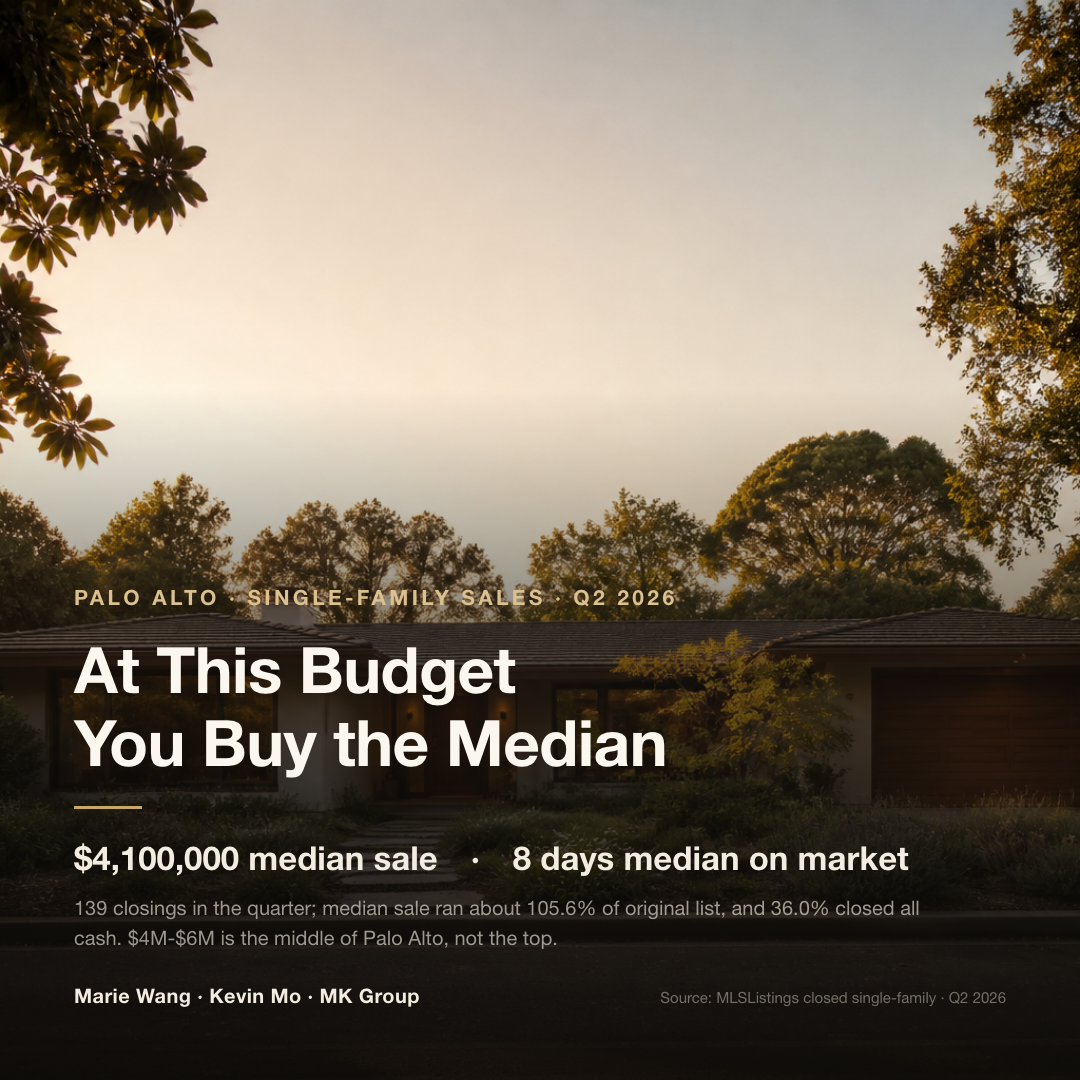
This budget buys the median Palo Alto house, not the top of the market. The Q2 2026 median single-family sale price in Palo Alto was exactly $4,100,000. So one of three things has to give: the lot and the garden, the finish level, or the square footage and the bedroom count.
Who this article is for
- Families touring Palo Alto with $4M–$6M who want to know what that number actually corresponds to on the ground
- Buyers stuck between a large lot with an older house and a smaller lot with a fully finished renovation
- Anyone comparing a traditional single-story home, a studs-out renovation, and a new two-story build inside the same budget
- Buyers planning to remodel after purchase who want to sort fixable flaws from permanent ones first
- Families whose budget might stretch past $6M and who want to understand how the competition changes above $5M
Three trade-offs that define this budget
Reset the expectation first. In Palo Alto, $4M–$6M is not the luxury tier. It is the center of the market, and a house at the center of the market has almost always been cut somewhere. Rather than hunting for the home with no weakness, decide in advance which weakness you can live with. MK Group tours the week's new Palo Alto listings in person every Friday. Three homes that came up in the same week of August 2026 landed on three different versions of the same trade-off.
One: lot and garden — the more mature the yard, the more traditional the plan
The first archetype is a large lot with traditional single-story living. The home asking near $6M that week fell into this category: a genuinely central Palo Alto location, with front and back gardens that had been growing for years. Mature planting like that is not easy to find in the core. The family room has a wet bar and looks straight out to the backyard, and large skylights over both the family room and the hallway pull daylight into the part of an older house that usually loses it.
The cost is in the plan. Four bedrooms sit together along one corridor, fully separated from the living room and kitchen at the front. The formal living room, dining room, family room, and kitchen are each their own enclosed space — good when the house is full and everyone wants a different room, but the kitchen does not open to the living area, and a buyer used to the sightlines of a new build will read it as traditional. There is no separate laundry room either; the washer sits in the hallway. The secondary bedrooms are modest, though the windows face the garden and the light is good, and the walls have been used for a built-in desk and storage. The primary bedroom is generous, with a full wall of glass opening onto the side yard. Two things work against it: the bedrooms run standard 8-foot ceilings, so the volume falls off noticeably after the family room, and the primary shower is tight enough that the bathroom needs a full reconfiguration.
The garden carries a counterintuitive note as well. The house has a beautiful pool — and the pool takes up nearly the entire backyard, leaving only a small seating area behind it. Marie Wang said plainly in the video that she would consider filling it in. At Palo Alto lot sizes, a pool is not a free amenity. It is bought with usable backyard.
Two: finish level and flow — move-in ready costs you land
The second archetype is smaller, and finished to a much higher standard. Another home that week keeps its 1958 build year but has been rebuilt to the studs. The living room, dining room, and kitchen are fully open; a vaulted roofline with skylights raises both the ceiling height and the light at once. Pale wood, stone, and black linework read as clean, warm, and current. Bedrooms are grouped on one side of the house, so the public and private zones separate cleanly. The secondary bedrooms are compact but well lit, with built-in desks and custom lit storage cabinetry — a level of finish that is uncommon in renovations of this size, and that many new builds skip entirely. The primary bedroom does not chase scale; its advantage is the custom closet and the completeness of the bathroom. The roof is steel, with a service life of roughly 70 years, considerably more durable than standard asphalt shingle — a difference that shows up in holding cost rather than in the listing photos.
The cost is in the land. The lot is a little over 6,600 sqft and is used efficiently, with easy day-to-day upkeep, but the backyard is shallow: a small terrace and artificial turf, with power poles fairly prominent in the sightline. It is a practical, low-maintenance yard, not a landscape yard. This is the house for a family of three or four that values finish and wants to move in without a project.
Three: square footage and bedrooms — more rooms, more compromise on location
The third archetype trades location for space. The third home that week is a two-story build completed in 2020: roughly 2,698 sqft of interior, 5 bedrooms and 4 bathrooms, on a 7,069 sqft lot, plus an ADU. To the right of the entry is a separate flexible room, currently set up as a study and piano room, facing the front yard with good light — it works as a home office or a practice room. The front door is tall and wide, and it opens directly into the living room, where the fireplace anchors the space and narrow flanking windows plus a large glass door to the backyard bring in daylight. The living room runs into the kitchen and dining area behind it; the footprint is not especially large, but the circulation is clean. The bay window is done particularly well — beyond the light, it is somewhere to actually sit and read. Upstairs holds three bedrooms plus a storage room. The rear terrace has a wood-slat ceiling detail, the yard is roomy, and the outdoor barbecue is already built in.
The cost is in the location. The house sits somewhat closer to the freeway, and there is a trace of road noise, audible in the backyard. Be honest about what this layer of the trade-off means: bedroom count and living area are the two most expensive things to buy in any fixed budget, and the usual way to buy them is to give up a step on micro-location.
One common judgment worth correcting while we are here: new does not mean better across the board. The lit custom cabinetry and built-in desks in that renovated house are exactly what many new builds do not have. For the wider pricing logic between old and new stock in Palo Alto, see why a century-old Palo Alto house can cost more than a new build.
Screen the unchangeable half first
Underneath those three dimensions sits a filter that should run before all of them: is this flaw something money fixes, or something money does not?
Money fixes these. Whether the kitchen opens to the living room. Reconfiguring a shower. Filling a pool. Adding closets and storage. The finish level of floors and cabinetry. These are budget questions, not house questions — the cost can be estimated and the work can be scheduled.
Money does not fix these, or the cost is high enough that it is not worth doing. Road noise. Lot depth. Power poles in the sightline. Eight-foot bedroom ceilings. The micro-location of the house itself. If any one of those five is going to grate on you for years, no renovation buys your way out of it.
So run a showing in the opposite order from instinct. Spend the first ten minutes deciding whether the unchangeable items are acceptable, and only then look at the kitchen, the cabinetry, the finish. Falling for the finish level first and discovering the road noise or the ceiling height after you are in contract is the most common way buyers in this band lose a month. For what a remodel actually has to clear on the permitting side, see the seven-town Bay Area remodel and addition permit comparison.
Where this budget actually sits: three sets of closing numbers
The core numbers first. Palo Alto closed 139 single-family sales in Q2 2026 (April–June) at a median sale price of $4,100,000 — which lands right at the bottom edge of the $4M–$6M band. Put another way, this budget buys the median house in the city. Over the same quarter the median home spent 8 days on market, closed at about 105.6% of its original list price, and 36.0% of sales were all-cash.
| Segment | Closed sales | Median sale price | Median days on market | Sale price / original list | All-cash share |
|---|---|---|---|---|---|
| Palo Alto single-family | 139 | $4,100,000 | 8 days | 105.6% | 36.0% |
| Bay Area $3M–$5M band | 822 | $3,600,000 | 8 days | 105.3% | 26.8% |
| Bay Area $5M–$10M band | 279 | $6,000,000 | 8 days | 103.8% | 44.4% |
Two things are worth carrying out of that table. First, a median of 8 days on market alongside a median sale price of 105.6% of original list means the decision window is extremely short and homes are still selling above ask. A house that lists on Friday usually gives you one weekend to decide whether its unchangeable flaws are acceptable. Second, the all-cash share jumps from 26.8% in the $3M–$5M band to 44.4% in the $5M–$10M band, roughly 1.7x — and a $4M–$6M budget straddles the $5M line. Step up and the houses genuinely get better, but the people you are bidding against change too: close to half of them are paying cash.
What we see in the field: preview first, recommend second
Marie Wang and the MK Group team walk the week's new Palo Alto and Stanford-circle listings in person every Friday, form a view on each house's strengths and weaknesses, and only then match homes to a specific buyer's requirements. She put it bluntly in the video: recommending a house you have never set foot in is not defensible.
Behind that working habit is a standard any buyer can apply. In a market with a median of 8 days on market, the real deliberation time a buyer gets is usually one weekend. When the buy-side agent has already previewed the inventory, the weekend is a multiple-choice question — three houses, and you already know what each one asks you to give up. When nobody has previewed, it becomes a timed quiz, and a several-million-dollar decision rests on fifteen minutes of first impressions. The gap between those two positions is not negotiating skill. It was settled before anyone walked through the first door.
Marie Wang's YouTube channel @MarieWang (44K+ subscribers) publishes these on-site tours of new listings weekly. For the full decision order in Palo Alto — budget, neighborhood, street-level school assignment, transaction channel — see the complete Palo Alto buying guide.
Common Misconceptions
"With $4M to $6M in Palo Alto, I should be able to find a house with no weaknesses"
The Q2 2026 median single-family sale price in Palo Alto was $4,100,000, which means the bottom of this budget band is the citywide median. A house at the median has been cut somewhere by definition — a smaller lot, an older plan, or a step given up on location. Making "no weaknesses" your screening criterion can easily end with twenty or thirty showings and nothing bought, and at a median of 8 days on market the inventory does not wait. The more useful move is to name in advance the one thing you are willing to give up.
"A pool is pure upside"
At Palo Alto lot sizes, a pool is paid for with usable backyard. The home asking near $6M in the video has a pool that takes nearly the entire rear yard, leaving a small seating area behind it — not enough room for children to run or for a long table at dinner. Do the arithmetic before you offer: how many days a year will your household actually swim, versus how much backyard you need for everything else. Filling a pool is a real option, but it is an added cost, and it should not be treated as free at the offer stage.
"A new build beats a renovated house across the board"
New builds do win on square footage, bedroom count, and system age — and they often pay for it in location. The 2020-built home in the video, 5 bedrooms and 4 bathrooms with an ADU, sits closer to the freeway with road noise audible in the backyard. Meanwhile the 1958 house that was rebuilt to the studs has lit custom storage cabinetry and built-in desks that many new builds never get. Old versus new is not a single ranked axis. Compare it item by item.
"We can renovate later — let's just buy it first"
It depends which half you plan to renovate. Opening the kitchen, reconfiguring a shower, filling a pool, adding storage — all budget questions with estimable costs. Road noise, lot depth, power poles in the sightline, 8-foot bedroom ceilings, and micro-location are not fixable, or not worth what fixing would cost. The first ten minutes of any showing belong to the unchangeable list, not to the countertops.
"The roof is a cosmetic issue"
A roof is a holding-cost item. The renovated house in the video has a steel roof with a service life of roughly 70 years, far more durable than standard asphalt shingle; the replacement cycles differ by a multiple, and across a holding period that is real money. The same logic applies to HVAC, electrical, and plumbing. Those invisible systems often create a bigger spread between two visually similar houses than the kitchen finish does.
Next Steps
- Name the one thing you are giving up before you tour. Lot and garden, finish level and flow, square footage and bedroom count — pick two. If you cannot decide, rank them by how your family actually spends a week: hours in the yard, hours in the kitchen, hours in the bedrooms.
- Put the unchangeable list on your phone and run it at the front door. Road noise, lot depth, power poles in the sightline, bedroom ceiling height, micro-location. If those five do not clear, there is no reason to look at the finish.
- Build a rough budget for the fixable items. Opening the kitchen wall, rebuilding the primary shower, filling the pool, adding custom storage — put a number on each, add them to your all-in cost, then ask again whether the house is worth its list price.
- Set your pace to 8 days on market and 105.6% of original list. For a house that lists on Friday, the decision window is usually that weekend. Getting the week's new-listing sheet in advance is worth far more than researching a house after you have seen it.
- If your budget may cross $5M, know who you are bidding against. All-cash runs 44.4% in the $5M–$10M band against 26.8% in the $3M–$5M band, roughly 1.7x. Line up your financing, proof of funds, inspection period, and closing timeline to that level of competition before you write.