Quick Answer
Because a great many owners meet the right buyer while they are still getting ready to list. The price of admission to that channel is not budget. It is precision — the neighborhood, the size, the move-in date and the range, stated clearly enough that a buyer's agent can place you against something specific in a peer's pipeline.
Who this article is for
- Buyers working an $8M–$10M budget in Palo Alto, Atherton or Los Altos who feel the public market simply does not hold enough of the right houses
- Relocating families anchored to a school start or a job start, who cannot wait for inventory to arrive on its own schedule
- Buyers already being shown off-market properties who want to understand how a price in that channel actually gets negotiated
- Owners of dated homes on strong land, still deciding whether to renovate before listing
- Sellers who live outside the Bay Area and want the sale to consume as little of their time and attention as possible
Three dimensions that decide how this works
Dimension one: off-market almost never means the owner doesn't want to sell
Say "this house isn't going on the market" and most people picture an indifferent owner sitting on a trophy property, waiting for someone to overpay. The reality usually runs the other way.
The first closing Marie Wang and Kevin Mo revisit in this video is the pattern case. The owner had already decided to sell. Furniture was moving out. Staging was nearly booked. The house simply had not gone live yet. MK Group intercepted it in that last stretch before listing — and did so at a negotiated discount, not by bidding high enough to talk the owner out of going to market.
Once you see that, the room to negotiate makes sense. At that moment the seller is not weighing your number against the highest price the market might ever produce. He is weighing a deal now against another stretch of preparation — clearing, staging, photography, marketing, showings, waiting on offers. That time and expense is real, and it is where a buyer's leverage lives.
Dimension two: how these homes get heard about — the sharper the brief, the easier you are to place
The mechanism is not mysterious. Listing agents often know months ahead which owners in their patch are thinking about selling. A buyer's agent's job is to work those relationships, ask, and put a credible matched buyer in front of them.
The second closing came together exactly that way. The family was working against a school start, and the public market in Palo Alto held very little that fit — in Crescent Park, less still. There was no time to wait for inventory. So the team went agent by agent through the local luxury network, asking who had an owner preparing to sell but not yet public. The work is unglamorous: some never reply, some have something that falls apart under questions, and throughout you have to make the other side believe your buyer is real and can close. Eventually one agent had a Crescent Park property whose owner was willing and not yet on the market.
Which is why the entry ticket is specificity, not a budget figure. "We're looking for a nice house in the Bay Area" says nothing inside an agent network. Which neighborhood — which pocket of that neighborhood — what square footage, what month you must be in by, what range. The sharper the brief, the more places a buyer's agent knows to look on your behalf.
Dimension three: the $700K was itemized, not asked for
Back to the first deal. The roughly $700K came off through argument, not force, and the argument stood on three legs. First, recent comparable sales and their condition — anchoring price to what the street actually did rather than to what the seller hoped. Second, an honest accounting run for the seller: if he insisted on a formal listing, how much more time and money stood between him and an executable offer. Third, certainty on the buyer's side — funds in place, a clean close, no obligation for the seller to walk an uncertain process alongside a stranger. Put those together and a real negotiating zone exists.
The second variable, and the one most people miss, is pace. Kevin Mo set the window at roughly 10 days from the outset. Marie Wang's explanation: "This can't move too fast. You have to let it work a little before it settles." (Translated from Mandarin.) In the video she breaks Kevin Mo's contribution into three parts — composure, the ability to explain to both sides exactly why each number makes sense, and a good instinct for timing.
The third layer is psychological. Buyers at this level are not short the last $100K. Nobody at this level is short the last $100K. So what stalls a negotiation late is rarely capacity — it is the gap between what the seller anchored on and what the buyer can bring himself to pay. Negotiation is work done on price anchors and on that gap, not on affordability.
Three deals, three different off-market mechanics
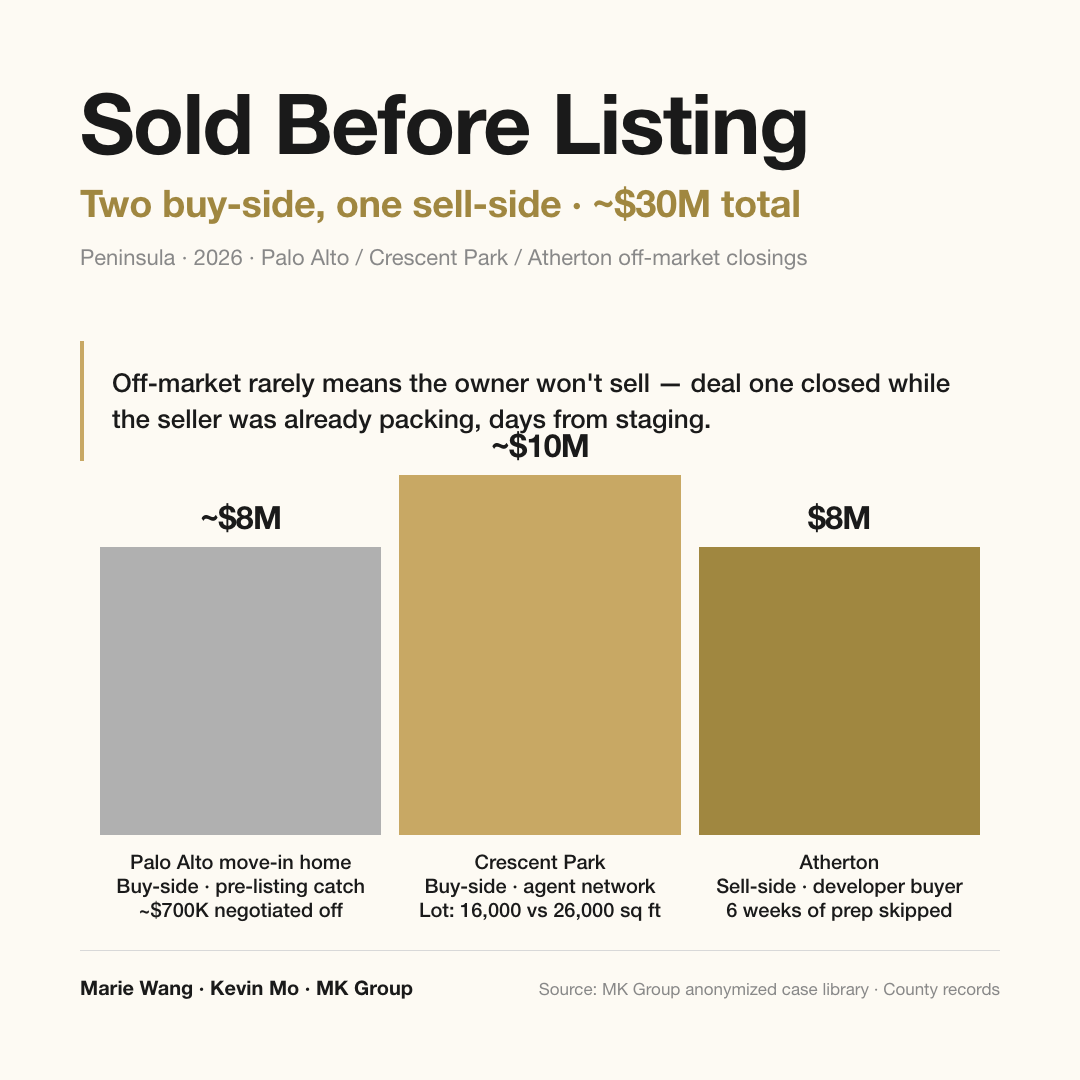
The headline first. These three closings total roughly $30M — two on the buy side, one on the sell side, none of them publicly listed, and all three reached along entirely different routes. The Palo Alto home near $8M was move-in ready and was negotiated in the final stage of the owner's listing preparation, with about $700K coming off. The Crescent Park property near $10M surfaced through a peer network the buyer's agent worked by hand, and its lot size differed by a full 10,000 sq ft between two databases. The $8M Atherton sale was a seller engagement matched to a local developer, with no renovation, no listing and no open house.
| Deal | Side represented | Neighborhood and price | How the property surfaced | Key move and outcome |
|---|---|---|---|---|
| First | Buyer | Palo Alto, move-in ready, near $8M | Owner already packing, staging nearly booked; intercepted before the listing went live | Set a roughly 10-day negotiating window, argued price line by line, took about $700K off |
| Second | Buyer | Palo Alto / Crescent Park, near $10M | Local luxury agents contacted one by one until an unlisted property surfaced | Verified the lot at about 26,000 sq ft via County records plus an electronic survey (the MLS recorded 16,000) |
| Third | Seller | Atherton, $8M | Never listed, never shown publicly; matched directly to a local developer | Skipped at least six weeks of pre-listing preparation; the sellers flew in only to sign |
Two things are worth carrying out of this table. The first is that the Atherton deal is the counterintuitive one — proof that off-market is not a channel where buyers simply get a break. That house was dated; the value was in the land. A public listing meant at least six weeks of work on the house, the grounds and the pool, and the sellers lived far from the Bay Area and could not supervise any of it. Once the target buyer changed from an owner-occupier to a developer, that entire renovation-and-packaging budget became an unnecessary expense. The second is the 10,000 sq ft gap in Crescent Park, which every off-market buyer should file away: the MLS said about 16,000 sq ft, Realist said about 26,000 — roughly 62% apart, a difference large enough at that level in Palo Alto to change the entire valuation frame. Off-market gets you an early look. It does not retire any of the homework.
What MK Group has observed
The 10,000 sq ft gap: off-market does not exempt you from diligence
The most time-consuming part of the second deal was not finding the house. It was verifying the data. The Crescent Park property arrived with two numbers already in conflict: the MLS recorded the lot at about 16,000 sq ft, Realist at about 26,000. Ten thousand square feet, in core Palo Alto, is a materially different asset.
MK Group's approach was not to pick a side but to move upstream — pull the Santa Clara County public record, which confirmed roughly 26,000 sq ft, then run an electronic survey to recompute it independently. Only once three sources agreed did the valuation judgment stand up. The first deal, near $8M, bought a finished house you could move into. This one, near $10M, bought a significantly larger parcel inside the same school assignment.
But a large lot is not a fully buildable lot. Setbacks, protected trees, the run of underground utilities, and the city's rules on floor area and lot coverage each have to be verified on their own. This is precisely where off-market buyers relax. The more "inside" the source of a property feels, the easier it is to believe you have already won. The real sequence is the reverse: access solves whether you get to see it, and nothing that comes after. Read alongside the luxury home due diligence checklist and the Crescent Park neighborhood guide.
From the sell side: off-market is not automatically the buyer's advantage
MK Group represented the buyer in the first two deals and the seller in the third — and the third overturns the default assumption most people carry about this channel.
The property was an older Atherton house built in the 1940s or 1950s. Interior insulation, the pool, the grounds and a great deal of mature planting all needed work. Brought to market in that condition, preparation alone ran to at least six weeks. But the land had three points of access, and to an experienced developer that reshapes what the parcel can become far more than the condition of the house does. So the team did not start renovating and packaging. It changed the target buyer from an owner-occupier to a local developer and closed off-market at $8M before any listing preparation began. The sellers flew in to sign, and that was their part.
So off-market is neither automatically better for the buyer nor automatically cheaper. Some sellers care most about exposure and want a public listing to bring competing buyers to the table. Others care more about privacy, time, and whether the transaction will actually complete. The question was never "list" or "don't list" — it is which structure fits both sides of this particular deal. This conversation was published on YouTube @MarieWang (44K+ subscribers). If you are making the call from the seller's side, start with the self-assessment in should my home be publicly listed or sold off-market.
Common mistakes
Mistake 1: "Off-market means the owner doesn't want to sell, so there's no point asking"
The opposite, usually. In the first deal the owner was already packing and had nearly booked staging — the house simply had not gone live. Owners in that state, decided but not yet listed, are not rare in the core Peninsula, and they are the group with the most room to negotiate. For them, a committed buyer who can close now offsets an entire preparation period that has not yet begun.
Mistake 2: "To buy off-market, I just need to tell an agent my budget is high enough"
A large budget does not make you easy to place. When a buyer's agent calls a peer, the peer's first three questions are whether the buyer is real, whether he can close, and whether he wants this particular house. What answers all three is the specificity of the brief — which neighborhood and which pocket of it, what size, what month you must be in by, what range, and how the purchase is funded. Naming only a ceiling hands the screening work straight back to the other side.
Mistake 3: "Off-market is always cheaper than a public listing"
It is not. The third deal, in Atherton, was a seller engagement, and the price was not discounted for staying off the market — the developer was buying the parcel's redevelopment potential, so the condition of the house was never a pricing input to begin with. Off-market pricing turns on how scarce the property is and how well the buyer type matches it, not on whether it appeared online. By the same logic, sellers should not assume that skipping the market means leaving money behind.
Mistake 4: "An unlisted house comes through a special channel, so diligence can be lighter"
This is the costliest assumption on the list. In the second deal the MLS and Realist disagreed about the same parcel by a full 10,000 sq ft, and it took County public records plus an electronic survey to settle it at about 26,000. And a large lot is not a fully buildable one — setbacks, protected trees, utility runs and city rules still have to be cleared item by item.
Next steps
- Write your brief as one actionable sentence: sub-neighborhood, size range, the month you must be in by, the price range, and how you are funding it. Send that to your buyer's agent in a single message. How specific that sentence is determines whether he can match you against anything in a peer's pipeline.
- Establish your own hard deadline first — school start, job start, lease expiry — and work backwards to how long you can actually give the public market. If the math does not work, off-market is not a preference, it is a requirement.
- On any off-market property, verify lot and title against three independent sources before anything else: the MLS record, a third-party database such as Realist, and the County Assessor or Recorder's public record. Where they conflict, the County record governs, with an electronic survey where the stakes justify it.
- Once the lot size is settled, ask a separate question about what can be built: setbacks, protected trees, the path of underground utilities, and the city's floor-area and lot-coverage rules. Get each one on paper. Do not stop at "it's a big lot."
- If you are the seller, determine first whether the value sits in the land or the house, and only then decide whether to spend on pre-listing preparation. Get that judgment backwards and most of what you spend on renovation and marketing is wasted.
Further reading: Should my home be publicly listed or sold off-market? | Luxury home due diligence checklist | Crescent Park neighborhood guide | Atherton off-market: why the highest offer doesn't always win