Quick Answer
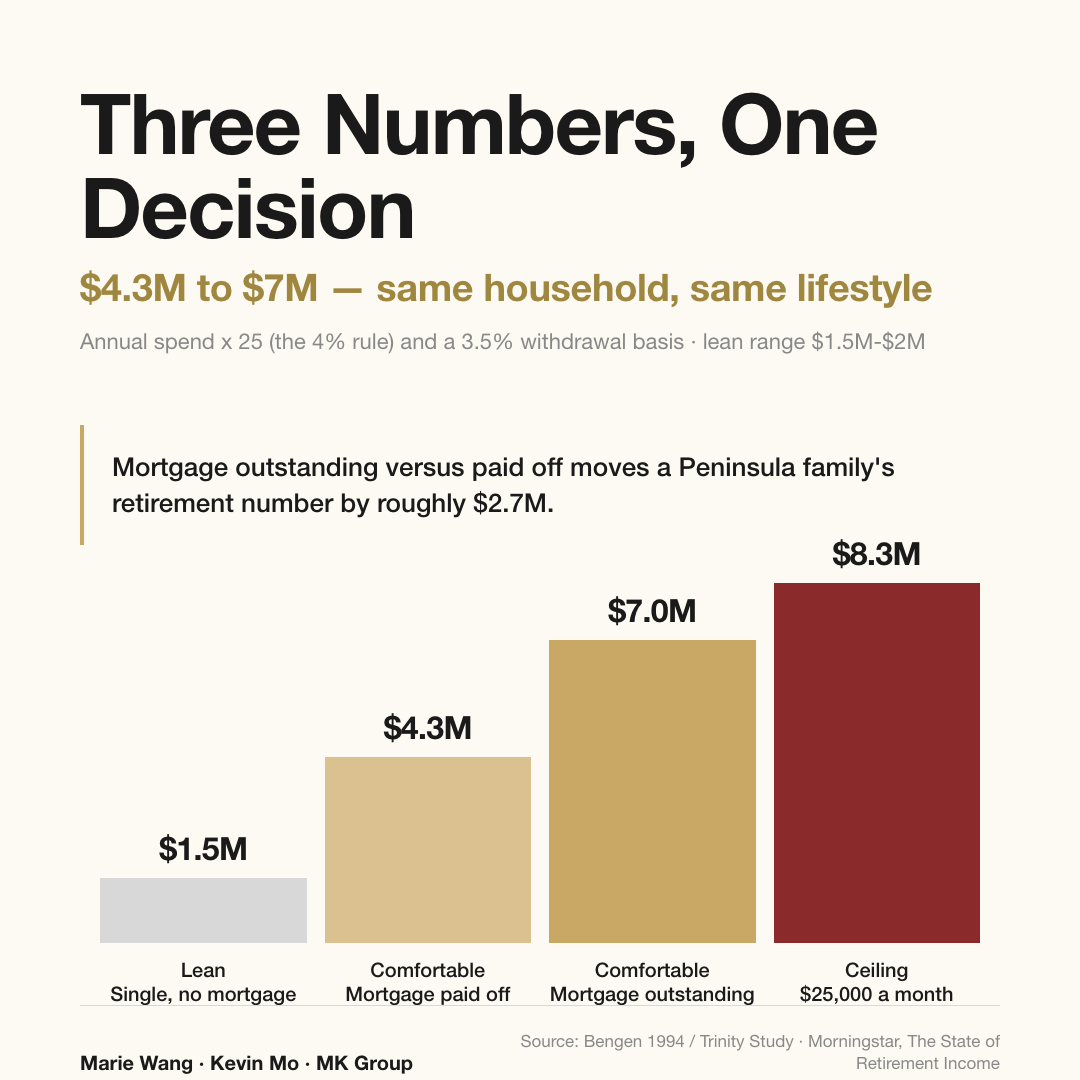
There is no single Bay Area retirement number. There are three. A single person with no mortgage, holding spending under $60,000 a year, needs roughly $1.5M–$2M. A family of four spending $250,000 a year with a mortgage still outstanding needs $6M–$7M — about $4.3M once that mortgage is gone. A $25,000-a-month household needs roughly $8.3M. Housing decides almost the entire spread.
Who this article is for
- Bay Area technology households sitting on several million in equity and cash, starting to run the "how many more years" math seriously
- Families targeting retirement or semi-retirement between 45 and 55, who need health insurance and California tax in the model before anything else
- Peninsula and South Bay owner-occupiers trying to settle whether the house counts toward the retirement number
- Households weighing a trade-up, where the decision would move the retirement date
- Families already past $10M in net worth who want to know where the spending ceiling actually sits
Three dimensions that decide the answer
Dimension one: settle your horizon and your health insurance before you pick 4% or something lower
The 4% rule comes from William Bengen's 1994 paper in the Journal of Financial Planning and the 1998 Trinity Study that back-tested it. Withdraw 4% of your portfolio in year one, and history says it lasts 30 years. Run it backwards and it is simpler still — multiply annual spending by 25. Spend $40,000 a year, you need $1M. Spend $100,000, you need $2.5M.
The problem is that the rule carries three assumptions, and it wrote them for a 65-year-old American retiring in the 1990s.
The first assumption is that somebody else covers health insurance. Medicare eligibility starts at 65 — a federal age that does not move because you retired early. Retire at 45 and you are buying your own coverage on the ACA exchange (Covered California) for 20 years. For a family of four, premiums plus deductibles land in the $20,000–$30,000 a year range. Most spreadsheets people build themselves do not have a line for it at all.
The second assumption is preferential treatment of capital gains. Federally, long-term gains do get their own brackets. California does not follow: the state taxes capital gains as ordinary income, top marginal rate 13.3% (California Franchise Tax Board). Every dollar you pull out of the portfolio to spend passes through that first. At the same $250,000 of annual spending, a California resident has to sell noticeably more stock than someone in a no-income-tax state.
The third assumption is a 30-year horizon. Retire at 40 and live to 90 and you need 50. Morningstar recomputes this every year in The State of Retirement Income, and its recent 30-year starting safe withdrawal rate has come in below 4% — the figure cited in this video is roughly 3.9%. Stretch the horizon from 30 years to 50 and the number goes lower again. So the honest starting point for early retirement here is not 4%. It is closer to 3.5%, and possibly less. Moving from 4% to 3.5% raises the principal you need by about 14% at identical spending.
Dimension two: move the house from the asset column to the expense column, then run the math again
This is the step Bay Area households get wrong most often. Home equity and withdrawable assets are not the same thing. The denominator in the 4% rule is a portfolio that produces returns you can harvest. A primary residence does not belong in that denominator — it generates no cash, and it takes cash out every year for property tax, insurance, and maintenance.
One transaction in MK Group's case library makes the point. In 2023 a client bought a 7,000-square-foot older home on a 1-acre lot in West Atherton for $12M+. By 2025, comparable assets in that pocket were trading above $18M — roughly 50% in three years, ahead of the index over the same stretch. It reads like $6M of new retirement money. But the house produced not one dollar of spendable cash across those three years, and the owner has no intention of listing. Put that $6M in the asset column and the whole spreadsheet changes character, while the amount actually available to spend stays zero.
There are two ways to convert home equity into retirement cash flow, and both cost something. Sell or downsize, and you trigger capital gains that California taxes as ordinary income. Borrow against it — a HELOC or a reverse mortgage — and you recreate the monthly payment you just eliminated. To work out which column your house belongs in, start by pulling the carrying cost apart: Total Cost of Bay Area Homeownership: The Hidden Line Items Beyond the Mortgage.
Dimension three: the mortgage ends, the property tax does not — Prop 13 writes your purchase price into your retirement budget
The family in the video spends $250,000 a year, of which $80,000 is mortgage plus property tax. Take that $80,000 out and the retirement number falls from the $7M range to the $4.3M range — that is the $1.7M–$2.7M swing. But one detail has to be corrected: the mortgage gets paid off. The property tax never does.
California's Prop 13 locks the assessed value to your purchase price, then caps annual increases at 2%. Effective rates in Santa Clara and San Mateo counties run about 1.1%–1.25% (the 1% base plus local bond assessments). So a $5M purchase price carries roughly $55,000–$63,000 a year, and an $8M purchase price roughly $88,000–$100,000. That is about $35,000 a year of difference. At a 3.5% withdrawal rate, it means carrying permanently about $1M more portfolio — purely because of the number on the deed the day you bought.
And it grows. A $60,000 tax bill compounding at the 2% cap for 20 years becomes roughly $89,000. Thirty years out, the mortgage is zero and the property tax is higher than it is today. Your purchase year and purchase price do not reset when you retire; they follow the house into retirement, and they are the only permanent, permanently rising fixed housing cost on the sheet. That is why any Bay Area retirement conversation runs through Prop 13 — including the reassessment notice that lands after closing: Why a second property tax bill arrives months after a $10M+ Bay Area closing.
Two tables: three numbers, and the fork housing creates
Table one: the three Bay Area retirement numbers
The headline figures first: a single person with no mortgage holding annual spending under $60,000 can retire on $1.5M–$2M. A family of four spending $250,000 a year with a mortgage outstanding needs $6M–$7M. A household spending $25,000 a month needs roughly $8.3M net of Social Security. Between the first number and the second, the requirement triples or quadruples — and what sits in between is not lifestyle. It is a spouse, children, and a house with a loan on it.
| Number | Profile | Annual spending | Withdrawal basis | Portfolio required |
|---|---|---|---|---|
| Lean | Single, no mortgage, spending compressed | $60,000 | 4% (spending × 25); upper bound from the CNBC reference | $1.5M–$2M |
| Comfortable, mortgage outstanding | Family of four; mortgage plus property tax is $80,000 | $250,000 | 3.5%–4% (as given in the video) | $6M–$7M |
| Comfortable, mortgage paid off | Same family, loan retired (the video's figure; excludes the property tax that survives payoff — see table two) | ~$170,000 | 4% (spending × 25) | ~$4.3M |
| Ceiling | $25,000 a month, net of Social Security | ~$300,000 | — | ~$8.3M |
What to take away: the gap from $7M to $8.3M is $1.3M, while the gap from $1.5M to $7M is $5.5M. Nearly the entire range of Bay Area retirement numbers is spent traveling from "single, renting cheaply" to "family of four with a mortgage" — not from comfortable to luxurious. The household spending study cited in the video points the same direction: multiply net worth by five and monthly spending rises only 66%. Consumption caps out. The house is bought, the cars are replaced, the trips are taken, and the ninth million buys a life indistinguishable from the eighth. That study deserves a caveat: a self-reported community survey of roughly 150 households, not official data, with obvious self-selection. Read it for direction, never as a benchmark.
Table two: same standard of living, and how housing status moves the number
The headline figures first: split that family's $250,000 into $80,000 of housing and $170,000 of everything else, then change only the housing status. Renting a comparable four-bedroom on the Peninsula costs about $96,000 a year in cash and requires roughly $7.6M at a 3.5% withdrawal rate. Staying put with the current mortgage requires about $7.14M. Paying the mortgage off, leaving only property tax, drops it to $5.43M–$6.57M. The spread across those three states is $1M to $2.2M — and this household's income, lifestyle, and spending habits have not changed by a single line.
| Housing status | Annual housing cash cost | Total household spending | Number at 3.5% | Number at 4% | Does it end in retirement? |
|---|---|---|---|---|---|
| Renting a comparable Peninsula 4-bedroom (about $8,000/month) | ~$96,000 | ~$266,000 | ~$7.6M | ~$6.65M | No, and it resets upward with the rental market |
| Owner-occupied, mortgage still outstanding | ~$80,000 (mortgage plus property tax) | ~$250,000 | ~$7.14M | ~$6.25M | The mortgage ends; the property tax does not |
| Owner-occupied, mortgage paid off | ~$20,000–$60,000 (property tax only, depending on purchase price and year) | ~$190,000–$230,000 | ~$5.43M–$6.57M | ~$4.75M–$5.75M | No, but Prop 13 caps growth at 2% a year |
What to take away, in two parts. First, renting and carrying a mortgage cost almost identical cash — $96,000 against $80,000 — but only the mortgage has a final payment. Rent has no terminus and it climbs. Same dollar amount, completely different behavior inside a retirement model. Second, the video's "mortgage paid off equals $4.3M" comes from removing the entire $80,000 housing line and multiplying by 25 ($170,000 × 25 ≈ $4.25M). That step is optimistic. Retiring the loan does not retire the tax. Add property tax back and the honest floor for the same family is closer to $4.75M–$5.75M on a 4% basis, or $5.43M–$6.57M at 3.5%. That $500K–$1.5M gap is the line almost everyone building this in a spreadsheet leaves out.
What MK Group observes
The $4M at that dinner never turned into retirement — it turned into CoastFIRE
In this video (YouTube @KevinMoRE, 24K+ subscribers) Kevin Mo walks back through a dinner earlier this year with an engineer friend at one of the large technology companies. Income near $900,000 a year, stock and cash totaling exactly $4M. Under the 4% rule that sounds finished. Then they added back the mortgage, two children, self-purchased health insurance, and California tax, line by line — and both of them shook their heads.
The friend did not quit. What he did was transfer: to a team that is not competing on promotion, has no marquee project, and lets people leave on time most weeks. What he told Kevin was this: "I don't need to quit — I need to know I could quit any time." (Translated from Mandarin.) The state he moved into has a name: CoastFIRE. You are still working, but compounding has started working alongside you. $4M does not buy full retirement in the Bay Area. It bought that. And that, more often than not, is the thing people were actually trying to buy.
The video cites two more extreme reference points. Techlead, the former Google engineer turned YouTuber, runs a sharp thought experiment: would you buy a $10,000 grocery-store gift card? Nobody wants one, because it is pure consumption you cannot spend down. So what if the world itself is one large grocery store? He sold his company at 36 for roughly $3M and retired, then spent the first year playing StarCraft — until, on vacation in Mexico, he realized he had handed a full year of his life to a video game, and the first thing he did at home was uninstall it. Four years into retirement he started another company. And the Fremont early retiree CNBC profiled said something a few years out that is worth keeping: "What most people want isn't retirement. It's a long vacation." (As relayed in the video.)
What we keep running into on the sell side: a low rate and a low tax base are themselves retirement assets
MK Group's case library holds a consultation from late 2025. A homeowner in 94087, on the Sunnyvale–Cupertino line, owned an 1,800-square-foot three-bedroom, two-bath house on a 7,500-square-foot lot in the Homestead attendance area, and wanted to move up to Los Altos. Three other agents had already been consulted. All three said list it now. Marie Wang and Kevin Mo walked the property and gave the opposite advice: do not sell right now. The house carries a rate that cannot be reproduced in the current environment, and selling forfeits it permanently. Neither the target city nor the timeline had been settled, which usually means selling turns into waiting for the market. The alternative was to keep the low-rate property and raise the next down payment through a HELOC. The owner's reaction: "My God — you're the only ones who told him not to sell." (Translated from Mandarin.)
Read through the retirement math, that advice carries more weight than it appeared to at the time. A trade-up does two things that permanently raise a retirement number: it swaps a low rate for a new loan above 6%, and it resets the Prop 13 assessed value to the new purchase price. The first has an end date. The second does not. One move up can add $30,000–$50,000 a year of fixed housing cost across the entire retirement period, which at a 3.5% withdrawal rate means carrying $850K–$1.4M more portfolio, permanently. This is not an argument against trading up. It is an argument that the real cost of a trade-up belongs in the retirement model, not only in the monthly payment calculator. Owners past 55 who are considering a downsize have one California route for taking the old base with them: Prop 19 in the Bay Area: How Much Property Tax Can a 55+ Move Actually Save?
Common mistakes
Mistake 1: "The house is up $6M, so my retirement fund is up $6M"
It is not. The denominator in the 4% rule is a portfolio that produces cash flow, and a primary residence is not in it — no dividends, no interest, and an annual outflow for property tax, insurance, and maintenance. That West Atherton property appreciated roughly 50% in three years, and the owner took zero spendable dollars out of it over the same period. Before writing home equity into a retirement model, answer one question: how exactly do I plan to turn this into cash? If the answer is sell or borrow, the capital gains tax or the new monthly payment has to go into the model with it.
Mistake 2: "The 4% rule says $2.5M, so $2.5M is my Bay Area number"
All three of the rule's assumptions fail for early retirement here. There is no Medicare before 65, so retiring at 45 means roughly 20 years of self-purchased ACA coverage at $20,000–$30,000 a year for a family of four. California taxes capital gains as ordinary income at a 13.3% top marginal rate. And a 30-year back-test does not cover the 50 years between retiring at 40 and living to 90 — Morningstar has already pushed the 30-year starting safe withdrawal rate below 4%. Rerun the math near 3.5%. At identical spending, the principal requirement rises about 14%.
Mistake 3: "Once the mortgage is paid off, I can retire"
The mortgage ends. Housing cost does not. The day the loan hits zero, property tax, insurance, and maintenance are all still there — and under Prop 13 the tax rises up to 2% every year and never reaches zero. A $5M purchase price carries roughly $55,000–$63,000 a year today, and compounding at the 2% cap for 20 years takes it to roughly $82,000–$94,000. The video's "$4.3M once the mortgage is paid off" comes from deleting the entire housing line. Put property tax back and the honest floor is closer to $4.75M–$5.75M.
Mistake 4: "No income in retirement means taxes stop mattering"
There is no salary in retirement, but there are withdrawals. Every dollar of capital gain you realize from an investment account is taxed by California as ordinary income at up to 13.3%, with none of the federal long-term preference. That means a California resident spending $250,000 a year has to liquidate more securities than a resident of a no-income-tax state. Purchase price, carrying cost, and withdrawal tax belong on the same page. Modeling any one of them alone produces a number that is too optimistic.
Mistake 5: "I need $10M before it's safe"
Consumption caps. The roughly 150-household spending survey cited in the video shows net worth multiplying by five while monthly spending rises only 66% — the house is bought, the cars are replaced, the trips are taken, and then nothing further happens. A household spending $25,000 a month, or about $300,000 a year, needs roughly $8.3M net of Social Security, and that is close to the ceiling. It moves up clearly if you are carrying a $5M house with a $3M loan and two children — but that is a different category of household. The caveat bears repeating: this survey is self-reported community data, not official statistics, and should be read for direction only.
Next steps
- Split annual spending into housing and non-housing before you multiply. In the video's example, $80,000 of the $250,000 is housing — and housing is the only line that forks violently across the three states. Skip the split and every number you produce is an average of things that do not average.
- Rerun the whole model at 3.5% instead of 4%. If you intend to stop working before 55, a 30-year back-test is not long enough. The principal requirement rises about 14%, and that difference is larger than most people expect.
- Look up your own current assessed value and annual property tax bill. It is public record at the county assessor. This is the single housing cost in your retirement model that is permanent and grows up to 2% every year, and it is set by the year and the price at which you bought.
- Count the years and the dollars in your pre-65 insurance gap. Price it on Covered California's published rate tables by household size and age, and put premiums plus the out-of-pocket maximum into annual spending. This line goes missing entirely more often than any other.
- Price the permanent retirement effect of any trade-up before you commit to it. The new loan ends; the reset Prop 13 base does not. Divide the added annual fixed housing cost by 0.035 and you get the portfolio increment that one move demands — usually six figures, often seven.
Further reading: Total Cost of Bay Area Homeownership: The Hidden Line Items Beyond the Mortgage | Why a second property tax bill arrives months after a $10M+ Bay Area closing | Prop 19 in the Bay Area: How Much Property Tax Can a 55+ Move Actually Save?