Quick answer
Neither, exactly. What moved is the direction of wealth. As tech concentrated in the South Bay and San Francisco stumbled through the pandemic, Atherton's momentum eclipsed Hillsborough's. But Hillsborough hasn't lost value — it has shifted from the Peninsula's default trophy address into a market judged property by property: on the home itself, the buyer's taste, and long-term lifestyle fit.
Who this article is for
- Buyers and market-watchers tracking where Peninsula wealth is actually moving — you want more than "which one costs more," you want to see what sits behind the gap.
- Anyone weighing Atherton against Hillsborough who suspects Hillsborough is underpriced — you're after a read on trend and valuation, not another tour checklist.
- Families who commute into San Francisco, prioritize top private schools, and want acreage at a better basis — Hillsborough's commute and school access may line up with how you actually live.
- Readers following San Francisco's recovery and the AI industry's return — who want to understand what it means for the northern Peninsula.
Three ways to read the gap
One: the gap is about where wealth flows, not the houses themselves
Two or three decades ago, "Peninsula luxury" brought one name to mind first: Hillsborough. For a stretch it cost more than Atherton. It was the old-money estate address, and "we live in Hillsborough" was itself a status line — an impression that still held as recently as three to five years ago.
What pulled the two apart wasn't the housing stock. It was industry. The whole arc from San Francisco to the South Bay gets called Silicon Valley, but over the past decade the tech economy concentrated further south — the mid-Peninsula and the South Bay. San Francisco took a hard hit through the pandemic: companies decamped, the urban fabric frayed, and northern communities like Burlingame and Hillsborough felt it in their home prices. At the same time, that southward pull lifted Atherton, which sits closer to Palo Alto, Stanford, and Sand Hill Road. Over the past ten years Atherton's momentum plainly overtook Hillsborough's.
Luxury enclaves also run on a cluster effect: they absorb move-up buyers from the cities around them. Many of Hillsborough's earlier residents worked and lived in San Francisco, and the nearest top-tier enclave was Hillsborough. Atherton, by contrast, catches the families trading up out of Palo Alto, Los Altos, Saratoga, and the South Bay. So this was never "Hillsborough got worse." The newly minted Silicon Valley wealth simply sits closer to the Atherton end of the map.
Two: the zip-code premium — how much does the same house cost across a city line?
So is the Atherton house genuinely better, or is the zip code itself worth more? Set two real closings next to each other and it gets clear. Both were newly built, close in size, and traded only a few months apart — yet the Atherton home closed about $3.6M higher, at a materially higher price per square foot. Same kind of house; cross one city line, and the number can move completely.
In the top luxury market, buyers are never paying for the house alone. They're paying for the area's liquidity, the peer signal of who the next buyer will be, and the market's consensus about the address. That resolves a question we get often: Atherton is flat, with no hillside view — why does it command so much? Because at the most core locations, what you're buying is the flat land itself — parcels so deep the house disappears from the street. You're buying land value and the shared conviction that this is the place. Scarcity plus consensus is the true engine of a top-tier zip premium. (For a systematic breakdown of where the gap comes from, see our three-city comparison; we won't repeat it here.)
Three: the re-rating case for Hillsborough — being closer to San Francisco could be worth something again
Hillsborough's opening is written into its geography: it sits very close to San Francisco. On a clear run, the drive from Hillsborough into the city is more than twenty minutes shorter than from Atherton, and I-280 makes the commute easy. For the past decade that edge was buried under San Francisco's decline. But if the city's commercial energy keeps returning — if AI, finance, investment, and international business reconcentrate downtown — Hillsborough's commute position gets noticed again. For buyers who don't want to plant themselves fully inside the South Bay tech circle, yet want a top community, real acreage, privacy, and access to San Francisco, it becomes genuinely compelling. The private-school bench nearby is deep, too: Crystal Springs Uplands School and The Nueva School both sit within reach.
Two things need to be said plainly, so this isn't misread. First, "re-rating" does not mean "price will overtake Atherton." Atherton sits closer to Silicon Valley's core, its supply is severely limited — the entire town holds only a couple thousand homes, so every sale takes one off the board — and its buyer depth is strong. Those structural advantages won't reverse in the near term. The more realistic read is that, measured against Hillsborough's own current level, the room to grow could be meaningful.
Second, many Hillsborough parcels run two to three acres or larger, but a real share of that land is sloped — limited development potential, ten-plus minutes up and down the hill on narrow roads. Day to day, Atherton is simply the easier place to live: it's a small town of a couple thousand homes and roughly 7,000 residents, with no commercial district of its own by design — yet Menlo Park and Palo Alto sit two or three minutes away, and Stanford Shopping Center is about ten. Hillsborough's value, then, increasingly turns on whether that specific home is good, not on whether the city as a whole can out-price Atherton. Tellingly, the Peninsula's most expensive active listing is still in Hillsborough: an ultra-modern estate asking around $35M across roughly 12,000 square feet. When it comes to scarce trophy property, Hillsborough has never come up short.
One table, two towns, two ways of measuring
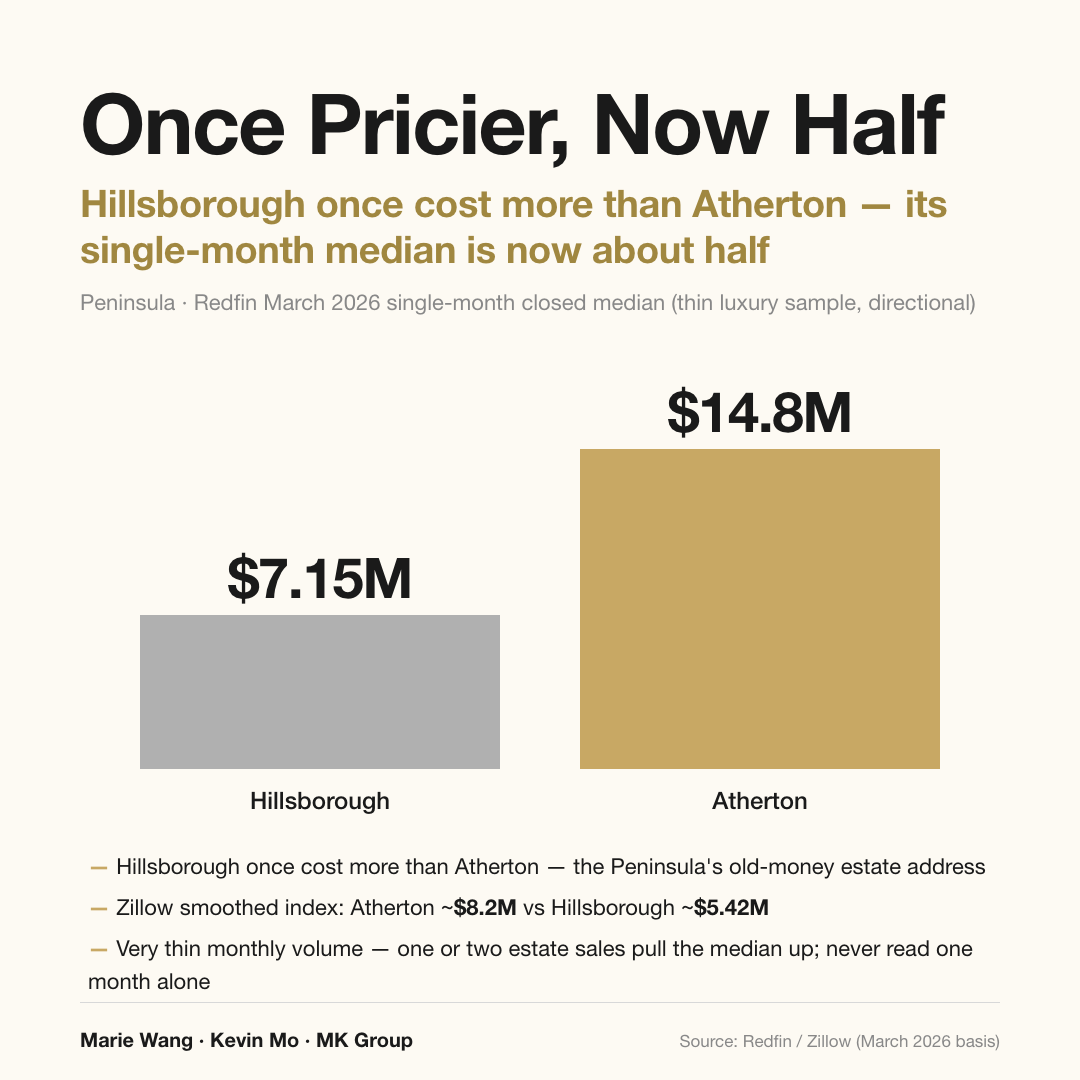
Start with the headline numbers. On Redfin's March 2026 single-month closed median, Atherton ran about $14.8M and Hillsborough about $7.15M — roughly half. A luxury enclave may close only a handful of sales in a month, so one or two oversized estate sales can move that figure sharply — treat any single month as directional. Switch to Zillow's smoothed home-value index and the gap narrows to about $8.2M for Atherton and $5.42M for Hillsborough.
| Basis | Atherton | Hillsborough | Note |
|---|---|---|---|
| Redfin March 2026 single-month closed median | ~$14.8M | ~$7.15M | Thin single-month sample, high volatility |
| Zillow smoothed home-value index (same period) | ~$8.2M | ~$5.42M | Smoother; gap narrows |
| Peninsula's most expensive active listing | — | ~$35M / ~12,000 sqft | Top trophy property is still in Hillsborough |
The one thing to hold onto: luxury enclaves trade in very small volumes — a handful of closings in a month — so a single oversized estate sale can drag the median straight up. Never read one month in isolation. Put the closed median, the smoothed index, and market attention side by side, and the direction gets clear. Mind the measurement basis, too. The figures above are Redfin and Zillow city-level medians; our Atherton Q2 2026 market deep report uses MLS quarterly closings (23 sales that quarter, median around $10.5M). Single-month versus quarterly, Redfin/Zillow versus MLS — the numbers differ by design. What matters isn't memorizing one figure; it's understanding what each one is actually measuring.
What MK Group is seeing on the ground
MK Group — Marie Wang and Kevin Mo, who work the Silicon Valley luxury market with a focus on high-end homes around Stanford — has been watching this shift in wealth play out in recent client conversations.
One signal is in who's buying. Several of the buyers coming through recent consultations carry OpenAI backgrounds, especially those with families and young children. They tend not to want to live inside San Francisco proper. One group felt the city's prices had already run to an extreme and that they were getting outbid hard, so they wanted to pull back toward the Peninsula — somewhere with a yard and more room to live. That is exactly the pattern of new wealth, minted by a high-end industry, beginning to spill back outward.
A second signal is the direction of the trade-up. On one filming afternoon, Marie and Kevin met with two sets of Palo Alto homeowners — and where both were headed was Atherton. The cluster effect, luxury enclaves absorbing the move-up buyers of the cities around them, is easy to see from the front line.
And there's a conversation that comes up often, one that captures what the top market is really selling. A client's friend toured Atherton and couldn't make sense of it: flat land, no Beverly Hills hillside view — why the price? The answer is that at the most core locations, you're buying the flat parcel itself — land value, scarcity, and the market's shared conviction. Run that logic back through Hillsborough and its position reads more clearly: the trophy homes, the acreage, the privacy are all still there; it's the center of gravity of market consensus that tilted toward Atherton this past decade. To compare which buyer each town actually suits, see our earlier piece on how high-net-worth buyers choose between Atherton and Hillsborough. (Related market commentary also runs on Kevin Mo's YouTube channel, @KevinMoRE, 24K+ subscribers, and Marie Wang's @MarieWang, 44K+.)
Common misreads
Has Hillsborough fallen out of favor and lost its value?
Not accurately. It hasn't lost value — the Peninsula's most expensive active listing, that ultra-modern estate asking around $35M across roughly 12,000 square feet, sits in Hillsborough. What changed is its role. It's moving from the Peninsula's default trophy address into a market that leans on specific property quality, on buyer taste, and on long-term lifestyle fit. The city median trailing Atherton for now doesn't mean its best homes lack value.
Does a single-month median tell you the city's real price?
A luxury enclave might see only a few closings in a month, and one or two oversized estate sales pull the median straight up. Read the closed median, Zillow's smoothed index, and market attention together, and the direction holds up. Treating any single month as "this is what the city costs" invites being misled by a very small sample.
Does a pricier zip code always mean a better house?
Two homes — both new, similar in size, closed only months apart — and the Atherton one closed about $3.6M higher, at a higher price per square foot. That premium didn't buy a deeper foundation or better finishes. It bought regional liquidity, the peer signal of the next buyer, and market consensus. Translating "more expensive" directly into "better house" is the most common misread in the top market.
If San Francisco recovers, will Hillsborough climb back past Atherton?
Re-rating isn't overtaking. Atherton sits closer to Silicon Valley's core, its supply is severely limited, and its buyer depth is strong — structural advantages that won't reverse in the near term. The more realistic read: if AI, finance, and international business keep reconcentrating in San Francisco, Hillsborough's commute position gets seen again, and against its own current level the room to grow could be meaningful. But that's a different thing from "price overtakes Atherton." Don't conflate the two.
Next steps
- Don't treat a single-month median as the price. Cross-reference Redfin's single month, Zillow's smoothed index, and MLS quarterly data, understand why medians swing so hard in low-volume markets, then judge what a given town is actually worth.
- To see where the gap comes from, get the comparative frame first. Read the three-city comparison to take in usable flat acreage, privacy types, and off-market share in one pass — we don't repeat that here.
- If you commute into San Francisco and value private schools, run Hillsborough's commute radius (roughly twenty-plus minutes closer to the city, easy I-280 access), its nearby private-school options, and its current basis seriously into your shortlist.
- When you tour Hillsborough lots, separate flat land from slope. Two to three acres sounds generous, but a high slope share directly affects what you can build and how you'll live on the parcel — ask exactly how much usable flat land there is.
- Watch the pace of San Francisco's commercial recovery and the AI industry's return. That's the variable that decides whether Hillsborough's commute position gets re-rated — and the core clue for whether it's underpriced today or fairly priced.