Quick Answer
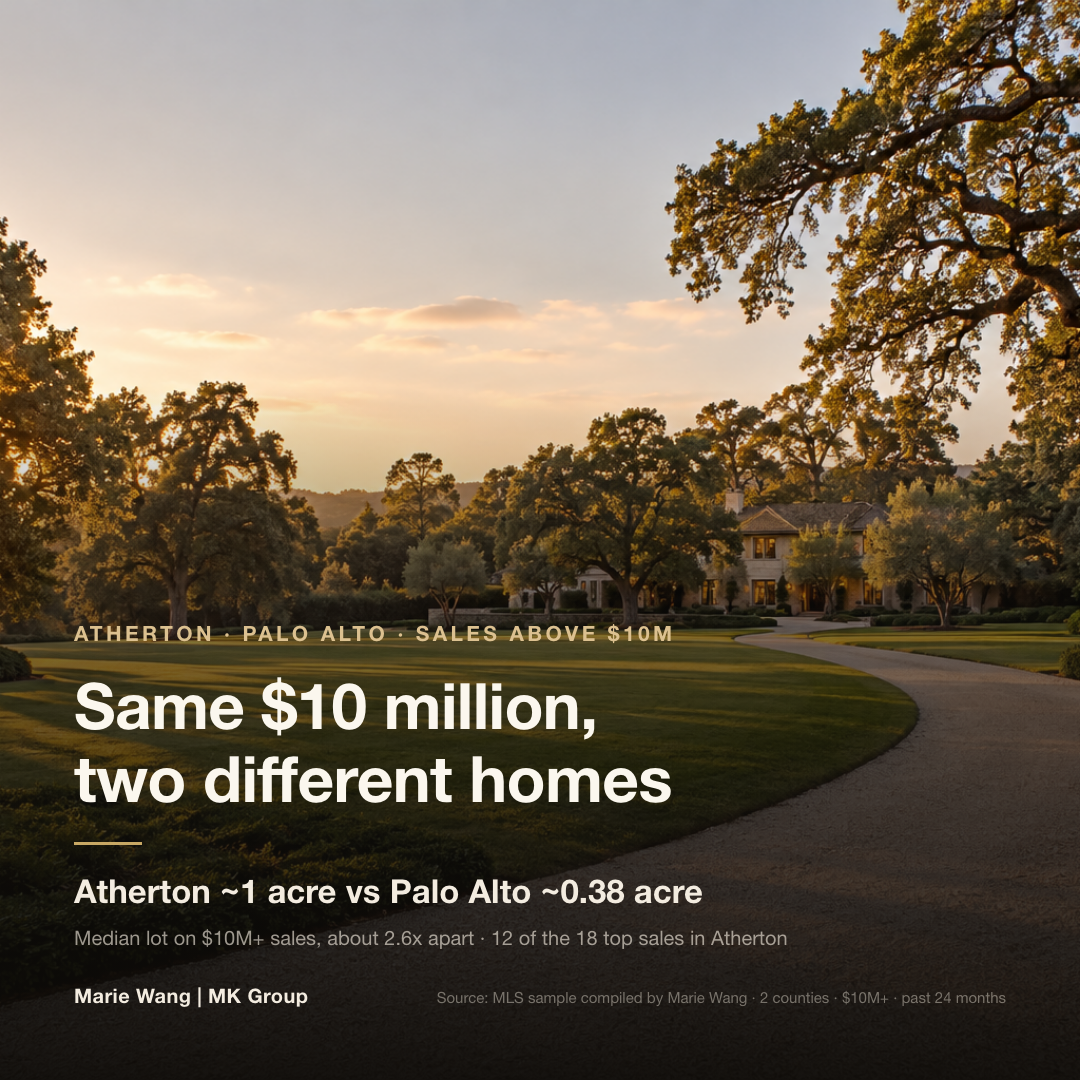
The same $10 million buys about an acre of land and privacy in Atherton, and about 0.38 acre of prime location in Palo Alto. Between $10M and $15M, the two cities can be traded against each other. Above $20M, the choice largely comes down to Atherton.
The $10M-plus market is heating up, and it is concentrated in these two cities. In a September 2026 video, Marie Wang cited an MLS sample of closed sales: in January–August 2026, sales of homes above $10M in Santa Clara and San Mateo counties were up 66% over the same period of 2025. Over the past 24 months (roughly September 2024 through August 2026), the two counties recorded 231 sales at that level, and more than half of them were in Atherton or Palo Alto. At this budget, these are the two cities you cannot avoid.
Who this article is for
- Buyers with $10M to $20M to spend who have both Atherton and Palo Alto on the list and haven't decided where to start looking
- Buyers relocating from Southern California, another state or overseas who are used to valuing a home against the same development, the same floor plan and last month's sale — a method that barely works on $10M-plus homes in either city
- Buyers with $25M or more who first want to know where each city's price ceiling sits
- Owners of a $10M-plus home in Atherton or Palo Alto preparing to sell, who want to know which sales they should price against
Three core dimensions
In the video, Marie breaks the comparison into eight points: micro-location, land, privacy, how finished the house is, room to renovate or rebuild, speed of sale, negotiating room, and resale and appreciation potential. For a buying decision, those eight fold into three questions — and the order matters. Decide where the money goes first; choose the city second. A companion piece, Palo Alto or Atherton: Which Silicon Valley Luxury City Actually Fits You?, compares the two towns by stage of life. This one looks only at sales above $10M.
Dimension one: land or convenience — where does the $10 million go? (land, privacy, micro-location)
In Atherton, the median lot among sales above $10M is about 1 acre — roughly 43,560 square feet, or a little over half a soccer field. Most of the money goes into land, privacy, grounds and distance from the neighbors, and day to day it lives like an estate. In Palo Alto, the same price buys a median lot of about 0.38 acre, roughly 16,500 square feet. There, the money goes into a very specific neighborhood — Old Palo Alto, say, or Crescent Park — and what it buys is shops and restaurants within walking distance and a street where neighbors stop to say hello. Marie's shorthand: in Atherton you buy "a life with room to spread out"; in Palo Alto you buy "a concentrated location." (Translated from Mandarin.)
There is no right answer here, and two generations of the same family can land on opposite sides. Marie tells of an older family friend who moved here from Shanghai. His son bought in Atherton, but he found Atherton "like the countryside — no shops." (Translated from Mandarin.) He preferred Palo Alto, where you can walk to a shopping street. The home he was shown was an $18M-range house in Crescent Park: a longer walk into town, but a walkable one.
Dimension two: what you have to get right on day one (the home's condition, room to rebuild)
The street, whether the house sits on a busy road, and the size and shape of the lot are essentially fixed once you buy. The house itself can be renovated, or torn down and rebuilt. So at every showing, clear the "can't change" test first, and only then talk about old versus new. Marie's observation is that a teardown and rebuild is easier to move forward in Atherton than in Palo Alto — one reason Atherton sees so much new construction, and why older homes there are so often bought to be demolished. In this town, much of an older home's value is the land beneath it. For how large a house an acre in Atherton can actually carry, see If I Buy an Acre in Atherton and Rebuild, How Big Can the House Be? For which flaws money can fix at a showing and which are permanent discounts, see Buying at $10M to $14M in Atherton — Why Did Every One of These Homes Close Below Asking, and What Should I Be Marking Down at a Showing?
Dimension three: who buys it from you (speed of sale, negotiating room, resale and appreciation)
Buying is the pleasant part; someday, someone has to buy the house from you. The two cities' buyer pools are built very differently. By the figures Marie gives in the video, Atherton's citywide median sale price is about $11M in 2026. At $10M you are near the town's median, and buyers are comparing which of several homes suits them best. Palo Alto's citywide median is about $4M, so $10M is roughly 2.5 times the median. Buyers there start by asking why this particular house is worth that much, and noticeably fewer are willing to pay it. Marie also notes that in Palo Alto, the higher the price, the longer homes tend to sit. A small number of buyers — those who buy good land when they see it and hold indefinitely, with no plan to sell — can put less weight on this question. Most families will sell eventually, and for them it needs an answer before they buy.
The numbers: above $10M, the two cities part ways at $20M
Key numbers first: in the MLS sample Marie Wang cites — sales above $10M in Santa Clara and San Mateo counties over the past 24 months, 231 in total — the median lot is about 1 acre in Atherton and about 0.38 acre in Palo Alto, roughly 2.6 times apart. The highest sale in the sample was about $45M in Atherton and about $22M in Palo Alto. Of the 18 highest-priced sales in the entire sample, 12 were in Atherton and none were in Palo Alto.
| Metric | Atherton | Palo Alto |
|---|---|---|
| Median lot, sales above $10M | About 1 acre (about 43,560 sq ft) | About 0.38 acre (about 16,500 sq ft) |
| Citywide median sale price (2026, all price bands) | About $11M | About $4M |
| $10M relative to the citywide median | Roughly level | About 2.5x |
| Highest sale in the sample (MLS) | About $45M | About $22M |
| Among the sample's 18 highest-priced sales | 12 | 0 |
Scope: lot size, highest-sale and top-18 figures come from the MLS closed-sales sample cited in Marie Wang's September 27, 2026 video (homes above $10M in Santa Clara and San Mateo counties, roughly September 2024–August 2026, 231 sales); citywide medians are the figures given in the video. This article restates the video's numbers and has not re-verified each sale. Square footage converts at 1 acre = 43,560 sq ft. Off-market sales are not included in the MLS sample.
What to remember: $10M sits in completely different places in the two markets. In Atherton it is roughly the citywide median, with plenty to choose from. In Palo Alto it is about 2.5 times the median — the top of the market. From $10M to $15M the two cities overlap heavily and can be weighed against each other. Past $20M, Atherton pulls clearly ahead on land, depth of inventory and price ceiling. On the MLS, Palo Alto tops out around $22M and Atherton around $45M, and Marie notes off-market sales in Atherton above $50M. One client she is advising, with a $40M budget, is looking only at Atherton. High-end Palo Alto listings move far more slowly: Marie mentions a large-lot, $30M-range off-market listing in Old Palo Alto that has yet to find its buyer.
The pace of sales differs, too. The year-to-date figures in the video: in Palo Alto, through the end of August 2026, the citywide median home sold in 8 days, at a median 107% of original list price. As a cross-check on a different basis, MK Bay Area Pulse 2026 Q2 — MLSListings single-family closings from April through June 2026, across all price bands — shows Palo Alto with 139 sales, a median price of $4.1M, a median 8 days on market, and a median sale at 105.6% of original list. Atherton recorded 31 sales, a median price of $10M, a median 13 days on market, and a median sale at 97.1% of original list. The quarterly reading points the same way as the video's year-to-date numbers. Palo Alto is a high-volume, fast market where the median home closes above list; Atherton is a thin market where every sale is negotiated on its own terms.
Key numbers first: within the same 231-sale sample, homes 0–4 years old accounted for 54 sales, with a median 30 days on market. Homes 50 or more years old accounted for 58 — about a quarter of the sample — and sold in a median of just 18 days. By lot size, 1 to 2 acres was the largest group: 94 sales, about 41%, at a median price of $14.8M and a median 23 days on market.
| Group (within the 231-sale sample) | Sales | Share of sample | Median days on market | Median sale price |
|---|---|---|---|---|
| Homes 0–4 years old | 54 | 23% | 30 days | Not given in the video |
| Homes 50+ years old | 58 | 25% | 18 days | Not given in the video |
| Lots of 1–2 acres | 94 | 41% | 23 days | $14.8M |
Scope: as above. "Share of sample" is calculated against 231 sales and rounded. Age and lot size are separate groupings that overlap, so the rows cannot be added together.
What to remember: at $10M and up, buyers do not rule a house out because it is old — homes 50-plus years old sold in a shorter median time (18 days) than homes 0–4 years old (30 days). Marie's reading is that what decides whether a home is worth buying is usually what can't be changed after you own it. This is a correlation, not proof that new homes are hard to sell: new construction above $10M generally asks more, and its buyer pool is narrower to begin with. Land follows the same logic. Lots of 1 to 2 acres are where sales cluster, at a median $14.8M. Marie's reading: land matters, but price does not keep climbing with acreage. Whether the location is truly prime is what sets how far a premium can go.
What MK Group sees on the ground
Old Palo Alto at $10.3M: a 7,500-square-foot lot, bought for its location
This summer, MK Group helped a family relocating from Irvine, in Southern California, buy a home in the heart of Old Palo Alto for $10.3M. The lot is about 7,500 square feet, or about 0.17 acre — less than a fifth of the median lot on $10M-plus sales in Atherton, and less than half of Palo Alto's own median lot at that price (about 16,500 square feet). The house has more than 5,000 square feet of living space, including a basement. The money bought a position in Palo Alto's most prized neighborhood; the land was a small part of it.
How the deal came together also shows why Palo Alto's citywide "8 days, 107%" pace doesn't carry over to this price point. The home was brought to the buyers before it was formally listed, with the seller planning to ask $11M. Kevin Mo led the negotiation and set a window of about 10 days from the outset, building the case for price point by point: the condition of nearby comparable sales, the time and cost the seller would still face by going to market, and the certainty of the buyers' funds and closing. The result was $700K off, negotiated off-market — a price about 94% of the intended list. A $10M-plus home is one of a kind, and its price has to be argued from the house itself.
A 1954 Atherton house sold in zero days, against a West Atherton new build still unsold after 75+ days
MK Group represented the seller of an Atherton home built in 1954 — dated, and a realistic teardown. The team's read was that the value lay in the land: the lot has three points of access, which leaves generous room to replan it. So instead of starting with renovation and a marketing launch, the team went directly to a local developer, and the home sold off-market for $8M before it was ever listed. Days on market: zero.
Over the same stretch in West Atherton, a brand-new house on a busy road, asking about $27.8M, had been on the market for more than 75 days without selling (a market observation, not an MK listing). Put the two side by side and the usual conclusion about age runs in reverse: the old house sold in zero days, while the new one was still waiting after 75. Marie acknowledges that the buyer pool above $27M is far smaller to begin with. But the factor she weighs more heavily is the one no one can change — the busy road. That is exactly the test Dimension two asks you to run first.
Common Misconceptions
Misconception 1: "Buyers at $10M want new construction; old houses don't sell"
In the 231-sale sample above $10M, homes 50 or more years old accounted for 58 sales, about a quarter, and sold in a median 18 days — faster than the 30 days for homes 0–4 years old. At this level, buyers look first at location, road exposure, and lot size and shape, the things that can't be changed. An older house can be renovated or rebuilt; in Atherton especially, older homes are often bought as good land. New construction has real value. Age alone just isn't how $10M buyers filter.
Misconception 2: "The bigger the lot, the more it's worth — in Atherton, just buy the biggest parcel"
Lots of 1 to 2 acres are where $10M-plus sales concentrate: 94 sales, about 41%, at a median $14.8M and a median 23 days on market. Land matters, but price does not rise indefinitely with acreage. What drives the premium is whether the location is prime — the $10.3M Old Palo Alto home sits on a lot of about 7,500 square feet. When comparing two parcels, compare micro-location and road exposure first, and size second.
Misconception 3: "Palo Alto homes sell in 8 days at 107% of list, so a $10M home will too"
By the video's figures, Palo Alto's citywide median home, year-to-date through the end of August 2026, sold in 8 days at 107% of original list price. That is the pace of a market centered on a median price of about $4M. At $10M you are roughly 2.5 times that median, with noticeably fewer buyers, and each house has to justify its own price. The Old Palo Alto purchase above closed $700K below the seller's intended list price. A seller who prices a $10M home off the citywide average can easily end up priced outside the buyer pool.
Misconception 4: "Every house gets slower to sell as the price goes up"
Higher prices do mean a smaller buyer pool and, overall, a slower pace — as noted above, in Palo Alto the higher the price, the longer homes tend to sit. But Marie's view is that the luxury market gets more polarized as it gets more expensive, not uniformly slower. Within the same price band, a house with the right location and the right fundamentals still moves quickly. She mentions a $40M-range home that sold in 30 days this year, while the $27.8M new build on a busy road in West Atherton was still unsold after more than 75 days. Price sets the size of the buyer pool; within a band, how fast a home sells depends more on what can't be changed.
Next steps
- Allocate the money before you choose the city. Rank land, privacy, walkable shops and restaurants, and neighborhood feel, and settle on your top three. If land and privacy lead, focus on Atherton; if walkability and neighborhood lead, focus on Palo Alto.
- Calibrate your search against the $20M line. Between $10M and $15M, look at both cities and compare them directly. At $20M and above, treat Atherton as the main field — Palo Alto's MLS high is about $22M.
- Clear the "can't change" list at every showing. Street, busy-road exposure, lot size and shape, micro-location: if any one of them fails, there is no need to discuss finishes or age. An older house that passes all of them deserves to be evaluated as a piece of land.
- For every candidate, write down who the next buyer will be. In Palo Alto, noticeably fewer people will take on a $10M-plus home. In Atherton, know whether the house sits near the citywide median or near the ceiling; the two resell very differently.
- When making an offer or setting a price, use only same-city, same-price-band, similar-lot sales as your reference. Don't apply Palo Alto's citywide "8 days, 107%" average, and don't value an Atherton home the way you would a house in a new development — same floor plan, last month's price. In Atherton, no two homes are alike.