Quick Answer
Ask first whether the next buyer will pay for it. A new-build premium that buys only fresh finishes and new systems will have depreciated in five years. With an old house or a large lot, run the renovation and upkeep math first. Neither house age nor acreage, on its own, decides how fast a home resells.
That is the view of MK Group co-founder Kevin Mo (YouTube @KevinMoRE, 24K+) in an October 2026 video. He sets up a choice. Same budget, same town: Atherton. One house is brand new, every finish and system replaced, ready to move into. The other is more than 50 years old and may need major work, but it sits in a core location, on land you would struggle to find a second time. Most people's instinct is to take the new one. Kevin's point is that the real question is whether the extra you pay today for "new" will still be recognized by a buyer five years from now. The same question decides the choice between a flat acre and nearly two acres with a slope and a long driveway.
Who this article is for
- Buyers with $10M or more who are looking at both new builds and 50-year-old houses in large-lot markets such as Atherton, Woodside and Portola Valley
- Buyers weighing a flat lot of about an acre against two acres or more, who want to price the cost of ownership before they decide
- Families who may move, relocate overseas or rebalance their portfolio within five years, and need to judge resale difficulty before they make an offer
Three core dimensions
Dimension one: why are you willing to pay more today? Take the premium apart
Kevin's first question is blunt. Are you paying extra because you will actually use it, or because the specs look more impressive? A large flat lot, a horse facility, a wine cellar for several thousand bottles, a generous guesthouse: each is worth its share of the price only if you use it. If the reasoning is "someone will always want this later," you may be placing a bet on the next buyer's taste with your own money.
Break a new-build premium into its parts. The share that comes from a core location, a better floor plan, sounder construction or scarce supply is a justified premium, and the next buyer will most likely pay for it too. The share that comes only from new finishes and new equipment is an emotional premium. In five years, that sense of newness will have worn off. With an old house, run the test in reverse: are the location and the land genuinely hard to replicate, and are they worth enough to cover a future renovation or rebuild?
In practice, this comes down to closed sales, not instinct. Take the last few sales in the same town at a similar price. Value the house and the land separately, and see how much the market paid for the structure and how much for the ground beneath it. Then decide whether the premium on this new house is justified or emotional. For how large a house a given lot can carry, see how big a house an acre in Atherton can hold.
Dimension two: once you own it, how much more will you pay?
Many buyers count only the purchase price. At the high end, the real cost often arrives after closing. An old house is not inherently cheap. Repairs, permits, design, waiting on construction and the carrying cost while the work is underway are all part of what you pay, and together they can swallow the entire discount. If the lot is scarce enough, those costs are worth absorbing. If the lot is ordinary and the location is ordinary, the lower price only means you have taken the problem on yourself.
Large lots hide their costs better. The key is to separate land you can use from land you have to maintain. If most of the extra acreage is slope, long driveway and dense trees, what you have really bought is the next ten years of upkeep: landscaping, tree care, irrigation, slope drainage and driveway repair, starting on day one. Kevin's order of magnitude: for a $10M-class Silicon Valley home on nearly two acres, tens of thousands of dollars a year in added ongoing costs is common. Major tree work, a drainage system or slope stabilization can each run anywhere from tens of thousands of dollars to more than $100,000 as a single project. If you genuinely need the privacy, a horse facility, a tennis court or a property the family will hold for the long term, that money may be well spent. If it doesn't buy real use, it is simply value that erodes before you sell.
Dimension three: why would the next buyer also pay more?
Kevin considers this the most important of the three, and it can't rest on a hope that someone, someday, will love the place. Look at three things. Have comparable homes nearby actually sold? Has any buyer paid for the same feature? And how many similar homes are competing for the same buyers right now?
If there is a chance you will move, relocate overseas or rebalance your portfolio within five years, give this question more weight. How long a resale takes belongs in the price you offer today. The data below shows that the resale wait lengthens sharply once a lot passes 2 acres.
The numbers: house age, lot size and days on market for $10M+ single-family homes
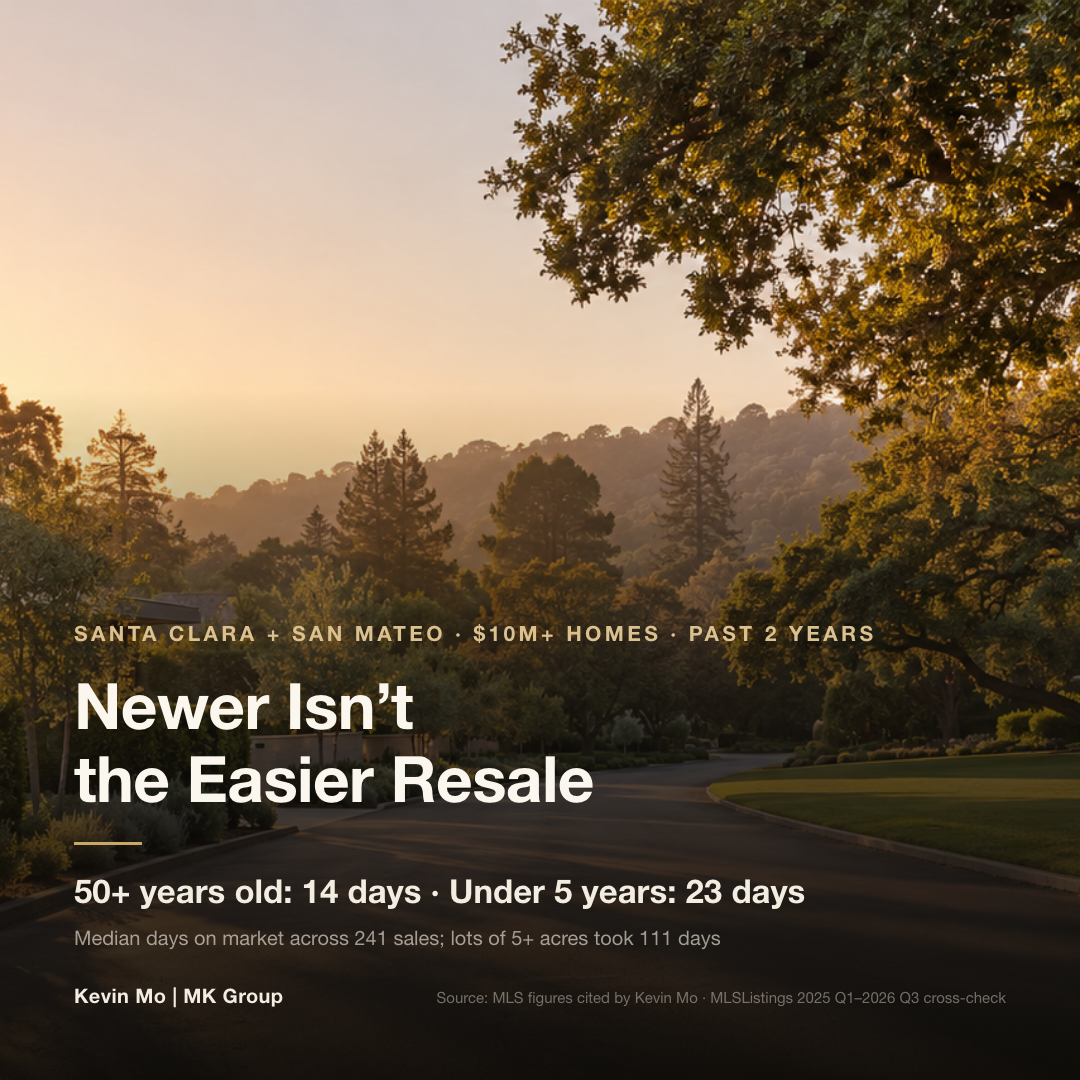
The headline numbers: the MLS figures Kevin Mo cites in the video show 241 single-family homes selling for $10M or more in Santa Clara and San Mateo counties over the past two years. Houses 50 years or older had a median of only 14 days on market, faster than homes under 5 years old (23 days). By lot size, the median jumps from 20 days at 1–2 acres to 51 days at 2–5 acres and 111 days on 5 acres or more. An independent cross-check of MLSListings closed sales from 2025 Q1 to 2026 Q3, compiled from MK Bay Area Pulse raw data (218 sales), points the same way: 12 days for houses 50+ years old, 20 days for new builds and 103 days on 5+ acres.
| Factor | Group | Median days on market (video, 241 sales) | Median days on market (cross-check, 218 sales) | Cross-check sales | Median sale price / original list (cross-check) |
|---|---|---|---|---|---|
| House age | Under 5 years | 23 | 20 | 50 | 94.7% |
| House age | 5–19 years | 32 | 23 | 70 | 96.0% |
| House age | 20–49 years | 37 | 29 | 46 | 96.9% |
| House age | 50+ years | 14 | 12 | 52 | 99.5% |
| Lot size | Under 0.5 acre | — | 16 | 43 | 96.6% |
| Lot size | 0.5–1 acre | 16 | 13 | 49 | 99.1% |
| Lot size | 1–2 acres | 20 | 18.5 | 88 | 97.1% |
| Lot size | 2–5 acres | 51 | 74.5 | 22 | 92.5% |
| Lot size | 5+ acres | 111 | 103 | 16 | 79.5% |
| Price band | $10M–$20M | 21 | 18 | 176 | — |
| Price band | $20M+ | About 58 | 43.5 | 42 | — |
Basis: the video figures are the "past two years" MLS statistics for the two counties cited by Kevin Mo. The cross-check covers MLSListings $10M+ single-family closings in the two counties from January 13, 2025 to September 30, 2026 (MK Bay Area Pulse raw data, deduplicated by MLS number), with house age = year of sale minus year built. The two sets differ in time window and filters, so the figures don't match exactly. Both count closed sales only and exclude off-market sales and listings withdrawn unsold.
What to take from this: an old house selling fast doesn't make the old house better. One plausible explanation is that many houses 50+ years old sit on good lots in good locations within established neighborhoods, so buyers are paying mainly for the land and the location. But each group differs in town, price, lot and condition, and the data can't prove that. It only warns you not to judge resale safety by house age. Note, too, that in the cross-check, homes under 5 years old closed at a median 94.7% of original list, against 99.5% for houses 50+ years old: new-build asking prices gave up more by the time they closed. Sales on 5+ acres closed at a median of only about 80% of original list. Yet the larger-lot groups are also more expensive to begin with ($20M+ homes took a median of about 58 days on the video figures), so this doesn't mean more land draws fewer buyers either.
Change the town, and the conclusion changes with it. On the video's figures, Atherton sold 84 single-family homes at $10M or more over the past two years, on a median lot of about 1 acre, with a median of 22 days on market. Portola Valley's median lot is 3+ acres; its 12 sales took a median of nearly 98 days. Woodside's lots are also over 3 acres, yet its 22 sales took a median of only about 13 days.
| Town ($10M+ single-family) | Video figures (sales / median lot / median days on market) | Cross-check sales | Cross-check median lot | Cross-check median days on market | Cross-check median sale price |
|---|---|---|---|---|---|
| Atherton | 84 / about 1 acre / 22 days | 78 | 1.0 acre | 20 days | $15.6M |
| Portola Valley | 12 / 3+ acres / nearly 98 days | 8 | 3.5 acres | 115 days | $14.5M |
| Woodside | 22 / 3+ acres / about 13 days | 19 | 3.2 acres | 14 days | $15.8M |
| Los Altos Hills | — | 18 | 1.2 acres | 14.5 days | $13.2M |
| Hillsborough | — | 33 | 0.9 acre | 12 days | $12.0M |
| Palo Alto | — | 30 | 0.3 acre | 35.5 days | $13.4M |
What to take from this: none of it says Woodside will always sell faster than Portola Valley, or that large lots are always hard to sell. Portola Valley has just 8 sales in the cross-check, and a single property can move the median. Palo Alto, on a median lot of only 0.3 acre, took a median of 35.5 days on market, slower than Woodside on 3+ acres. At the high end, no single parameter tells the story. The comparisons that matter are always made within the same town, at a similar price and on similar land.
What MK Group has seen: an old house sold as land, and a large lot the buyer walked away from
MK Group was co-founded by Marie Wang (DRE# 02110980) and Kevin Mo (DRE# 02127623). Two real transactions the team handled this year, anonymized here, sit on opposite sides of the table. One was a sale, one a purchase, and they map directly onto the two scenarios: the old house and the large lot.
Sell side: an old house that needed major work, marketed by explaining the land first
In July 2026, the team sold a 1954 Atherton house as exclusive listing agent. The house needed major work. Preparing it to list publicly as it stood would have taken at least six weeks, and the sellers had long lived outside the Bay Area, which made overseeing a renovation from afar difficult. A buyer looking only at the house would first see repair costs, construction time and uncertainty.
The team didn't start by renovating and staging. It first concluded that the value lay in the land, not the house: the Atherton location, the usable space on the lot and three points of access, which left plenty of room to replan. That changed the target buyer from owner-occupiers to local developers. Before any preparation for market had begun, the house sold off-market for $8M.
Kevin's summary for houses like this one: when a seller keeps talking about the house, the buyer sees only the bill for fixing it. Make the land, the location and the room to rebuild clear, and the buyer sees a different bill. An old house isn't necessarily a drawback, provided the part that has aged isn't the part the buyer is actually paying for. He also cautions that one sale doesn't prove old houses sell more easily than new ones. For the rebuild math when you are bidding on an old house as land, see the rebuild math on an acre in Atherton under $10M.
Buy side: nearly two acres, and no reason to pay ahead for the next buyer
In 2026, Kevin Mo and Marie Wang were helping a $10M-class buyer choose a home. He was initially drawn to a Silicon Valley estate on nearly two acres: more land on paper, better-looking numbers. Once his real needs were laid out, there were only three. He wanted a relatively new house, a core location and upkeep that wouldn't weigh on him after closing. He would rarely use the extra land, yet from the first day he would be paying for its landscaping, trees, irrigation, slope drainage and long driveway. And the next buyer would run exactly the same numbers.
The team ultimately advised him to pass. Kevin's view is that a buyer's agent earns their keep not only by getting the client the house. Sometimes the more valuable work is steering the client away from a choice that looks beautiful but doesn't suit him. There is no reason to pay in advance, on the next buyer's behalf, for land you won't use. When a lot is large enough to carry split or long-term holding value, the math changes; compare who should buy a 2.3-acre Atherton estate.
Common Misconceptions
Misconception 1: "A new house needs less upkeep, so it will always be easier to resell"
On the video's figures, homes under 5 years old had a median of 23 days on market, while houses 50+ years old needed just 14. In the cross-check, new builds closed at a median 94.7% of original list and the oldest houses at 99.5%. A new house really is easier to live in. But the part of the price paid for new finishes and new equipment will have depreciated in five years, and the next buyer may not pay for it in full.
Misconception 2: "An old house costs less, so whatever I save is money earned"
First subtract repairs, permits, design, construction waits and the carrying cost during the work from the price gap. The discount is real only if the lot and the location are genuinely hard to replicate and can cover the cost of future work. Otherwise, the savings may all go back out the door once construction starts.
Misconception 3: "The bigger the lot, the scarcer it is, so it will be worth more when I sell"
On the MLS figures cited in the video, the median days on market jumps from 20 days at 1–2 acres to 51 days at 2–5 acres and 111 days on 5+ acres. In the cross-check, sales on 5+ acres closed at a median of only about 80% of original list. Those groups are also higher-priced, so more land doesn't simply mean fewer buyers. But if most of the extra acreage is slope, long driveway and trees, the next buyer will price it as an upkeep obligation too.
Misconception 4: "One parameter is enough to tell whether a home will sell easily"
On the video's figures, Portola Valley and Woodside both have median lots of 3+ acres. Yet Portola Valley took a median of nearly 98 days on market and Woodside about 13, each on only a dozen or two sales. Weigh house age, acreage, town, terrain, privacy, condition and price together, and compare only within the same town, price band and land conditions.
Next steps
- Write the premium down. For each candidate home, spell out what the extra money over comparable homes in the same area actually buys: location, floor plan, construction quality, scarce supply, or finishes and equipment. Depreciate the last two over five years.
- Pull the latest sales in the same town, at a similar price and on similar land. Value the house and the land separately to judge whether the premium in front of you is justified or emotional.
- Price the full cost of ownership. For an old house, list repairs, permits, design, construction waits and carrying costs. For a large lot, separate the land you will use from the land you will only maintain, then estimate annual upkeep plus one-off projects such as large trees, drainage and slopes.
- Check the competition. See how many comparable homes are listed now and how long each has been on the market. Those are the homes you will be up against when you sell.
- Match your offer to your holding period. If you may move, relocate overseas or rebalance your portfolio within five years, build both the resale wait for comparable homes and their discount from original list into the price you offer today.