Direct answer
It depends on whether you will trade convenience for quiet. Atherton has had no commercial land since it was founded, so a carton of milk is a dedicated car trip to the next town. What you get in return is streets without streetlights, hedges the code itself requires, and a permit before you touch your own oak.
Who this article is for
- Families with a budget of $8M and up who see Atherton as a long-term home, not an investment position
- Buyers who have toured several Atherton houses but have never spent an ordinary weekday here
- Anyone used to walking to a market, a café and a park who wants to know what daily life feels like when everything requires a car
- Families eyeing a specific one-acre lot with plans to tear down and rebuild, or to remodel heavily
- Families who rank privacy above light, square footage and finishes
Three core dimensions
Dimension one: your daily radius sits entirely outside the town
Atherton has no commercial land. No grocery store, no restaurants, nothing to browse. Food and errands mean driving to Menlo Park, Palo Alto or Redwood City. The distances are short, but living here surfaces a very specific gap: picking something up on the way home does not exist as a category. Out of milk means a trip made for that purpose. There is one café in town — the only place in Atherton to spend money — where a large coffee is $8.50, alongside sandwiches and baked goods. It solves an afternoon. It does not solve three meals a day.
The town has been without commerce by design since day one. In 1923, Menlo Park moved to annex the area, and residents who wanted to protect a purely residential, low-density setting incorporated Atherton first. More than a century later there is still no commercial land. Transit followed the same logic. Caltrain once stopped in Atherton. Ridership was thin, so weekday service was cut in 2005 and only weekend trains remained; on December 13, 2020, the last train pulled out and the station closed for good.
Turn that page over. The inconvenience is exactly what keeps foot traffic and through traffic out, and it is why the town stays as quiet as it does. What you give up on this dimension is what you buy on the next one.
Dimension two: the privacy is written into the code
The first time Marie Wang drove through Atherton, the thing that struck her was how little there was to see. Eight-figure houses on every block, and from the road, almost nothing — hedges, and one gate after another.
Part of that is planning. The town has more than 50 miles of streets, and most residential ones have neither sidewalks nor streetlights. The rest is code. Fences cap at 6 feet in general locations, can reach 8 feet in places along school or railroad boundaries, and drop to 3 feet near intersections so a driver's sightline stays clear; gates and pillars cannot exceed 10 feet overall. The clause that does the real work is the companion requirement: any fence over 6 feet needs street-side landscape screening, and those plantings must reach roughly fence height within 3 years. Some of the tallest, densest hedges on these streets are there because the ordinance says so.
So where do residents actually go? Mainly three public places. The town center. The library, ribbon-cut in late 2021 and opened to the public in June 2022. And the 22-acre Holbrook-Palmer Park, the only park in town. Its perimeter wall holds 17 private gates — 15 opening from Fulton Gables on the Menlo Park side, 2 from Lane Place in Atherton — so the neighbors walk out their own back yards and are already in the park.
Dimension three: what you can eventually do with the land
With essentially no sales tax base, Atherton's money comes mainly from two places: property tax, which accounts for roughly 70% of town revenue — a $10M house at the roughly 1.2% baseline runs about $120K a year — and building permit fees, which bring in about $2.45M annually, close to 10% of general fund revenue. The town's finances rest on these houses and on the rebuilding of these houses.
Paying the permit fee is not the same as being free to build. On a one-acre lot the main house is capped at roughly 7,840 square feet, with a separate limit on the second floor; front and rear setbacks are typically 60 feet each, with side setbacks on top of that. It is why so many houses here sit on generous land yet stand far back from the road. Marie puts the practical warning plainly in the video: two lots can both be an acre and still differ enormously in what is actually buildable, because shape and position change everything. The full method is in how much you can actually build on an Atherton acre.
Then there are the trees. Chapter 8.10 of the Atherton municipal code governs heritage trees. An oak is protected anywhere on the lot once its trunk circumference reaches 48 inches — roughly 15 inches in diameter — and other species meet the same standard outside the main building envelope. Removing a protected tree without a permit can be fined at up to twice that tree's appraised value. Before pruning or removing anything, have a certified arborist walk the lot, or confirm directly with the town.
The numbers behind Atherton
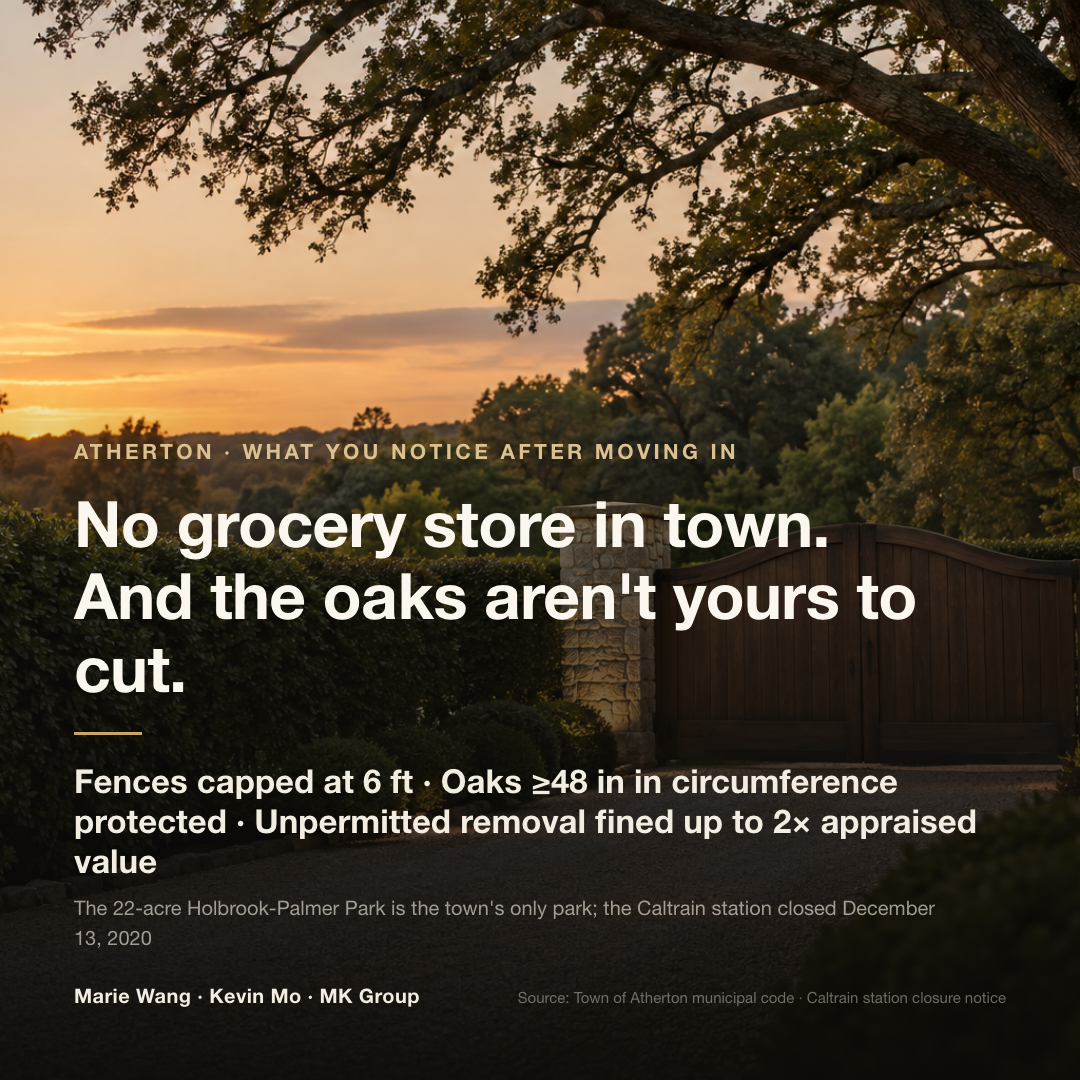
The headline figures first. Atherton has had no commercial land since it was founded in 1923, and the town has exactly one café. Fences cap at 6 feet in general locations, and anything above 6 feet requires street-side landscape screening that reaches fence height within 3 years. An oak in your yard is protected once its trunk circumference hits 48 inches, and unpermitted removal can be fined at up to twice the tree's appraised value.
| Category | Rule / figure | What it means for a family living here |
|---|---|---|
| Commercial land | None — established at incorporation in 1923, to pre-empt annexation by Menlo Park | Groceries, meals and errands all happen in Menlo Park, Palo Alto or Redwood City |
| Places to spend in town | One café; $8.50 for a large coffee, plus sandwiches and baked goods | Covers a coffee, not three meals a day |
| Caltrain Atherton station | Weekday service cut 2005; weekend service ended 2020; last train December 13, 2020 | Rebuilding the center platform as side platforms was estimated near $30M; ridership never justified it |
| Streets | More than 50 miles town-wide; most residential streets have no sidewalks and no streetlights | Not a walking network, and dark at night — traffic and foot traffic are suppressed structurally |
| Fence height | 6 ft in general locations; up to 8 ft in places along school or railroad boundaries; 3 ft near intersections; gates and pillars capped at 10 ft overall | The 3 ft near intersections is a driver sightline rule, not an aesthetic one |
| Landscape screening | Any fence over 6 ft requires street-side planting that reaches roughly fence height within 3 years | Some of the tall, dense hedges are code compliance, not owner preference |
| Public space | Town center; library (ribbon-cut late 2021, opened June 2022); 22-acre Holbrook-Palmer Park | The park is the only one in town; of the 17 private gates in its wall, 15 open from Fulton Gables on the Menlo Park side and 2 from Lane Place in Atherton |
| Town revenue mix | About 70% from property tax; building permit fees about $2.45M a year, close to 10% of general fund revenue | Essentially no sales tax base — the money comes from the houses and from rebuilding them |
| Property tax scale | A $10M house at the roughly 1.2% baseline runs about $120K a year | Carrying cost belongs in the cash-flow plan next to the mortgage, not after closing |
| Buildable scale (one acre) | Main house capped near 7,840 sq ft; separate limit on the second floor; front and rear setbacks typically 60 ft each, plus side setbacks | Two lots of the same acreage can differ enormously in what is actually buildable |
| Heritage trees (Chapter 8.10) | Oaks protected anywhere on the lot once trunk circumference reaches 48 in (about 15 in diameter); other species held to the same standard outside the main building envelope | Unpermitted removal of a protected tree can be fined at up to twice its appraised value |
Two things to remember. First, those improbably tall hedges are frequently not a matter of taste. The code requires street-side screening for any fence over 6 feet and gives the planting 3 years to reach fence height — privacy here is written into the ordinance, with a schedule attached. Second, $2.45M a year in permit fees, close to 10% of the general fund, tells you the town processes a lot of construction and cares a great deal about how it is reviewed. Your future rebuild will get a serious read, and the oak in the yard with a 48-inch trunk has more influence over the final house than most buyers expect.
What MK Group sees on the ground
Marie Wang (YouTube @MarieWang, 44K+ subscribers) has been showing homes in Atherton for years, and her read in this on-location video is unsentimental. Some families move in and say three months later that they cannot take it — every grocery run is a drive. Others find it quiet, private and unhurried, and settle in happily. Same town, same rules, opposite conclusions. So she asks families seriously weighing Atherton to hold convenience, privacy and rebuild intent in view at the same time, and to let no single one of the three sell them or scare them off on its own.
Privacy in Atherton extends all the way into how a transaction is run. The MK Group case library includes an Atherton exclusive listing (case-022) where the owner was in no hurry to sell. What she cared about was privacy and control over the process — the house was a private setting for her family's life, not a product. The sale closed entirely off-market: no public listing, no broad open houses, and no unnecessary exposure of the floor plan or the details of how the family lived. The hedges and gates you see from the street are only the outermost layer of that same logic.
On the rebuild side there is a counterintuitive lesson. A brand-new house can still be a rushed one. A second case in the library (case-016) involved a newly built $20M-tier Atherton estate. The layout and the location were both fine, and the buyer walked away anyway — MK Group's read was that the workmanship had been rushed, closer to a builder's spec home than to a house built to be lived in. If the plan is to buy new and skip the construction headache, put that possibility into the analysis early. The full buy-side process is in the complete guide to buying in Atherton.
The video ends with Marie driving under five minutes across town, flowers and a gift in the car, to visit a family who bought their Atherton home earlier this year. Marie notes in the video that the absence of a single grocery store is neither a strength nor a flaw on its own — it is one layer in a stack of choices, and what decides the answer is how you want to live.
Common Misconceptions
Misconception 1: "The lot is big enough and the house expensive enough that I can do what I like with fences and hedges"
Neither price nor lot size changes the fence rules: 6 feet in general locations, up to 8 feet in places along school or railroad boundaries, 3 feet near intersections, and gates with pillars capped at 10 feet overall. Go above 6 feet and you owe street-side landscape screening that reaches fence height within 3 years. More privacy here usually comes from planting and site layout; the wall itself has a ceiling.
Misconception 2: "An acre is an acre, so the houses should come out about the same"
On a one-acre lot the main house is capped at roughly 7,840 square feet, with a separate second-floor limit; front and rear setbacks typically take 60 feet each, and the sides take more. Stack those setbacks on an awkwardly shaped or poorly positioned lot and what remains can be far smaller than on another acre nearby. Shop on what survives the setbacks; acreage alone tells you little.
Misconception 3: "The trees in my yard are my property — I can cut them if I want"
An oak is protected anywhere on the lot once its trunk circumference passes 48 inches, and other species meet the same standard outside the main building envelope. Remove a protected tree without a permit and the fine can be calculated at up to twice its appraised value. The worst possible sequence is discovering the tree was protected after it is already down — so bring in an arborist first, or confirm with the town directly.
Misconception 4: "No grocery store, and even the train station closed — this town must be sliding"
The direction is the opposite. Zero commerce was a deliberate choice made at incorporation in 1923, when residents formed Atherton ahead of annexation to preserve a purely residential, low-density setting. Closing the station was arithmetic too: ridership was thin, and converting the center platform to side platforms carried an estimated $30M price tag. One fewer station is one fewer channel bringing outside traffic into town.
Misconception 5: "We'll move in first and get used to the inconvenience over time"
A commute is something you adapt to. Errand friction happens every single day — a child needs something on short notice, dinner is one ingredient short, the weekend walk has no sidewalk to take. The difference usually comes down to whether you actually spent a few days living the way this town requires before you bought.
Next steps
- Drive the errand loop yourself at six in the evening. Leave from the lot you are considering, drive to a grocery store in Menlo Park, Palo Alto or Redwood City, buy something, and drive back. That weekday round trip is what several thousand future evenings will look like.
- Walk the lot with the fence and setback numbers in hand. Take 6 / 8 / 3 / 10 feet and the 60-foot front and rear setbacks onto the property and pace them out, and confirm specifically whether the lot sits near an intersection, where the cap drops to 3 feet. The full buildable-area method is in how much you can actually build on an Atherton acre.
- Have an arborist tag every tree before you write the offer. Ask for trunk circumference tree by tree, flag everything at 48 inches or more, and check whether any of them stand where you want the house. That fee is a different order of magnitude from a penalty calculated at twice appraised value.
- Sample the public side of town on its own. Spend an afternoon in the library, walk the town center, and make a full loop of the 22-acre Holbrook-Palmer Park. That is most of the public realm this town offers, and it is worth confirming in person whether it is enough.
- Choose Atherton first, then choose the pocket within it. Lots, setting, schools and pricing vary meaningfully by area inside the town — see the buyer's decision framework for Atherton's seven sub-communities.