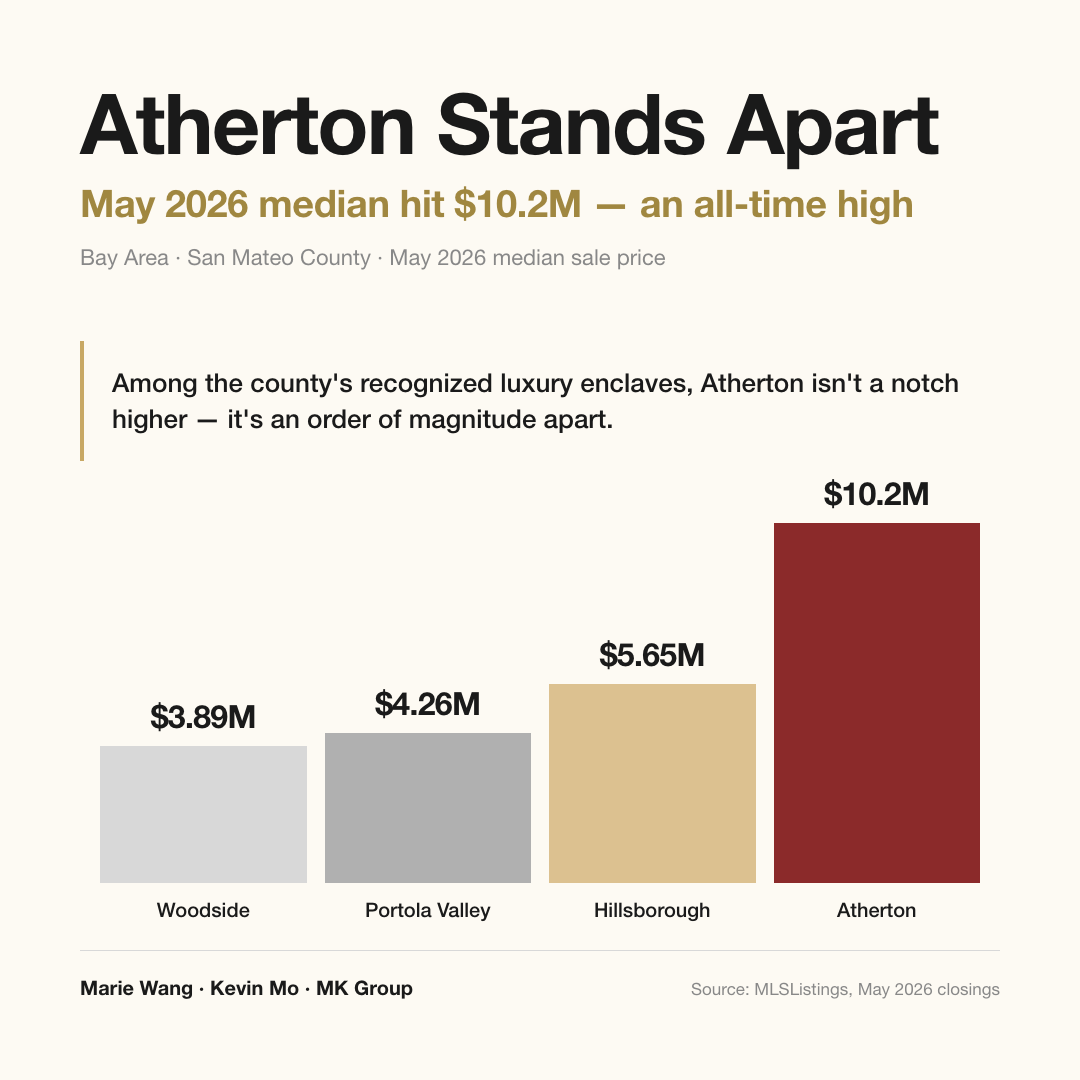
In May 2026 Atherton's median closing price reached $10.2M — the highest figure the town has ever recorded. As recently as February it stood at $8.88M; in three months it has climbed roughly $1M a month. In Atherton, $10M is the price of a home that is merely livable — an entry ticket, not a ceiling. The run-up is so fast for one reason: the buyer pool has turned over, layering AI new-money and cross-border family offices on top of the buyers who were already there.
Who this is for
- Buyers with a budget above $10M who are considering Atherton but worried that entering now means buying the top.
- Owners of an Atherton home weighing whether this is a good moment to sell and step out.
- High-net-worth families trying to understand why Atherton sits an order of magnitude above Hillsborough or Woodside.
- AI new-money principals, holders cashing out of primary- or secondary-market stock, and cross-border family offices who want to understand the structure of the market they're entering.
Three dimensions for reading Atherton's market right now
1. $10M is the entry price, not the ceiling
Many people see a $10.2M median and assume that's the high end of Atherton. The opposite is true. The figure means that if you go looking in Atherton today, more than half of all listings are priced at $10M or above. And what $10M buys in Atherton is a home that is merely livable — you couldn't call it especially fancy. Strictly speaking, the median even runs a little conservative, because it folds in plenty of entry-level lots that need a full teardown and rebuild. For a genuinely good home, there is a great deal of room above this number. So in Atherton, $10M is a threshold to clear, not the top of the market.
2. Atherton's scarcity is structural
The whole town holds just over 7,000 residents and a little over 2,000 homes, with no commercial district at all. Lots start at roughly one acre — locals call it an "Atherton lot," about the size of half a soccer field. In a Bay Area that is mostly hills, flat land on that scale is exceptionally rare. The people who earn an entry ticket here are venture investors, startup founders, and public-company owners; what they're buying isn't only the house — it's the privacy that comes with it. That combination of scarcity, peer circle, and privacy is the underlying reason Atherton's prices lead the field by an order of magnitude.
3. The buyer pool is turning over
This is the key to why prices have climbed three months running. Atherton's core buyers used to be traditional VCs and legacy tech executives. They're still here — but three new forces have layered on top. The first is AI new-money: principals from AI-adjacent companies. The second is holders cashing out large stock positions in the primary or secondary market. The third is cross-border family offices. Six months ago an OpenAI IPO was only a faint rumor; now it is essentially public knowledge. A cohort of AI and hardware companies are carrying high valuations, and a new generation of wealth is forming quickly. That means a large wave of fresh buying power has flowed in on top of Atherton's existing pool — demand has thickened suddenly while supply has barely moved, and prices step up as a result.
Atherton's three tiers: each one is buying something different
The headline number first: over the trailing twelve months, Atherton recorded just 77 closings (69 of them analyzed here). Split by price, the market falls into three tiers: about 13 sales above $20M; about 21 sales between $10M and $20M, the most active core; and about 35 sales below $10M. The buying logic differs completely across the three — the top tier buys scarcity, the middle buys livable quality, the entry tier buys redevelopability.
| Price tier | Trailing-12-month sales (approx.) | What this tier is buying |
|---|---|---|
| $20M+ (top) | ~13 sales | Scarcity, a marker of standing, a legacy family estate. Every lot that sells is one fewer that ever will. Last year's high was a Lindenwood estate at $45.5M. |
| $10M–$20M (middle) | ~21 sales | Genuinely livable quality. The most active core of the market; buyers are largely tech executives and AI founders. |
| Below $10M (entry) | ~35 sales | Redevelopability and upside — many are bought for a teardown and rebuild. The purchase is the land, not the house. |
The one thing to remember: Atherton is not a linear ladder where pricier always means better. It is three markets with completely different logic stacked on top of one another. Among the roughly 35 sales below $10M, many buyers aren't buying a house at all — they're buying a lot to tear down and rebuild. By the time you reach the roughly 13 sales above $20M, the purchase is no longer about living space; it's about scarcity and a transferable family asset, where every lot that sells is one fewer that ever will. So comparing Atherton's median against another town's tells you very little. First decide which tier you're actually entering.
Data source
- Sources: MLSListings May 2026 closed-sale data; San Mateo County Recorder public transfer records. The three-tier sales distribution and the read on the off-market character of these sales are MK Group field estimates, led by Marie Wang (DRE# 02110980) and Kevin Mo (DRE# 02127623).
- Updated: 2026-06
- Scope: Atherton $5M+ single-family home market
Same town, two stories: a home sells in two days, another sits 108 days untouched
The most striking contrast in Atherton is this: within the same town, some homes sell before they're ever formally listed, while others sit on the market for 108 days with no takers. One concrete pairing — a $32.5M estate in West of Alameda, one of Atherton's most central pockets, sold the day after it came up; a listing in Lindenwood sat 108 days and still hadn't found a buyer. Earlier in the year there were also two newly built homes asking $26.5M and $24.8M — both large, 7,000-to-8,000-plus-square-foot houses. Plenty of people came to see them, but after two or three months on the market neither would sell.
There were reasons they wouldn't sell. Take the $26.5M home: the lot wasn't rectangular (it was fan-shaped); the build quality was poor (a 2 out of a possible 10); and it faced directly onto a road — undesirable both by feng shui and by day-to-day livability. The catch is that buyers in this band hold the whole package to an extremely high standard. Spending north of $20M on a home with a visible flaw isn't a question of money for them; it's a question of whether they'll actually enjoy living there. That is the defining feature of the $20M+ band: almost no tolerance for flaws — one visible defect is enough for a buyer to walk away from the entire house. Unlike mid-market buyers driven by need, who'll accept "good schools, close enough," this group can't abide a single grain of sand. But the reverse is also true: the moment they see a home that genuinely fits, they can close all-cash on the spot, without hesitation.
Months of supply: Atherton is the extreme within a super seller's market
To judge who holds the leverage between buyer and seller, the common gauge is months of supply (MSI): assuming no new inventory comes on, how long it would take to sell everything currently on the market. As a rule, anything under three months is a strong seller's market. San Mateo County, where Atherton sits, currently runs just 1 to 1.3 months — everything would clear in under a month, which is already a super seller's market. Atherton is more extreme still: at its peak the entire town has only about a dozen active listings at any one time, and it records roughly 70 sales a year. With supply locked down to that degree, and with the fresh buying power described above flowing in, prices moving in one direction is close to structural.
Off-market is the norm: the most expensive homes never touch the MLS
In this band of Atherton, the most expensive homes often never appear on the MLS at all. Silicon Valley's most expensive residential sale of 2026 was $51.5M — roughly 10,000 square feet of living space in Atherton's most central location, sold by a former tech-company executive. From start to finish the deal never went on the MLS, never had a public listing, and never held a showing. Buyer and seller moved entirely through private channels, and quietly completed Silicon Valley's most expensive home sale of the year.
And this isn't a one-off — it's the norm. The reasoning is simple: these sellers are often people of considerable standing who don't want crowds touring their home (in many cases they're still living in it). The standard playbook is for the seller to get the home ready, have the listing agent privately notify roughly ten active agents, and let only that small circle of first-hand contacts know the home exists. In this point-to-point market, both buyers and sellers are highly targeted resources concentrated in the hands of a few agents — and whether you ever get to see these exclusive homes comes down directly to whether your agent has first-hand offline channels.
What we see in the field
A $20M-tier new Atherton estate, viewed by a family office that walked — and the plain truth we gave them: "the workmanship was rushed"
Last month a cross-border family office came to us (MK Group) on an extremely tight clock — the decision-maker was flying back overseas the day after the viewing. We took them through a newly built Atherton estate: a good floor plan, a fine community, and on paper almost nothing to fault. The client asked us, on the spot, for our honest read. We didn't talk the house up to force the deal. What we gave them, after walking through it, was the plain truth: the home was good in every respect except one — the workmanship was too rough. For a $20M home, it read more like a spec home a builder had rushed out to sell than a property crafted for long-term ownership. In the end the client passed on this one, but said they'd be back in Silicon Valley in August to keep looking with us.
This case bears out two of the points above. First, the $20M+ band has almost no tolerance for flaws: buyers at this price won't compromise on "good enough," and one workmanship defect is enough to walk away from the whole house. Second, a cross-border family office's window is extremely short: the decision-maker is often "flying back overseas the day after the viewing," which requires an agent to deliver a credible, actionable judgment within a single showing rather than hedging. For a family-office client, one honest "we kept you out of a mistake" often earns more long-term trust than one closing ever could.
At the off-market tier, what matters is first-hand offline access
The $51.5M core-location sale described above — and a separate home we toured last week, asking $26.0M, where the seller (a well-known CEO) had the listing agent privately notify roughly ten active agents and refused to go on the MLS — both point to the same thing: Atherton's best homes are frequently not on the open market. Marie Wang and Kevin Mo, as a team rooted in the Atherton area, hold off-market Atherton inventory and first-hand offline buyer and seller relationships. We can take clients to see these homes that never touch the MLS precisely because we hold that first-hand information — which, in an Atherton band where point-to-point deals are the norm, is what truly determines whether you get to see the homes at all.
Common misconceptions
"The median's already $10M — won't I be buying the top right now?"
Reading $10M as the high end of Atherton is the most common misinterpretation. What the median actually means is that more than half of Atherton's listings sit at $10M or above, and $10M buys only a merely-livable entry home — a threshold, not a ceiling. The fast run-up isn't pure speculation, either; it's a turnover in the buyer pool. AI new-money, holders cashing out of primary- and secondary-market stock, and cross-border family offices have flowed in alongside the traditional VCs and legacy executives, and demand has thickened suddenly. At the same time Atherton is acutely scarce — roughly 70 sales a year town-wide, just 1 to 1.3 months of inventory. Supply is locked while demand is building; that is structural, not short-term sentiment. Every market has cycles, of course, and whether you personally should enter now still comes back to which tier you're entering and whether you're buying scarcity or redevelopability.
"In Atherton, anything brand-new is automatically good."
"Brand-new" is a selling point, not a guarantee of quality. The two new builds listed earlier in the year at $26.5M and $24.8M were both large, 7,000-to-8,000-plus-square-foot homes; they drew plenty of visitors and still wouldn't sell — because the lots weren't rectangular (one was fan-shaped), the workmanship rated a 2 out of 10, and they faced directly onto a road. A spec home that a builder rushed out for a fast turn often doesn't deserve its price tag in the luxury band. Buyers here have almost no tolerance for flaws, and one visible defect is enough for them to walk from the whole house. So when you view a new build in Atherton, don't stop at "it's new" — check whether the lot is rectangular, whether the workmanship holds up to scrutiny, and whether the orientation and road exposure are right.
"To buy in Atherton, searching the MLS is enough."
In this band of Atherton, the most expensive and the best homes frequently never reach the MLS. Silicon Valley's most expensive sale of 2026 ($51.5M) had no public listing and no showing from start to finish; buyer and seller moved through private channels. The sellers are people of considerable standing who don't want crowds touring the home, and the standard move is to have the listing agent notify roughly ten active agents point-to-point. That means relying on public listing sites alone will cause you to systematically miss the best homes — whether you ever reach these off-market properties depends on whether your agent has first-hand offline channels.
Next steps
- First decide which tier you're entering: above $20M buys scarcity and a family estate, $10M–$20M buys livable quality, below $10M buys land for redevelopment. The three follow completely different logic — settle that before you start viewing.
- Don't treat Atherton's median as your pricing anchor: it folds in a large number of entry-level teardown lots, and the tier you actually care about (especially $20M+) carries a different price distribution and a different tolerance standard.
- When viewing a new build, check lot shape, build quality, and orientation/road exposure as separate line items — the $20M+ band has almost no tolerance for flaws, and a single hard defect is reason enough to pass on the whole house.
- If you're a cross-border family office on a short viewing window, have your agent line up a few candidates before you arrive, so a single visit yields an actionable judgment.
- Don't rely on public MLS inventory alone: Atherton's best homes largely move through point-to-point private channels — confirm directly whether your agent holds off-market inventory and first-hand offline buyer and seller relationships.
- If you already own an Atherton home and don't plan to keep living there, this window — supply acutely scarce, the buyer pool turning over and trending up — is a good moment to assess whether to sell and step out.