The short answer
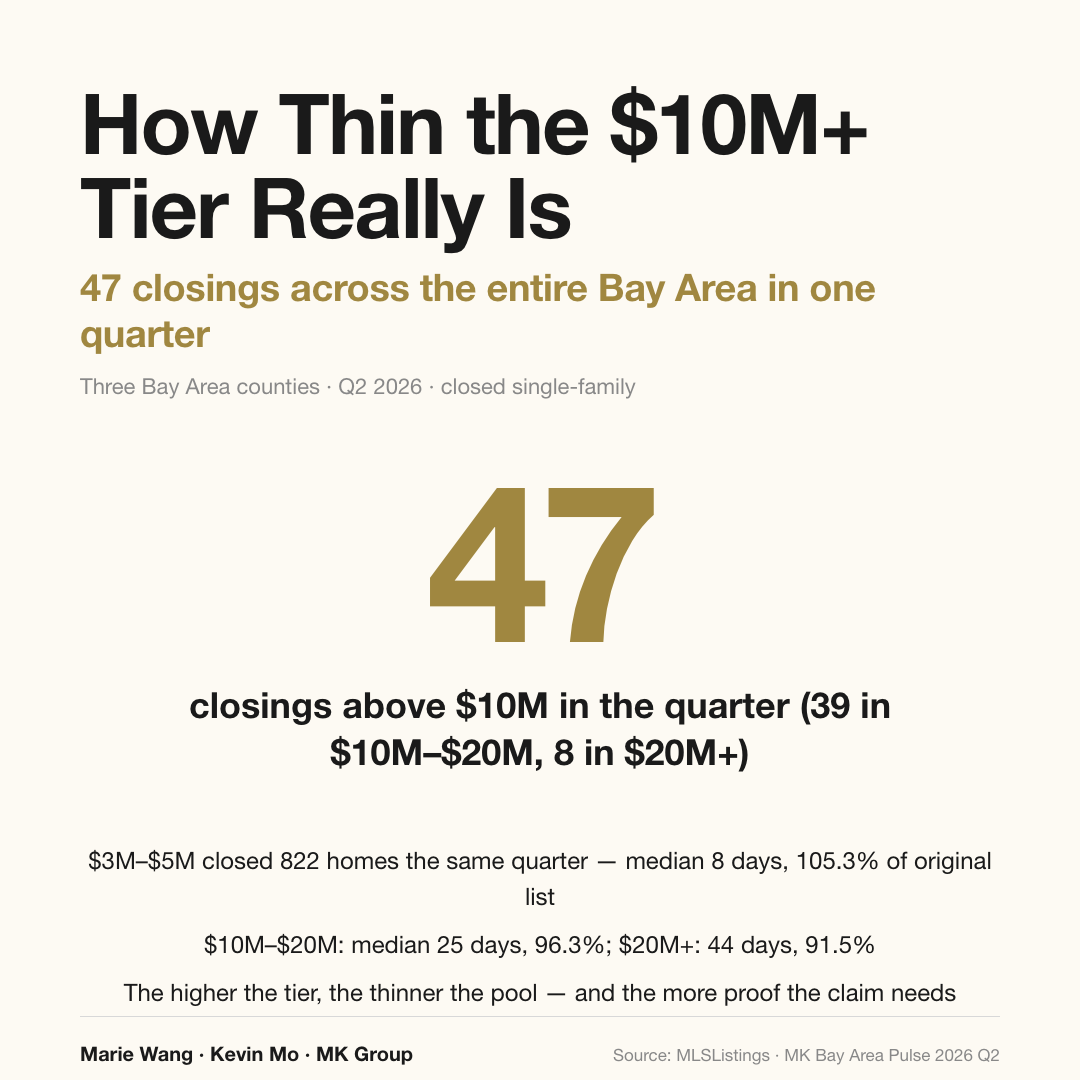
In California, "I happen to have a buyer for your house" is a statement, not a promise. It creates no contractual obligation. You can believe it — but verify it in the room, because a real buyer pool leaves a traceable trail and an improvised one does not. Calibrate the scale first: across the entire Bay Area, only 47 single-family homes above $10M closed in the whole of the second quarter of 2026 — 39 in the $10M-$20M band and 8 above $20M (MLSListings, compiled in MK Bay Area Pulse 2026 Q2). The higher the tier, the more that sentence needs specifics behind it.
The law gives you three fixed points to stand on. California Civil Code §§2079.13-2079.24 establish the agency disclosure regime for residential transactions: a licensee must deliver a written Agency Disclosure — the AD form in industry shorthand, with the statutory text set out at §2079.16 — to both seller and buyer, and must then confirm in writing, under §2079.17, exactly whom each licensee represents in the purchase contract. One agent representing both sides is not illegal in California, but it requires the informed consent of both parties. The line drawn by §2079.21 matters more: without the express written consent of the party concerned, a dual agent may not tell the seller that the buyer would pay more than the offered price, nor tell the buyer that the seller would accept less than the list price. Financial condition, motivation and bargaining position are equally protected as confidential information. B&P Code §10176(d) backstops all of it at the license level — acting for more than one party without the knowing consent of all is grounds for discipline by the California Department of Real Estate.
Who this article is for
This is written for a seller in a very specific position. You own a Peninsula home worth more than $5M — Atherton, Palo Alto, Menlo Park, Los Altos Hills, Hillsborough, Woodside. It is not listed yet. You are interviewing two or three teams. And at least one of them said the sentence in your first meeting: I happen to have a buyer for your house.
You are not offended by it. You simply cannot tell whether it is a fact or a technique. What you want to know is three things: if it is true, what factual structure should sit behind it; if it is not, which follow-up question exposes that; and if it is true and the same person ends up representing both sides, where does that leave you legally and what are you entitled to ask for.
This article answers those three. It applies equally to an owner who has already received an off-market approach and been told to "sign the exclusive first, then we'll talk." Asking these questions before you sign costs nothing. Asking them afterward is a dispute over interpretation.
Three questions that decide the answer
One: a buyer pool is accumulated, not assembled — which means it has a shape you can describe
A genuine standing buyer pool usually comes from three things compounding over a long period. Sustained content reach, so that a certain kind of buyer starts following a neighborhood a year or two before they actually transact. Repeated in-person contact, where the same names keep appearing at showings, private appointments and community events. And a transaction history — some of those buyers have actually written offers and actually closed, so their capital structure, decision chain and lender have all been tested in the real world.
Those three things share one feature: all of them were finished before your house existed as a listing. So if "I happen to have a buyer" is true, what it means is I have known a group of people who want this kind of home in this area for some time, and yours falls inside that. It does not mean I'll go look for someone tomorrow.
The difference between those two shows up immediately under questioning. The first can describe the pool's shape: how many households, what profile, roughly what capital structure, how long they have been looking, when the agent last wrote an offer for one of them. The second can only offer adjectives — we have a lot of resources, our network is enormous, everyone in the circle knows each other. Adjectives are not evidence.
One clarification worth making explicit: whether the pool exists and whether your house should go off-market are two independent questions. The first is fact-checking an agent. The second is a strategy judgment about your property — public listing or off-market takes that trade-off apart, and this article does not repeat it. You may perfectly well conclude that his buyer pool is real and your house should still be publicly listed. Those two findings do not contradict each other.
Two: five questions you can ask in the room — each with its good answer and its deflection
The design principle behind these five is that the answer must be either traceable or writable into a document, never merely felt. The question he cannot answer is itself the answer.
Question one: in the past 12 months, how many comparable homes have these buyers actually toured, and in which neighborhoods?
A good answer looks like this: rough counts and a neighborhood distribution, an account of how their criteria shifted over the year — they started out on Atherton only, then last fall opened up to a one-acre parcel on the west side of Menlo Park — and an explanation of why they still haven't bought (price never arrived, the parcel was wrong, the tax structure isn't built yet). The signature of a real answer is that it has a timeline, counterexamples and failures in it.
A deflection looks like this: adjectives and aggregate totals only — we have over a thousand high-net-worth contacts in our database, an enormous number of buyers follow us. Audience size is a traffic metric, not a buyer-pool metric. Whether one of those thousand subscribers can write an offer on your house this month is an entirely separate question.
Question two: when did you last write an offer for any one of these buyers? Did it close? Why not?
This is the sharpest of the five, because what it asks for is a date. Real buyer relationships necessarily carry a real offer history. An agent who "has buyers" but has not written an offer for any of them in six months most likely has a dormant pool — those people may have bought already, or stopped looking.
A good answer gives you the date, gives you the outcome, and volunteers why the one that failed failed. Failed deals carry more information than closed ones: they reveal the buyers' actual price ceiling and their real preferences on terms. A deflection pivots to our sales volume is very high — volume is that agent's production record, not your buyer pool.
Question three: are you willing to put "we already have named buyers" into the listing agreement in writing?
This question does not ask him to hand over names, and it should not. What can be documented is the mechanism, not the identities: agree that a named-buyer list exists, agree when it will be delivered to you in writing, agree how commission is calculated if the home ultimately sells to a buyer outside the list, and agree that contact with buyers on the list must be logged.
A good answer is yes, we usually write it this way — followed by the actual language he is used to. A deflection is there's no real need to write that down, you can trust how we work — which tells you the sentence was never meant to be tested. And it costs him nothing: if the list is real, writing it in adds no obligation. If it isn't, he will start explaining immediately why it cannot be written in.
Question four: if that buyer turns out to be represented by you, how do you plan to handle it?
This moves the legal boundary in section three onto the meeting table early. One licensee representing both sides is lawful in California, but it changes what you actually receive. You pay the full seller-side commission set out in the listing agreement — and since the 2024 NAR settlement, both the rate and any compensation offered to the buyer's side are fully negotiable, governed by the agreement you sign — while getting an advisor who is barred from pressing the price on your behalf.
A good answer distinguishes three dispositions unprompted: he stays seller-side only and refers the buyer to an agent outside his team; another licensee on his team represents the buyer (still dual agency at the brokerage level, which must be disclosed to both parties on the AD form and consented to); or he genuinely intends to act as dual agent — in which case he will state on the spot what he can therefore no longer do (no analysis of the other side's price ceiling for you, no design of targeted pressure) and whether the commission adjusts accordingly.
A deflection is this is the most efficient way, one fewer layer in the middle. The efficiency is real. Who captures it is a separate calculation. The mirror-image question from the buyer's side — whether to bring your own agent at all — is taken up in buying a $10M+ Bay Area estate: do you still need your own buyer's agent. Read that logic in reverse and you are looking at exactly what you now have to price.
Question five: if none of these buyers makes an offer, how long before we go publicly to market?
A real buyer pool gives you a specific window. Depending on tier, two to four weeks is the common answer, because a standing buyer's decision chain is already short. As an external reference point: the median days on market in the $10M-$20M band in Q2 2026 was 25 days (see the source box below), so a two-to-four-week private window is the right order of magnitude for the market's actual rhythm. Someone without a pool gives you an open-ended answer: let's see how it goes first.
This question also surfaces a technical prerequisite you need settled up front. A home's exposure during the off-market phase is constrained by industry rules, and those rules determine which day your days-on-market clock starts (details under mistake five below). For what a withdrawal, a written cancellation and an expiration each mean at the agreement level — and how the days-on-market clock behaves around them — can I change agents after signing an exclusive listing agreement goes deeper.
Three: the legal boundary — you have a right to know who represents whom, and to know what they cannot say
The first two sections are fact-checking. This one is a list of rights. California's protection for sellers is procedural, and it comes down to three things.
First: disclosure is mandatory, and it is written. Civil Code §2079.14 requires a licensee to deliver the Agency Disclosure form (statutory text at §2079.16) to seller and buyer at specified points in the transaction. Section 2079.17 goes further and requires written confirmation in the purchase contract of whether each licensee represents the seller, the buyer, or both. Who represents whom is not established verbally or ratified after the fact — it must appear on paper twice: once at disclosure, once in the contract. If you reach escrow without ever having seen that form, that is itself a signal.
Second: dual agency requires the informed consent of both parties. The statutory disclosure text at §2079.16 says plainly that one licensee may represent both seller and buyer, provided both know and consent. B&P Code §10176(d) adds the license-side consequence: acting for more than one party without the knowing consent of all is grounds on which the DRE can discipline a licensee. So your choice is real. You may consent, you may refuse, or you may consent conditionally — requiring two separate licensees within the team, requiring a commission adjustment, requiring your attorney at the key negotiation points. What matters is that the decision be yours, made knowingly, rather than waved past you the day before closing.
Third, and most often overlooked: a dual agent may not disclose your price floor. Section 2079.21 runs in both directions. Without the seller's express written consent, the agent may not tell the buyer that the seller would accept less than list. Without the buyer's express written consent, the agent may not tell the seller that the buyer would pay more than offered. Financial condition, motivation and bargaining position are likewise protected.
That has two practical meanings. The protective one: the actually, I could live with $9.2M you said in a private conversation cannot be carried to the buyer. The costly one is less often noticed — the same constraint means he cannot probe and exploit the buyer's ceiling on your behalf either. What you lose is not integrity; it is an information advantage working for one side only. This is not an argument for stigmatizing dual agency, which works well in a great many transactions and genuinely reduces friction. It is an argument that it is a trade with a price, and that you are entitled to know what you are trading before you trade it.
How thick can a buyer pool actually be: calibrating with volume and speed
After the five questions, you still need an external benchmark — otherwise you cannot judge whether the answers you got were reasonable. The benchmark is simply this: at your price, how many homes does the entire market close in a quarter?
The core numbers first. In the second quarter of 2026 (April 1 to June 30), the $3M-$5M band across the three Bay Area counties closed 822 single-family homes at a median 8 days on market and a median sale price of 105.3% of original list. The $5M-$10M band closed 279, also at a median 8 days and 103.8%. The $10M-$20M band closed 39 for the entire quarter, with median days on market stretching to 25 and the median sale-to-original-list ratio falling to 96.3%. Above $20M, 8 homes closed all quarter, at a median 44 days and 91.5%. Which is to say: the two bands above $10M together produced 47 closings across the whole Bay Area in a quarter — fewer than four a week.
| Price band | Closings in quarter | Median sale price | All-cash share | Median days on market | Sale price / original list |
|---|---|---|---|---|---|
| $3M-$5M | 822 | $3,600,000 | 26.8% | 8 days | 105.3% |
| $5M-$10M | 279 | $6,000,000 | 44.4% | 8 days | 103.8% |
| $10M-$20M | 39 | $12,750,000 | 71.8% | 25 days | 96.3% |
| $20M+ | 8 | $22,375,000 | 75.0% | 44 days | 91.5% |
What to take from this. The table holds two counterintuitive facts. First, the higher the tier, the thinner the buyer pool, not the thicker. A market that produces 47 closings above $10M in a quarter means any given agent's "buyers" are a single-digit number of specific human beings, not a pool. That is precisely what makes verification possible: if they exist, he can describe the profiles; if they don't, adjectives will not survive three follow-up questions. Second, the higher the tier, the less "fast" is the norm. The $3M-$5M band closed at a median 8 days and 5.3% over original list; above $20M, the median ran 44 days and closed 8.5% below original list. So when an agent promises a close "within two weeks" at $15M, that promise is nearly twice as fast as the band's own median ($10M-$20M median 25 days; two weeks is 14). It is not necessarily untrue. It simply needs more support than a sentence.
The city view is the same conclusion from another angle. In the same quarter Atherton closed 31 single-family homes at a median sale price of $10,000,000, 64.5% all-cash, a median 13 days on market and 97.1% of original list. Palo Alto closed 139 at a median $4,100,000, 8 days and 105.6%. Thirty-one closings in a quarter, spread across every licensee working the town, gives "I have Atherton buyers" a concrete unit of scarcity.
Data source: MLSListings (Santa Clara / San Mateo / Alameda counties), compiled in MK Bay Area Pulse 2026 Q2
Period: Closed single-family sales, April 1 - June 30, 2026
Methodology: Median days on market is the median from listing to offer acceptance, counted only among homes that closed within the quarter; listings that did not sell, were withdrawn, or remain active are excluded. Private sales that never entered the MLS are outside this dataset, so the closing counts above should be read as a floor rather than a total — which matters most at the very top.
Scope: Market benchmarks by price band for the Peninsula and Silicon Valley, intended to calibrate expectations; not a prediction for any individual property.
Statutory status checked: 2026-08-09
What MK Group sees in practice
Two Atherton transactions handled by Marie Wang (DRE# 02110980) and Kevin Mo (DRE# 02127623) happen to answer the two different halves of this article — one from the seller's side, one from the buyer's.
The first shows what a real buyer pool looks like. An Atherton owner approached MK Group while also talking to other teams. She was deliberate and in no hurry to sell; she was in fact still sitting on three unresolved questions — whether to sell this house at all, who should sell it, and how it should be priced. The day after their first meeting, the team told her directly that it already had several buyers who had been following Atherton for a long time, at least one of whom was clearly interested in this kind of property and could be moved toward an offer if the terms fit. Her reaction: you move awfully fast. The transaction ultimately closed entirely off-market. The house was never formally listed publicly, there were no broad open houses, and the interior layout and details of family life were never unnecessarily exposed.
What is worth noticing is the composition of that speed. It was not people found on the day. It was the product of long accumulation — those buyers had been following the team's work as they formed their own view of value in the Peninsula's core neighborhoods (the founders' sustained output on @MarieWang, 44K+ subscribers, and @KevinMoRE, 23K+, is exactly that kind of reach), and trust was built a piece at a time over long conversations. So when the right house appeared, the match happened naturally. This is precisely the point of section one: the evidence of a buyer pool is not "are there people," it is "when and how did these people arrive." An agent who can narrate that origin has given his sentence a structure.
The second shows that "having a buyer" and "getting the best terms the market would give" are not the same thing. In a separate Atherton off-market transaction, MK Group acted as buyer's agent and closed at $18M. The point is this: the offer MK submitted was not the highest price on the table, and it carried a loan — roughly $10M, requiring two bank appraisals and a 30-to-35-day escrow, against competitors that included all-cash buyers who could close in 7 to 10 days. The owner initially declined it. The turn came when the buyer cancelled an existing itinerary, booked the first flight the next morning and flew in specifically to see the house; the owner then asked to meet in person, and after meeting, accepted that same evening.
The lesson for a seller runs backward, and it is not comfortable. If, even in a transaction where the owner was personally present and could judge the buyer face to face, the final sale price was not the highest number offered — then in a scenario built on nothing but the sentence "I have a buyer," with no open competition at all, on what basis do you conclude you got the best terms the market had? That owner had his own reasons for choosing below the top bid — fit, certainty, his read on the buyer — and that was entirely his prerogative. But it was a choice made with full information. What you should be fighting for is not "it must be publicly listed." It is I decide whether to accept this one while knowing roughly what the market would give.
Common mistakes
Mistake one: "He says he has a buyer, so I don't need to list publicly"
Two independent judgments have been collapsed into one. Whether he has buyers is fact-checking the agent. Whether this house should be publicly listed is a strategy judgment about the house. Neither implies the other. It is entirely possible that his pool is real and your home's buyer profile is broader than that pool, so open competition would win better terms — in which case the right move is to run a private window of an agreed length, then convert to public on expiry. Only by keeping the two judgments separate can you use his resources without giving up market pricing.
Mistake two: "One agent on both sides is a violation, so I should simply refuse"
It is not a violation in California. Civil Code §§2079.13-2079.24 recognize dual agency as lawful, conditioned on written disclosure (the AD form), the informed consent of both parties, and confirmation of the agency relationships in the contract. What B&P Code §10176(d) punishes is acting for more than one party without the knowing consent of all — not dual agency itself. So the correct posture is not refusal but exercising the choice: understand what it means, then decide whether to consent, consent with conditions, or require two separate licensees. Blanket stigma will cost you some transaction structures that work well and carry less friction.
Mistake three: "Since a dual agent can't reveal my floor, I'm fully protected"
The protection is real, but it is bidirectional, and the other direction is your loss. The same rule that stops him probing you also stops him probing for you. The result is that you pay the full seller-side commission set out in your listing agreement (the rate is negotiable; the agreement you sign governs) and receive an advisor who must stay neutral through negotiation — he cannot estimate the buyer's ceiling for you, and he cannot design targeted pressure on your behalf. Safety and advantage are two different things. Do not mistake the first for the second.
The right move here is not refusal but conditional consent, with the conditions on paper. Three provisions can usually be written in. One: if dual agency arises, your separate written consent must be obtained beforehand, and a general clause buried in the listing agreement does not substitute for it. Two: two licensees within the team are assigned, each serving one side only, with the information-separation arrangement between them stated. Three: how commission adjusts in a dual-agency scenario (the rate, or how any buyer-side compensation is handled). What those three share is that before signature they are negotiable terms, and after signature they are a dispute over interpretation.
Mistake four: "We get along well — whether it's in the agreement hardly matters"
When a dispute arrives, only documents can be cited. When the buyer list is delivered in writing; how commission is calculated on a sale outside the list; whether contact with buyers on the list is logged; how long the private window runs and whether it converts to public automatically on expiry; and whether a dual-agency scenario requires your separate prior written consent with commission treatment specified — all five can be written, and none is complicated to write. An agent who genuinely has buyers will not resist putting it on paper, because it costs him nothing. The information you extract from his reaction to are you willing to write it in is often larger than the information in the answer itself.
Mistake five: "We'll sell privately for two weeks, then go public — the house will still be brand new to the market"
Do not build a schedule on that assumption. Exposure and days on market are constrained by industry rules: NAR's Clear Cooperation Policy requires submission to the MLS within one business day of public marketing, and the Delayed Marketing Exempt Listings option added in 2025 allows a listing already submitted to the MLS to stay out of IDX and syndication for a period — but the length of that period is set by each local MLS. Which day your days-on-market clock starts, and whether the private phase has already triggered the submission obligation, are governed entirely by the current rules manual of your MLS (MLSListings for most of the Peninsula and Silicon Valley). Have your agent pull the rule text, and put "how the window converts to public on expiry, and how days on market are counted" into the agreement. This is a thing that can be settled in advance; it should not be left to explanation afterward.
The California Civil Code §§2079.13-2079.24 and B&P Code §10176(d) provisions cited here are described as mechanism and legal consequence only; no statutory form or agreement text is reproduced. How those provisions actually apply, the specific effect of the agreement you sign, and the consequences of dual agency in your particular transaction are governed by the text of your own documents and by the opinion of your licensed attorney. NAR policy and MLS rules both change; rely on the current version. Statutory and policy status reflects a check date of August 9, 2026. Anything with tax consequences should be confirmed with your CPA.
Next steps
- Before signing any exclusive, ask all five questions in one sitting and take notes. Which comparable homes have these buyers toured in the last 12 months; the date and outcome of the last offer written for any of them; whether he will put a named-buyer-list mechanism into the agreement; how he would handle it if the buyer ends up represented by him or his team; and how long before the listing goes public if no one bids. The question he cannot answer is the information you came for.
- Ask to see the AD form before you discuss price. Have the licensee produce the Agency Disclosure and explain the agency relationship before pricing comes up. You should know whether this person intends to represent the seller, the buyer, or both before you enter substantive negotiation.
- Put those same five items on paper. When and in what form the buyer list is delivered; how commission is calculated on a sale outside the list; that contact with listed buyers must be logged; the number of days in the private window and automatic conversion to public on expiry; and that any dual agency requires your separate prior written consent, with commission treatment stated. Those five clauses are the only part of this whole exercise that can be cited later.
- Calibrate his promises against your band's medians. Pull this quarter's closing count, median days on market and sale-to-original-list ratio for your city and price band, then measure how far his promised timeline and price sit from the median. Deviation is not a lie, but the larger the deviation, the more supporting evidence it requires.
- Have the agent pull the MLS rule text. Confirm, for your specific off-market or delayed-marketing arrangement, which day the submission obligation triggers, which day the days-on-market count begins, and when IDX and syndication switch on. Write those three dates down, then decide how long the private window gets.