The short answer
Hong Kong and Silicon Valley are both among the most expensive housing markets in the world — but the reason they are expensive is different. Hong Kong is priced on density, efficiency, low tax, and capital mobility; it suits families running Asian businesses who value how fast their money moves. Silicon Valley is priced on land and access — it sits at the source of AI, founding, and next-generation wealth, and it suits families who want to place a child’s education and a career inside the Stanford innovation network for the long term. There is no single right answer. What decides it is where your career’s center of gravity and your family’s structure actually sit.
Who this article is for
This is written for high-net-worth families weighing a long-term decision between the two cities — in particular:
- Families with an established business in Asia (mainland China, Southeast Asia) who are also considering moving part of the family or part of their assets to the U.S.
- People working in tech, AI, founding, or venture capital, weighing "stay in Silicon Valley" against "move back toward Hong Kong."
- Families who treat a child’s long-term education path as a primary input and need to decide which city to anchor the home in.
- People who already hold real resources and want to run them more efficiently — or want to sit closer to the next wave of opportunity.
Three core dimensions to weigh
Break "Silicon Valley or Hong Kong" open and it is really a choice across three things.
First, is your wealth already created and in need of efficient circulation — or do you want to sit closer to the next wave of wealth being created? Hong Kong behaves like a mature Asian financial network: the money is already moving inside it, and when you arrive you plug straight in. Families in finance, trade, and cross-border family-office allocation treat it as a natural node. Silicon Valley behaves like an innovation network: the next round of money may be created here, fast. AI, tech founding, equity, IPOs, and M&A are densely concentrated in one place, and that density is very hard to reproduce anywhere else.
Second, can you accept trading tax and service efficiency for land, access, and education? Hong Kong has low tax, an extremely convenient daily system, and people you can meet on short notice. Silicon Valley has higher tax and slower service — but what you buy is the lot, the school zone, the neighborhood structure, and a logic of position: how close you sit to Stanford, to venture capital, to the tech companies.
Third, where is your family’s center of gravity? If you mostly serve Asian markets, travel often to the mainland or Southeast Asia, and like the feel of a high-density city, Hong Kong’s convenience and capital efficiency are more direct. If you want a child to grow up inside the U.S. education system over the long term, and you value low density, privacy, community, and land, every dollar in Silicon Valley earns its keep.
A five-dimension comparison
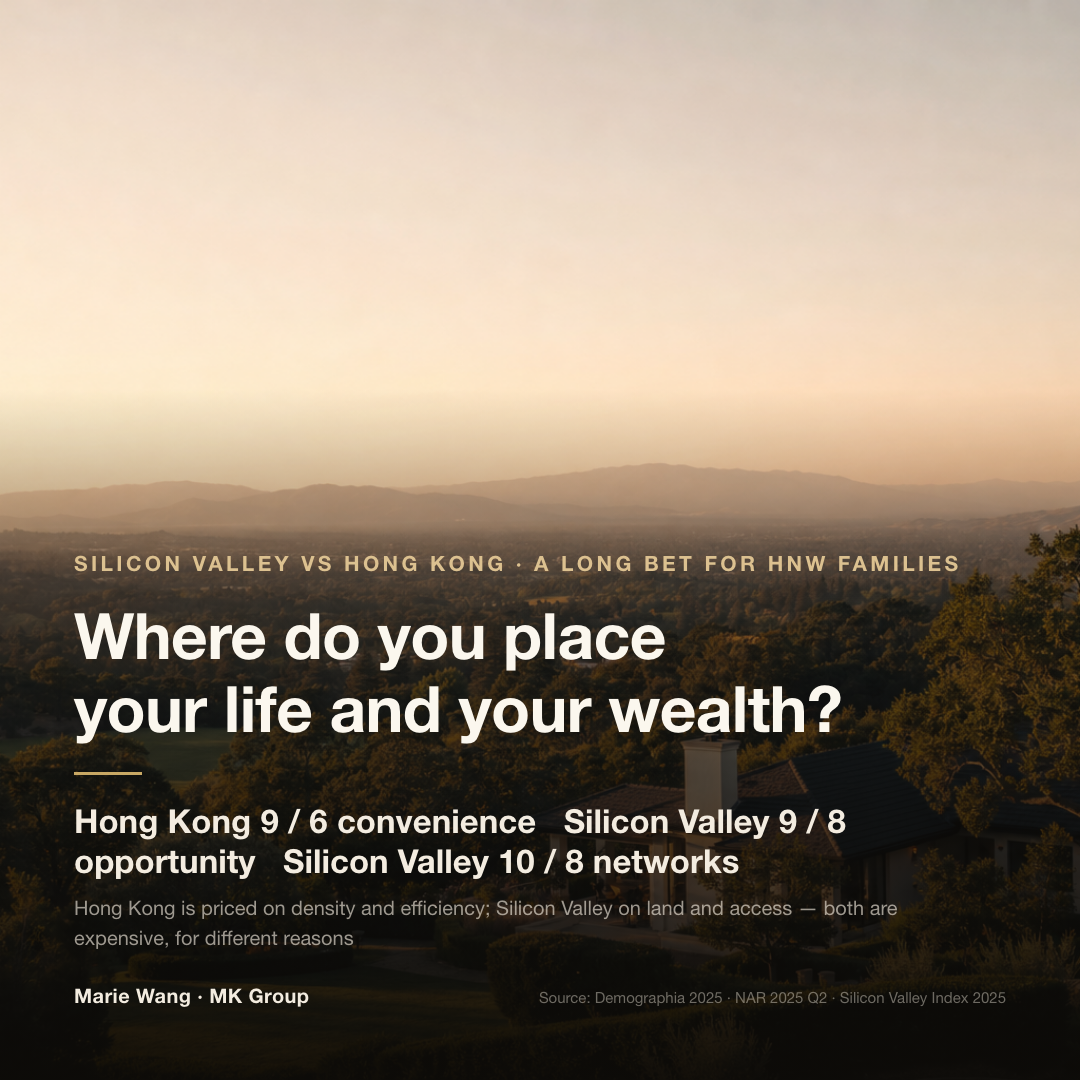
Lead with the numbers. Across five dimensions scored 1–10, Hong Kong leads on daily convenience (9 vs 6) and on cost value (price index 7 vs 5); Silicon Valley is stronger on wealth opportunity (9 vs 8), on networks and working environment (10 vs 8), and on housing accessibility (housing index 8 vs 5). Both cities are expensive. Hong Kong’s price-to-income ratio is roughly 14.4x (Demographia 2025 — its "impossibly unaffordable" tier), while the San Jose metro single-family median runs about $2.138M (NAR 2025 Q2, one of the most expensive metros in the country), and luxury entry pricing in Atherton, Palo Alto, and Menlo Park routinely starts at $4M–$5M and up.
| Dimension | Hong Kong | Silicon Valley | What drives the gap |
|---|---|---|---|
| Daily convenience | 9 | 6 | Hong Kong is walkable, car-free; Silicon Valley runs on the car, with little late-night service |
| Work and wealth opportunity | 8 | 9 | In Hong Kong the money is already moving; Silicon Valley is the source of new money |
| Networks and working environment | 8 | 10 | Hong Kong’s finance/trade/legal circles are mature; Silicon Valley’s founder/VC/Stanford circle has to be earned |
| Housing index (harder to afford = lower) | 5 | 8 | Hong Kong: big money for small space; Silicon Valley: big money for land, a yard, trees |
| Cost-of-living index (daily costs) | 7 | 5 | Hong Kong: pricey food/tuition but cheap household help; Silicon Valley: very costly labor plus high California income tax |
Two counterintuitive points are worth holding onto. First, Silicon Valley’s network score (10) comes with a condition — it is not something you own the day you arrive. The web of founders, VCs, Stanford faculty, and tech executives takes time, projects, and active connection to enter; once you are in, what it gives you is very hard to replicate anywhere else. Second, Hong Kong looks like the better value on cost, but Silicon Valley’s high expenses — labor, California personal income tax, especially for high earners on W-2 — are usually a cost chosen on purpose, for a career and a child’s education, not a burden absorbed passively. Same magnitude, different nature.
What MK Group sees in practice
At MK Group, Marie Wang (DRE# 02110980) and Kevin Mo (DRE# 02127623) have worked with many cross-border families who go back and forth between Silicon Valley and Asia. A pattern shows up again and again: the deciding factor is rarely "which side has the better-value house" — it is "which side the family’s center of gravity and the next generation’s education belong on."
What the team observes is that families who finally anchor the home in the Bay Area are usually not won over by Silicon Valley’s convenience. If anything, the opposite is true — the hardest adjustment for someone arriving from the mainland or Hong Kong is exactly the part where everything requires a car, where you cannot summon late-night service, where every errand runs through a process. What actually lands them is the low density, the privacy, the land — and the long, patient work of letting a family settle into an innovation network centered on Stanford.
For these families, the work in the Atherton, Palo Alto, and Menlo Park tiers is not only finding a house. It is helping them judge whether their career direction and family structure actually fit a life bet placed on Silicon Valley for the long run. Marie Wang has lived in Silicon Valley for 12 years, and much of the content on her YouTube channel @MarieWang (44K+) unpacks exactly this kind of long-term "lifestyle plus asset allocation" decision rather than a single transaction.
Common misconceptions
"Hong Kong has low tax and an easy life, so financial freedom is easier to reach there."
Low tax and convenience are real. But whether you reach financial freedom depends on whether your wealth already exists or whether you want to sit closer to the next wave being created. If you run an Asian business and your money is already moving inside the financial network, Hong Kong’s efficiency is genuinely more direct. But the next generation’s wealth — AI, founding, equity, IPOs, M&A — is densely concentrated in Silicon Valley and nearly impossible to reproduce elsewhere. The two cities solve problems at different stages; tax rate alone is not enough to settle it.
"Silicon Valley’s network is strong, so once I move I plug into the founder and VC world."
You do not get it automatically. Silicon Valley’s real network is founders, VCs, Stanford faculty, and tech executives, and that web takes time, takes projects, takes a good idea and active outreach to enter. The density is extreme — sit down to dinner and the person beside you may be a company’s CTO or a VC who just closed a $100M fund — but only once you are inside. Treating "I moved here" as the same thing as "I’m plugged in" is the most common misjudgment.
"Both cities are expensive, so the expense is roughly the same."
The magnitude is close; the nature is entirely different. Hong Kong is big money for very small space (a price-to-income ratio of about 14.4x, among the highest in the world). Silicon Valley is big money for land, a yard, trees, and a logic of position (a San Jose metro single-family median of about $2.138M, with core luxury areas starting at $4M). A Hong Kong home is like a first-class ticket — limited space, extreme efficiency. A Silicon Valley home is like a lot that is very hard to replicate — get the position right and the price logic is very firm.
Next steps
- Clarify your career’s center of gravity first: mostly Asian markets with frequent travel to the mainland or Southeast Asia leans Hong Kong; tech / AI / founding / investing and a wish to sit near the next generation’s opportunity leans Silicon Valley.
- Evaluate the child’s long-term education path as its own variable — it often decides where to anchor the home more than tax rate or price does.
- If you lean Silicon Valley, calibrate the budget against public data first: a San Jose metro single-family median of about $2.138M, with Atherton / Palo Alto / Menlo Park luxury entry at $4M–$5M and up.
- Hand cross-border tax and asset allocation (Hong Kong’s rate structure, California income tax, FIRPTA, trust architecture) to your attorney or CPA for a formal model — do not decide on "which side has lower tax."
- Think of "where to live" as a long bet, not a transaction — how close you are to the life you want matters more than physical distance from home.