Quick Answer
A sweeping, overnight jump to "$10M across the board" isn't going to happen — but the direction is already clear. Silicon Valley's high end has split off from the mid-market and is now moving on its own. The mid-tier is still pinned down by rates and layoffs; at the top, a few cash buyers converging on one good house can take it over asking. The next wave of equity-unlocked buyers is still queued, and what's actually climbing is the core ring of towns around Stanford. There is still time to get in — but "still time" means setting up calmly, not writing an offer today.
Who this article is for
This article is written for buyers who already hold cash or high liquidity and are seriously weighing an $8M+ Silicon Valley home — especially:
- Leading AI researchers or core engineers at tech companies who already have deployable capital and are weighing "buy now or wait a little longer"
- People whose equity comes from an already-public company, or whose signing-bonus RSUs are already liquid — those who don't need to wait for an IPO lockup to clear
- Families targeting the Stanford circle (Palo Alto / Menlo Park / Los Altos / Los Altos Hills / Atherton) for its top schools and core neighborhoods
- High-net-worth buyers new to this tier who want to understand the market structure and the right timing before they act
Three dimensions that actually decide the call
To judge whether now is your moment, think through three things first — not just "is the market hot."
First, which side of the split you're on. When someone tells you "the market is hot right now," that read is incomplete — the high end and the mid-market run on two different engines. Mid-tier buyers are still shaped by rates, layoffs, and financing pressure, and many are waiting. Top-tier buyers at this stage aren't leaning on loans, and they're clearly more active than a year ago. In Atherton's $20M+ pockets, a home where privacy and architecture are both dialed in usually draws several strong buyers at once and clears over asking. Knowing which band you belong to matters more than calling the broad market.
Second, who your competition is now — and who it becomes in a year or two. This is the crux of the whole piece. Buy today and you're up against a small set of people who already hold cash. A year or two out, you're up against a large wave of buyers whose equity has just unlocked, all in a hurry to upgrade and push into the same top schools and core neighborhoods. The next cohort of AI-company employees whose stock is about to unlock is already lining up — they simply haven't fully arrived yet. Whoever's money can move first gets to screen first, tour first, negotiate first, and reach off-market inventory first.
Third, whether you're buying into a neighborhood the same income tier will cluster in. Homes at this level are highly bespoke; the house you pass on today almost certainly won't have an identical twin tomorrow. Rather than betting on a single property, concentrate where buyers of the same income tier converge — demand stays high over the long run and the odds of buying wrong stay low. For how this ring of towns layers internally, see our breakdown of the Stanford circle's three-tier market.
The whole price ladder may step up a rung
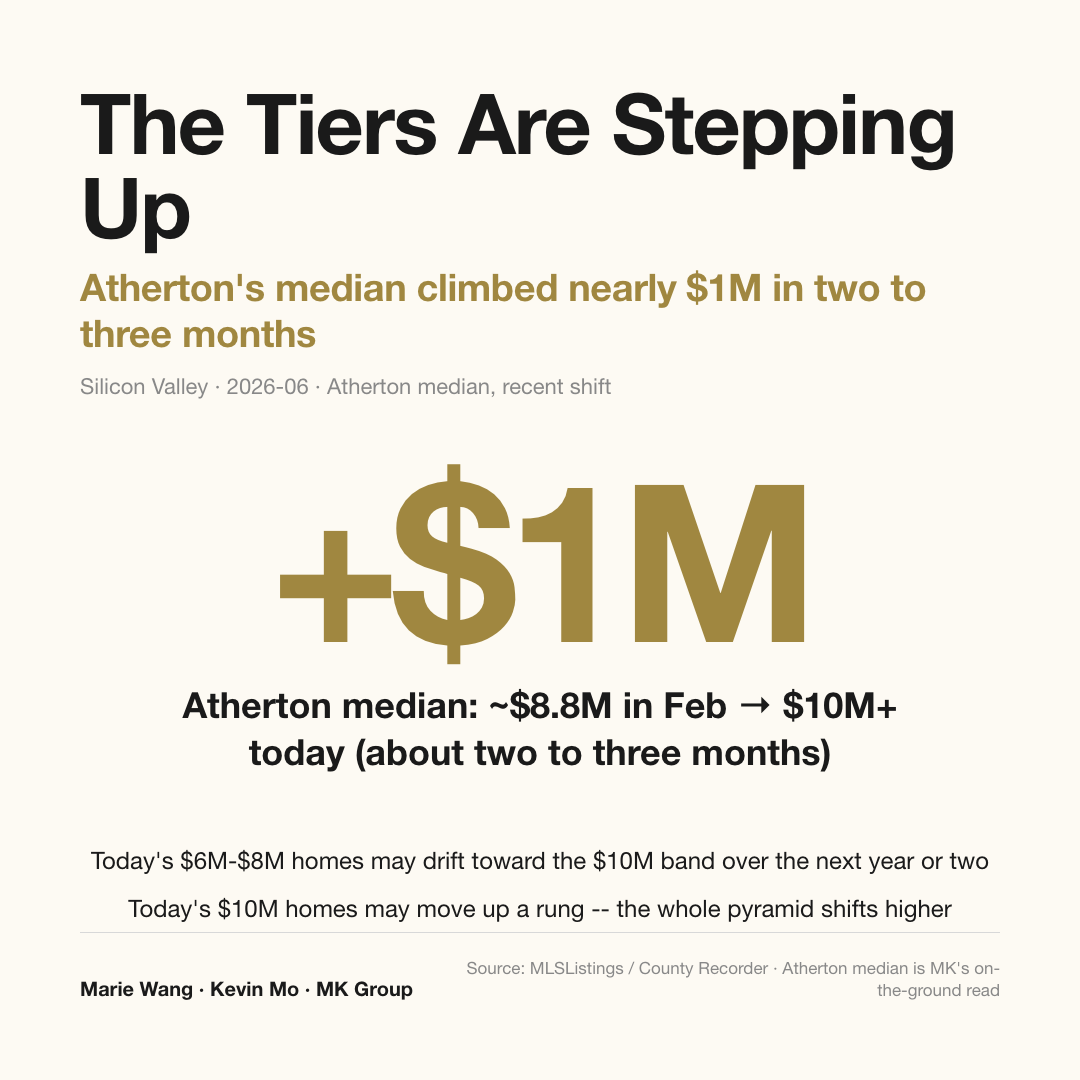
Start with the core numbers. Over the long run, the income structure of top-tier talent is shifting and the buyer pool is widening — so a home worth $10M today may move up a rung, and some homes at $6M, $7M, or $8M today may become $10M homes. The most immediate evidence is closer at hand: Atherton's median sat at roughly $8.8M in February and is now north of $10M — close to $1M of movement in about two to three months.
| Price tier | Today | Possible step over the next 1–2 years | What's driving it |
|---|---|---|---|
| Entry luxury | $6M–$8M | Drifting toward $10M | A wider buyer pool, demand crowding into the same ring of towns |
| Core $10M band | $10M | Up another rung | More total wealth at the top, the pyramid shifting higher |
| Atherton median | ~$8.8M in Feb → north of $10M now | Supported by core-neighborhood scarcity | About +$1M in two to three months (MK Group's on-the-ground read) |
What to remember: this "whole ladder stepping up" doesn't mean the pyramid gets flattened. The pool at the top grows larger, but the market ultimately snaps back to a pyramid — certain homes get repriced higher and capital redistributes by wealth tier. A temporary quirk worth naming: the price band top-tier scientists are touring right now happens to overlap with the band some public-company executives are touring — even though the underlying wealth levels aren't the same. We've heard of a public-company executive shopping homes in the very same band — but this window, where different tiers live close on similar budgets, won't last. For where this new money comes from and how lockups actually work, see how the trillion-dollar IPO wave is rewriting Silicon Valley luxury.
What we see on the ground
At MK Group, Marie Wang and Kevin Mo work the front line of Silicon Valley's high-end deals, and the question buyers in this tier ask most often isn't "where are the homes" — it's "is this one actually worth buying." Those are two very different questions.
In this part of the market, many homes never list at all. Owners here tend to be public figures who would rather the wider world not know their situation. So if you wait until you spot something on Redfin and then ask whether it's worth buying, you're often already late. For people who already have the means, the scarce thing isn't listing data — it's the information gap: which homes are selling, getting ready to sell, or not yet public, and the real condition of each. Why so many of the best homes in this ring of core neighborhoods never touch the MLS, we lay out more systematically in a separate piece.
But off-market access is only the door. What really tests expertise at this level is diligence: how much room there is to expand on a given lot down the road, how the setbacks compute, whether terrain or trees constrain the build, and where city approvals hide their traps — all of which vary sharply by city and by parcel, especially across Atherton, Palo Alto, and Los Altos Hills. Whether a home's craftsmanship, materials, and construction actually match its asking price is usually something you only read on site. Kevin Mo has walked through plenty of that "read the lot, read the expansion potential, read the diligence" logic for this tier on YouTube at @KevinMoRE (23K+).
There's one more layer: the privacy boundary. Buyers in this band routinely hold property through a trust or corporate structure to shield personal information, and they need the information boundary between buyer and seller held firm inside an off-market deal. At the top of the market, the last thing being negotiated is trust — price is only one link in the chain.
Common misconceptions
"The market's hot, so buying a little later won't matter"
"The market's hot" doesn't hold equally for the high end and the mid-market. The mid-tier is still pinned down by rates, layoffs, and financing and is waiting; top-tier buyers at this stage aren't leaning on loans, and a few cash buyers locked onto one good house can clear it over asking. The real risk isn't "buy a little later and pay a little more" — it's that when the next wave of equity-unlocked buyers arrives en masse in a year or two, the home you wanted is far likelier to be taken ahead of you. Keep the two engines separate, and you won't misread a high-end window using a mid-market clock.
"The day the company goes public, employees can buy a house right away"
IPO day isn't the day everyone can pull out cash and buy. In between sits a lockup, typically 180 days or more; the largest offerings may even unlock in stages to avoid a flood of selling. Add vesting cadence, tax timing, and asset allocation, and for many employees the stock doesn't truly become home-buying money until six months to a year or two after listing. So that buying power won't storm the market in a day — it's more like a cohort queued at the door, which is exactly the time gap that lets people with liquidity today move first.
"An ordinary engineer could never afford a $10M neighborhood"
In years past, a home north of $10M was effectively out of reach for a programmer two or three years out of school — and living next door to a top executive was nearly impossible. But a temporary window has opened: the band top-tier scientists are touring overlaps with the band some public-company executives are touring, and people at different wealth levels are crowding into the same ring of neighborhoods on comparable budgets. This won't last — the market will redistribute by financial position, and certain homes will be repriced higher. So "can't afford it" is the old framing; "you can still live close to another tier on the same budget" is the real, current opportunity.
"I'll just scroll Redfin myself and ask whether it's worth buying when I see a good one"
By that point you're usually already late. Many homes in this tier never list at all, because owners don't want to reveal their situation. By the time a listing is public enough to surface on Redfin, it has often already been seen and negotiated once inside the off-market channel. For people who already have the means, lining up pre-market and off-market inventory in advance matters far more than "wait until it lists, then decide" — the right to screen the best homes always goes first to those whose money can move first and who built the access ahead of time.
Next steps
- Confirm which side of the split you're on. People whose equity comes from an already-public company, or whose RSUs are already liquid, are not on the same starting line as those still waiting on an IPO and a lockup to clear — the former are the ones positioned to move first.
- Narrow your search to the Stanford circle (Palo Alto / Menlo Park / Los Altos / Los Altos Hills / Atherton) and watch where the same income tier converges; clustering where your peers buy makes it hard to buy wrong.
- Calibrate your expectations on the trend with public data: Atherton's median has moved from roughly $8.8M in February to north of $10M now — close to $1M in about two to three months. Build that pace into your timing.
- Line up pre-market and off-market inventory now, rather than waiting until you spot something yourself — many of the best homes in this tier never list publicly.
- Hand the tax timing of equity unlocks, and the title and privacy arrangements for holding property through a trust or corporate structure, to your attorney and CPA for a formal read before you decide how to hold.