Direct answer
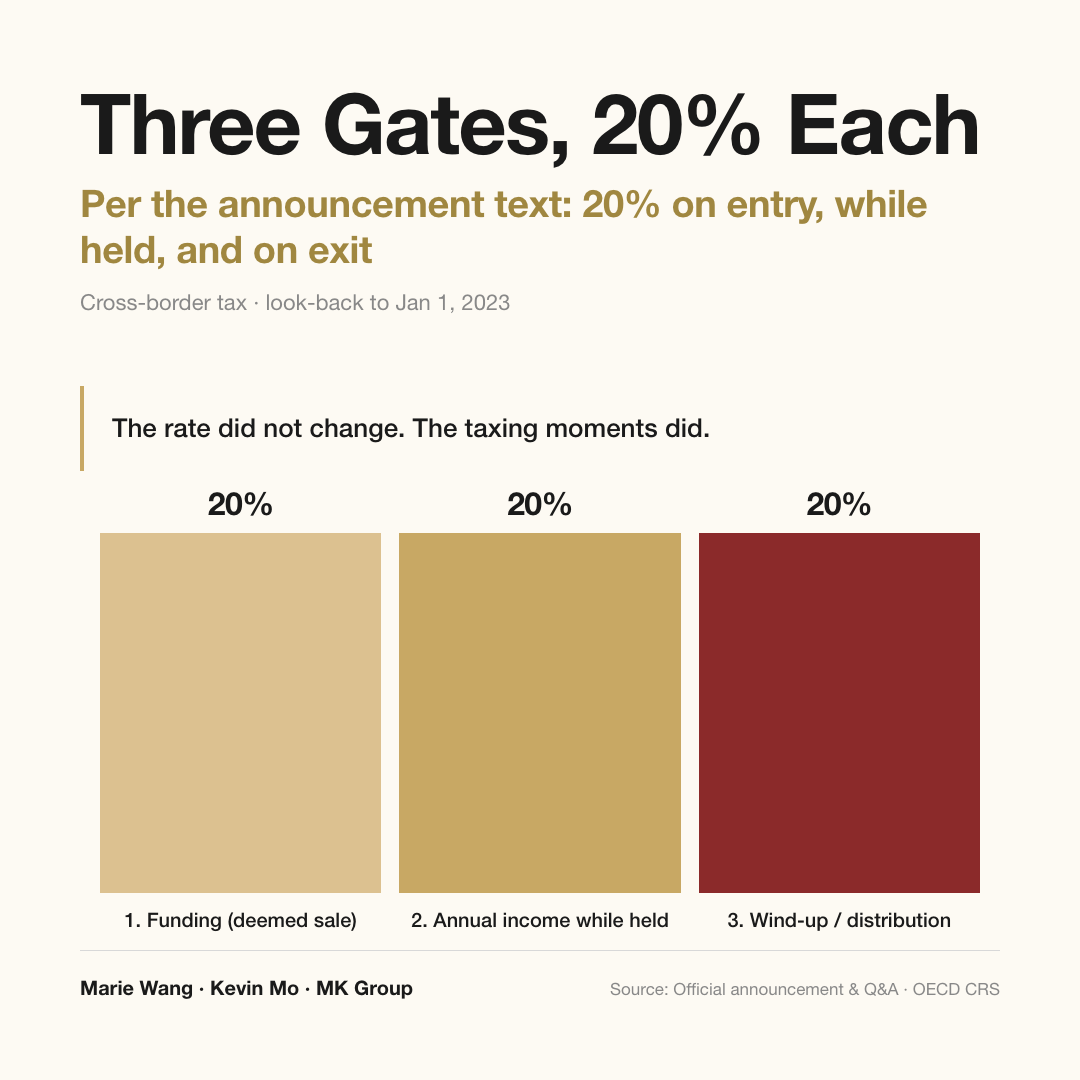
According to the text of the announcement, three moments are taxed at 20% each: assets contributed into an offshore trust, the trust's income every year whether or not it is distributed, and the proceeds at liquidation or withdrawal. The contribution gate looks back to January 1, 2023, with a 90-day voluntary-disclosure window that waives late-payment interest.
Who this article is for
- Families whose business and income center of gravity is still in China, and who own — or are preparing to own — a $5M+ home on the Peninsula or in the South Bay
- Holders and beneficiaries of offshore structures set up, or funded, after January 1, 2023 (Cayman Islands, BVI, Singapore, Hong Kong)
- Cross-border buyers moving the family's asset base to the United States, who need to settle the sequencing question: assets first, or residency first
- Family-business owners who use a trust for risk isolation, succession, probate avoidance or share-holding, and want to know which of those functions still work
- Family-office principals and finance leads taking inventory on behalf of a household
Three dimensions that decide your answer
One: what changed is the timing of tax, not the rate
Twenty percent is not a new number. The force of this announcement is that three taxing moments open at once.
The first gate is the way in. The moment assets are transferred into the trust, they are treated as sold — market value at the time, less original cost and reasonable expenses, with the gain taxed. The second gate is the holding period, and it is the one that rewrites the math: dividends, trading gains and other income earned inside the trust must be reported and taxed every year, distributed or not. The old shape of the plan — leave it in, owe nothing — has no place in the announcement text. And on the text as written, the management fees and legal fees the trust actually incurs each year are given no deduction.
The third gate is the way out. When the trust terminates and assets are distributed, the gain is taxed again.
For Silicon Valley allocation the implication is direct. If the plan is to liquidate inside the trust, wire the proceeds out and buy on the Peninsula, every point on that chain can generate its own tax event. That arithmetic belongs in your cash-flow model before the offer is written — not in escrow, where you discover that the timing and the amount of available funds no longer line up.
Two: the look-through follows control, not the passport
According to the text, it does not matter how many entities are stacked or whose name sits on the certificate. If the ultimate controller is you, the structure can be read through, layer by layer. How elegant the chart looks is not the question. Whose instruction the money follows is the question.
Changing residency is not the exit either. The announcement is explicit on two points: a resident who becomes a non-resident is deemed to have liquidated on the day of the change and settles first, then leaves; and even with a foreign passport or overseas permanent residency, tax still applies as long as the principal economic interests remain in China. So the self-audit question is not "is my structure compliant." It is "where are the roots of my income."
Three: visibility was solved eight years ago
The real question most families are asking is quieter than the rules: the money is in Cayman, or Singapore — how would a tax authority even see it. The answer is not in this announcement. It is in CRS, the Common Reporting Standard, the automatic tax-information exchange framework led by the OECD. China completed its first exchange in September 2018, and the network now spans more than 100 countries and jurisdictions.
The mechanism is automatic. Banks, brokerages and insurers in a participating jurisdiction must first establish which country an account holder is a tax resident of, then report name, account number, balance, interest, dividends and disposal proceeds to their local tax authority each year, which passes the file to the holder's country of residence. No case has to be opened. No letter has to be sent. The load-bearing detail is that a financial institution cannot stop at the name on the account — it must identify the ultimate controlling person, and both the settlor and the beneficiaries of a trust are within scope. Inside a compliance system, in other words, the box was always transparent. Cayman, BVI, Singapore and Hong Kong are all inside the net.
In the video, Marie Wang calls this the single most important idea of the segment: offshore is not off-grid.
The three gates and the timeline, in numbers
The short version first. According to the text of the announcement, an offshore trust is taxed at three points, 20% each — on the gain at contribution, where the transfer is treated as a sale; on annual trust-level income, distributed or not; and on the gain at liquidation or withdrawal. The contribution gate looks back to January 1, 2023, and carries a 90-day voluntary-disclosure window; filing inside that window waives late-payment interest, while missing it can bring both interest and penalties.
| Gate | When tax is triggered | Rate | The usual misreading |
|---|---|---|---|
| 1. Contribution in | At transfer, treated as a sale | 20% on the gain | "Putting it in a trust is a change of name, not a sale" |
| 2. Holding period | Annually, on trust income | 20% | "If it isn't distributed to me, nothing is due" |
| 3. Liquidation / withdrawal | At termination or distribution | 20% on the gain | "I paid on the way in, so the way out is free" |
| Look-back and window | Contribution gate traced to 2023-01-01 | — | "This only applies going forward" |
Gate two is the one to remember. Gates one and three mostly pull a one-time disposal tax forward and push it back; gate two changes the economics of the structure itself. The bill arrives every year even in a year when not a dollar reaches your hand — and because the announcement text offers no deduction for management and legal fees, a maintenance-heavy structure now carries an annual net cost visibly higher than the model used when it was set up.
Now the timeline. The reason this does not read as an ambush is that the data pipe and the enforcement both ran ahead of the announcement: China completed its first CRS exchange in September 2018, and as reported by Bloomberg, tax authorities in Jiangsu, Shenzhen and Shanghai spent last year working through offshore structures case by case, with individual cases assessed at 20%. Back taxes on offshore income in the first half of 2026 came to roughly RMB 13 billion.
| When | What happened | The number that matters |
|---|---|---|
| September 2018 | China completes its first CRS exchange | Network spans 100+ countries and jurisdictions |
| January 1, 2023 | Start of the look-back for the contribution gate | Contributions after this date must be reported |
| 2025 | Jiangsu, Shenzhen and Shanghai review offshore structures case by case (as reported by Bloomberg) | Individual cases assessed at 20% |
| Full-year 2025 | Millionaires relocating across borders (Henley & Partners) | ~142,000, a record |
| Full-year 2025 | Net millionaire inflow to the United States (same source) | ~7,500, among the largest globally |
| 2026 (projected) | Millionaires relocating across borders (same source) | ~165,000 |
| First half of 2026 | Back taxes collected on offshore income | ~RMB 13 billion |
Two things to carry out of that table. First, the announcement is a shoe dropping, not an ambush — the pipe opened in 2018 and enforcement was already happening case by case last year, and the United States has taxed its own tax residents on worldwide income for more than a century, so this is hardly an isolated model. Second, cross-border relocation was already accelerating on its own: 2026 is projected to run about 23,000 people above 2025. The new rules are a foot on the accelerator, not the engine.
Sources: official announcement text and press Q&A (China); OECD Common Reporting Standard (CRS); Bloomberg reporting; Henley & Partners, Private Wealth Migration Report (2025 / 2026 editions); public reporting; MK Group front-line observation
Updated: 2026-07
Scope: cross-border high-net-worth families with business or income ties in China who own, or plan to own, a $5M+ home on the Peninsula or in the South Bay. Every description of the new rules here is a compilation of published announcement text; this article does not identify the issuing authority or a document number, and it does not constitute tax advice.
What we are seeing on the ground
MK Group works year-round with cross-border buyers in Atherton, Palo Alto and Los Altos Hills, and inquiries have picked up noticeably over the past few days. One question is hard to avoid: "can I still use this structure to buy the house." Three observations are worth putting here.
One: "not in the public record" and "invisible" have never been the same thing. A privacy-focused ultra-high-net-worth buyer once formed a new LLC for an $8M+ home and held that company through a BVI entity, so that a personal name would not appear on the County Recorder's public title record. Marie Wang and Kevin Mo held two lines on that transaction. The holding structure had to be settled before the offer went out — the moment an offer names an LLC, the bank, escrow and title company all start requiring documents, signing authority and a defined path of funds, and last-minute paperwork is the fastest way to break a timeline. And the boundary of privacy had to be stated plainly: an LLC removes the name from the public record, but where a bank, escrow, title company or tax authority is required by law to verify the real person, the real person still appears. That is the same lesson CRS teaches. Inside a compliance system, the box was always transparent.
Two: on the ground, the buying decision has not actually changed. An established entrepreneur relocating from China, budget $13M–$15M, planning to live in Silicon Valley long term, zeroed in on a new-construction home on a two-acre Atherton lot. What made him hesitate was not the price: "The two-acre garden is too big — I don't have the energy to maintain it." (Translated from Mandarin.) MK Group's approach was to take the operating burden off the table — full-service monthly landscaping by a local crew is standard at this tier — and to get a direct answer from Atherton's planning department on whether a SB9 / SB10 lot split was feasible on that parcel. What decides a purchase is still the asset itself: the land, the schools, the community. The holding entity and the tax structure run on a parallel track. Both move at once; neither is allowed to contaminate the other.
Three: during a change of regime, sitting still is also a response. Among the buyers the team is currently working with, one family with a roughly $35M budget has gone quiet. Marie Wang's read on the market: core Peninsula addresses like Atherton and Palo Alto have already had two years of AI wealth underneath them, and if a wave of capital looking for certainty layers on top of that, the scarcest assets get harder to buy and sellers get slower to part with them.
Common misconceptions
Misconception 1: "Once the assets are in an offshore trust, they are legally not mine, so the new rules don't reach me"
"Legally not yours" settles the question of who holds title. It does not settle the question of who is taxed. According to the text of the announcement, the test is who the ultimate controller is — stacked entities and nominee holders can be read through layer by layer, and a trust's settlor and beneficiaries were already inside CRS reporting scope. The question to put to yourself is simpler than the chart: whose instruction does this money follow? If the answer is you, "it isn't mine" does not survive contact with a tax analysis.
Misconception 2: "As long as nothing is distributed to me, nothing is due"
This is the largest single change. According to the text, income earned inside the trust during the holding period — dividends, trading gains, anything — is reported and taxed every year, distributed or not. And because the announcement text provides no deduction for management fees or legal fees, what you spend each year maintaining the structure buys you nothing back on the tax side. The annual net cost of a complex structure is now very likely higher than the number modeled when it was built. That math deserves a fresh run.
Misconception 3: "I'll change nationality or take permanent residency somewhere else, and this stops being my problem"
The announcement addresses this in two lines, both pointing the same way: on the day a resident becomes a non-resident, there is a deemed liquidation — settle first, then go; and even holding a foreign passport or overseas permanent residency, tax still applies as long as the principal economic interests remain in China. The person can leave. If the root of the earning stays where it was, the passport does not decide the outcome. Leaving cleanly means moving the business, the income sources and the economic center of gravity too — a far larger project than changing a document.
Misconception 4: "The money is in Cayman, BVI or Singapore — no tax authority can see it"
True before 2018. Not true after. Pre-CRS, tax authorities genuinely did not talk to each other; tracing one overseas account meant opening a file and writing to one country at a time, slowly and expensively, which is why in that era offshore was close to disappearance. CRS turned it into automatic annual reporting: China completed its first exchange in September 2018, and Cayman, BVI, Singapore and Hong Kong are all inside the net. The data pipe opened eight years ago. The announcement only added the last piece.
Misconception 5: "Trusts are finished — unwind the structure fast"
What died is the tax-free myth, not the trust. Risk isolation, succession on defined rules, avoiding a slow probate process, and holding shares in a listed entity are four legitimate uses that all still stand — the instrument is simply one you now use after paying tax, not instead of paying tax. The greater risk runs the other way: unwinding in a panic, or building sloppily in the first place. The widely reported Wahaha inheritance dispute is the public example — a trust with no properly executed documents, assets never placed with a professional trustee, a structure in disarray, and a family matter meant to stay private argued out in court. A badly built structure is more dangerous than no structure at all.
Next steps
- Draw the family's structure chart first. When each entity was formed, what was put into it, who holds the documents now, who the beneficiaries are. For many families the first bottleneck is not tax — it is not being able to state clearly what they own.
- Take that chart to a cross-border tax attorney and a CPA to assess whether a filing is required and how to use the 90-day window. Voluntary disclosure inside the window waives late-payment interest; missing it can bring both interest and penalties. Time is itself a cost here.
- Treat "buying US assets" and "taking US residency" as two separate decisions. The United States also taxes its tax residents on worldwide income and imposes an estate tax, so taking residency first means adding a tax return before you have planned for it. The workable sequence is assets first, residency carefully, with the tax planning finished before landing.
- Rule out anyone selling "they'll never find it" or "one more layer and you're invisible." In an environment of automatic information exchange and layer-by-layer look-through, that promise is itself the warning sign. The direction has shifted from concealment to disclosure, and it is a one-way street.
- If a Peninsula or South Bay purchase is coming, settle the holding entity before the offer goes out. Individual, trust and LLC each trigger a completely different set of bank diligence, escrow funding-path and title-document requirements. Deciding this near closing is where transactions break.