The short answer
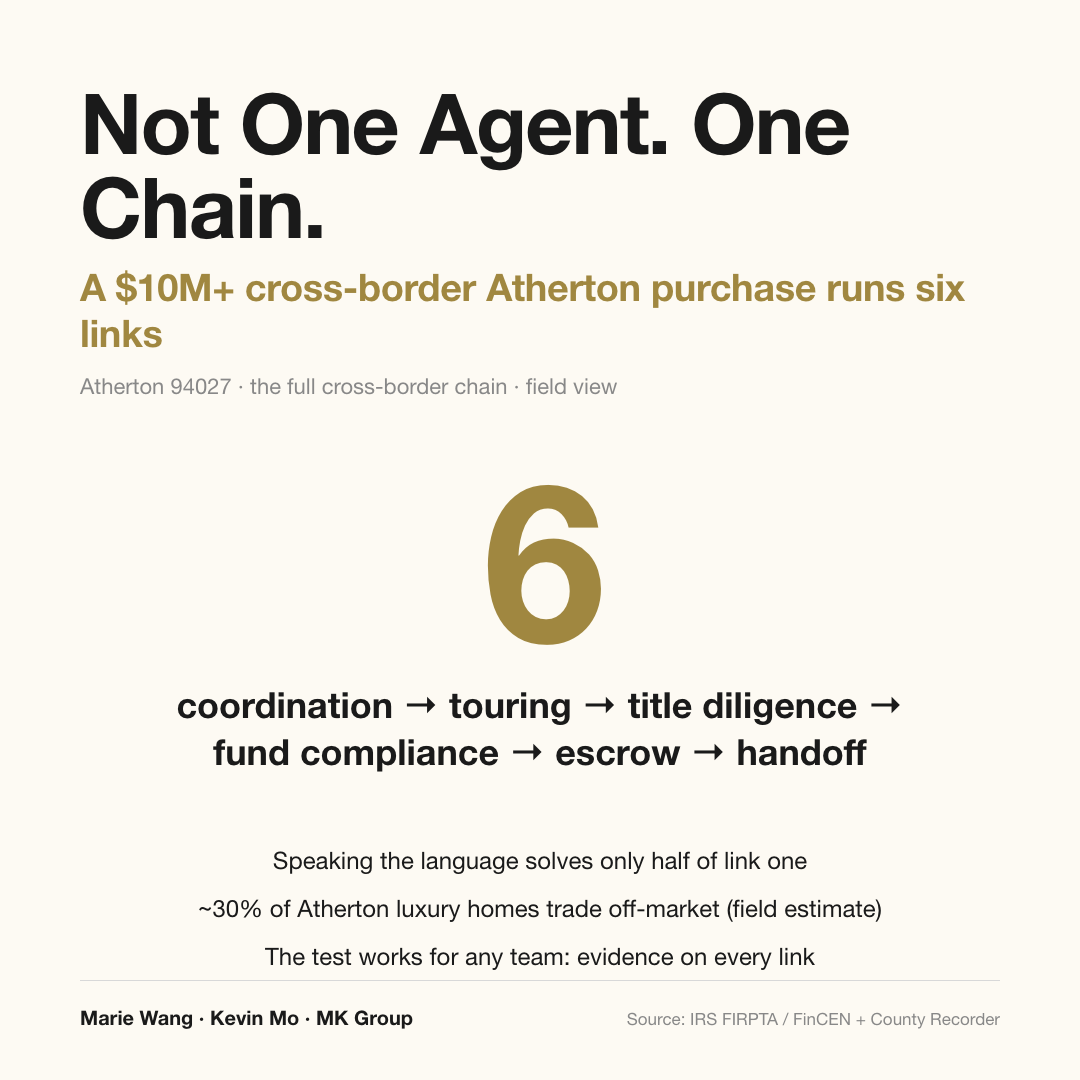
To buy a $10M-plus home in Atherton (ZIP 94027) from abroad, the asset you should be hiring is not a Mandarin-speaking agent — it is a buyer-advisory team that can carry the full transaction across six links in your own language: home-country coordination, on-the-ground touring, title and disclosure diligence, cross-border-fund compliance (AML and FinCEN reporting), escrow and closing, and the post-closing handoff of renovation and tax. At this tier, a single bilingual solo agent is no longer enough. The thing to evaluate is how thoroughly the entire service chain is documented in your language — not how fluently one person speaks it.
Who this is for
Cross-border families weighing a $8M–$30M+ primary residence in Atherton (ZIP 94027) or the neighboring estate markets of Menlo Park, Hillsborough, and Woodside — typically established founders, family offices, second-generation principals, or technology executives splitting their lives between the Greater China region and Silicon Valley. They can converse in English, but want every formal decision, legal document, and capital reconciliation mirrored in their own language. It is equally for the U.S.-based children or staff of such families, who are often the ones tasked with vetting and interviewing a buyer-advisory team on a principal’s behalf.
The six links a cross-border Atherton purchase actually has
Before deciding who to hire, lay out what the work is. A cross-border Atherton purchase above $10M passes through at least six links between the first impulse abroad and the keys in hand, and any one of them can stall the entire transaction:
- Link one — home-country coordination. Progress updates, budget framing, and itinerary planning conducted in your home time zone over WeChat and phone, with English information translated into a clean decision brief.
- Link two — touring. On-the-ground showings, navigating the listing agent, remote video walkthroughs, and screening for hidden defects. A buyer abroad cannot inspect in person, and leans heavily on an advisor’s judgment of whether a home is clean of problems.
- Link three — title and disclosure diligence. The disclosure package (TDS, SPQ, NHD), the Preliminary Title Report, and the inspection set — general, sewer, pool, roof, structural — routinely running past two hundred pages of English per transaction.
- Link four — cross-border-fund compliance. FinCEN beneficial-ownership reporting, Form 8300, bank KYC, the international wire timeline, and the relevant IRS filing posture. This is the most under-estimated link — and precisely the one most likely to delay a closing.
- Link five — escrow and closing. Opening escrow, title insurance, a second verification of wiring instructions (wire fraud is a genuine risk at this tier), and signing.
- Link six — the post-closing handoff. Transfer of title, property-tax filing, a high-net-worth homeowner’s policy, renovation permits, utilities — and packaging all of it into an executable checklist for a family office back home.
Speaking Mandarin solves only half of link one. What actually determines whether a $10M-plus cross-border purchase runs smoothly is whether the other five links are backed by translated documents, a partner attorney, a partner CPA, and a local service bench. The three tests below exist to check whether a team can hold all six — and any team claiming a cross-border practice should be able to show the evidence.
Test one: can the team cover a cross-time-zone response chain?
The window on a top-tier Atherton off-market deal is brutally short — from the moment a listing agent quietly mentions it to a decision to go see it, you sometimes have only twenty-four to seventy-two hours. If you are in Beijing, Shanghai, Hong Kong, or Shenzhen, the offset to California is roughly fifteen hours: the meetings and showings happen while you sleep.
A solo bilingual agent cannot both be touring in Atherton and answering your voice message at three in the morning. What you need is a team of at least two: one anchor in the California time zone — touring, working the listing agent, running inspections and appraisals — and one anchor in the home time zone, syncing with you by phone and message, distilling English documents into a decision brief in your language, and arranging your next trip.
How to verify. In the first conversation, ask plainly: “If I need an urgent decision on an off-market home at three o’clock on a Monday afternoon my time, how does your team respond?” If the answer is “I’ll call you,” the team is not large enough. If the answer is “My partner sends you a voice brief within fifteen minutes, and within two hours of speaking with the listing agent I send a full summary to your phone,” that is a structure that works. This standard applies to any team you interview — it is not specific to one firm.
Test two: is every link backed by documents and a professional bench?
Each of the six links can produce two hundred pages of English. If your advisory team can only translate out loud, the risk of omission or misread is high. A practice that actually works has someone who can catch every professional node on the chain:
- A bilingual legal bench — a real-estate attorney plus an estate-planning attorney — who can issue a decision summary in your language on disclosure-package risk and holding structure.
- A cross-border CPA / tax advisor fluent in IRS Form 8938, FBAR, Form 3520, and California franchise tax, who can map the tax boundaries a non-resident buyer faces.
- An escrow company that can staff a client manager in your language, double-checking every wiring instruction.
- A compliant cross-border-fund partner — not someone advising a workaround, but someone who lays out the timeline and the compliance boundaries of currency conversion, offshore accounts, and the wire itself.
How to verify. Ask: “In the thirty days from accepted offer to closing, how many documents will you give me in my language, and what are they?” “I’ll walk you through it verbally” is not enough. A team that can list an offer summary, a disclosure-risk brief, inspection action notes, an escrow timeline, a pre-closing checklist, and a twelve-week post-closing renovation-and-tax action list — that is a documented service chain. Ask, too, to see a redacted sample from a past cross-border client. A team that can produce the artifact is more credible than one that simply says “we handle all of that.”
Test three: is the off-market network in Atherton real?
Only a portion of Atherton’s $10M-plus volume ever reaches public listings. A meaningful share of the very top moves through agent-to-agent notice, whisper listings, and pre-market homes that have not hit MLS. If your advisor is not inside Atherton’s real day-to-day network, you will only ever see what Zillow and Redfin show — which means you do not see the homes at the very top of the market.
The number, stated plainly. Atherton closes roughly 100–140 single-family homes a year, and MK Group’s field estimate is that about 30% of luxury homes there trade off-market, never reaching MLS at all (a field estimate from inside the agent network, not an MLS-sourced figure). Sellers at this level are often public-company executives who do not need the money and do want privacy; they would rather pass a home quietly within the circle. That is why being inside the network — or not — decides how much inventory you can even see.
The table below lists concrete indicators of how deep a team’s Atherton off-market network really runs — you can ask any team the same questions.
| Capability | Weak | Moderate | Genuinely operational |
|---|---|---|---|
| Private contact with top Atherton listing agents | Waits for listings | Once or twice a quarter | Weekly; in the group chat even on holidays |
| Atherton $8M+ closings worked in the last 24 months | 0–1 | 2–3 | Several (incl. assisting / co-listing / buy-side) |
| Lead time on a whisper listing | 3–7 days after listing | Day of listing | 24–72 hours before listing |
| Experience bringing cross-border buyers into deals | Rarely | Occasionally | Routine business, multiple groups a year |
| Local service-provider bench | Recommends 1–2 names | Has a basic checklist | 3+ inspectors / 2+ attorneys / 2+ escrow / multiple architects on call |
What to remember. Do not settle for “I’ve sold in Atherton.” Ask for three specific numbers: how many Atherton $8M+ closings the team has worked in the last twenty-four months; how often it speaks with Atherton peers each week; and, if there were an $18M whisper listing right now, how many hours of lead time you would get. A team that cannot answer in specifics does not have the network depth. The flip side of that ~30% figure is simple — if you only search public platforms, the homes at the very top are invisible to you.
Updated: 2026-06
Scope: Cross-border buyers of $8M+ single-family estates in Atherton 94027 and neighboring Menlo Park / Hillsborough / Woodside. The ~30% off-market share is an MK Group field estimate, not an MLS-sourced figure.
Interviewing a buyer advisor: what to ask, what to demand
The method, first. To evaluate a team, do not ask a vague “do you handle cross-border?” Take the six links apart and interrogate each one — for every link, ask “what can you deliver, and what evidence can you show me?” The table below maps each link to a specific question and an artifact you can request, and you can use it with any team. A team that gives a concrete answer and a sample on every link is genuinely full-chain; one that only answers on a link or two is usually “speaks the language and runs showings” — but cannot carry the diligence, the compliance, the closing, or the handoff that follow.
| Link | The question to ask | The evidence to demand |
|---|---|---|
| Home-country coordination | How do you respond to an urgent cross-time-zone decision? Who is in my time zone? | A redacted progress-brief template from a past client |
| Touring | How is a first concentrated tour arranged? How do remote video walkthroughs work? | A cross-border client’s tour route plus a candidate-home comparison sheet |
| Title & disclosure diligence | How will you read a 200-page disclosure package for me? Do you issue a risk brief in my language? | A sample disclosure / inspection risk brief |
| Cross-border-fund compliance | Who are your partner attorney and CPA? How do you sequence the AML and FinCEN filings? | The partner attorney / CPA roster plus a compliance timeline |
| Escrow & closing | Does escrow staff a client manager in my language? How is wiring double-verified against fraud? | The partner escrow company plus a closing checklist |
| Post-closing handoff | Who sequences the tax, insurance, and renovation actions in the first 12 weeks? | A 12-week post-closing action list |
The one row to remember. The two links most easily overlooked in this table are cross-border-fund compliance and the post-closing handoff. Most cross-border buyers pour all their attention into touring and bidding — but what actually delays a deal and creates extra tax cost is usually compliance that was not run ahead of time and a holding structure that was not built ahead of time. If, in the interview, a team cannot name a specific partner attorney, a CPA, and a timeline for those two rows, it is doing half the chain, not the whole chain.
What a real cross-border practice looks like
Cross-border buyer service in Atherton’s $10M-plus tier is a different discipline from the rest of the Bay Area — the real decision is not made on the day of the tour, but in the sixty days before it. Making the budget compliant, building the holding structure, planning the tax, and pre-targeting off-market inventory are all best completed before the buyer ever lands in the United States. Two real engagements from MK Group (Marie Wang & Kevin Mo) illustrate the full-chain logic.
The first is the concentrated first tour. A Shenzhen entrepreneur’s family planning to buy in Silicon Valley reached Marie one morning, wanting to tour that same day and form a read on the luxury market within twenty-four hours. Within half an hour Marie drew four representative homes from MLS and off-market inventory across Menlo Park, Palo Alto, Los Altos Hills, and Los Altos, and deliberately sequenced them cheapest-to-most-expensive so the experience escalated rather than deflated. By the end of the afternoon, the family had moved from unfamiliarity to a clean read on the difference between a $7M and a $9M estate. The lesson: for a high-net-worth family flying in from abroad, the first U.S. trip should be spent building a mental map of the market and making a final decision — the groundwork belongs to remote, home-country research. That is exactly why links one and two must be front-loaded.
The second is the information gap on holding structure and local rules. A China-based entrepreneur planning to relocate to Silicon Valley as a long-term resident settled on an Atherton new-build of roughly $13.5M on a two-acre lot, then hesitated through two showings — the concern was “two acres of garden is too much; I don’t have the bandwidth to maintain it.” Marie and Kevin recognized the real concern was not price but the perceived operating burden, and resolved it in two steps: first explaining that Atherton landscaping is a standard monthly-managed local service requiring no owner labor; then proactively calling Atherton’s planning department to confirm the lot’s feasibility under California’s SB9 lot-split law, framing the future split as a concrete, actionable value path. The buyer’s read shifted from “too big” to “two acres for $13.5M is a bargain,” and the deal moved into escrow. The dividing line on that transaction was an advisor turning uncertainty into executable information — precisely the value of the local attorney, planning-department, and tax bench that spans links three through six.
Both engagements share one trait: what decided the outcome was never “can the team speak Mandarin,” but whether it could carry each of the six links. Marie maintains deep Atherton breakdowns on YouTube @MarieWang (44K+ subscribers), and Kevin runs series on Silicon Valley luxury tiers and all-cash buyer structure on YouTube @KevinMoRE (24K+ subscribers); together the two channels form the asynchronous pre-education a cross-border buyer can absorb before the one-on-one conversation even begins. On why Atherton’s top homes so often move off-market, see why Atherton is America’s most expensive ZIP code; on the full all-cash process, see all-cash cross-border purchase service and the overseas all-cash buyer guide; on holding structure, see trust and estate-planning support.
What is described here is the process and mechanism of MK Group’s cross-border buyer service, not a promise of any specific outcome — every transaction turns on budget, location, timing, and compliance readiness.
Common mistakes
Mistake one: assuming “a Mandarin-speaking American agent” equals full service in your language
Speaking the language is the entry point. It is a different order of capability from distilling a 200-page disclosure package into a decision summary, handling cross-border-fund compliance, and coordinating with a tax advisor back home. At Atherton’s $10M-plus tier, language alone is nowhere near enough; what matters is how thoroughly the entire chain — especially title diligence, AML compliance, escrow, and the post-closing handoff — is documented in your language. Language is the first link, not all six.
Mistake two: hiring the busiest Atherton listing agent and letting them run “dual agency”
Dual agency is legal in California, but the conflict of interest is severe — one agent representing both seller and buyer leaves you with no independent advocate at the negotiating table. At this tier the price gap in a negotiation can sit between $500K and $2M, and losing an independent buyer advisor costs far more than a slightly lower commission saves. Always hire an independent buyer agent; never let the seller’s listing agent double as your representative.
Mistake three: waiting until you arrive in the U.S. to start looking for an advisor
From the moment you decide to buy in Atherton to the first home you actually see, there should be a 60–90-day runway — building the holding structure, making the funds compliant, learning the market, and getting onto off-market notice. If you only start looking for an advisor after you land, the first ninety days of off-market opportunity are already gone, and you are left with public listings. The earlier you build the advisory relationship, the more homes you see and the stronger your negotiating position.
Mistake four: asking about commission and not about service structure
Post-NAR, buyer-commission terms are genuinely more negotiable — but at the $10M-plus tier, a 0.5% difference in commission is $50K, while a difference in service quality can cost $500K-plus (overpaying, extra tax cost from a holding structure that was not built right, missing a better off-market home). Choose an advisor by first confirming the service structure and the document chain in your language, then discuss commission terms. Do not invert the order.
Mistake five: believing “cross-border all-cash” is the simplest kind of deal
All-cash is indeed faster than financing, but its compliance complexity is higher, not lower — FinCEN reporting requires the title company to file beneficial-ownership information on all-cash LLC buyers, and source of funds needs a traceable compliance record. If your advisory team has not run those filings before, the closing can be delayed by weeks or stalled outright. “All-cash” does not mean “simple”; if anything, it demands more complete compliance preparation than a financed buyer.
Next steps
- Map your real capital position and cross-border path. List, separately, the funds you can mobilize at home, the dollars already offshore, your conversion capacity over the next twelve months, whether you already hold a U.S. account, and whether you have an ITIN or SSN — this is the baseline for your first conversation with any team.
- Build the holding structure early. Before touring, discuss the trade-offs among a Living Trust, an LLC, and direct personal ownership with an estate-planning attorney and a CPA, and leave at least 6–8 weeks for the attorney to draft and execute documents.
- Interview two or three buyer-advisory teams. Ask each the same set of questions, link by link — cross-time-zone response, which documents in your language they deliver from offer to closing, how many Atherton $8M+ closings they have worked in the last 24 months, which bilingual attorneys / CPAs / escrow they can recommend, and how many hours to a first off-market brief — and demand a sample artifact for each link.
- Complete 30–60 days of asynchronous pre-education before flying in. Use market updates, video breakdowns, and Atherton-specific reports to pre-build your read on which pockets, price bands, builders, and schools matter. The first U.S. trip should be spent on final decisions, not basic research.
- Lay the compliance path out as a timeline. With the team’s partner attorney and CPA, sequence the FinCEN beneficial-ownership filing, Form 8300, FBAR, Form 8938, and FIRPTA milestones into a single timeline, confirming that every capital movement sits inside a compliant frame.