Quick Answer
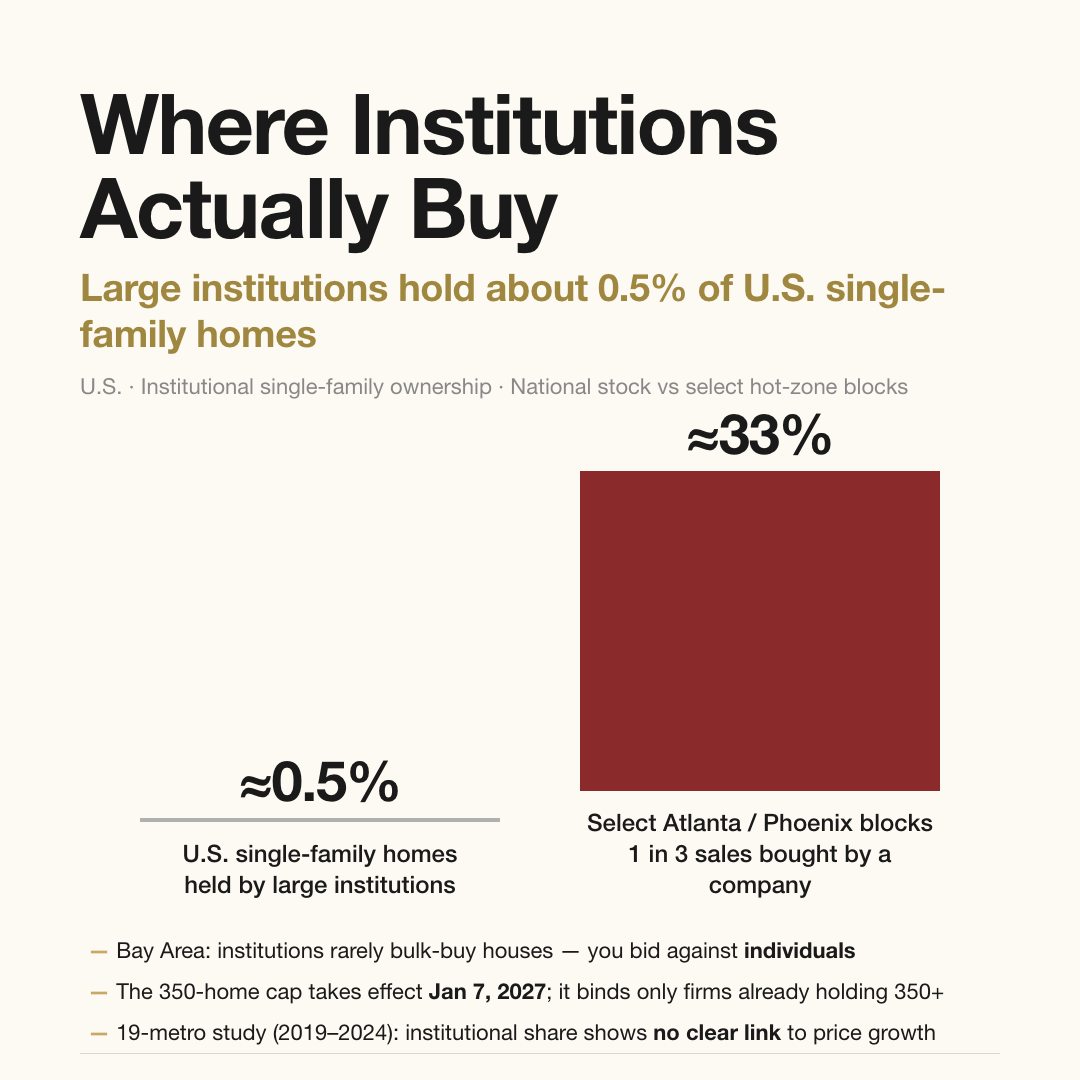
Short-term, no. The large institutions this law caps hold only about 0.5% of the national single-family stock, and in the Bay Area almost no institution bulk-buys houses in the first place — the buyers you're up against are mostly individuals. Neither prices nor the difficulty of winning a home is likely to move much in the near term.
Who this article is for
- Families who saw the "Wall Street is capped" headlines and want to know whether it actually changes their own buy or sell decision
- Buyers touring homes on the Bay Area Peninsula or in the South Bay who worry about competing with all-cash institutional bids
- Readers who want to separate a long-term supply tailwind from next quarter's sale price
- Anyone buying or investing in institution-heavy markets like Atlanta or Phoenix
- Bay Area families weighing whether looser rules on ADUs and prefab / modular construction change their longer-term plans
Three dimensions to judge it by
First, the law itself. The 21st Century ROAD Housing Act officially became law on July 11, 2026 — and how it got there is unusual. It was pushed jointly by Republican Senator Tim Scott and Democratic Senator Elizabeth Warren; the Senate passed it 85–5 on June 22, and the House followed the next day 358–32 — overwhelming bipartisan support. The White House step was the dramatic one: President Trump neither signed nor vetoed it, and under the constitutional 10-day rule, a bill the President leaves untouched becomes law on its own. The full act runs ten chapters; the one drawing all the attention is Chapter 10, Section 1 — the 350-home red line for large institutions. To read what this news means for you, work through three dimensions.
Dimension one: who the cap actually targets
The red line only locks up institutions that are already very large: a for-profit institution that already holds 350 single-family homes generally can't keep acquiring more. That threshold sits a long way from almost every ordinary buyer. It traces back to the 2008 financial crisis, when a wave of homes went into foreclosure and Wall Street funds began buying single-family houses in bulk — before 2011, no U.S. institution held more than 1,000, and today some large ones hold tens of thousands. These institutions show up with cash, often need no loan, and often waive an inspection contingency; they simply aren't standing on the same starting line as a regular buyer. While an ordinary family is still tallying a down payment and waiting on loan approval, an institution has already closed. That gap is exactly what the red line is meant to address at the very top of the scale. But here's the thing to see clearly: the more numerous players in the market are actually the small and mid-size investors holding anywhere from a few to a dozen homes, and the law doesn't restrict them at all. "Capping institutions" is not the same as "capping most of the rivals you'll meet in the market."
Dimension two: is the supply upside long-term, or next quarter?
The parts of the law aimed at ordinary families are three supply-side changes. First, prefab homes no longer have to keep a permanent steel chassis — dropping that requirement is projected to save $5,000 to $10,000 per home. Second, a four-year pilot specifically to push small mortgages under $100,000. Banks tend to skip these because the loan is small but the paperwork is just as much work — the margin ends up too thin to bother — yet across much of the Midwest and the South, a home's whole price sits in that range, so the barrier was never that buyers couldn't afford the house; it was that banks wouldn't write the loan. Third, $200 million a year to reward cities willing to rezone for higher residential density, plus a pilot for cheaper single-stair six-story apartment buildings. The direction is right — the National Association of Home Builders estimates that regulatory requirements add more than $130,000 to the cost of a new home on average, so it's only when the rules loosen and approvals speed up that build costs can genuinely come down. But the path from a law passing to land getting approved, projects breaking ground, and homes actually delivering usually takes several years; HUD also has to carry out 35 new tasks, and its execution speed is itself an unknown. This is a long-term tailwind, not a next-quarter price cut.
Dimension three: what your city's buyer mix looks like
The same law lands very differently city to city, and the buyer mix is the reason. This is the real "who wins, who loses" of the bill — the answer isn't national, it's local. In institution-heavy markets like Atlanta, Phoenix, Dallas, and Tampa, some neighborhoods once saw up to one in three sales bought by a company — buyers there will genuinely face lower odds of running into an all-cash institutional bid going forward, and they're the ones most likely to feel the change first. The Bay Area is another story: not many large institutions bulk-buy single-family homes here to begin with (frankly, they can't afford to), and the rivals you actually meet in a bidding war are mostly individual buyers or small-to-mid investors — neither of whom falls under this cap. So don't stop at the "Wall Street is capped" headline; look first at the city under your own feet, and who's really bidding against you.
The 350-home red line: what the law actually says
Start with the numbers. 350 is the threshold on that red line: once a for-profit institution already holds 350 or more single-family homes, it generally can't buy any more. Each illegal acquisition carries a minimum $1M fine — or three times the home's price if that figure is higher, effectively buy-one, pay-for-three. The rule takes effect January 7, 2027 and runs for 15 years.
| Key provision | What it says |
|---|---|
| Trigger threshold | Once a for-profit institution already holds 350 single-family homes, it generally cannot acquire more |
| Group aggregation | Homes under the same group or affiliated entities are counted together — you cannot split into shell companies to get around it |
| Scope of acquisition | Covers open-market purchases, mergers and acquisitions, foreclosures, and bulk buys |
| Penalty | Minimum $1M fine per illegal acquisition; if 3× the home price is higher, the 3× figure applies |
| Reporting duty | Institutions must report to HUD each year how many homes they hold in each city |
| Effective date and term | Takes effect January 7, 2027; runs for 15 years |
Two things are worth remembering. First, the group-aggregation clause closes the most common workaround — an institution can't register dozens of subsidiaries, each holding a slice, to slip under the line; every home under one group gets summed. Second, and the part headlines most distort: this red line looks fierce, but it only reaches about 0.5% of the national single-family stock. In other words, the law is aimed precisely at the giant institutions that have already stockpiled tens of thousands of homes — not at the housing market as a whole. It changes the acquisition rules for large institutions going forward; it does not change the direction of national home prices.
What MK Group is watching on the ground
Lately a lot of people have brought this news to Kevin Mo (YouTube @KevinMoRE, 23K+ subscribers) with the same question: "In a situation like mine, should I actually move right now?" But that question can never be answered by a single law or a single headline. The same law lands on two families in opposite ways — because every city has a different inventory, a different buyer mix, a different supply picture, and every family has a different timeline, a different capital structure, a different reason for buying. Some people are well positioned to buy now; others are better off waiting a little. And for some clients, after Marie Wang (DRE# 02110980) and Kevin Mo (DRE# 02127623) walk them through the real local data and their own circumstances, MK Group's advice is to hold off.
That's exactly how we make the call: not to get everyone to buy or sell in a hurry, but to first help you see clearly — does acting now actually work in your favor? After years in the Bay Area Peninsula and South Bay luxury market, we believe one thing more than most: policy rewrites the rules, but it won't answer your own question for you.
Common misconceptions
"Wall Street got capped — so prices are finally going to drop, right?"
Not that fast. The single-family homes large institutions hold add up to only about 0.5% of the national stock, and a 19-metro study covering 2019 through 2024 found almost no clear link between institutional ownership share and local price growth. More to the point, the law only stops large institutions from buying more existing single-family homes — it doesn't force them to sell what they already own, and it leaves two big doors open. New-build rental communities are exempt, and a purchase where renovation runs more than 15% of the price can also qualify for an exemption. Read those exemptions together and the likely institutional response isn't a fire sale; it's a rotation. Money that used to buy finished houses moves toward building new ones or gutting and renovating old ones — the same capital, a different lane. Add in the small and mid-size investors the law doesn't touch, who make up the larger share of the market, and pinning hopes on this single law for a nationwide price drop is likely to disappoint.
"If institutions can't buy, bidding wars in the Bay Area must ease a lot"
The Bay Area isn't Atlanta or Phoenix, where institutions cluster. Not many large institutions bulk-buy single-family homes here in the first place — the rivals you actually meet in a bidding war are mostly individual buyers or small-to-mid investors, and neither group falls under this cap. So the "institutions are capped" tailwind may genuinely take real bidding pressure off an Atlanta buyer, while doing almost nothing to the difficulty of winning a home in the Bay Area.
"Construction costs are coming down, so Bay Area prices will follow"
Don't read "construction costs are falling" as "Bay Area prices are falling." Looser rules on prefab and modular construction may well shave off part of the build cost, which is genuinely good news in many regions. But in core Bay Area locations, the expensive part usually isn't how the house is built — it's where the land sits. You can build the house a little cheaper; the land won't get cheaper because of it. That's exactly why the most valuable thing about a Bay Area luxury property is often not the house, but the ground underneath it.
"The moment it passed, supply jumps"
There is a supply upside — but it's slow. Rezoning, higher residential density, lower build costs: the direction is right, but the path from a law passing to land getting approved, projects breaking ground, and homes actually delivering usually takes several years. Meanwhile, HUD still has to carry out 35 new tasks, and how efficiently it does so is its own unknown. This law is more likely to change housing supply over the next few years than to change what price you can buy at next quarter.
Next steps
- First, be clear on what you're actually betting on — the long-term supply picture or next quarter's sale price. This law favors the former and barely touches the latter, so using it to bet on a near-term price drop will most likely miss.
- Read your own city's buyer mix. In institution-heavy markets like Atlanta or Phoenix, the odds of running into an all-cash institutional bid should fall over time; the Bay Area was already individual-buyer driven, so the effect here is limited.
- Two things sit closer to home for Bay Area families: ADU financing (a backyard unit for parents, kids, or rental income) may open up a few more options, and looser prefab / modular rules may change build costs — just don't equate that with lower home prices.
- Don't let the "Wall Street got capped" headline rush you into buying or selling. Work out your own inventory, timeline, and capital structure first, then judge against real local data.
- Watch the pace at which HUD delivers its 35 follow-on tasks — that's the real signal for how fast the supply upside actually shows up.