The short answer
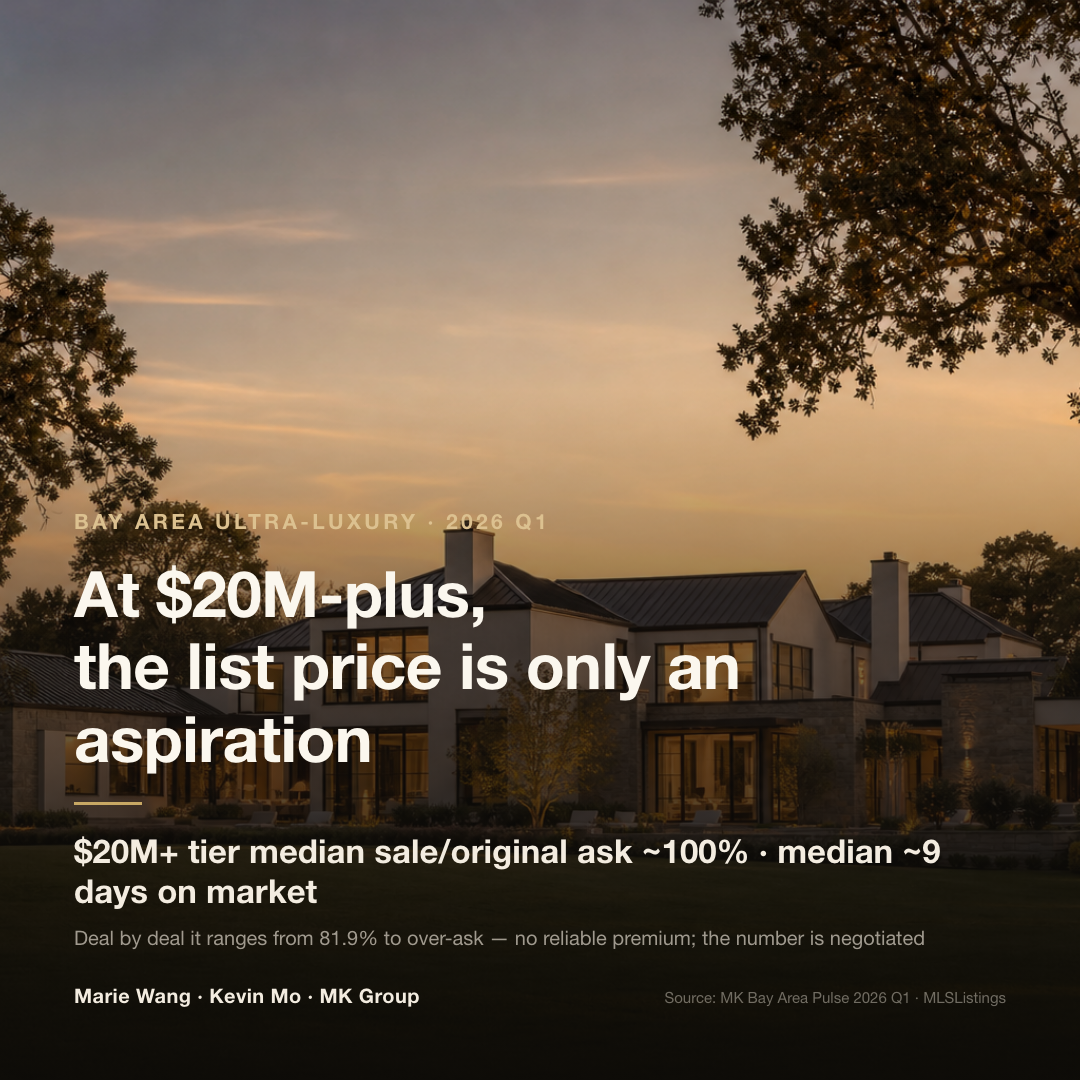
Yes. In Q1 2026, homes above $20M across the Bay Area closed at a median of roughly 100% of original list, with a median of about nine days on market — but deal by deal the range is enormous, from 81.9% of list (well below asking) all the way to over asking. At this level there is no reliable over-asking premium the way there is in the mid-market; the list price reads more as the seller's aspiration, and the real number is set through bilateral negotiation. Room to negotiate is real — provided you can read the home's scarcity and the seller's motivation.
Who this article is for
This is written for anyone dealing with the number above $20M, in particular:
- Buyers with a $20M+ budget touring the top of Atherton, Palo Alto, Woodside, and Los Altos Hills, trying to work out whether a given home can be negotiated — and by how much.
- Sellers preparing to list a $20M+ home and agonizing over where to set the original asking price — too high risks scaring off buyers, too low leaves money on the table.
- Buyers used to the mid-market Silicon Valley rhythm, where a home lists and sells over asking within a week, stepping into the ultra-luxury tier for the first time and finding the rules are entirely different.
- Anyone trying to understand the counterintuitive fact that a $2M home draws over-asking bidding wars while a $20M home can actually be negotiated down.
Three dimensions to judge first
Whether an ultra-luxury home can be negotiated, and by how much, isn't answered by a blanket instinct — "luxury always holds" or "luxury always gives" — but by reading three things, one deal at a time.
One: how irreplaceable is this home?
The first driver of negotiating room at this level is scarcity — the more irreplaceable the asset, the less room there is. A one-of-a-kind Woodside equestrian parcel, a one-acre legacy estate in West Atherton, an address inside a school boundary that turns over once every few years — for these, a buyer has almost no substitute, and the seller can afford to hold firm. Flip it: a sub-area with several comparable sales in the past twelve months, or a builder's spec home produced in a batch, hands the buyer a benchmark and an alternative, and that's where the leverage appears. To judge how negotiable a home is, ask yourself first: if this deal collapses, can I find something comparable within six months? The more certain the yes, the harder your position.
Two: who is the seller, and why are they selling?
Two homes at $20M can carry completely different motivations — a builder's spec home racing to recycle capital versus a home an owner built to their own standard and lived in for years — and the negotiation lands in completely different places. A builder carries a high holding cost and needs the capital back to fund the next project; time is the soft spot. An owner-builder usually attaches an emotional premium, isn't short of money, isn't in a hurry, and will happily sit for months rather than give ground. The same logic separates a home selling out of a relocation, an estate, or a divorce from one that's "listed to test the water and won't move unless the number is right" — the two aren't in the same league on negotiability. When you buy at this level, you're buying not just the house but the seller's circumstances at this exact moment.
Three: is the list price an anchor or an aspiration? Read days on market alongside the pricing start
At this level the original asking price is often not the market price but the seller's aspiration — put up a beautiful number, see if anyone bites, and negotiate if not. So you can't read an ultra-luxury home off its current asking price alone; you have to read its full listing history — original list, any price cuts, total days — as one story. A home that closes in eight days and a home that closes after more than two hundred tell entirely different negotiating tales. Days on market (DOM) is not itself good or bad; it only means something set next to whether the pricing start was reasonable. The data table below will show you two homes both past 100 days on market — one that never moved a dollar, and one that came down nearly ten percent.
Local data: the median lands near list, deal by deal it's a world apart
The headline number first: in Q1 2026, homes above $20M across the Bay Area closed at a median of roughly 100% of original list, with a median of about nine days on market (source: MK Bay Area Pulse 2026 Q1 / MLSListings). But that "about 100%" is a highly dispersed median — spread the public MLS closings out one by one and the range runs from 81.9% (well below list) all the way to over asking. For contrast, in the same quarter the $1.5M–$3M band closed at a median of 106.6% of list in a median of just eight days (same source) — a textbook over-asking seller's market. In other words, the higher you climb, the more the over-asking premium disappears and the more negotiating room returns. That tier inversion is exactly what unsettles buyers stepping into the ultra-luxury segment for the first time.
| Property (Q1 2026 public MLS closing) | Original list | Sold | Sold-to-list | Days on market | Payment |
|---|---|---|---|---|---|
| Palo Alto · 1700 Waverley St | $25.95M | $21.25M | 81.9% | 0 days | All cash |
| Woodside · 211 Winding Way | $25.0M | $23.0M | 92.0% | 248 days | All cash |
| Atherton · 291 Atherton Ave | $23.888M | $22.2M | 92.9% | 90 days | All cash |
| Atherton · 35 Barry Ln | $23.988M | $23.989M | 100.0% | 8 days | All cash |
| Woodside · 6 Cedar Ln | $23.5M | $23.5M | 100.0% | 11 days | All cash |
| Atherton · 54 Barry Ln | $27.5M | $27.5M | 100.0% | 108 days | All cash |
| Atherton · 190 Almendral Ave | $31.995M | $32.5M | 101.6% | 1 day | All cash |
| Atherton · 2 Somerset Ln | $26.5M | $28.0M | 105.7% | 11 days | Financed |
The differences worth remembering: the most dramatic line here is Palo Alto's 1700 Waverley — listed at $25.95M, closed at $21.25M (81.9%), and zero days on market, essentially negotiated to a number well below list almost the moment it hit. That tells you the asking price was an aspiration from the start and the real deal was struck across the table. At the other end, Atherton's 190 Almendral listed at $31.995M and closed in a single day at $32.5M, over asking — proof that when a home is right and scarce enough, the ultra-luxury tier can still run over list. In between sits a counterintuitive detail: 54 Barry Ln sat 108 days and closed at full price, not a dollar off; 211 Winding Way sat 248 days before coming down to 92% of list. "On the market a long time" does not automatically mean "negotiable down" — same slowness, one a seller who won't budge and would rather wait, the other a pricing start that was genuinely too high. This is why you can't map the mid-market over-asking instinct onto ultra-luxury: in this tier, every closing is an independent negotiation.
Data source: MLSListings public closing records / MK Bay Area Pulse 2026 Q1
Updated: 2026-07
Scope: Bay Area (Peninsula / South Bay) single-family closings above $20M
What we see in the field
The data can tell you that ultra-luxury closings are highly dispersed, but what decides which end of that distribution you land on comes down to three things: whether you hold real negotiating leverage, whether you have the nerve to use it, and whether you've looked hard enough — before you commit — at whether the home is actually worth the number. Here are three moments from ultra-luxury deals Marie Wang (DRE# 02110980) and Kevin Mo (DRE# 02127623) have handled at MK Group that make the point best.
All-cash and still negotiable: more than $1M off in Los Altos Hills. In late 2025, a family from a leading AI company sold pre-IPO shares on the secondary market in tranches and came in ready to pay all cash for a Los Altos Hills estate. Many people assume that an all-cash buyer in a hurry to lock in before an IPO simply pays whatever the seller asks. But after MK Group took over the negotiation — leaning on a long read of luxury supply and demand and a feel for the seller's psychological pressure points — the deal came in more than $1M below the original price. It bears out the second dimension: when the seller's mindset, the buyer's certainty of funds, and the market window line up, negotiating room at this level is real and can be pulled out. For the full path from paper wealth to negotiable cash, we walked through it in Turning Pre-IPO Stock into a Bay Area Luxury Home.
The nerve to walk away is a buyer's real leverage: a $20M Atherton new build the family office didn't buy. In 2026, the decision-maker for a cross-border family office came to Silicon Valley on an extremely tight schedule and flew home the day after the tour. MK Group showed him a brand-new Atherton estate — floor plan and neighborhood, on paper, without a flaw. What Marie and Kevin gave him was the plain truth: everything was good, except the workmanship was rushed, closer to a builder's spec home than the finish a $20M home should carry. He decided on the spot to pass on it and come back in August. For an ultra-luxury buyer, the willingness to walk isn't stubbornness — it's the hardest negotiating chip there is. The buyer who can walk earns the right to talk price; the one set on closing tends to be the one who gets negotiated.
A cautionary counter-example: no negotiation, no diligence, and money alone can still buy wrong. Another family office bought three homes in one stretch, guided mostly by "this place has a big name, and expensive means good," with almost no work done on price or fit. Six months later they found the problems: the home they lived in was a 30-minute one-way drive to the children's school — longer in traffic — with an awkward daily flow; the two investment homes sat in areas with weak rent-to-price ratios that, once property tax and upkeep were added, amounted to little more than betting on appreciation. Having the budget has never meant choosing well — at this level, the negotiating room you leave unclaimed and the diligence traps you fail to dodge often add up to more than the entire spread on a mid-market home.
Common mistakes
Mistake 1: "Ultra-luxury is like the mid-market — you have to bid over asking to win"
This is mid-market experience wrongly carried up into the ultra-luxury tier. In Q1 2026, the Bay Area's $1.5M–$3M band closed at a median 106.6% of list and sold in eight days — a textbook over-asking seller's market. But the $20M+ tier closed at a median of only about 100%, and the $10M–$20M tier at only about 100.2% (source: MK Bay Area Pulse 2026 Q1). The higher you go, the fewer buyers are both willing and able to step in, the more unique each home is, and the thinner the comparable sales — so the "highest bid wins" auction mechanism weakens and gives way to deal-by-deal bilateral negotiation. Charge into ultra-luxury carrying the mid-market "bid over or lose it" urgency and you're more likely to overpay. To understand exactly how much over asking each city's mid-market demands, compare it against How Much Over Asking Do You Need to Win in the Bay Area? 2026 Q1 Premium by City.
Mistake 2: "A long time on the market (high DOM) means something's wrong with the home, so it must be deeply negotiable"
DOM on its own is neither a good nor a bad signal — read it together with the pricing start. In the table above, Atherton's 54 Barry Ln sat 108 days and closed at full price, not a dollar off — it was slow because the owner didn't need the money and would rather wait for the right buyer, not because anything was wrong with the home. The reverse: Woodside's 211 Winding Way sat 248 days before coming down to 92% of list — it was slow because the pricing start was genuinely high and needed time and a cut to find the market. Same "long time listed," one you can't move and one you can, and the difference is the seller's motivation and the original pricing, not the day count itself. Treat DOM as a guarantee of a discount and you'll misread the room. (For the full breakdown of the same logic from the seller's side, see A Luxury Home One Block Over Sold in a Week. Mine Sat 10 Months. What's Different?.)
Mistake 3: "The list price is the market price — ultra-luxury holds firm and won't move"
At this level the original asking price is often the seller's aspiration, not a market consensus. The clearest example is Palo Alto's 1700 Waverley: listed at $25.95M, closed at $21.25M — only 81.9% of list — and zero days on market. That's not a market crash; it's simply how closings work in this tier — a beautiful number goes up, and the real, dollar-for-dollar price is set at the negotiating table. So the impression that "list price means it won't move" does not hold above $20M. What genuinely won't move are the one-of-a-kind homes whose sellers aren't in a hurry — not "because it's a luxury home."
Next steps
- Buyers: grade your target home on replaceability — are there comparable sales in the same sub-area over the past twelve months? The more one-of-a-kind it is and the more firmly the seller can hold, the earlier you need to settle on your ceiling.
- Buyers: pull the full listing history — original asking price, any price cuts, total days on market — and use it to judge whether the current asking price is an anchor or an aspiration.
- Buyers: find out who the seller is and why they're selling — a builder's spec home (racing to recycle capital, easier to negotiate) or an owner-built, long-held home (emotional premium, harder to move) — because the motivation decides where your leverage sits.
- Sellers: before you set the original asking price, decide what you want — to manufacture a bidding rush or to set an anchor and negotiate slowly. Ultra-luxury rarely produces an over-ask through underpricing, and a pricing start that's out of line only lengthens days on market.
- Both sides: leave the mid-market over-asking instinct at the door — above $20M, every closing is an independent bilateral negotiation, so argue from deal-by-deal data and the seller's circumstances, not from a blanket impression.